Your content stack isn't keeping up with your team.
That's the friction point driving most searches for AirOps alternatives in 2026. AirOps built a solid reputation for template-based AI content generation and programmatic SEO workflows. But as content teams grow more sophisticated - and as AI search visibility becomes a real strategic concern - the gaps in AirOps' model are getting harder to ignore.
This guide covers 12 alternatives worth serious consideration, with honest assessments of where each one wins, where it falls short, and which team type it actually fits.
Why content teams are moving beyond AirOps in 2026
AirOps does some things genuinely well. Its template-based approach lets teams spin up programmatic content at speed, and its pre-built workflows reduce the setup time for common content tasks. For teams that need volume fast and have relatively standardized content formats, it's a reasonable choice.
The limitations show up when teams scale or when their content needs get more complex.
Template rigidity is the most common complaint. AirOps' model works well when your content fits its templates. When it doesn't - custom editorial workflows, multi-stage review processes, nuanced brand guidelines - the tool starts fighting you rather than helping you.
Brand governance gaps matter more than they used to. With AI-generated content now a standard part of most content operations, the question isn't just "can it generate content?" but "can it generate content that consistently sounds like us and meets our compliance requirements?" AirOps' controls here are limited.
Workflow fragmentation is the structural problem. AirOps handles generation well, but it doesn't connect cleanly to the full content pipeline - planning, briefing, review, publishing, optimization, and performance tracking. Teams end up stitching together multiple tools to cover what they need.
When AirOps is still the right fit: If your primary need is rapid, template-based programmatic content at scale - product descriptions, location pages, data-driven articles - and you don't need heavy editorial governance or full pipeline orchestration, AirOps remains a strong option. Don't switch just because alternatives exist.
How we evaluated these AirOps alternatives
The global SEO software market was valued at $74.6B in 2024, growing at roughly 13.5% CAGR . Which means there's no shortage of tools claiming to solve every problem. We cut through that by evaluating each alternative against seven criteria that matter to content teams operating at scale.
End-to-end workflow coverage - Does the tool support the full pipeline from planning through publishing, or just one stage?
Brand governance and content safety - Can it enforce voice guidelines, compliance rules, and approval workflows consistently?
AI content quality - How sophisticated is the generation, and how much editing does output typically require?
SEO and AI visibility features - Does it cover traditional on-page optimization, and does it address LLM/GEO tracking?
Team collaboration and scalability - Does it support multi-user workflows, role-based access, and enterprise-grade permissions?
Integrations and ecosystem fit - How well does it connect to your existing CMS, analytics, and project management tools? HubSpot's 2026 State of Marketing found that 73% of SEO professionals agree AI tools are becoming an important part of their SEO strategy.
Pricing and value - What do you actually get at each tier, and is the cost justified by the capabilities?
Quick comparison - all 12 AirOps alternatives at a glance
Use this table to identify your shortlist before reading the full reviews.
1. Slate - best for workflow-first content engineering with brand governance
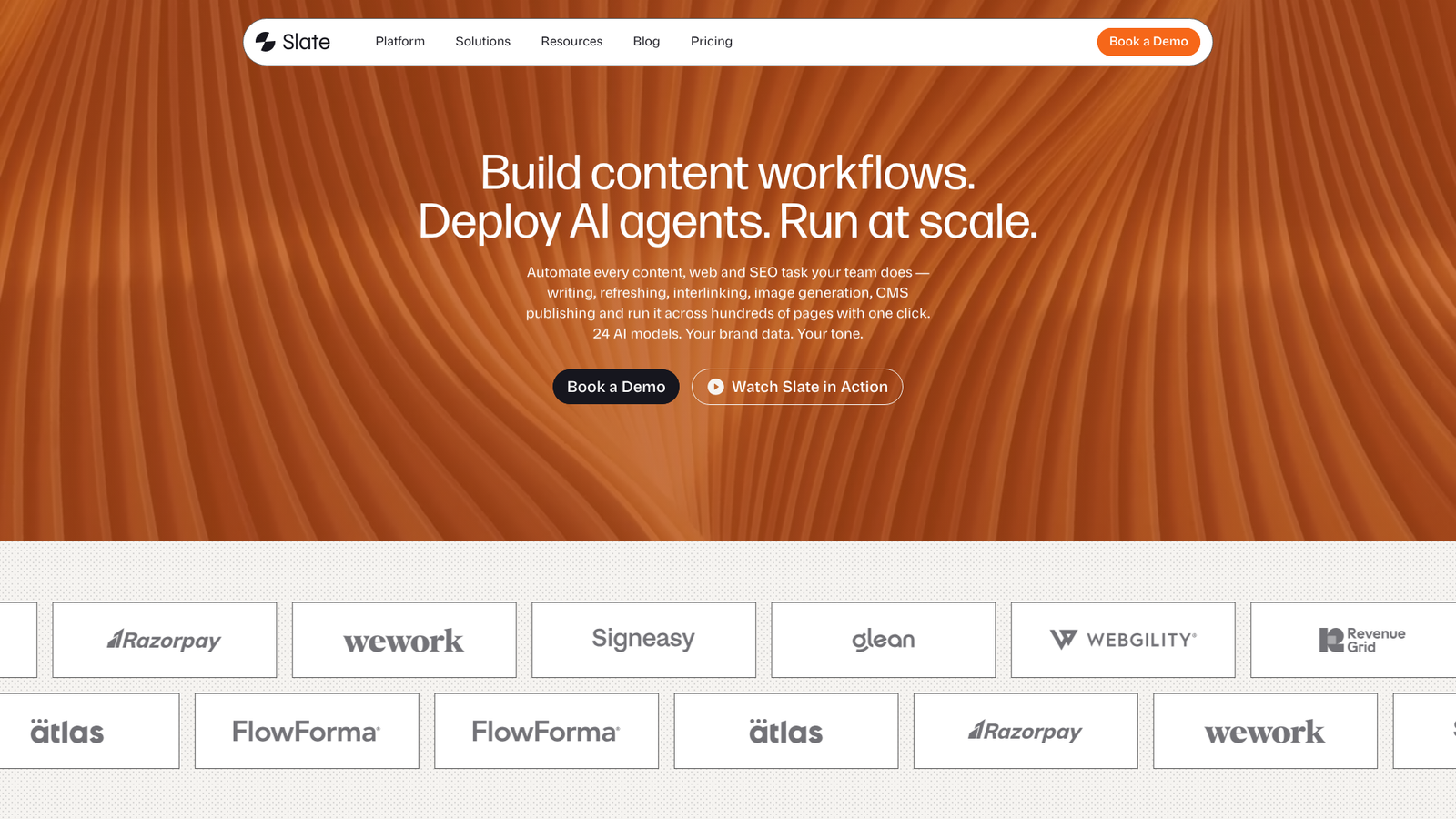
Slate is an end-to-end content engineering platform built for AI SEO and content teams that need more than AI generation - they need the full pipeline, governed.
Where AirOps optimizes for speed and volume through templates, Slate optimizes for quality and consistency through workflow orchestration. Every stage of the content process - planning, briefing, creation, review, optimization, publishing - runs through a single governed environment with brand safety controls baked in at each step. That's a fundamentally different architecture than template-first tools.
Best for: Mid-market to enterprise content teams (5+ people) that need workflow orchestration, brand consistency, and editorial governance - not just faster AI generation.
Key strengths
- End-to-end pipeline from planning through publishing in one platform
- Brand governance layer with voice guidelines and compliance rules at every stage
- Role-based access and approval workflows for editorial oversight
- AI content generation with brand-safe guardrails built in
- Deep integration with existing content stacks (CMS, analytics, SEO tools)
Pricing: Starting at $199/month
2. Jasper - best for AI-powered brand voice at scale
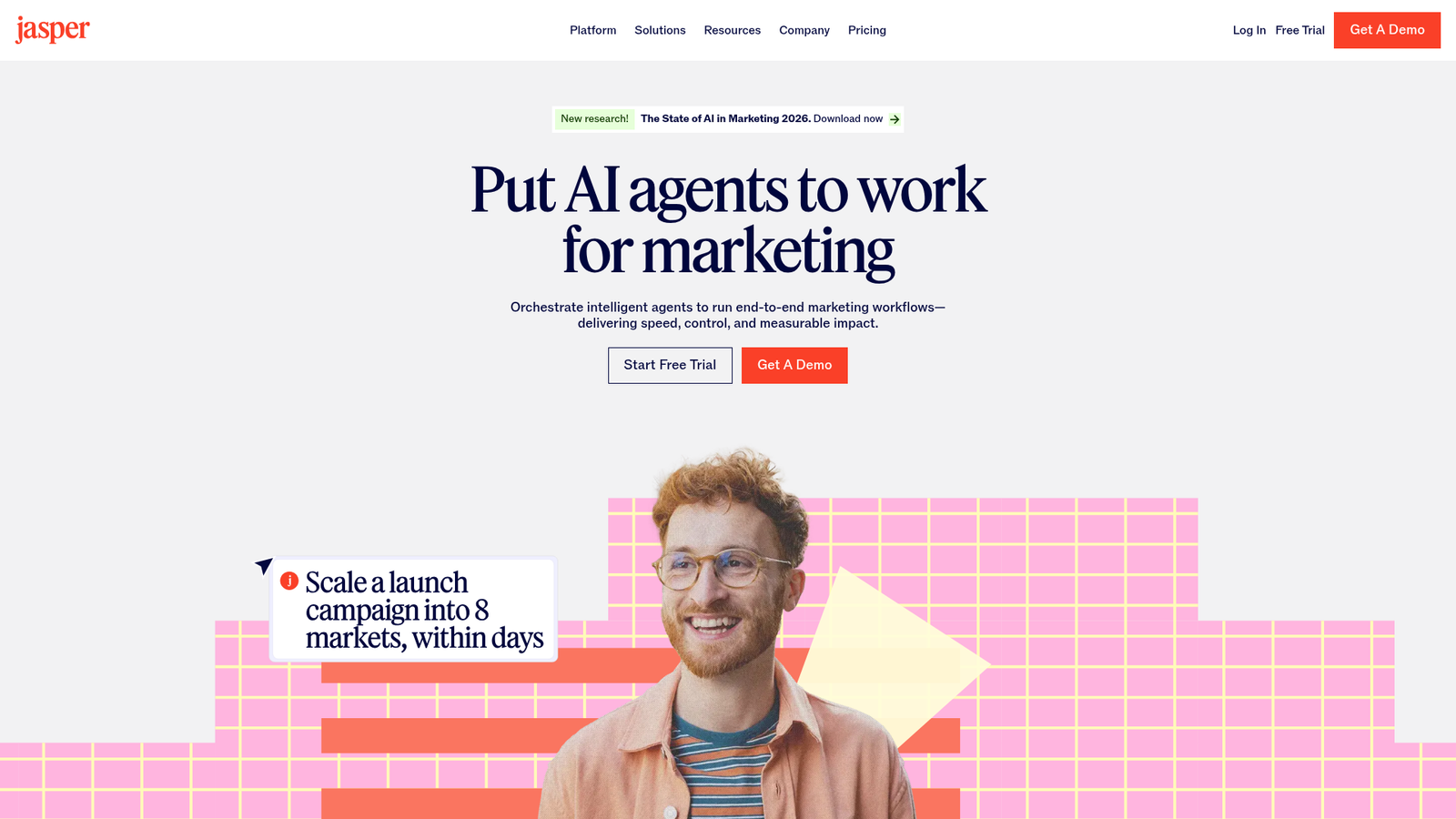
Jasper is one of the most established AI content platforms, used by 100,000+ teams worldwide, with a particular strength in brand voice customization across marketing formats.
Its Brand Voice and Knowledge Base features let teams train the AI on their specific tone, terminology, and style - then apply that consistently across blog posts, ads, email, and social. The breadth of use cases is genuinely impressive. The trade-off is that Jasper isn't a full workflow tool, and its SEO optimization depends on third-party integrations like Surfer.
Best for: Marketing teams focused on multi-channel content who need consistent brand voice across AI-generated outputs at volume.
Key strengths
- Mature Brand Voice and Knowledge Base for consistent AI output
- Campaign-level content generation across formats
- Jasper Chat for conversational AI assistance
- Strong integration with Surfer SEO and Google Docs
- Team collaboration and workspace management
Pricing: Pro $69/mo ($59/mo billed annually); Business custom.
3. Surfer SEO - best for data-driven content optimization

Surfer SEO is the go-to tool for on-page content optimization, using NLP and SERP analysis to score content in real time and guide writers toward better-ranking output. It holds a 4.7/5 rating on Capterra from over 1,200 reviews.
Surfer's Content Editor is genuinely best-in-class for optimization guidance. Writers get real-time feedback on keyword usage, content structure, and comprehensiveness as they draft. Where Surfer falls short is everything outside that optimization layer - it's not a generation tool, not a workflow platform, and not a governance solution.
Best for: SEO-focused content teams that need data-driven optimization guidance for writers, especially when paired with a separate AI generation tool.
Key strengths
- Real-time Content Editor with live SEO scoring
- SERP Analyzer for deep competitive content analysis
- Keyword research and topic clustering
- Surfer AI for AI-assisted content generation
- Integrations with Google Docs, WordPress, and Jasper
Pricing: Discovery $49/mo; Standard $99/mo; Pro $182/mo; Peace of Mind $299/mo; Enterprise custom.
4. Clearscope - best for enterprise content grading and optimization
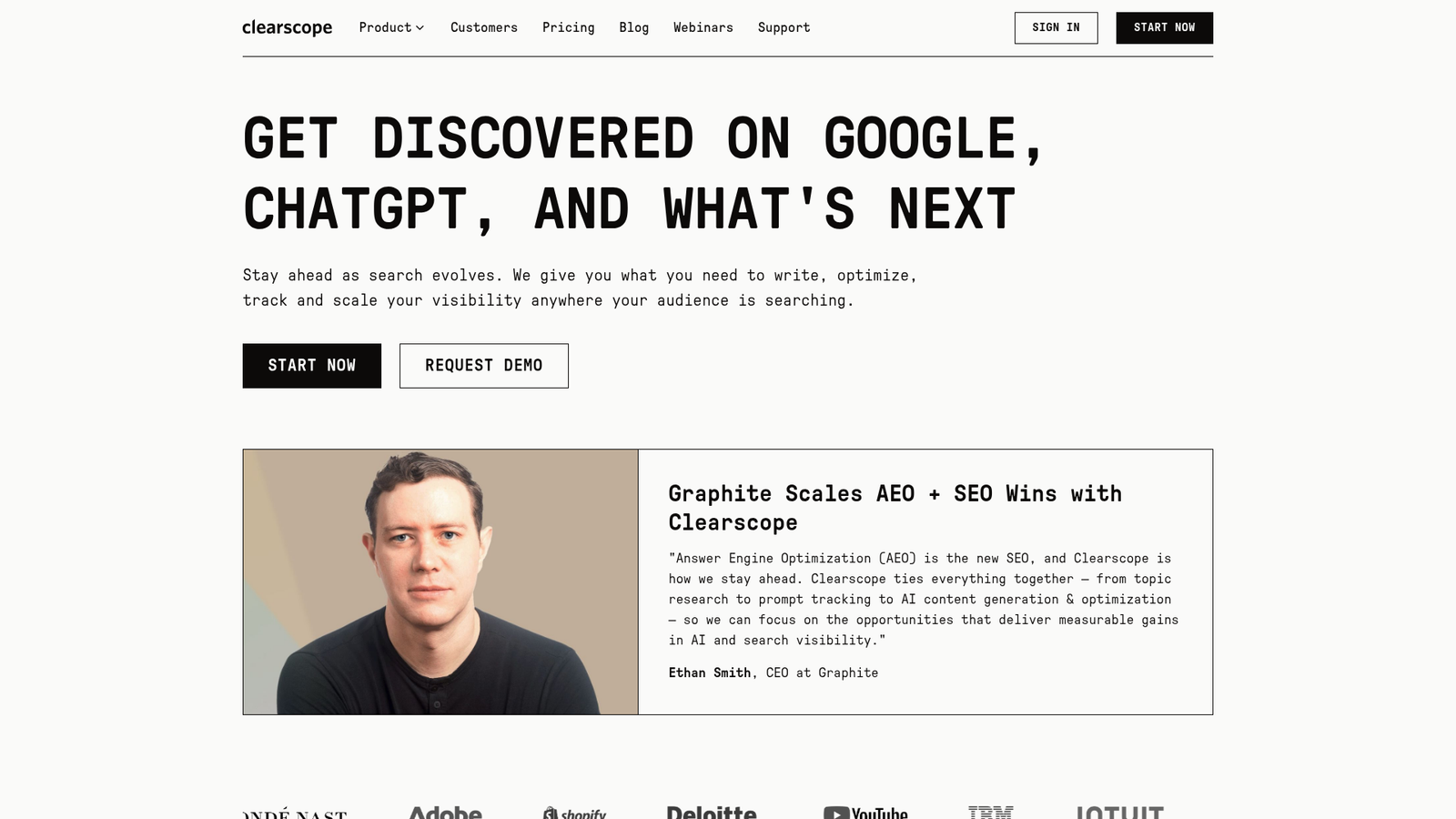
Clearscope is a premium content optimization platform built around its content grading system - A++ through F - which gives writers and editors a clear, actionable quality benchmark based on NLP analysis.
Enterprise teams at companies like Condé Nast and Shopify rely on Clearscope for its accuracy and its clean, intuitive interface. The tool raised $3.2M in seed funding and has grown steadily through product quality rather than aggressive fundraising. The limitation is clear: Clearscope is an optimization layer, not a content generation or workflow platform.
Best for: Enterprise content teams with established editorial workflows that need a reliable content grading and optimization layer.
Key strengths
- Highly accurate A++ to F content grading system
- Keyword discovery and content research tools
- Real-time optimization recommendations during editing
- Google Docs and WordPress integrations
- Team reporting and content inventory management
Pricing: Essentials $129/mo (unlimited users); Business $399/mo; Enterprise custom.
5. Writer - best for brand governance and AI content safety
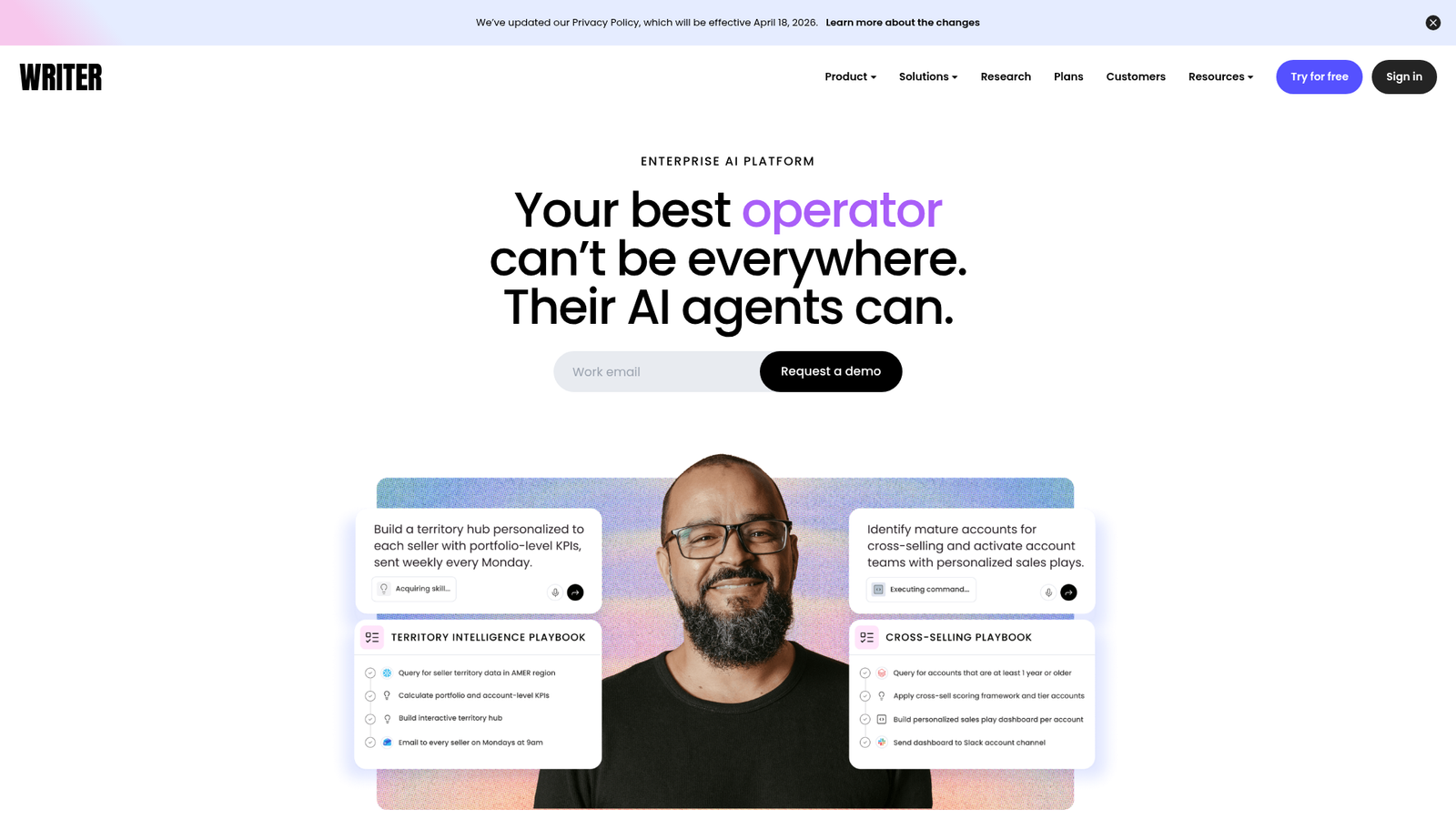
Writer is an enterprise AI writing platform built around a core premise: AI-generated content should be as safe, compliant, and on-brand as content written by your best human writer. It's the closest competitor to Slate's governance philosophy.
Writer's Knowledge Graph lets enterprises train the AI on proprietary company information, while its style guide enforcement and compliance checks make it a natural fit for regulated industries. The SEO optimization features are limited compared to dedicated tools, but that's not what Writer is for.
Best for: Enterprise teams in regulated industries - finance, healthcare, legal - where brand governance, compliance, and content safety are non-negotiable.
Key strengths
- AI writing with deep brand voice customization
- Style guide and terminology enforcement across all outputs
- Content safety and compliance checks built in
- Knowledge Graph for company-specific AI training
- Role-based permissions and enterprise-grade security
Pricing: Team plan starts at $18–$25/user/month (annual billing, seat-based); Enterprise custom (typical enterprise contracts run $10K–$50K/year for small teams, scaling to $75K–$250K+/year for mid-market).
6. Frase - best for content research and brief generation
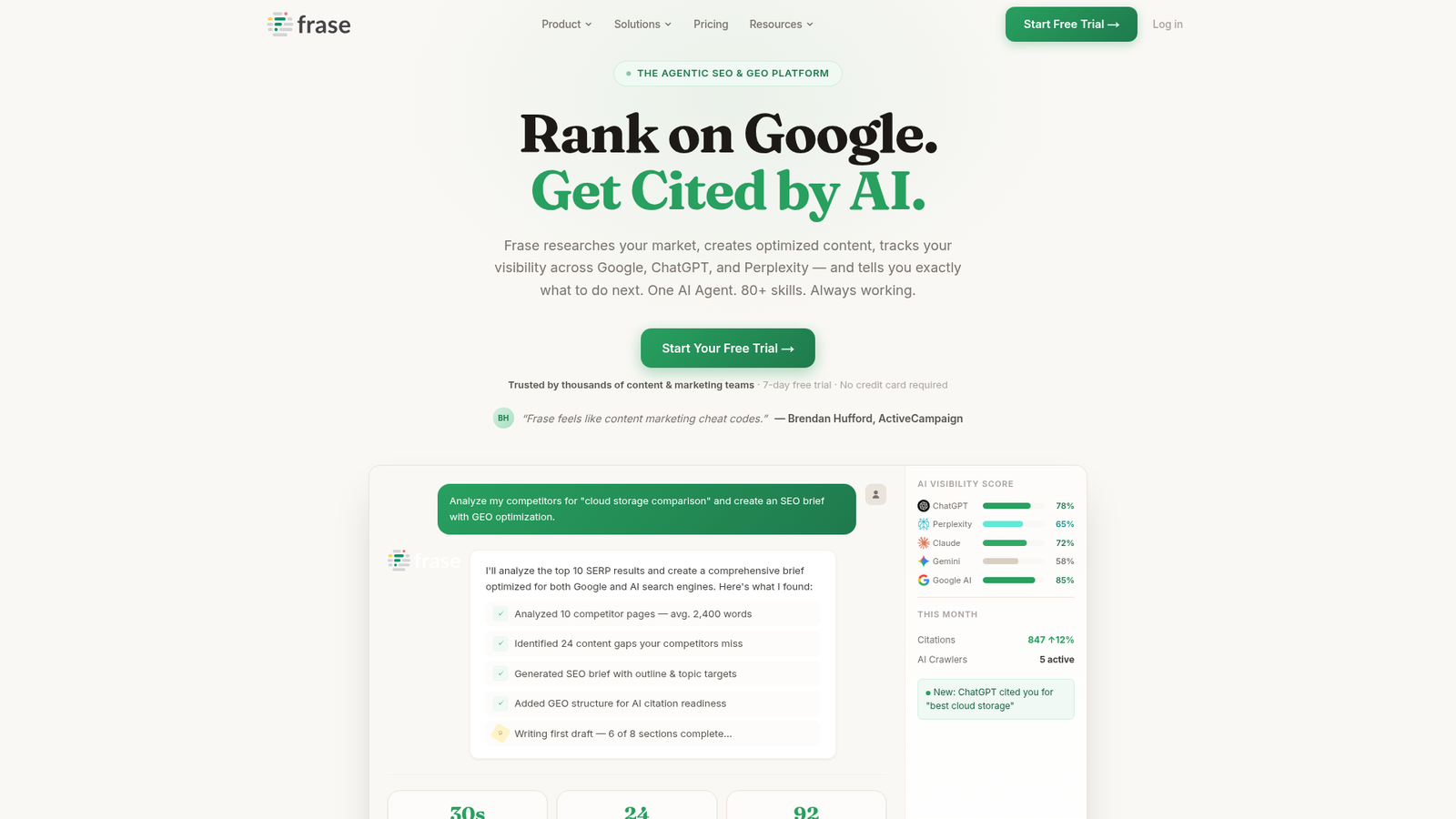
Frase, founded in 2014, excels at the research and planning phase of content creation. Its AI analyzes SERPs and competitor content to generate comprehensive briefs that give writers a clear roadmap before they start drafting.
The research and brief generation capabilities are genuinely strong, and the entry price makes it accessible to smaller teams and freelancers. The AI writing quality is mid-tier - good enough to get a first draft started, but most teams will need meaningful editing before publication.
Best for: Content strategists and freelance SEO writers who need fast, research-backed content briefs and topic analysis at an affordable price.
Key strengths
- AI-powered content brief generation from SERP analysis
- Competitor content research and topic gap identification
- Content optimization with topic scoring
- Answer engine for FAQ generation from SERP data
- Google Search Console integration
Pricing: Starter $49/mo ($39.20/mo billed annually); Professional $129/mo; Scale $299/mo; Enterprise custom.
7. MarketMuse - best for AI-driven content strategy and topic authority
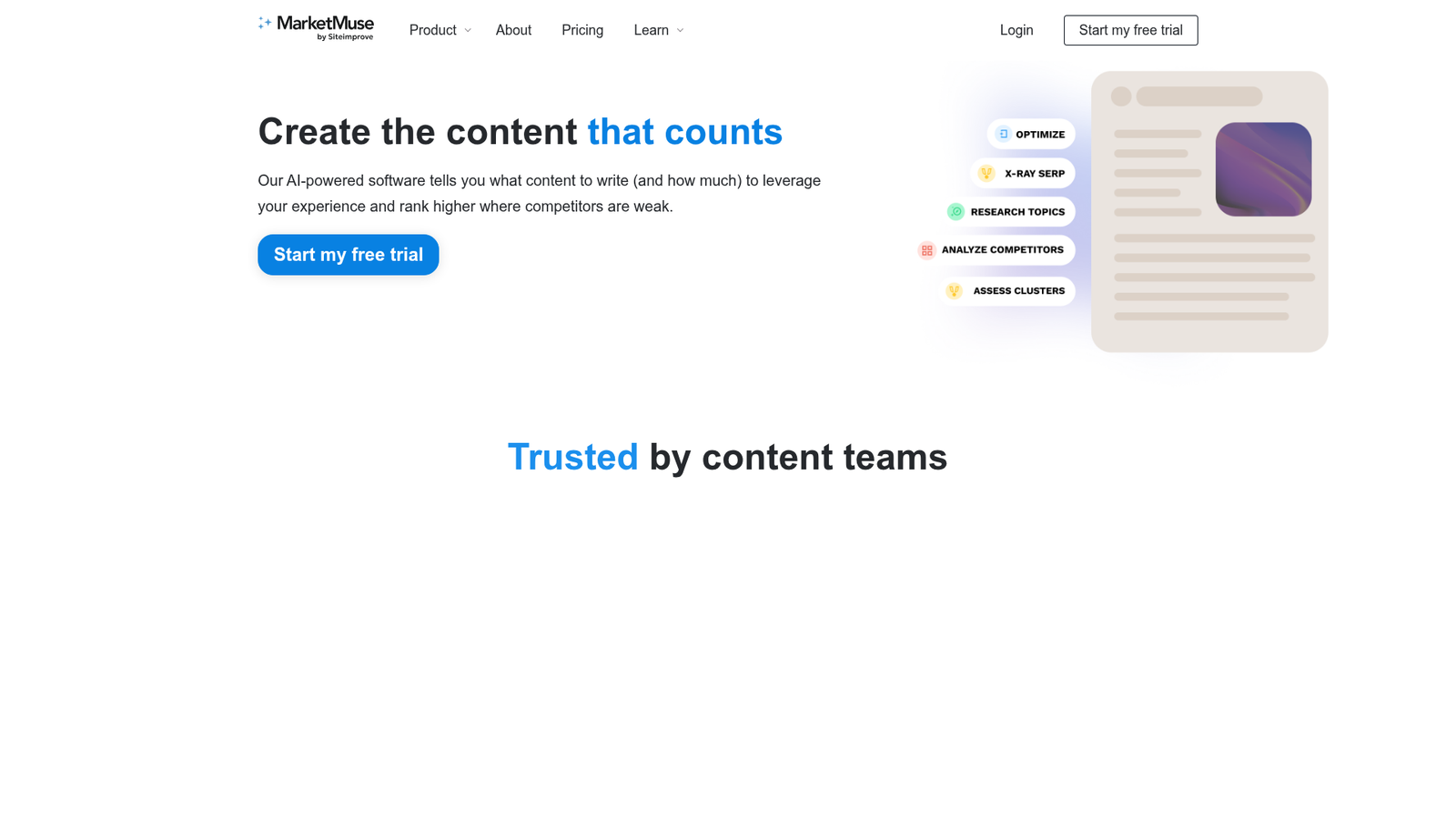
MarketMuse takes a different approach than most tools on this list. Rather than optimizing individual articles, it analyzes your entire content inventory to identify gaps and opportunities - then helps you build topical authority through strategic content planning.
The personalized difficulty scores are a standout feature: unlike generic keyword difficulty metrics, MarketMuse calculates difficulty based on your specific domain's existing authority. That makes its recommendations meaningfully more actionable. The platform maintains a 99.95% uptime SLA. The trade-off is cost - full access to MarketMuse's capabilities requires a significant investment.
Best for: Content strategists at mid-to-large publishers who need data-driven content planning and topical authority mapping, not just individual article optimization.
Key strengths
- Content inventory analysis and gap identification
- Topic modeling with personalized difficulty scores
- Content briefs with competitive analysis baked in
- Content optimization and scoring for individual articles
- First-draft AI generation for planned content
Pricing: Optimize $99/mo; Research $249/mo; Strategy $499/mo. Free tier available (10 queries/month).
8. Conductor - best for enterprise SEO intelligence and organic marketing
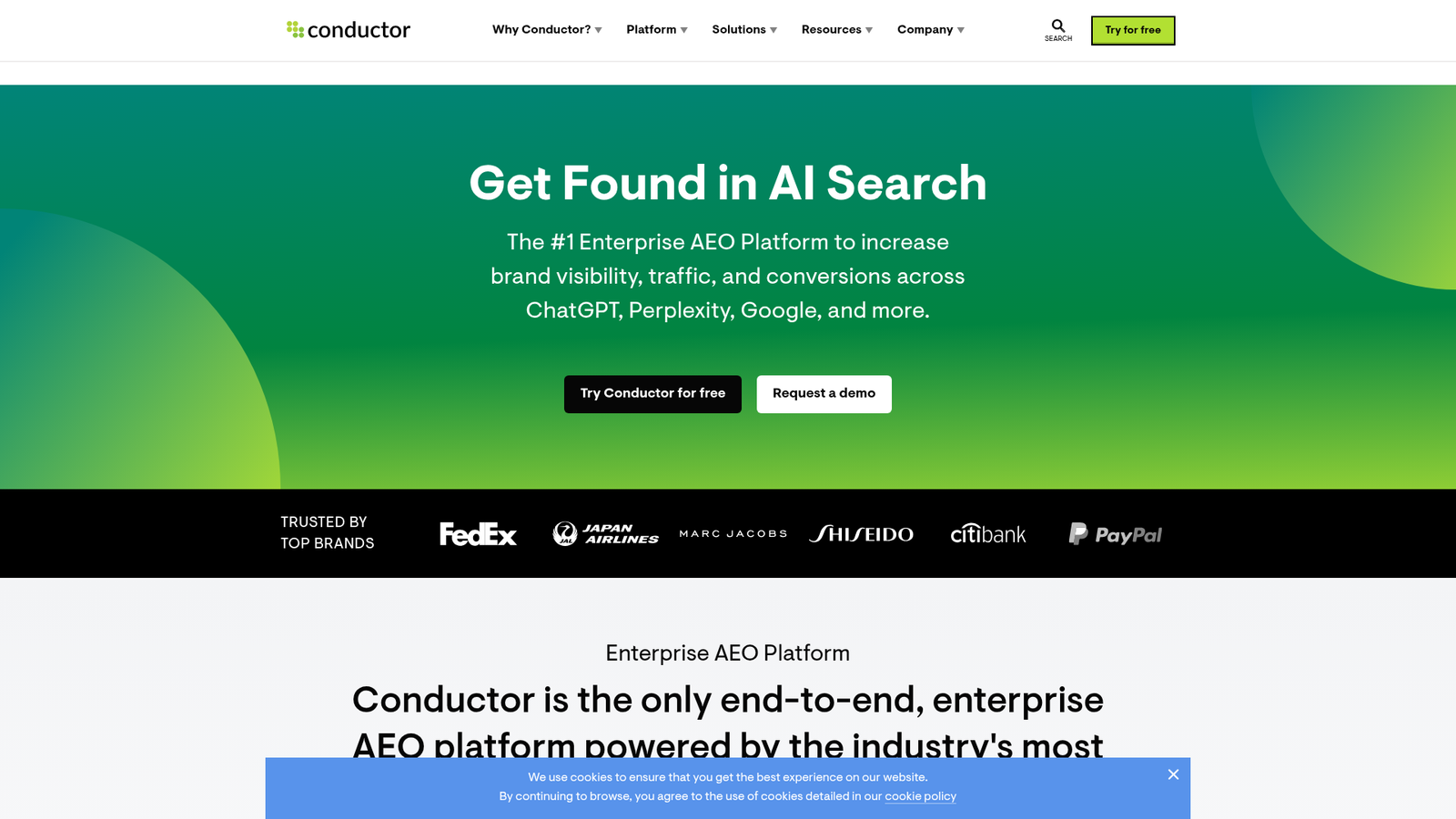
Conductor is an enterprise-grade organic marketing platform that combines SEO intelligence, content guidance, and website monitoring into a single system for large-scale operations. It supports 100+ integrations including Google Analytics, Ahrefs, and Slack.
Conductor is genuinely comprehensive - rank tracking, site auditing, competitive intelligence, content guidance, and real-time monitoring all in one platform. The customer success and training programs are a real differentiator for enterprise teams that need hands-on support. The price point reflects the scope: this is not a tool for teams under 100 content pieces per month.
Best for: Large enterprise marketing teams that need a full organic marketing intelligence platform with SEO guidance built in.
Key strengths
- Enterprise SEO platform with rank tracking and site auditing
- Content guidance and optimization recommendations
- Real-time website monitoring and competitive intelligence
- 100+ integrations with major CMS, analytics, and marketing tools
- Dedicated customer success and training programs
Pricing: Enterprise custom; Conductor does not publish public rates. Industry data places annual contracts at $26,800+ (≈$2,233+/mo) at the low end; mid-market deployments $40K–$70K/year; enterprise often $100K–$500K+/year. First-year TCO typically runs 1.5–2x the subscription price when implementation and professional services are included.
9. Copy.ai - best for AI-powered marketing workflows and automation
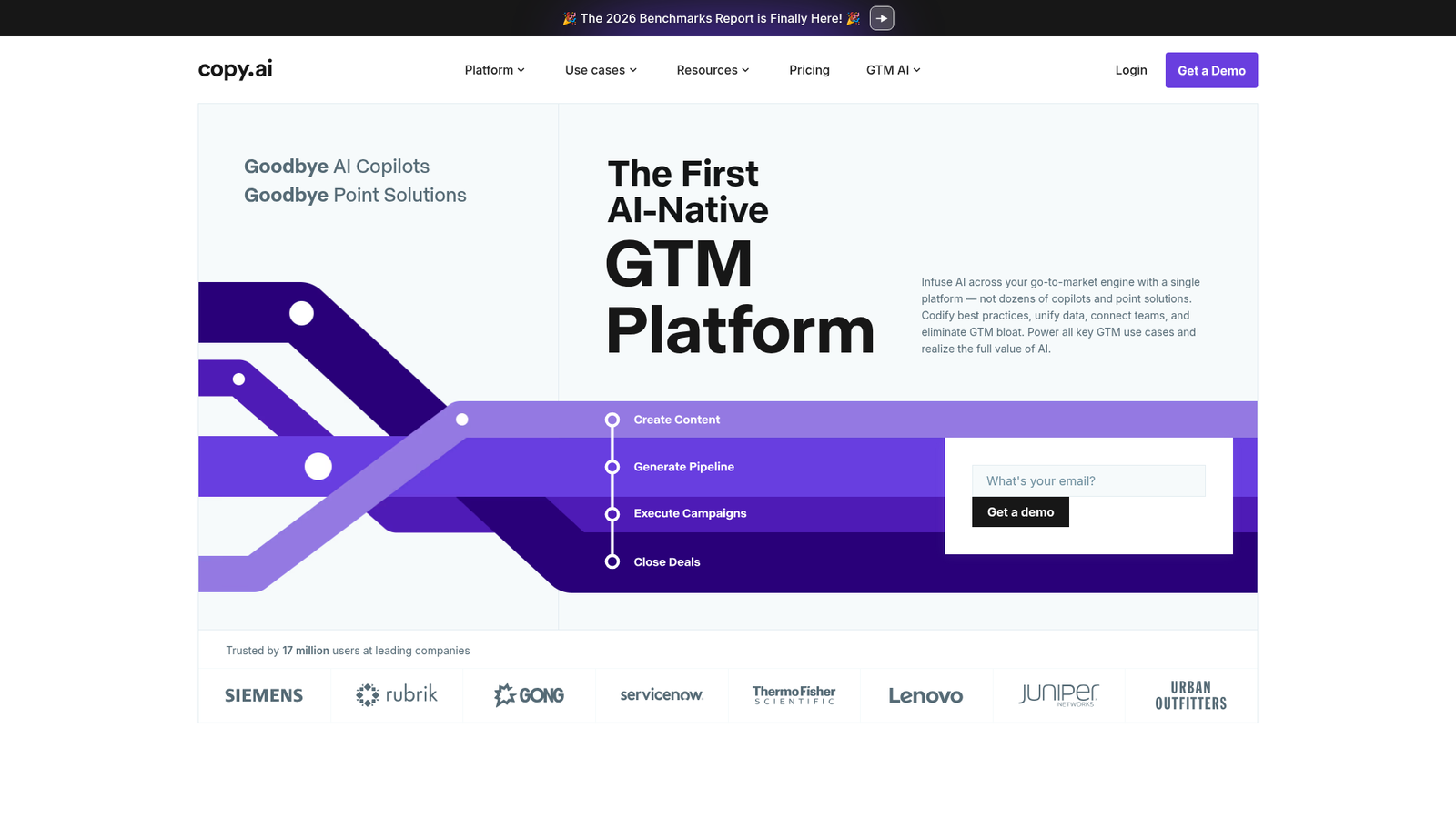
Copy.ai has evolved well beyond its origins as a simple AI copywriting tool. It's now a workflow automation platform for go-to-market teams, with pre-built workflows covering blog posts, social media, email sequences, and sales outreach.
The no-code workflow builder is genuinely useful for teams that need to automate repetitive content tasks without engineering support. The SEO optimization features are basic, though - Copy.ai is built for GTM breadth, not SEO depth. Teams that need serious content optimization will still need a dedicated tool alongside it.
Best for: Go-to-market teams that need AI automation across sales and marketing workflows, not just SEO content production.
Key strengths
- Pre-built GTM workflows for blog, social, email, and sales
- No-code workflow automation builder
- Brand voice and tone customization
- API access and integrations with HubSpot and Salesforce
- Team collaboration and workspace management
Pricing: Free plan (limited); Starter at $49/mo; Advanced at $249/mo; Enterprise at custom pricing
10. Writesonic - best for budget-friendly AI content generation
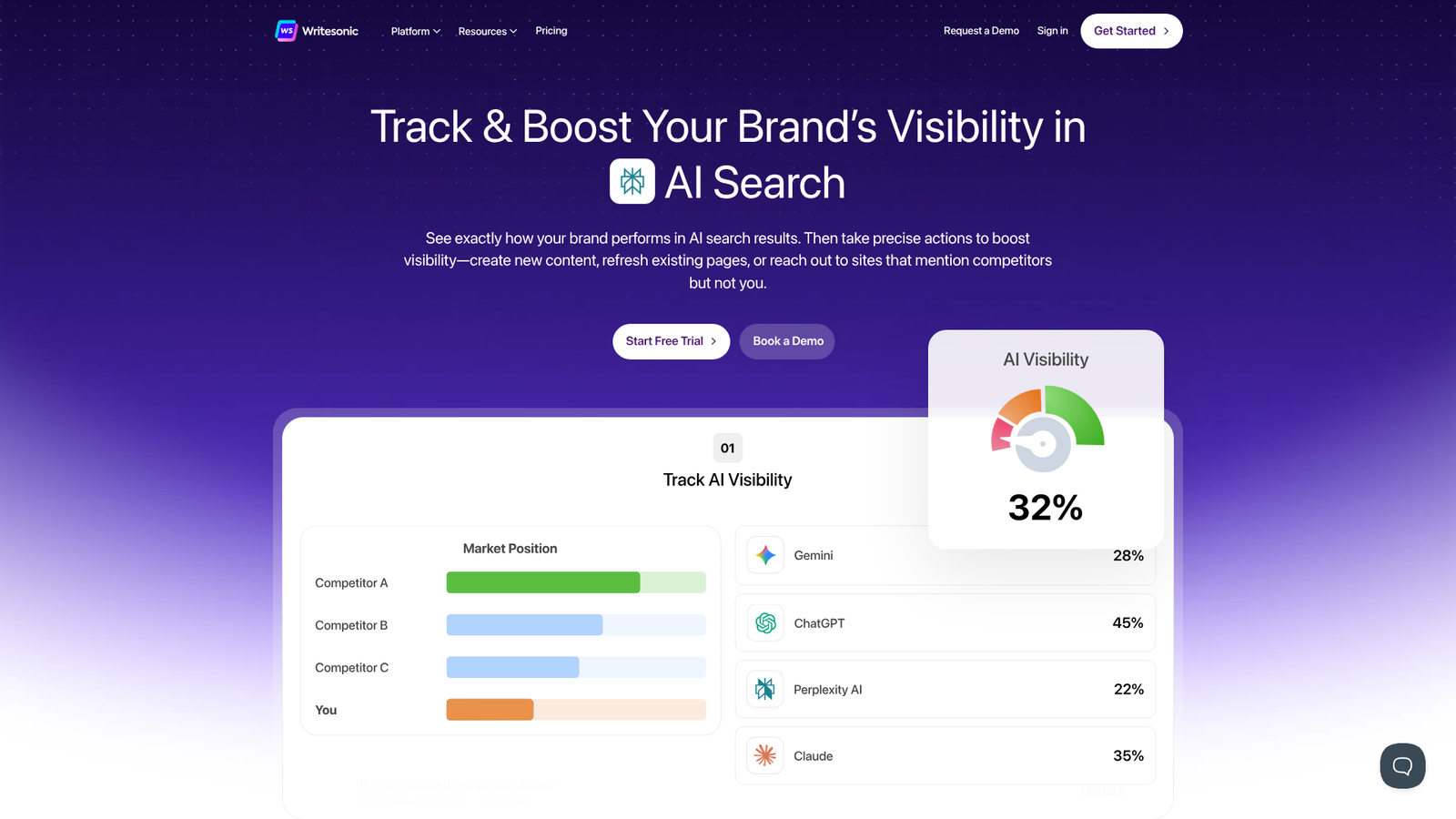
Writesonic offers AI content generation starting at $19/mo - one of the most accessible price points in this category - with a focus on blog posts, landing pages, and marketing copy.
The value-to-cost ratio is solid for smaller teams and solo marketers. Botsonic, its custom AI chatbot builder, is a genuinely useful add-on that most competitors don't offer. The limitations are real: SEO optimization is basic, brand governance is minimal, and content often needs significant editing before it's publication-ready.
Best for: Small teams and solo marketers who need affordable AI content generation with basic SEO features and don't require enterprise governance or advanced optimization.
Key strengths
- AI article writer with basic SEO optimization
- Landing page and ad copy generation
- Botsonic custom AI chatbot builder
- Chatsonic interface with real-time web access
- Multi-language support across 25+ languages
Pricing: Free tier (limited); Lite $39/mo (annual) or $49/mo (monthly); Standard $79/mo (annual); Professional $249/mo; Advanced $499/mo; Enterprise from $1,499/mo.
11. Scalenut - best for end-to-end SEO content lifecycle
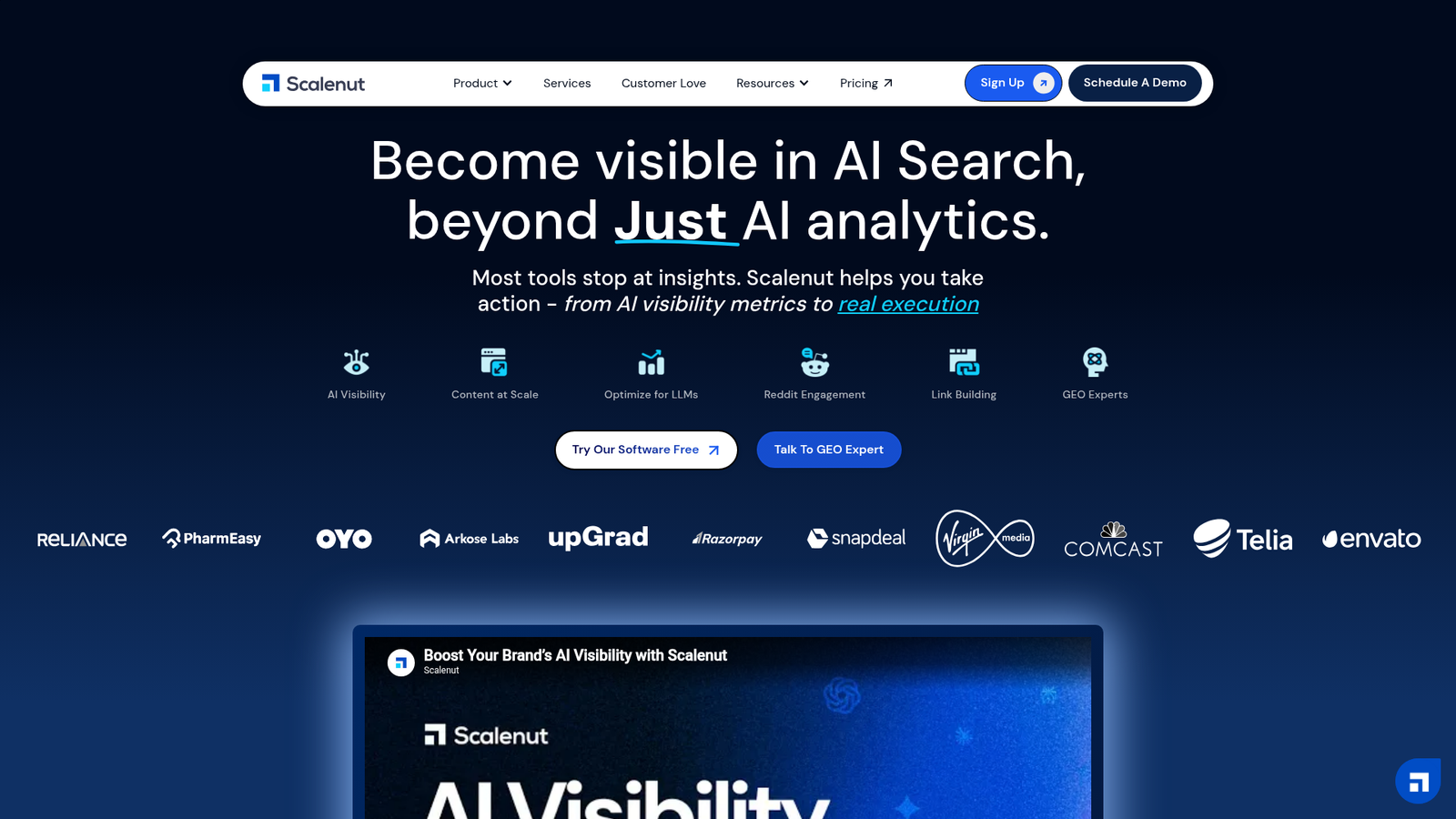
Scalenut aims to cover the full SEO content lifecycle - keyword research, content clustering, creation, and optimization - in a single platform at a mid-market price point.
Cruise Mode, its cluster-based content planning feature, is the standout differentiator. It lets teams plan and execute content clusters systematically, which works particularly well for teams building topical authority across a domain. The AI content quality needs editing, and the optimization accuracy doesn't quite match Surfer or Clearscope - but for teams that want lifecycle coverage without paying for multiple tools, the trade-off is reasonable.
Best for: Growing SEO teams that want a single platform covering research, creation, and optimization without paying for multiple tools - and can accept some quality trade-offs.
Key strengths
- Keyword research and topic clustering via Cruise Mode
- AI-powered long-form content generation
- NLP-based content optimization and scoring
- SERP analysis and competitor content insights
- Content calendar and planning tools
Pricing: Starter $59/mo; Plus $89/mo; Professional $199/mo; VIP Service custom.
12. Profound - best for AI visibility and LLM citation tracking
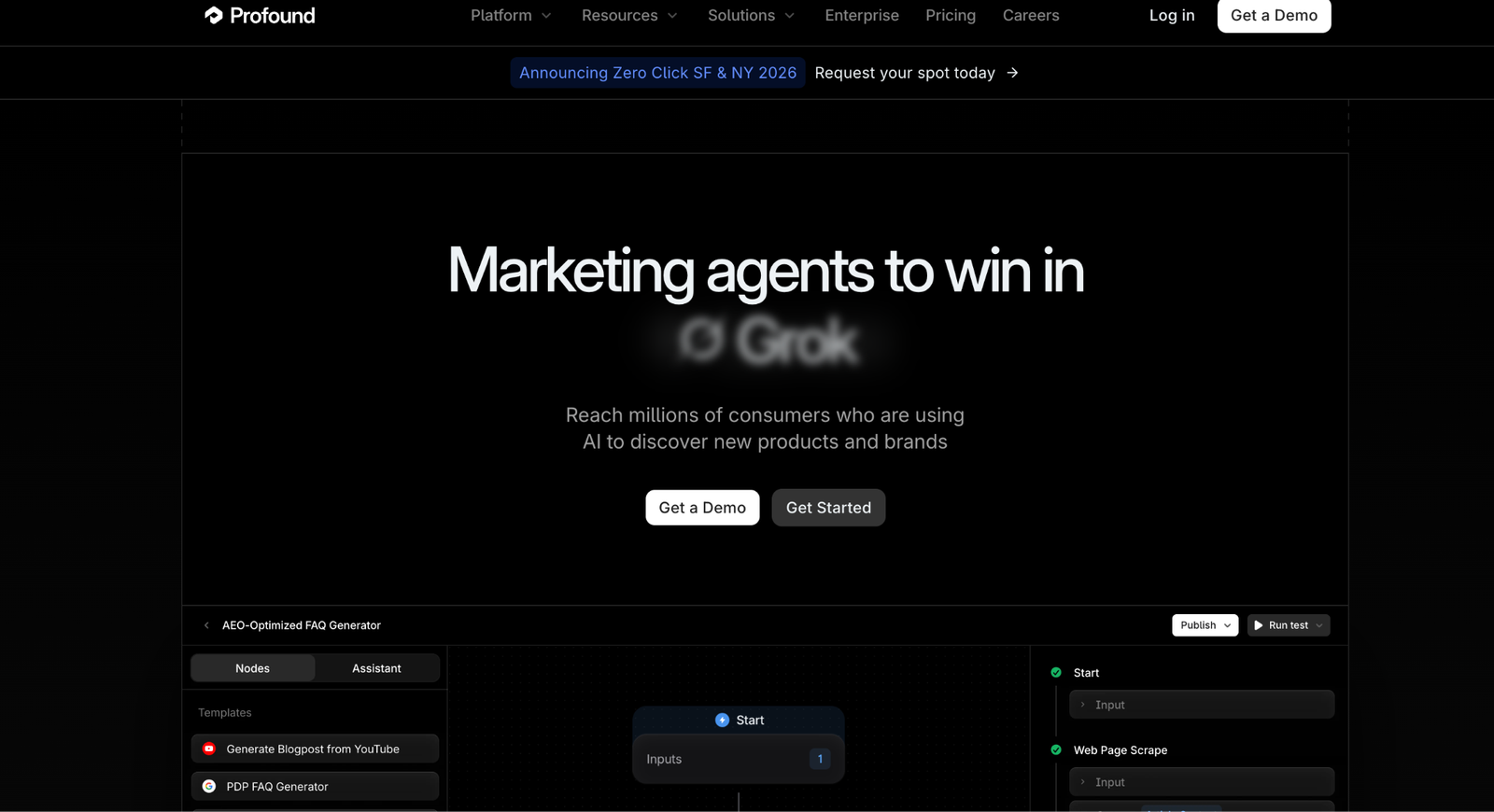
Profound (https://www.tryprofound.com/) addresses a problem that didn't exist three years ago: understanding how your brand appears in AI-generated answers from ChatGPT, Perplexity, Claude, and Gemini.
Profound is the most focused tool in this space. Teams using AEO-optimized content strategies with Profound have seen support ticket volume reduce by up to 35%, according to G2 reviews and case studies. The narrow focus is both its strength and its limitation - it doesn't replace your content creation or optimization stack, it complements it.
Best for: SEO and content teams that need to understand and optimize their brand's visibility in AI-generated search results, as a complement to their existing content creation stack.
Key strengths
- AI visibility monitoring across ChatGPT, Perplexity, Claude, and Gemini
- Citation tracking and brand mention analysis in AI responses
- Competitive AI visibility benchmarking
- GEO (Generative Engine Optimization) analytics
- Actionable recommendations to improve LLM citation rates
Pricing: Growth $399/month (3 platforms); Lite $499/month (ChatGPT-only); Enterprise $2,000–$5,000+/month (10+ platforms, dedicated support).
How to choose the right AirOps alternative for your team
Match your team size to the right tool
The right tool at five people is often the wrong tool at fifty. Here's how the landscape maps to team size.
Solo SEO / Freelancer: Frase, Writesonic, and NeuronWriter offer the best value at this scale. You don't need governance layers or enterprise collaboration features - you need affordable, capable tools that cover research, generation, and basic optimization.
Small content team (2–5 people): Surfer SEO, Scalenut, and Copy.ai work well here. You need some collaboration features and workflow support, but you're not yet at the scale where governance becomes critical.
Mid-market content team (5–20 people): This is where Slate, Jasper, and MarketMuse earn their keep. Workflow orchestration, brand consistency, and team collaboration start to matter significantly at this scale.
Enterprise content operations (20+ people): Slate, Conductor, Writer, and Clearscope are built for this environment. You need governance, role-based access, approval workflows, and deep integrations - not just faster content generation.
Prioritize by your biggest pain point
Different tools solve different problems. Be honest about what's actually breaking in your current workflow.
Need better workflows and governance: Slate and Writer are the two tools built around this problem. Slate covers the full pipeline; Writer focuses specifically on brand safety and compliance.
Need stronger SEO optimization: Surfer, Clearscope, and MarketMuse are the three strongest options here, each with a different emphasis - real-time scoring, content grading, and strategic planning respectively.
Need affordable AI generation: Writesonic at $19/mo, Copy.ai's free tier, and Frase at $15/mo are the most accessible entry points.
Need AI and LLM visibility tracking: Profound is the most focused tool in this space. It doesn't replace your content stack - it adds a visibility layer on top of it.
Need enterprise-scale SEO intelligence: Conductor and seoClarity are built for this. Both require enterprise budgets to match.
Integration considerations
Before committing to any tool, map it against your existing stack. The three integrations that matter most for most content teams are CMS (WordPress, Contentful, Webflow), analytics (Google Analytics, Search Console), and project management (Asana, Notion, Jira). Most tools on this list cover at least two of the three - but check the specifics before assuming.
When to stay with AirOps
If your primary use case is rapid, template-based programmatic content - product descriptions, location pages, data-driven articles at scale - and you don't need heavy editorial governance or full pipeline orchestration, AirOps is still a strong choice. The alternatives in this list are better for teams whose needs have grown beyond that model. If yours haven't, switching introduces cost and disruption without proportional benefit.
How to migrate from AirOps to a new platform
Switching content platforms is disruptive if you don't plan it. A few principles that tend to reduce friction.
Audit before you migrate. Before moving anything, document what you're actually using in AirOps - which templates, which workflows, which integrations. Most teams discover they're using 30–40% of what they're paying for. That audit shapes what you need to replicate in the new tool.
Run parallel for 30 days. Don't cut over immediately. Run your new tool alongside AirOps for a month on a subset of your content. That gives your team time to learn the new workflow without production pressure, and it surfaces integration gaps before they become emergencies.
Migrate templates and brand guidelines first. The most time-consuming part of any migration is recreating your brand voice, style guidelines, and content templates in the new system. Do this before you migrate any active workflows. Tools like Slate and Writer have structured onboarding for this - use it.
Measure before and after. Pick two or three metrics that matter to your team - content production velocity, time-to-publish, SEO performance - and track them through the migration. That data tells you whether the switch was worth it, and it gives you something concrete to report to stakeholders.
FAQs
What are the best AirOps alternatives?
The best AirOps alternatives depend on what's driving you to look for one. For teams that need end-to-end workflow orchestration and brand governance, Slate is the strongest fit. For SEO optimization specifically, Surfer SEO and Clearscope lead the field. For brand voice at scale, Jasper's maturity and 100,000+ user base make it a reliable choice.
How do AirOps alternatives compare on pricing?
Pricing varies significantly across this category. Writesonic starts at $39/mo (Lite, annual) — the old $19/mo plan has been retired. Frase starts at $49/mo (Starter, monthly) or $39.20/mo (annual) — the old $15/mo Solo plan has been retired. Mid-tier tools range $59–$199/mo (Scalenut $59, Copy.ai $49 Starter, Writesonic Standard $79, MarketMuse $99, Writer $18–$25/user, Clearscope $129, MarketMuse Research $249). Enterprise platforms like Conductor typically run $26,800+/year (≈$2,233+/mo) at the low end. Slate starts at $199/mo; Profound self-serve starts at $399/mo.
Is AirOps worth using in 2026?
AirOps is still worth using for teams that need rapid, template-based programmatic content at scale. If your primary workflow is generating high volumes of structured content - product pages, location pages, data-driven articles - and you don't need heavy editorial governance or full pipeline orchestration, AirOps remains a solid choice. The alternatives in this list are better fits when your needs have grown beyond that model.
What's the difference between AirOps and tools like Surfer or Clearscope?
AirOps is primarily an AI content generation platform with workflow templates. Surfer SEO and Clearscope are content optimization tools - they help you improve content that's already written or being written, using NLP analysis and SERP data to guide quality. Most serious content teams use both types: a generation tool and an optimization tool. The question is whether you want them integrated (Scalenut, Slate) or best-of-breed separate tools.
Which AirOps alternative is best for tracking AI search visibility?
Profound is the most focused tool for tracking how your brand appears in AI-generated answers from ChatGPT, Perplexity, Claude, and Gemini. It's purpose-built for this problem and doesn't try to be a content generation or optimization tool. For teams that need both content capabilities and AI visibility tracking, pairing Profound with a platform like Slate or Surfer tends to work well.