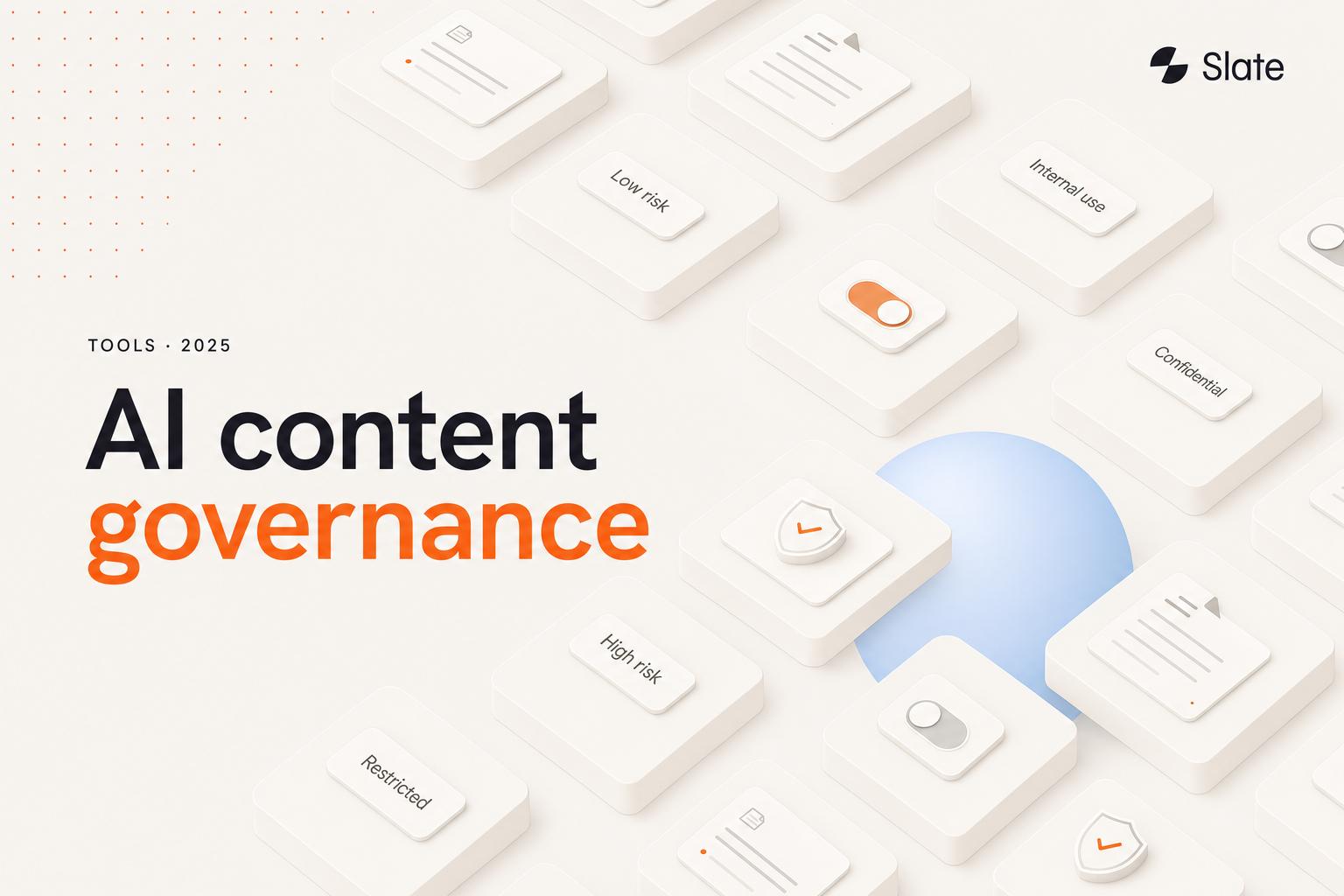
AI-assisted publishing is now a standard part of the operating model for many B2B marketing teams, but the review processes that used to protect brand, accuracy, and compliance have not scaled with it. This guide compares 12 platforms that either govern how AI content is created, reviewed, approved, audited, and published - or provide the policy and oversight layer around those workflows - for marketing, content, and compliance leaders who need control without losing velocity.
Direct answer: The best AI content governance tools in 2026 are platforms that enforce policy, approvals, audit trails, and brand controls at the workflow layer - not just the model layer. Slate leads for marketing and content teams that need AI search visibility tied to governed publishing workflows, while Acrolinx and Writer are strong fits for regulated enterprises and brand-voice-heavy organizations.
Key Takeaways
- AI content governance tools control workflows: They govern how AI-assisted content is created, reviewed, approved, audited, and published, not just how models behave at runtime.
- The category split matters: AI governance platforms focus on enterprise policy and model risk, while content governance tools focus on prompts, approvals, brand safety, and publishing operations.
- Slate ranks #1 for marketing and content teams: Acrolinx and Writer are strong contenders for enterprise style, compliance, and brand-control use cases.
- Workflow enforcement should outweigh generic governance messaging: Approval routing, human review, audit trails, RBAC, prompt governance, and CMS integrations are the deciding criteria.
- Governance affects growth, not just risk: Well-governed content is more consistent, source-backed, and structurally fit for AI search citation.
- This guide is built for cross-functional buyers: Especially CMOs, VP Marketing, Heads of Content, SEO leads, brand teams, and legal/compliance stakeholders.
Why AI Content Governance Matters In 2026
Most B2B marketing teams have already crossed the AI adoption line. Content Marketing Institute's 2026 B2B research reports that 95% of B2B marketers say their organizations use AI-powered applications, and 89% use AI tools for generating or optimizing written content. The question is no longer whether teams will use AI to publish - it is whether they can keep the output accurate, on-brand, and defensible at scale.
That is where the gap shows up. A 2026 American Arbitration Association survey found that 87% of large organizations have some form of AI governance in place, but only 22% believe those systems are operating effectively. Policy documents exist. Enforcement does not.
Three pressures are converging in 2026:
- Brand safety: Generic AI output erodes voice, accuracy, and differentiation across hundreds of pages.
- Regulatory exposure: Legal and compliance teams want auditable trails for AI-assisted claims, citations, and decisions.
- AI search citation quality: Position Digital's 2026 compilation of AI SEO research cites Seer Interactive data on AI Overview CTR impact showing organic CTR drops by 61% on queries where Google's AI Overviews appear - while brands cited inside an AI Overview see 35% higher CTR than those left out.
What used to be a policy problem - write a doc, share it in Notion, hope writers follow it - is now an AI risk management tools problem that has to live inside the workflow itself. Governance that cannot enforce approval steps, prompt rules, and brand checks at the moment of creation is not really governance. It is documentation.
What Are AI Content Governance Tools?
AI content governance tools are software platforms that control how AI-generated and AI-assisted content is created, reviewed, approved, audited, and published. They combine policy enforcement, role-based access, prompt controls, brand safety, and publishing workflows into one operating layer, so AI velocity does not outrun human oversight.
Core capabilities include:
- Policy and prompt governance: Rules that shape what prompts, claims, and outputs are allowed.
- Approval workflows and human review: Staged review with editorial, legal, or brand sign-off.
- Audit trails and version history: Evidence of what was generated, edited, and approved.
- Role-based access control: Permissions tied to seniority, function, and risk tier.
- CMS and publishing integrations: Governance that follows the content all the way to publish.
The people buying these tools are content ops leaders, marketing leaders, SEO and AEO leads, brand teams, and the legal or compliance partners who used to live downstream of publishing and now want to live inside the workflow. Many of these buyers are also evaluating broader content operations best practices as they redesign their publishing model around AI.
AI Governance Vs. Content Governance Vs. Model Monitoring
These three categories often get lumped together, but the buyer, the scope, and the controls are different.
Enterprise AI Governance Platforms
These platforms - Credo AI, Holistic AI, IBM watsonx.governance - focus on policy intelligence, model registries, risk assessments, and regulatory alignment with frameworks like the EU AI Act, NIST AI Risk Management Framework, and ISO 42001 AI management system standard. They answer questions like: which AI systems are in use, what risk tier do they fall into, and are we compliant?
AI Content Governance Tools
This is where Slate, Acrolinx, Writer, Templafy, and Aprimo operate. The scope is narrower but deeper: the actual workflow of producing AI-assisted content. Controls live inside the AI content governance platform at the prompt, draft, review, and publish steps - not in a separate compliance dashboard.
Model Monitoring And Observability Tools
These tools watch live model behavior - drift, latency, hallucination rate, performance against benchmarks. They are essential for teams running custom LLMs in production but they do not govern the editorial process. A model monitor will not stop a marketer from publishing an off-brand AI-generated landing page. A content governance tool will.
How We Evaluated The Best AI Content Governance Tools
The evaluation period is June 2026. Each platform was assessed against seven weighted criteria, with publicly documented capabilities and vendor materials cross-referenced where direct testing was not available.
- Policy enforcement at the workflow layer: Can the tool stop non-compliant content before publish?
- Approval workflows and human review: Are staged reviews, escalations, and sign-offs built in?
- Audit trails and version history: Is there evidence of who changed what, when, and why?
- Role-based access control and permissions: Can permissions be tied to function and risk?
- Prompt governance: Are prompts, models, and AI usage policies controllable?
- Brand safety and style controls: Can voice, terminology, and claims be enforced?
- CMS and publishing integrations: Does governance extend through the publishing pipeline?
Pure model-monitoring tools were excluded unless they offered meaningful content-layer controls. Tools were ranked by fit-for-purpose, not feature breadth - a content team buying a model registry is buying the wrong category. Teams comparing this list against broader AI content marketing tools should weight workflow enforcement above feature count.
Comparison Table - Best AI Content Governance Tools At A Glance
The 12 Best AI Content Governance Tools In 2026
1. Slate - Best AI Content Governance Tool For Marketing & Content Teams
Slate is an end-to-end AI search optimization and content engineering platform with governance built directly into the workflow layer - so AI-assisted publishing can scale without losing brand, quality, or oversight.
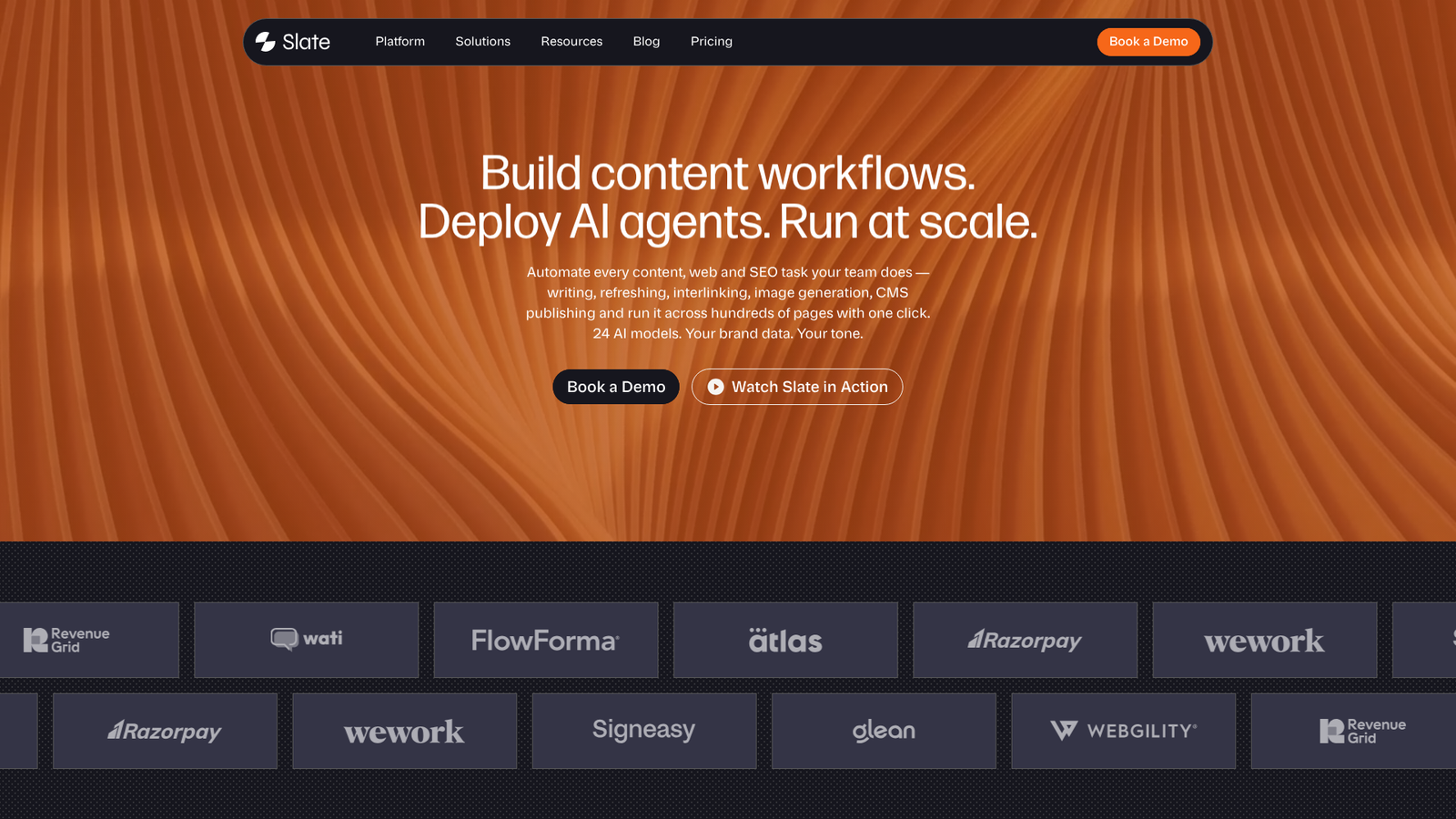
Best for: B2B SaaS marketing teams, content-led growth organizations, and SEO/AEO leaders scaling AI-assisted content under brand and compliance constraints.
Key features:
- Structured, repeatable content workflows with staged human review checkpoints
- Brand Kit and Knowledge Base for enforcing tone, style, and source-of-truth grounding
- Power Sheets for bulk content refreshes, audits, and programmatic publishing across thousands of URLs
- AI Search Analytics tracking visibility and citations across ChatGPT, Google AI Overviews, Google AI Mode, and Perplexity
- Direct CMS publishing to Webflow and WordPress, keeping governance attached through publish
- Role-based permissions and workflow controls that support audit-ready content operations
Why Slate ranks first: Most content governance tools treat governance as a tax. Slate ties workflow controls - review gates, brand enforcement, knowledge grounding - to AI search visibility tracking, so teams can manage publishing quality and search-readiness in the same system. That makes it a strong fit for teams that want control and execution in one platform, with visibility tracking attached.
Pricing: Starting at $199/month.
G2 rating: 4.9/5
2. Acrolinx - Best For Regulated Enterprises With Heavy Style And Compliance Needs
Acrolinx is an AI-powered enterprise content governance platform built to keep large organizations aligned with brand, style, and regulatory standards across many writers and workflows.
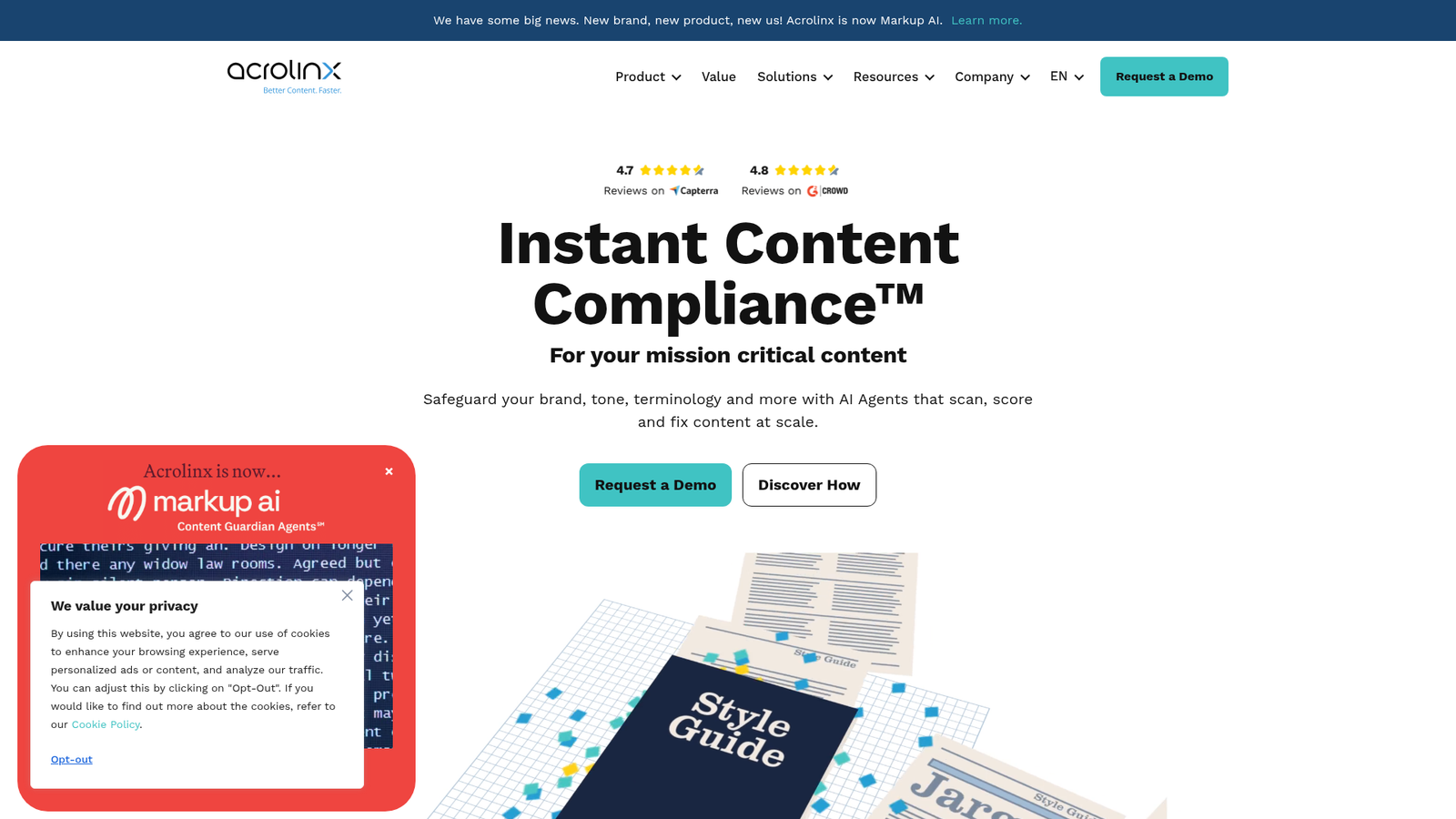
Best for: Large enterprises in regulated industries - pharma, financial services, manufacturing - that need brand and compliance enforcement across distributed writing teams.
Key features:
- Brand and style checking against centralized linguistic standards
- Instant content rewriting suggestions tied to enterprise guidelines
- Regulatory and compliance language checks for high-risk content
- Centralized governance for large, distributed writing teams
Pricing: Custom, sales-led. No public self-serve tier.
G2 rating: 4.8/5
3. Writer - Best For Enterprise Brand Voice And Generative Content Control
Writer is an enterprise AI platform for agentic work, letting teams delegate workflows to AI agents grounded in company data, voice, and systems.
Best for: Enterprises that want governed AI agents tied to brand voice, internal knowledge, and repeatable cross-functional workflows.
Key features:
- WRITER Agent for executing multi-step workflows and producing finished deliverables
- Knowledge Graph for grounding outputs in trusted company information
- AI Studio with connectors for integrating agents into business systems
- Brand controls and standards for governing output quality and voice
Pricing: Starter is per-seat with a 14-day free trial for up to 5 users; Enterprise is custom with advanced governance and unlimited users.
G2 rating: 4.4/5
4. Credo AI - Best For Enterprise AI Policy Management
Credo AI is an enterprise AI governance platform for discovering, assessing, governing, and monitoring AI agents, models, applications, and vendors.
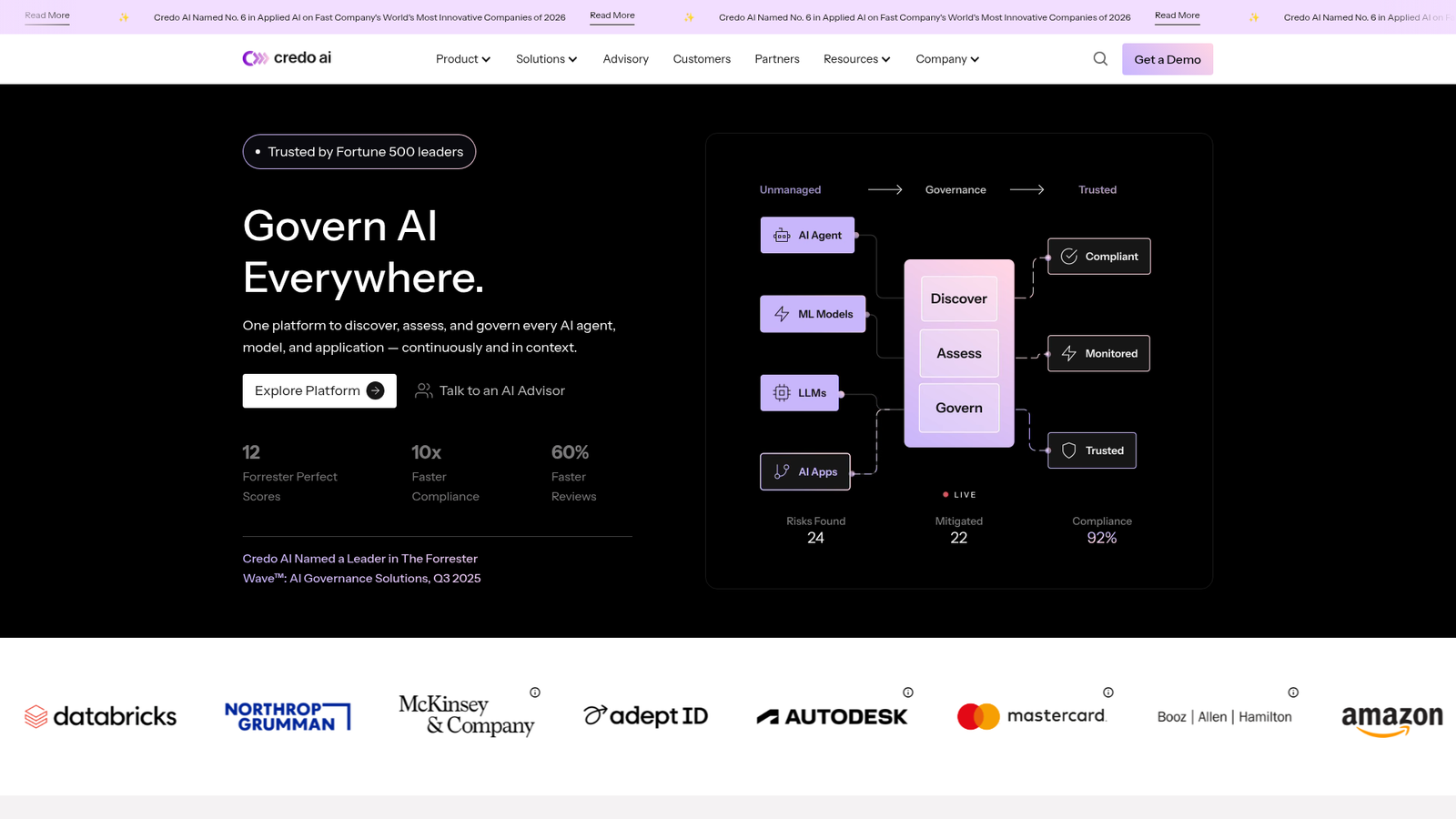
Best for: Enterprises that need centralized AI policy management and audit-ready compliance across internal and third-party AI systems.
Key features:
- AI Registry and Discovery for cataloging AI systems and detecting shadow AI
- Continuous risk intelligence with automated red-teaming and drift detection
- Compliance and policy engine with packs for EU AI Act, NIST AI RMF, and ISO 42001
- Audit-ready evidence collection
Pricing: Custom, sales-led.
G2 rating: Not publicly listed
5. Holistic AI - Best For AI Risk And Audit-Heavy Enterprises
Holistic AI is an enterprise AI governance platform focused on AI discovery, continuous risk testing, and regulatory compliance across the AI portfolio.
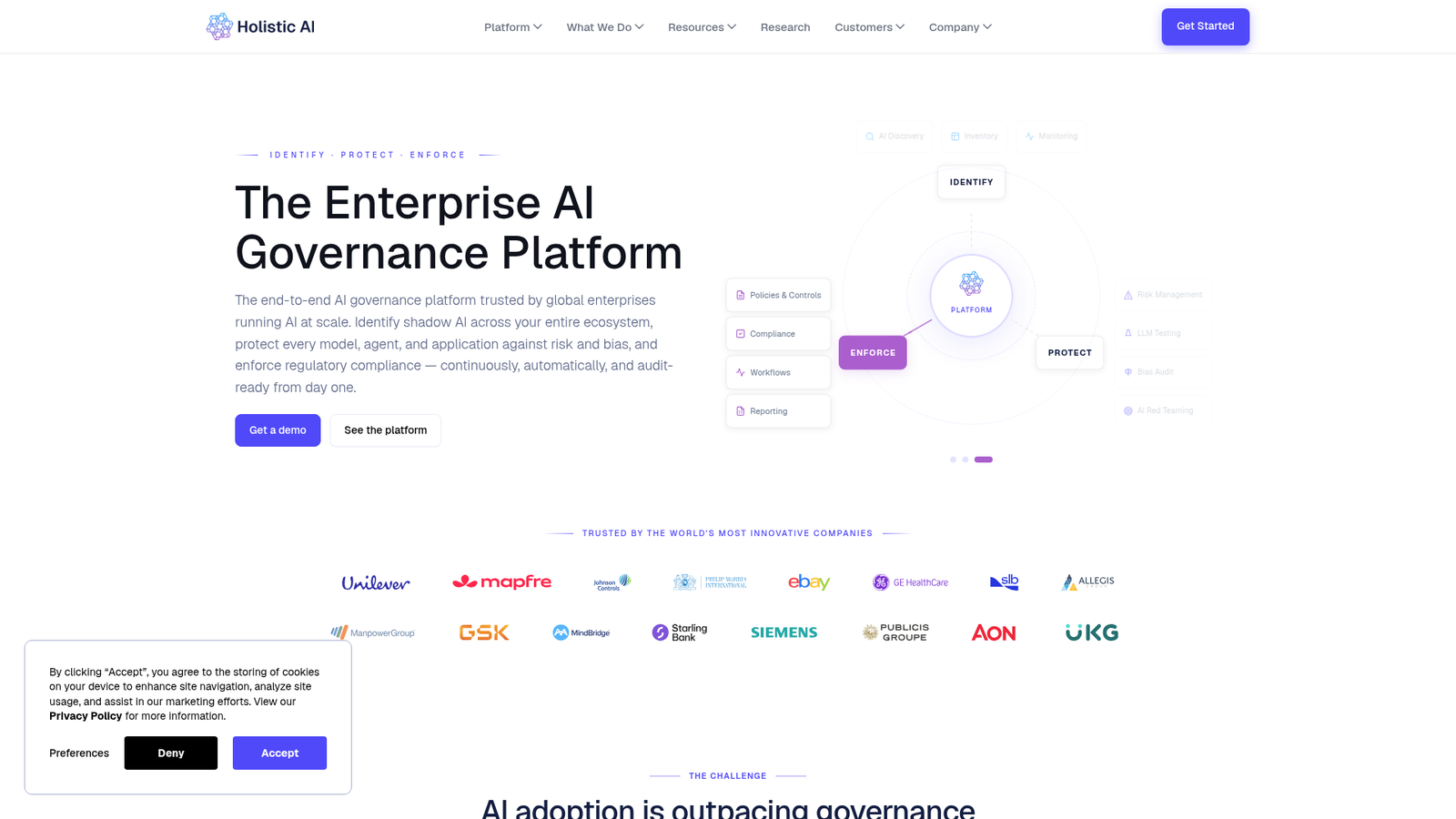
Best for: Large enterprises that need end-to-end AI risk management and compliance reporting across models, agents, and APIs.
Key features:
- Live AI inventory across models, agents, APIs, and workflows
- Continuous testing for bias, safety, security, and performance
- Compliance workflows for EU AI Act, NIST AI RMF, and ISO 42001
- Audit-ready reporting and policy enforcement
Pricing: Custom, sales-led.
G2 rating: Not publicly rated
6. IBM watsonx.governance - Best For Large Enterprises Already On IBM Stack
IBM watsonx.governance is an enterprise AI governance platform for managing risk, compliance, transparency, and oversight across hybrid, multi-vendor AI environments.
Best for: Enterprises already standardized on IBM that need governance across ML and generative AI use cases.
Key features:
- Governance Graph mapping AI assets, policies, risks, and regulatory requirements
- AI-driven control mapping and audit-ready reporting
- Monitoring against risk signals and business KPIs
- Free Lite tier for limited use
Pricing: Essentials usage-based starting at $1.28/month; GRC Essentials $795 instance plus $2,650/solution and $53/concurrent user (up to 25); Standard $3,710 instance plus $2,650/solution and $53/concurrent user (up to 200). Free Lite tier available.
G2 rating: 4.3/5
7. Microsoft Purview (AI Hub) - Best For Microsoft-Centric Enterprises
Microsoft Purview is a unified data security, governance, and compliance platform for securing and governing data across analytics, AI apps, and the broader data estate.

Best for: Enterprises already in Microsoft 365 and Azure that need unified data security, governance, and AI-app oversight.
Key features:
- Data Security Posture Management with continuous risk insights
- Unified catalog for data governance across sources
- Copilot in Purview for natural-language governance guidance
- AI app oversight tied to Microsoft 365 and Azure
Pricing: Purview Suite $12.00/user/month (paid yearly, requires M365 E3 or O365 E3 + EMS E3); Microsoft 365 E5 (no Teams) $48.45/user/month; Microsoft 365 E5 $57.00/user/month.
G2 rating: 4.7/5
8. Aprimo - Best For Enterprise Content Operations With AI Layered In
Aprimo is a digital asset management and content operations platform that centralizes assets, automates workflows, and uses AI to help enterprises scale content under governance.
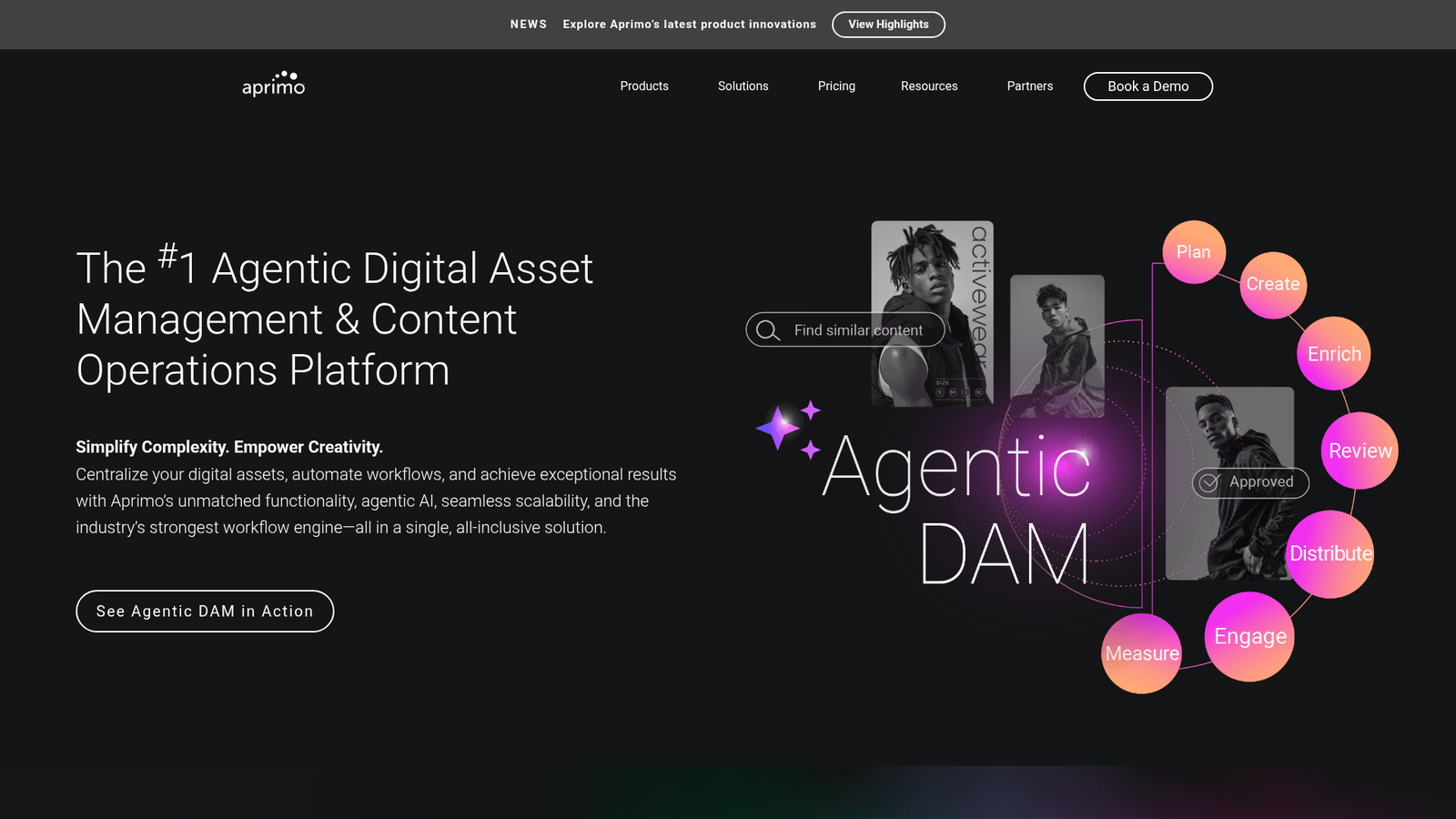
Best for: Enterprise marketing teams that need DAM, AI-assisted content operations, and workflow control across multi-channel publishing.
Key features:
- Centralized DAM for text, images, video, prompts, and 3D assets
- AI-powered metadata, search, and content intelligence
- Workflow automation with approvals, annotations, and review
- Module-based packaging (DAM, AI Elite, Personalization, Productivity)
Pricing: Custom, sales-led; contracts typically start at 12 months.
G2 rating: 4.3/5
9. Templafy - Best For Document And Template Governance At Scale
Templafy is an AI-powered document generation platform for creating accurate, compliant, and on-brand business documents at enterprise scale.
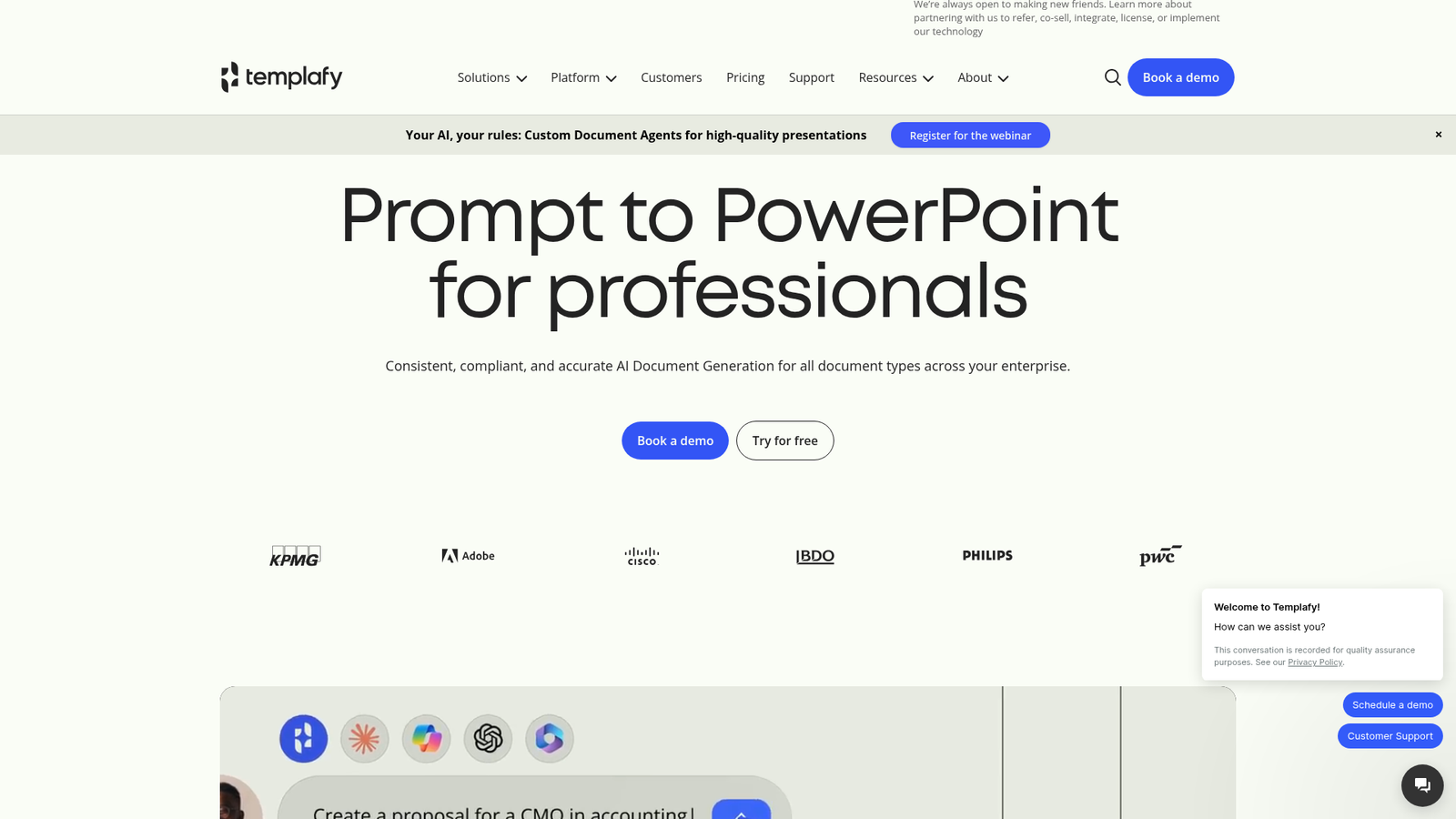
Best for: Enterprises that need compliant, on-brand document and presentation creation embedded inside Microsoft 365, Google Workspace, and Salesforce.
Key features:
- AI-driven document and presentation generation
- Centralized brand, template, and content governance
- Embedded workflows across Microsoft 365 and Google Workspace
- Embedded workflows in Microsoft 365, Google Workspace, and Salesforce
Pricing: Custom across Templafy Agents Platform, Agents Pro, and Agents Premium. Free PowerPoint agent available.
G2 rating: 4.4/5
10. Modulos - Best For Compliance-Led AI Governance Programs
Modulos is an AI governance, risk, and compliance platform for operationalizing AI compliance across multiple regulatory frameworks.
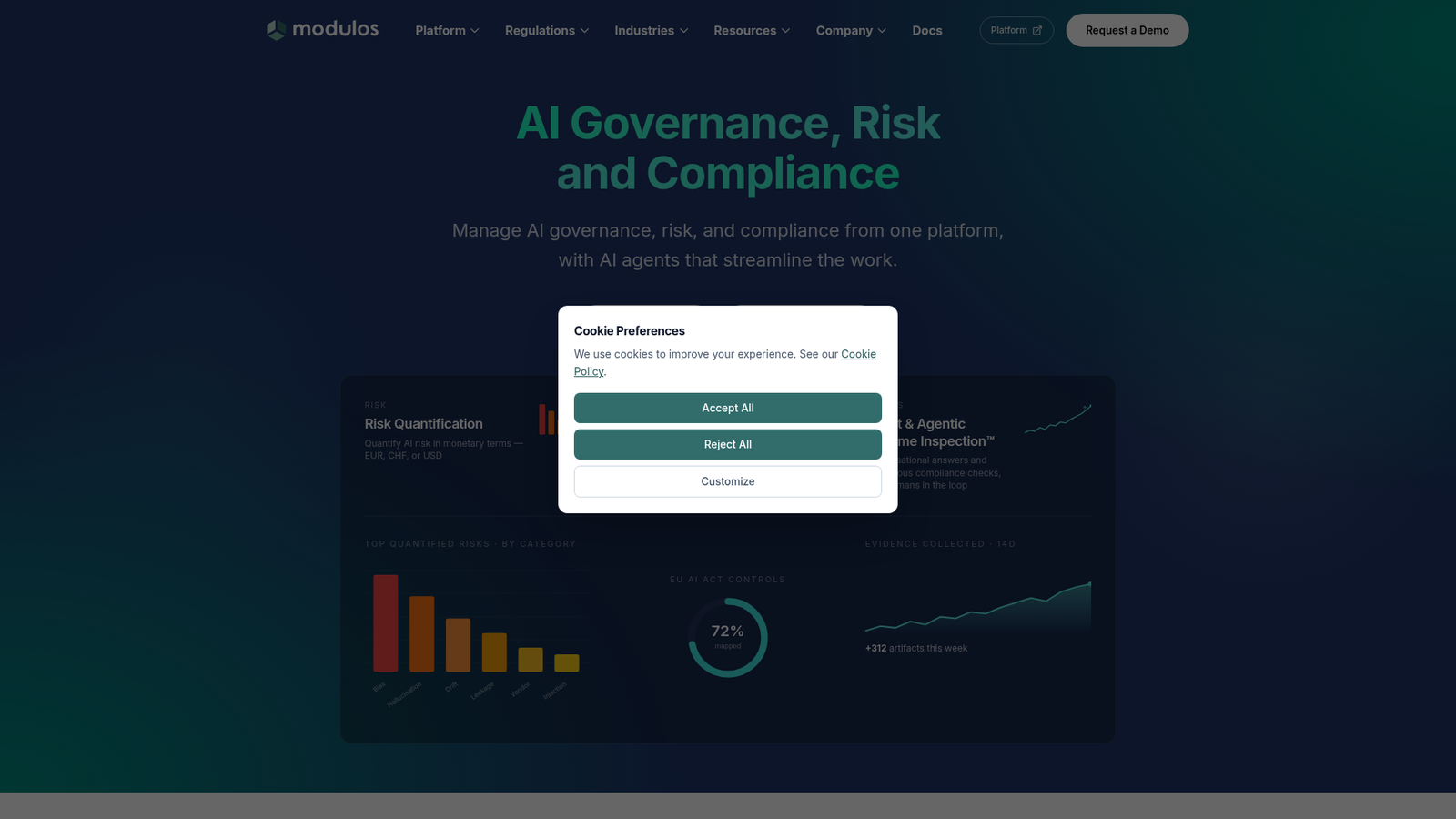
Best for: Regulated organizations that need audit-ready AI governance, quantitative risk management, and multi-framework compliance.
Key features:
- Governance workflows with project dashboards, ownership tracking, and audit trails
- Quantitative risk management with appetite limits and executive reporting
- Multi-framework compliance support
- AI agents for evidence collection and continuous compliance checks
Pricing: Custom paid tier via sales. Free Starter tier with full GRC modules, 1 user, 1 project, and 100 AI agent workflows per month.
G2 rating: Not publicly rated
11. TrueFoundry - Best For Infrastructure-Level Governance And Self-Hosted LLMs
TrueFoundry is an enterprise AI gateway and agentic deployment platform for governing, deploying, scaling, and tracing AI systems across cloud, VPC, and on-prem environments.
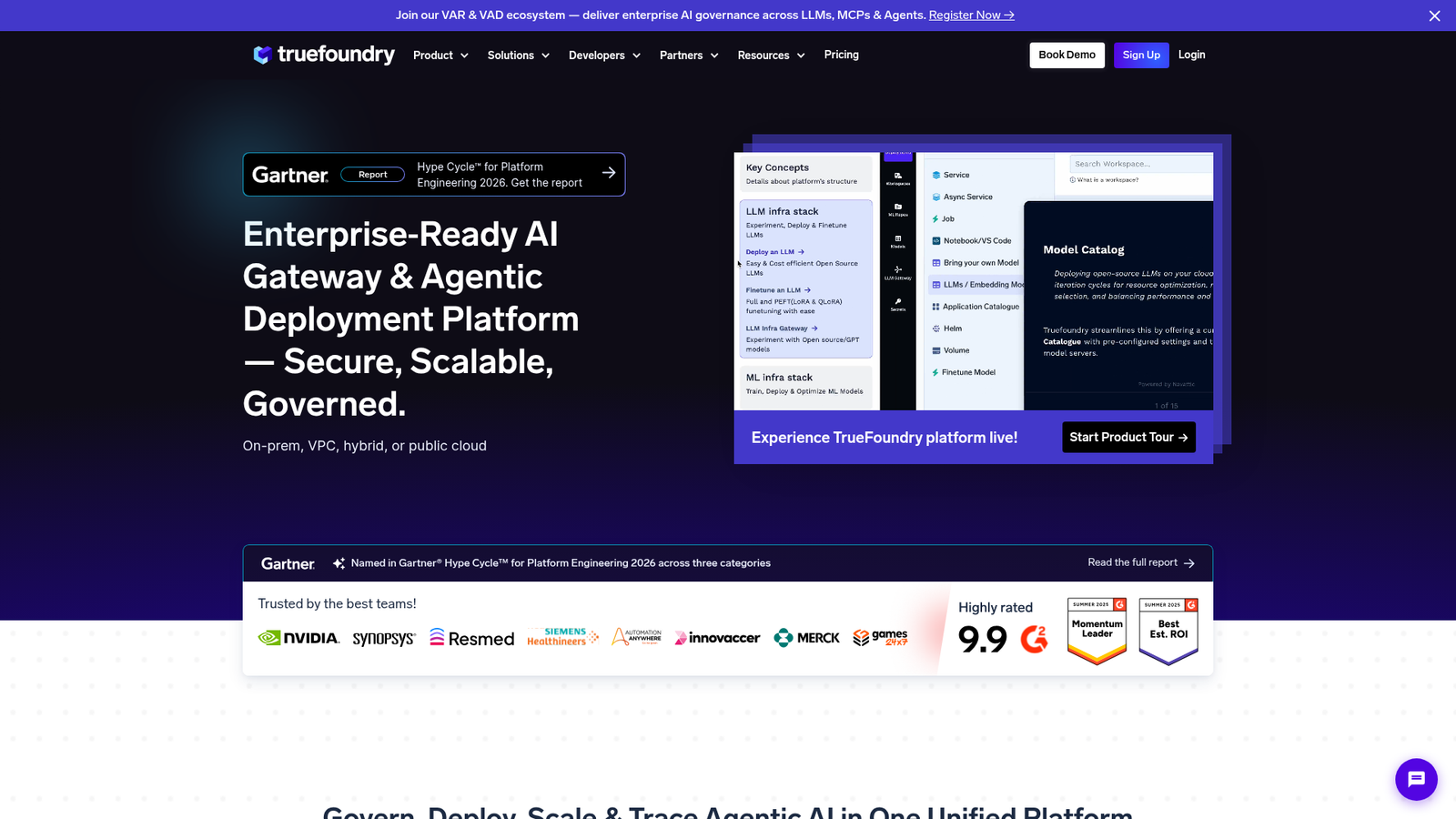
Best for: Engineering and platform teams that need to securely deploy and govern self-hosted LLMs and agents at the infrastructure layer.
Key features:
- AI Gateway for centralized model access, routing, guardrails, and observability
- MCP and Agents Registry with schema validation and access control
- Prompt lifecycle management with versioning and monitoring
- Multi-environment deployment across cloud, VPC, and on-prem
Pricing: Pro $499/month (1M requests, 10 users); Pro Plus $2,999/month (1M requests, 25 users); Enterprise custom. Free Developer tier (50k requests, 3 users) available.
G2 rating: 4.6/5
12. Domo AI Governance - Best For Data-Centric Teams With Embedded AI
Domo AI Governance is Domo's governed AI and data platform for building AI-driven analytics and agents on existing cloud data with security, compliance, and visibility controls.
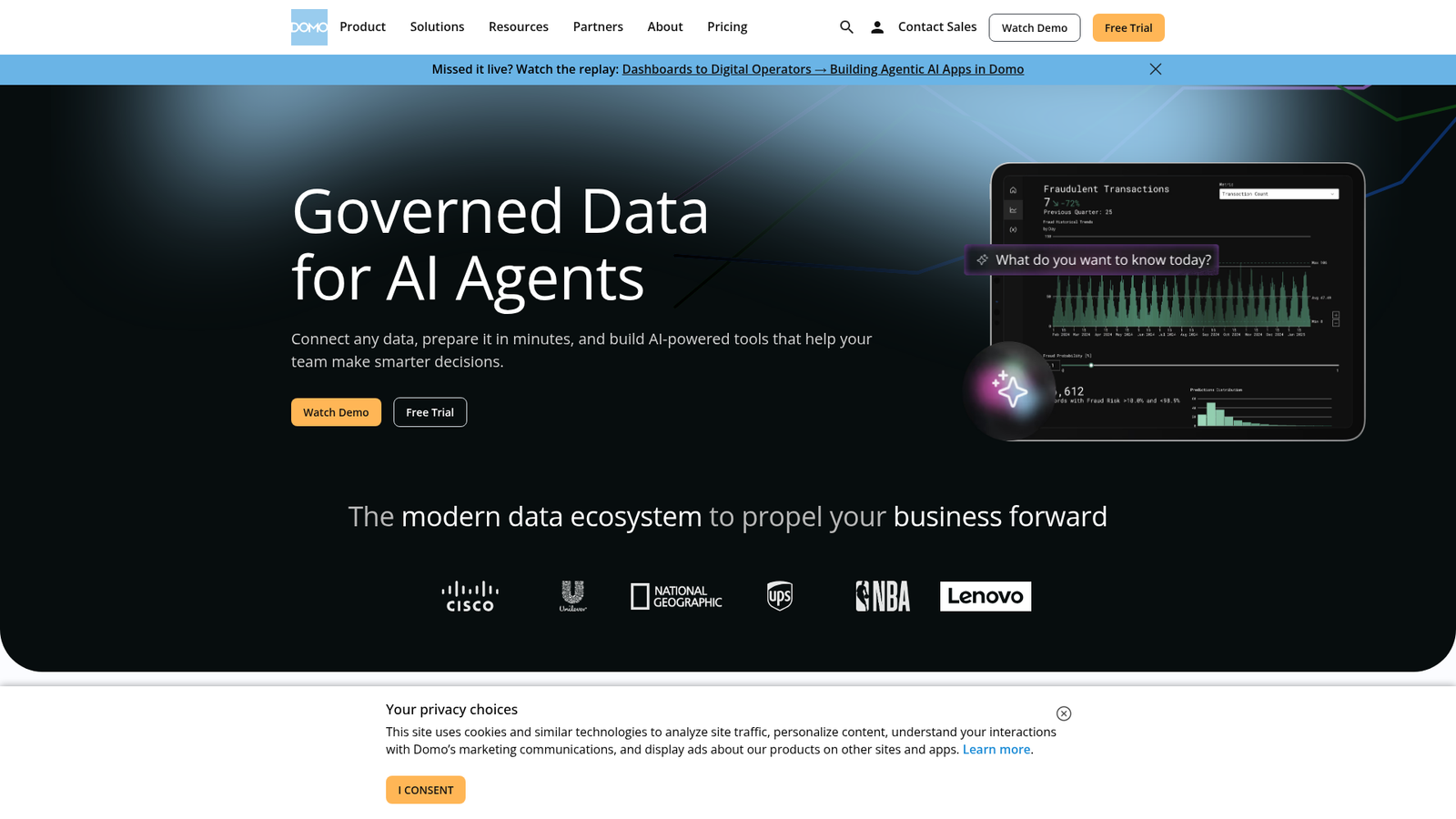
Best for: Enterprises that want AI and analytics on sensitive data with centralized governance and compliance-focused security.
Key features:
- Advanced user-level permissions and SSO
- Private AI usage with DomoGPT inside Domo Cloud
- Model management with observability, lineage, and auditing
- HIPAA-compliant environment options
Pricing: Custom credit-based usage billing with dedicated account team, volume discounts, and support packages. 30-day free trial available.
G2 rating: 4.3/5
What Features Matter Most In An AI Content Governance Platform
Governance is most useful when it is modeled as a stack - six layers that map to how content actually moves from idea to publish. Evaluating tools by layer surfaces gaps that feature lists hide.
Policy Layer
Usage policies, prompt rules, and claim restrictions that define what AI can and cannot do. This is where regulated language, banned terms, and approved sources live.
Workflow Layer
Approval routing, staged review, and escalation logic. This is where the AI governance for enterprises conversation usually breaks down - most tools have policies but no enforcement steps.
Review Layer
Human-in-the-loop checkpoints for editorial, brand, and legal sign-off. The right number of reviewers depends on risk tier; over-routing kills velocity, under-routing kills trust.
Audit Layer
Version history, change logs, and evidence collection. When legal asks "who approved this claim," the answer should take seconds, not days.
Access And Permissions Layer
RBAC, SSO, and prompt-level permissions. Junior writers should not have the same model access or publish rights as senior editors.
Integration Layer
CMS, DAM, knowledge sources, and publishing pipelines. Governance that ends before publish is governance that ends too early.
How To Choose The Right Tool For Your Team
Different operating models need different governance shapes. The wrong tool over-governs or under-governs - both are expensive.
For Startup And Early-Stage Content Teams
Lightweight workflows beat heavy compliance. Look for fast time-to-value, brand voice enforcement, and one or two review gates. Slate, Writer Starter, and Templafy's self-serve option fit here.
For Mid-Market B2B SaaS Marketing Orgs
This is where scaling content production collides with multi-contributor governance. Approval workflows, brand controls, audit trails, and CMS integrations matter most. Slate is the strongest fit; Aprimo and Writer are credible alternatives.
For Enterprise Marketing With Legal And Compliance Review
RBAC, audit trails, and regulated industry support become non-negotiable. Acrolinx, Writer Enterprise, and Aprimo cover the content side; Credo AI or Holistic AI sit alongside them for portfolio-level AI risk. Larger orgs often pair these with AI SEO tools for enterprise content teams to keep governance and search performance aligned.
For Multi-Brand Or Multi-Region Teams
Workspace separation, localization controls, and brand governance are the deciding criteria. Aprimo and Templafy are especially relevant here, while Slate can fit teams that need structured workflows and brand controls across growing content programs.
How To Roll Out AI Content Governance In 90 Days
Governance rollouts fail when teams try to enforce everything on day one. A phased approach earns adoption.
Days 1–30 - Audit And Define
Inventory current AI use across marketing, content, and demand gen. Document existing policies - even informal ones. Identify owners across marketing, legal, brand, and IT. Map the highest-risk content types: pricing claims, regulated language, executive bylines.
Days 31–60 - Pilot Workflows
Pick one content type - usually blog posts or landing pages - and configure a single approval workflow inside the chosen tool. Test with a small team. Measure cycle time before and after. Adjust review gates based on what actually slows things down versus what catches real issues.
Days 61–90 - Scale And Measure
Expand to additional content categories and contributors. Establish an audit cadence - monthly for high-risk content, quarterly elsewhere. Measure cycle time, approval rates, brand consistency scores, and AI search visibility. Connect the dots between governed content and citation pickup, the way most content governance tools buyers underestimate.
Watch out for: Over-governance kills velocity, under-governance kills trust. The teams that win calibrate continuously, not once.
AI Content Governance And AI Search Visibility - The Hidden Connection
Governance is usually pitched as a risk control. The more interesting story in 2026 is that the same disciplines behind governed content can also support stronger AI search visibility.
Here is why:
- AI answer engines reward content that is structured, source-backed, and consistent. Governance helps teams produce more of that consistently.
- Ungoverned AI content tends toward generic phrasing, fabricated claims, and inconsistent voice - patterns that can make content less trustworthy and less useful as a citation source.
- Brand safety and accuracy are upstream of citation eligibility. If a source appears inconsistent or weakly grounded, it is less likely to be quoted.
- Workflow governance - knowledge grounding, brand enforcement, review gates - can improve the odds that content is clear enough to be extracted, cited, and surfaced.
The same Seer Interactive data referenced earlier shows brands cited inside AI Overviews see 35% higher organic CTR than brands not cited. That is the visibility delta that makes citation readiness worth taking seriously. For teams comparing AI compliance monitoring software against pure LLM governance tools, the question is not just "can this reduce risk" - it is "can this also make our content more citable."
Slate's POV: governance is not a compliance tax. It is a growth lever.
Common Mistakes Teams Make With AI Content Governance
The biggest mistakes are not technical. They are operational.
1. Treating governance as a policy document instead of a workflow. A PDF in a shared drive does not stop a marketer from publishing an off-brand AI draft at 4:55 PM on a Friday. Enforcement inside the workflow does.
2. Buying enterprise AI governance platforms when content governance is the real need. A CMO who buys Credo AI to solve a content quality problem will be disappointed. Wrong category, wrong layer.
3. Skipping prompt governance until it becomes a brand crisis. Prompts shape output. Ungoverned prompts shape ungoverned output. Most teams learn this after a public mistake, not before.
4. Centralizing review so heavily that publishing velocity collapses. Every claim does not need legal review. Tier risk, and route only the high-risk content through the slowest gates.
5. Ignoring audit trails until legal asks for them. Audit trails are cheap to build into a workflow from day one. They are expensive to reconstruct after the fact.
Ready to govern AI content without slowing your team down? Book a Slate demo.
FAQs
What Are AI Content Governance Tools?
AI content governance tools are software platforms that control how AI-generated and AI-assisted content is created, reviewed, approved, audited, and published. They combine policy enforcement, role-based access, prompt controls, brand safety, and CMS integrations into one workflow layer, giving marketing, content, and compliance teams enforceable oversight without slowing publishing velocity.
How Is AI Content Governance Different From AI Governance?
AI governance platforms focus on enterprise policy, model risk, and regulatory compliance across the AI portfolio - typically owned by a CIO or AI risk lead. AI content governance tools focus narrower and deeper: prompts, approvals, brand safety, and publishing workflows inside the content function. Marketing teams need the second category; legal and IT often need the first.
Which AI Content Governance Tool Is Best For Enterprises?
It depends on the primary need. Slate fits enterprises whose top priority is AI-assisted content velocity and AI search visibility. Acrolinx is a strong fit for highly regulated industries with deep style and compliance requirements. Writer is a strong match for enterprises prioritizing agentic workflows tied to brand voice. Most large organizations end up combining one content tool with a portfolio-level AI governance platform.
What Features Should An AI Content Governance Platform Include?
Seven core capabilities: policy enforcement at the workflow layer, approval workflows with human review, audit trails and version history, role-based access control, prompt governance, brand safety and style controls, and CMS or publishing integrations. Tools that cover all seven let governance live inside the workflow rather than alongside it as documentation that nobody enforces.
How Is AI Governance Different From Model Monitoring?
AI governance is about controls and accountability - who can use which models, under what policies, with what evidence. Model monitoring is about runtime behavior - drift, latency, accuracy, hallucination rate, and performance against benchmarks. Governance answers "are we operating responsibly." Monitoring answers "is the model behaving as expected." Most enterprises need both, but they solve different problems.
Do AI Content Governance Tools Support Brand Safety?
Yes. Content-focused tools typically include style enforcement, terminology management, tone controls, and structured review steps for editorial, brand, and legal sign-off. Platforms like Slate, Acrolinx, and Writer combine brand voice rules with knowledge-base grounding so AI output is shaped before it ever reaches the review gate.
How Much Does An AI Content Governance Platform Cost?
Pricing models vary widely. Slate starts at $199/month. TrueFoundry Pro is $499/month, with a free Developer tier. Microsoft Purview Suite is $12.00/user/month (annual). IBM watsonx.governance Essentials is usage-based starting at $1.28/month, with separate GRC tiers from $795/instance. Acrolinx, Credo AI, Holistic AI, Aprimo, Templafy, Modulos, and Domo are sales-led with custom enterprise quotes.