A content marketer's typical schedule will probably make you want to sit down and console them.
On any given day, you can see them pulling keyword data from one tool, drafting in another, optimizing in a third, publishing through a CMS, tracking performance in GA4, and monitoring AI citations in…nowhere. All leading to mediocre results - with traffic, leads, and ultimately, organic revenue.
This process was, in fact, a “tried and tested content playbook” until recently.
But in 2026, with buyer journeys looking like a Russian novel - authored by AI at that - this manual, exhausting process barely cuts it.
The problem list is rather long:
- None of these tools talk to each other in any meaningful way
- SERP analysis doesn't travel into the writer's (human or AI) draft
- The optimization data doesn't exist inside the creation environment
- Performance signals never feed back into planning
This makes every handoff a “reset.”
This guide is our way of consoling the content marketer who is scrambling to improve results.
First off, we show you how the problem isn’t entirely around bad writing or (as many marketers resort to believing) bad luck, but rather with bad operations (the system of people + processes + tech that powers content from “idea” to “published asset”).
And then, we look at some content operations best practices that high-performing teams, both in-house and agency, use to turn fragmented workflows into a consistent content system.
Let’s get started.
Why Content Operations Matter More Than Ever in 2026
Until recently, content operations could afford to be messy.
There was only one master to serve: Google. And it was a pretty forgiving and predictable master.
Teams ranked through a mix of keyword targeting, backlinks, and reasonable content quality.
But in 2026, content has to perform simultaneously across traditional SERPs and AI answer engines: ChatGPT, Perplexity, Gemini, AI Overviews, Claude, and every new model that keeps getting released.
These are not the same system: Only 10% of ChatGPT's short-tail results overlap with Google SERPs.
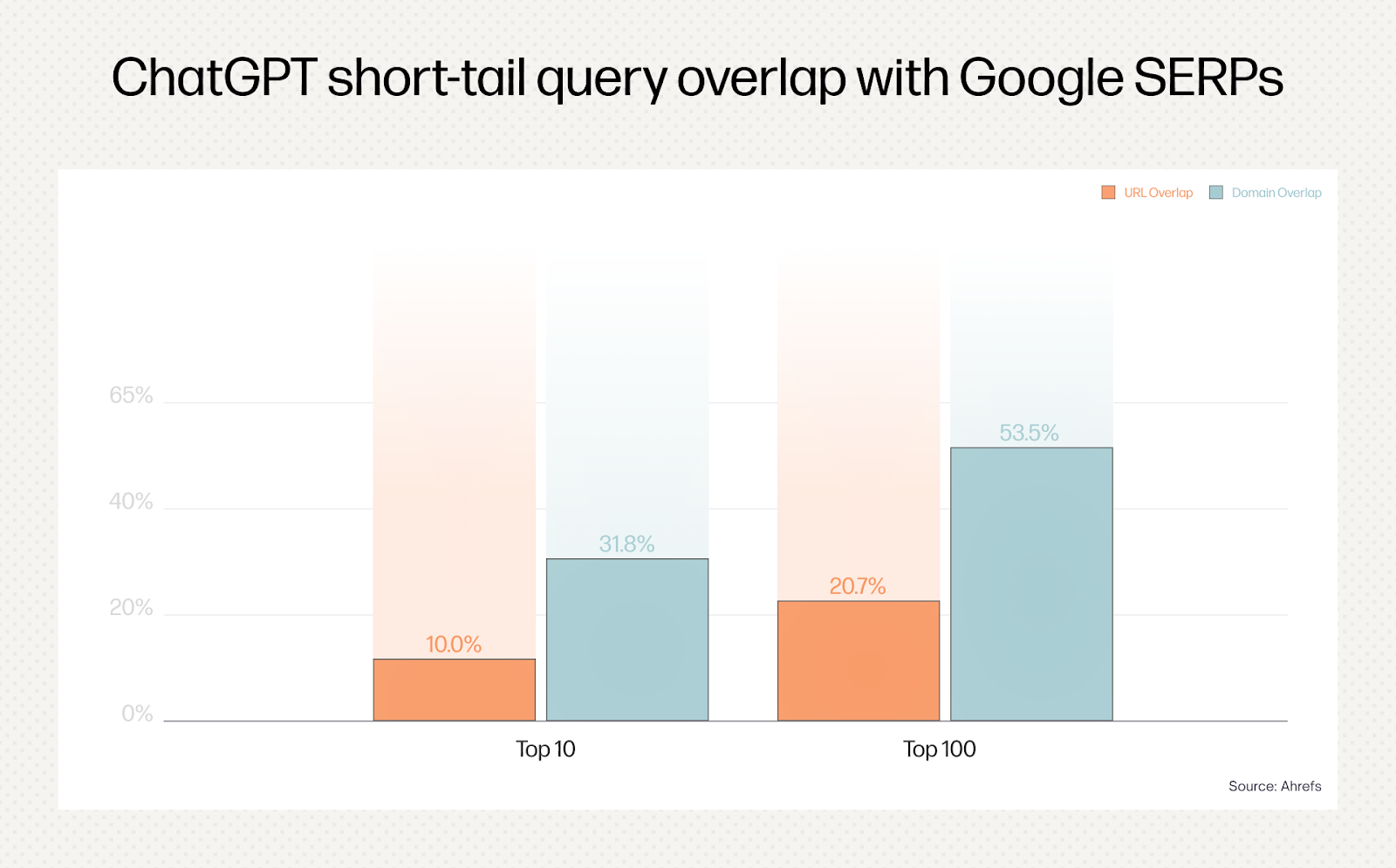
But these are both important systems: Google still processes 9 billion daily searches, and ChatGPT processes one billion daily prompts.
So, when you publish without a structured operations architecture, you don't just lose Google rankings, but simultaneously fail to build the topical coherence that AI models use to determine citation-worthiness.
Basically:
Research intelligence lost → content needs post-facto optimization → delays → content ages before it's live → decay → refresh → restart without context
The solution to this predicament is content engineering.
“Engineering” rather than “marketing”, because you design a system where every piece of content benefits from accumulated intelligence.
Research feeds creation. Creation embeds optimization. Publishing triggers measurement. Measurement informs refresh.
In the next section, we will look at content operations best practices - you will notice that most of the points we discuss will revolve around this aspect.
Content Operations Best Practices for High-Performing Teams
We have segregated this into 8 separate segments, based on how the typical content breaking points look today:
- Content Architecture
- Workflow set-ups
- Ownership, Roles, and SLAs
- Briefs, Brand Knowledge, and Research Intelligence
- SEO and AI Optimization
- Publishing and Distribution
- Measuring
- Refresh and Decay
Build Content Architecture Before You Build Content
Most teams begin content planning with keyword research.
There is one question that often leads the conversation:
"What has volume?"
Without content architecture (a structural blueprint that maps content pillars to product capabilities, audience segments, and the buyer journey), keyword research produces nothing but topically scattered content.
The content that comes out of this neither builds authority nor helps AI models understand what your brand is an expert in.
By Content Architecture, here’s what we mean:
A better version of the same earlier question looks like this:
"What does our product solve, and how do we map content territories to those capabilities?"
This way, the “architecture” comes first, and “keywords” are an input to the architecture, not the architecture itself.
A persistent architecture layer that accumulates intelligence over time, rather than starting every initiative from scratch, is what separates ad-hoc content from a system.
In reality, this affects different teams in different ways - and let’s quickly bring in the “in-house vs. agency” dynamic here.
For in-house teams, this architecture must be a shared document that product marketing, content, and growth co-own, and not a strategy deck sitting in someone's drive.
For agencies, this means co-creating the architecture with the client during onboarding rather than accepting a keyword list as the starting brief. They need to invest in this foundational step even when clients push to "just start writing."
Now, onto the next step: architecture tells you what to build. Workflows determine how it gets built.
Standardize Workflows End-to-End (But Differentiate by Content Type)
Most teams run every content type through the same production process.
But a blog post has different research requirements, approval stakeholders, and performance metrics than a case study or a programmatic landing page.
Running a case study (which needs customer interviews and legal approval) through the same pipeline as a keyword-targeted blog (which needs SERP analysis and entity mapping) is like wearing your sandals to a trek.
The best practice here: build differentiated workflows per content type, each with specific input requirements, quality checkpoints, and output standards.
Despite all this differentiation, all workflows share a common backbone:
- Ideation → briefing → creation → review → publish → optimize as the universal sequence, but with different depth and actors at each stage depending on content type
- Research context survives the handoff. The brief carries competitive gaps, SERP structure, AI visibility data, and brand positioning into the creation stage
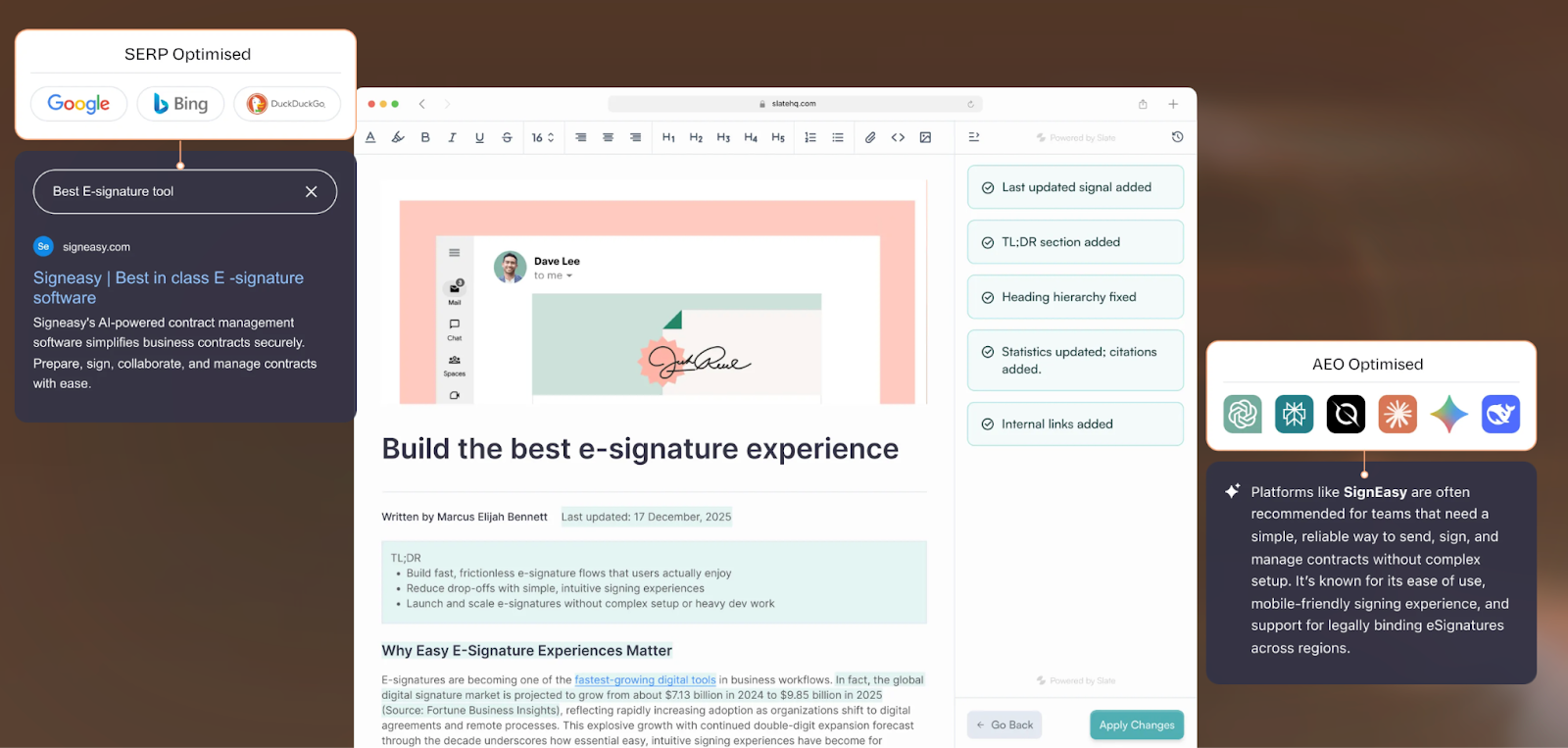
- Optimization is built into creation, not bolted on after. Heading hierarchy, entity coverage, internal linking, and AI-readiness are checked during drafting itself.
- Clear handoff points with defined owners. Who (or which system) moves the piece from brief to draft, from draft to review, from review to publish, and from publish to measurement is clearly defined
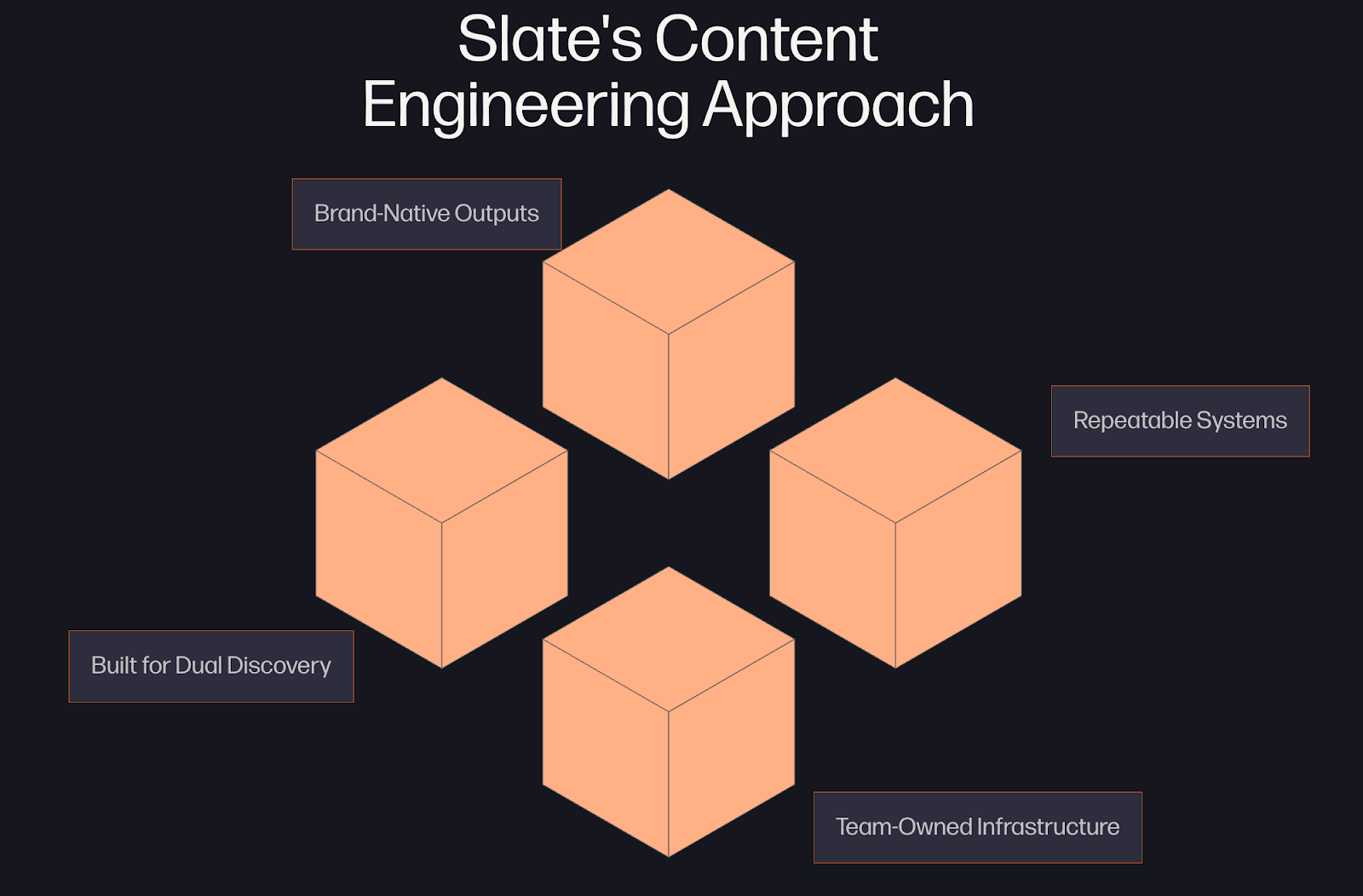
Today, this whole process can be done in the blink of an eye with a content operations system like Slate.
Define Clear Ownership, Roles, and SLAs
The most common reason content misses deadlines isn't writer capacity - today, scale is hardly an issue with AI able to scoop up drafts in no time.
It’s the ambiguity about who approves what, who has final authority, and what "done" means that leads to backlogs.
A blog post needs sign-off from the content manager, product marketing, and the VP of Marketing. Sequentially. Informally. With no documented authority hierarchy.
This way, a single piece can sit in limbo for days.
For agencies, the problem is bigger: unclear client-side ownership means revision cycles that eat into margins and destroy timelines.
Our best practice here is to document, or set up a system that accounts for:
- Who reviews for accuracy
- Who reviews for brand voice
- Who reviews for compliance
- Who has final publish authority
Modern content operations systems like Slate solve the approval bottleneck by making reviews parallel rather than sequential. Brand voice, technical accuracy, and compliance reviews happen simultaneously, with clear and quick timelines.
There's one more SLA that most teams forget entirely: refresh ownership.
Most teams define ownership for creation but not for the post-publish lifecycle. Who owns monitoring performance? Who decides when a page needs a refresh? Who executes that refresh?
When no single team or tool owns the refresh cycle across all assets, content decay accelerates invisibly.
The best practice, once again, is to assign refresh ownership to a system that is curated to handle it for you, from flagging to execution.
Centralize Briefs, Brand Knowledge, and Research Intelligence
This is one of the most consequential breakpoints in content operations.
A strategist spends hours analyzing SERPs, identifying content gaps, and mapping competitive angles. Then they hand the writer a keyword and a loose brief in a Google Doc.
All the competitive context, SERP structure insights, audience intent signals, AI visibility data: gone.
The writer - whether it is AI or human - starts from scratch. This makes the output disconnected from every insight that justified the topic in the first place.
Centralizing doesn't mean "put everything in one folder." It means:
- Structured briefs that auto-populate with research context: SERP data, competitive gaps, entity requirements, and AEO signals are loaded into the brief.
- A brand knowledge base encoded into the system: Brand voice, style guidelines, product positioning, competitor context, and audience personas live in one place.
- Topic and entity intelligence that persists: Instead of starting every new piece from scratch, the system accumulates knowledge about what the brand has covered, where gaps exist, and how the competitive landscape has shifted.
- Differentiated brief templates per content type: A blog brief looks different from a case study brief because the inputs, requirements, and quality checkpoints are different.
- Client context for agencies in a system of record: Past performance data, strategic decisions, and feedback from previous rounds live in the system. Not in Slack threads or someone's memory.
The most effective content operations encode brand identity (company information, audience details, features, USPs, competitor context) into a centralized knowledge base that every piece of content draws from.

This is what prevents the “voice fracture problem.”
Build SEO and AI Optimization Into Creation, Not After It
Until recently, a typical content lifecycle resembled something like this:
Content gets written, reviewed, and "finalized." Then someone runs it through an optimization tool and discovers structural issues.
This led to:
- Missing subtopics
- Wrong heading hierarchy
- Insufficient entity coverage
This triggered a rewrite cycle that frustrated writers, delayed publishing, and often produced "Frankenstein content" that's been patched rather than built right.
The root cause of this issue is that optimization data lives in a different tool than the creation environment.
With AI taking content structure and topical coverage seriously, this is a dangerous way to quickly lose leads.
The fix is making optimization intelligence native to the creation workflow.
Heading hierarchy, entity coverage, semantic depth, internal linking requirements, and AI-readiness signals should be visible while content is being written.
Particularly, when it comes to optimizing for AI engines, your system needs to factor in these points:
For in-house teams, the content team needs real-time access to optimization intelligence during drafting, not a separate SEO review step.
For agencies, the optimization requirements must be encoded into the workflow itself, so every writer (whether human or AI-assisted) receives these requirements as inputs alongside the brief.
Eliminate Publishing Friction and Scale Distribution
Publishing a single piece involves:
- Copying content from the creation environment into the CMS
- Reformatting headings and lists (they never transfer cleanly)
- Adding meta titles and descriptions
- Configuring images
- Setting categories and tags
- Adding internal links
- Checking mobile preview
Did reading that make you tired?
Imagine a publisher’s life, spending at least 30-60 minutes per piece, when the team wants to rapidly scale content.
For a team publishing 20+ pieces per month, that's 10-20 hours of pure production overhead. The equivalent of a part-time hire doing nothing but copy-paste.
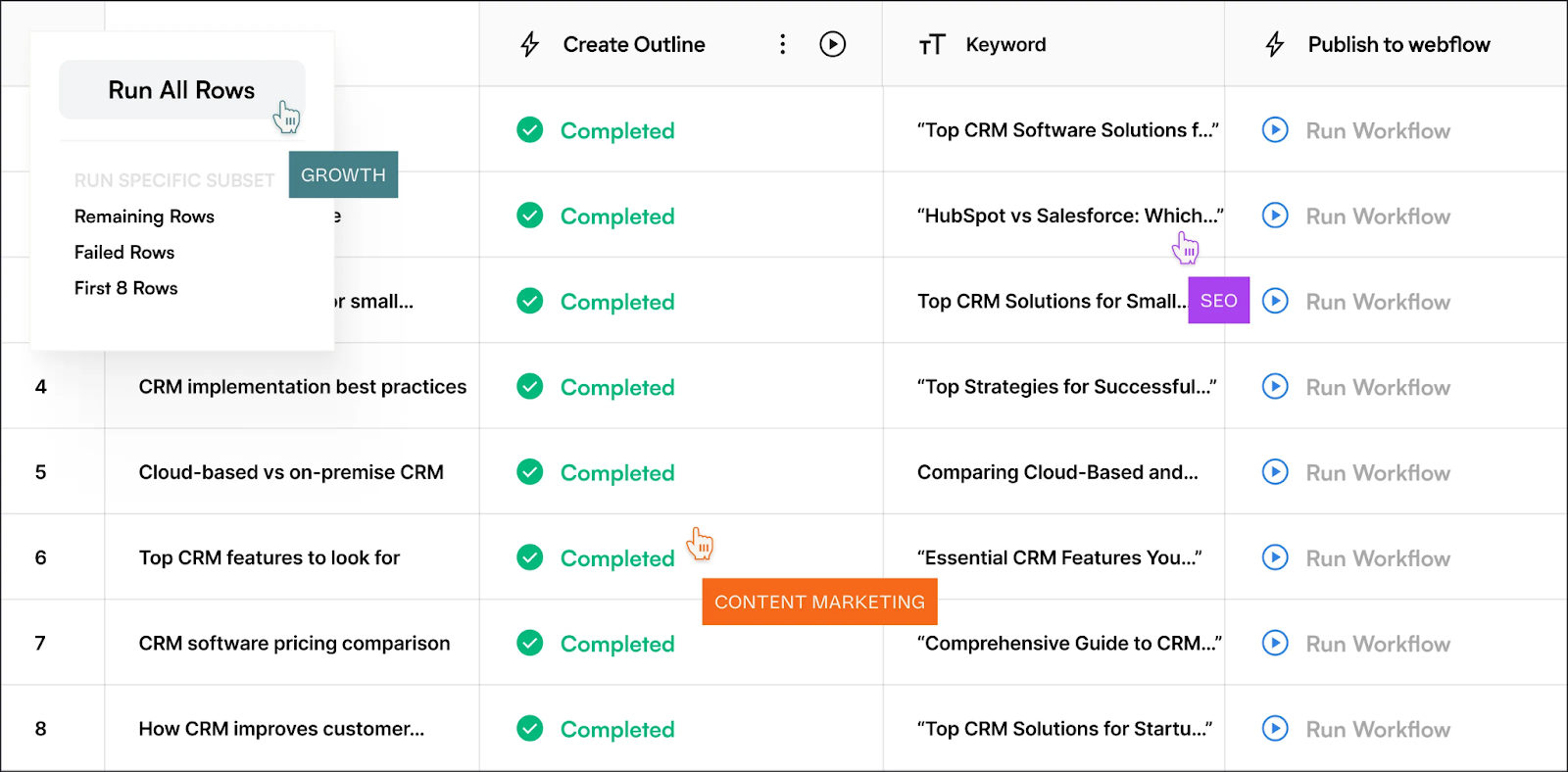
In cases where teams need to create pages at scale (location pages, comparison pages, integration pages), the absence of programmatic publishing infrastructure is a direct project killer.
And then comes the distribution gap.
For most company-side teams, content operations end at the publish button.
The article goes live, gets shared once on LinkedIn, and sits. There is no
- Amplification plan
- Repurposing workflow
- Syndication strategy
All resulting in: no revenue goal tied to the content.
When content has no revenue accountability, it becomes impossible to justify investment in the operations that produced it.
What you need to do is this:
Define a distribution protocol per content type at the architecture stage.
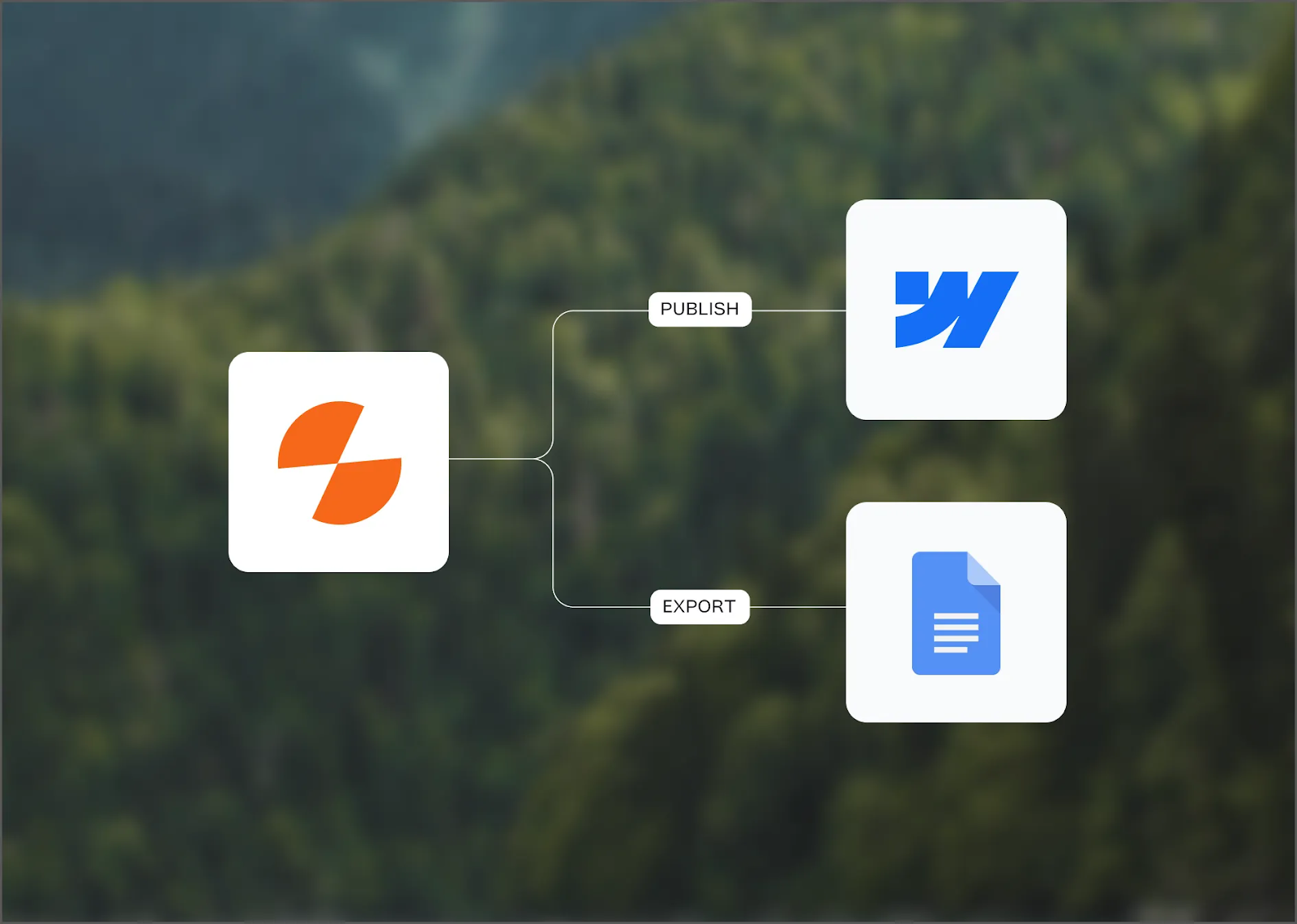
You can make this process more efficient through direct CMS integrations that eliminate the copy-paste-reformat cycle entirely.
Content moves from workflow to published page with metadata intact. For bulk and programmatic publishing, the system handles hundreds of pages with the same operational effort as ten.
Measure Performance Across Both Discovery Systems
Most teams track Google rankings, organic traffic, and maybe some conversion metrics.
But there's no data on whether AI answer engines cite the brand when prospects search in-category, or the share-of-voice measurement across AI platforms.
With ChatGPT leads converting at 4x the rate of Google, this is like leaving stacks and stacks of money on the table. And this can be solved with a simple tracking tool that shows you where you appear in AI.
Teams are making optimization decisions based on half the picture. And increasingly, it's the less important half.
As marketers, we need to rethink the metrics we are tracking.
Some crucial ones are listed below:
However, measurement alone doesn’t lead to outcomes.
When data lives in analytics tools, and the action happens in separate creation tools with a project management tool awkwardly trying to bridge them, it's of no use.
When performance signals indicate decay or opportunity, the system should trigger a workflow.
Systematize Content Refresh and Decay Management
Content decay hits teams like a shock when they suddenly face ranking or citation drops.
But if you look closer at it, content decays often follow a predictable pattern.
A page performs well for 6-12 months, then starts a slow decline. Rankings slip incrementally: position 3 to 5 to 8. By the time someone notices in a quarterly audit, the page has lost visibility big time, and the competitive landscape has already shifted.
The reason this happens: there's no system continuously monitoring freshness signals and flagging declining pages before rankings tank.
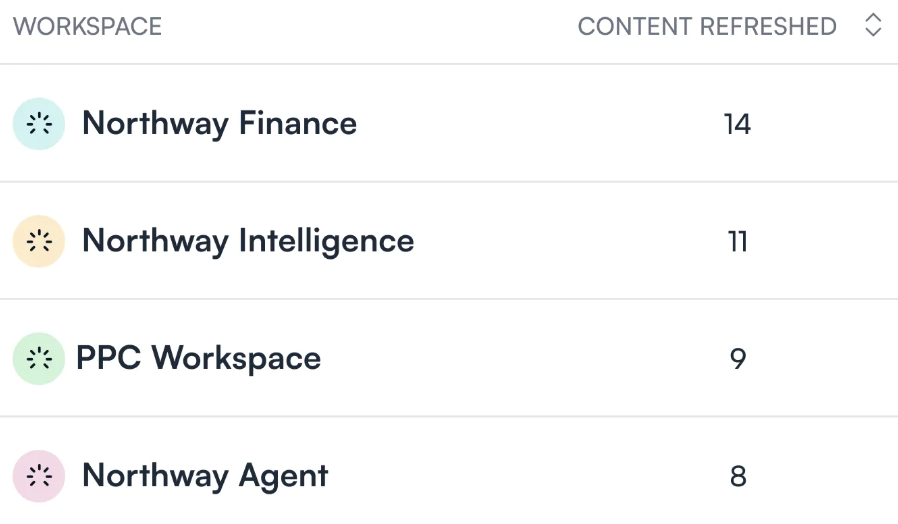
Today, refresh is unscalable without automated systems:
That's essentially another full-time role just to keep your content updated.
Most teams can't staff for this, so they refresh only the most visible pages and let the rest decay.
The best solutions for this are:
- Automated decay detection that flags pages proactively
- Impact-based refresh prioritization (scoring on freshness, topical authority, AI-readiness, and business value)
- Bulk refresh operations that process hundreds of URLs with the same effort as ten
This way, you don’t treat refresh not as a periodic audit but as a continuous system.
Common Content Operations Mistakes to Avoid
Treating Content Ops as "Just Project Management"
This is a big conceptual mistake.
Content ops is not about making sure the blog post ships on Tuesday (that's one of the outcomes).
It's about engineering a system where every piece of content benefits from the intelligence accumulated across the library.
Teams that frame content ops as project management invest in…better calendars and task management. Teams that frame it as growth engineering invest in architecture, connected workflows, and measurement infrastructure.
No Feedback Loop from Performance to Planning
Many teams have a production pipeline that's entirely one-directional: plan → create → publish.
Performance data, when it's collected at all, sits in a quarterly report. It never feeds back into what gets planned next, which topics get expanded, or which formats get prioritized.
Over-reliance on AI Without Context
AI-assisted content creation is standard now. But there's a critical difference between "use AI to write a draft" and "feed AI your brand voice, competitor analysis, SERP gaps, and AEO requirements, then generate a draft."
The first produces generic output. The second produces production-ready content.
Fragmented Tools with No Connective Tissue
Each individual tool in your stack does its job well.
But when your SEO tool doesn't know what your AI tracker sees, when your creation environment doesn't carry intelligence from research, and when your publishing system doesn't feed performance data back to planning, you're compounding operational debt with every piece of content you produce.
Why Content Engineering Platforms Are the Solution
SEO tools are instruments. A CMS is a stage. Neither orchestrates the full content lifecycle.
A new category of platform has emerged to close this gap: content engineering platforms that unify visibility tracking, content production workflows (with built-in approval, quality checks, and brand governance), and automated refresh cycles.
What a content engineering platform provides:
- Unified research combining SEO data and AI visibility data in one view.
- Workflow orchestration that carries research context, competitive gaps, and optimization requirements into every draft automatically.
- Brand governance encoded into the system
- Performance tracking spanning Google and AI platforms
- Continuous refresh infrastructure
The real value of a connected platform isn't any single capability; it's that every cycle gets faster because the system retains context.
Every refresh builds on what the last one learned, and every new piece of content benefits from intelligence accumulated across the library.
Conclusion
Content operations in 2026 are not about producing more content, but engineering a system where content compounds.
The best practices in this guide share a common thread: they replace ad-hoc decisions with systematic processes, siloed tools with connected intelligence and reactive fixes with proactive infrastructure.
Whether you're an in-house team trying to centralize governance without centralizing people, or an agency shifting from selling deliverables to selling content systems, the operating model has common best practices:
- Architecture first
- Differentiated workflows
- Centralized intelligence
- Dual-system optimization
- Connected measurement
- Systematic refresh
Slate is built to help teams do exactly this; only, it doesn’t just suggest - it executes.
With Slate, your whole content engine is one synchronous system that keeps improving. Built by people who have been in your shoes, it’s tailored to solve the very specific issues plaguing content operations of today
Try Slate out now - go from disjointed content operations to complete alignment.
Meet Slate: The AI Co-Pilot for Content Teams
Frequently Asked Questions
What are content operations best practices?
Content operations best practices are the proven processes, workflows, and systems that enable teams to produce, optimize, publish, measure, and refresh content consistently and at scale, covering people, process, technology, and governance across the full content lifecycle.
How are content operations different from content marketing?
Content marketing defines what to create and why. Content operations defines how it gets produced, approved, published, distributed, measured, and maintained. Marketing is strategy; operations is the system that executes strategy repeatably.
Do small teams need content operations?
Small teams benefit most because they have the least capacity for manual handoffs. A systemized operation automates the overhead that would otherwise consume a disproportionate share of a small team's time — meaning more hours go to strategy and creation rather than coordination.
What tools are used for content operations?
Modern teams use content engineering platforms like Slate. The trend is toward unified platforms that connect visibility tracking, content production, and performance measurement into a single system rather than a patchwork of disconnected tools.
How does AI impact content operations?
AI impacts content ops in two ways: as a creation accelerator (when governed with brand rules and optimization requirements as inputs) and as a discovery system that teams must optimize for. Content now needs to perform in both traditional SERPs and AI answer engines, which demands dual-system visibility and optimization built into workflows.
What is the best content operations platform?
The best content operations platform connects the full lifecycle from research and creation through optimization, publishing, measurement, and refresh, while providing visibility across both Google and AI search platforms. Look for platforms that unify these functions rather than excelling at just one stage, like Slate.