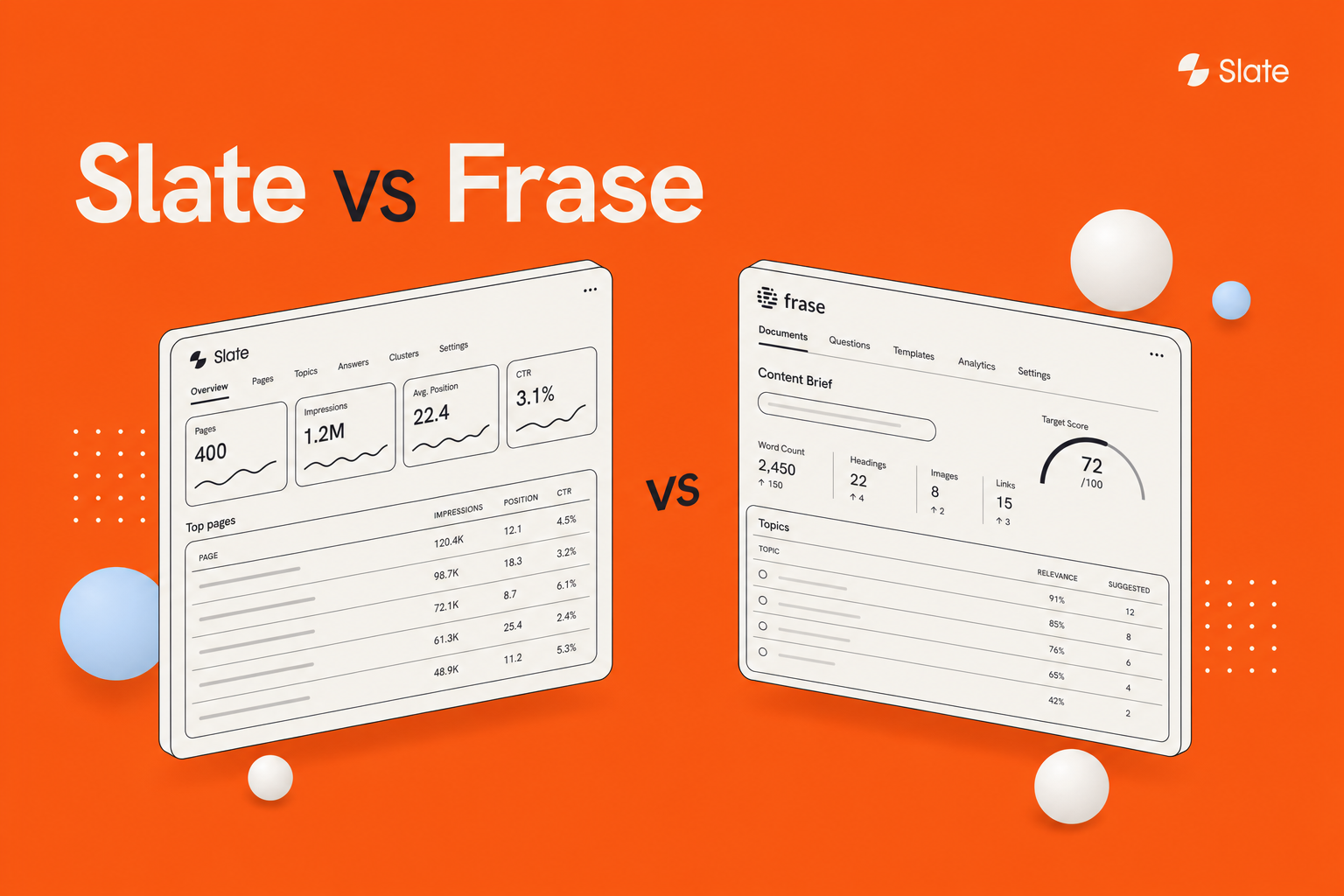
Choosing between Slate and Frase comes down to a single question: do you need a tool that optimizes individual articles, or a system that runs your entire content operation? This comparison breaks down both platforms across AI search visibility, content briefs, workflow automation, refresh at scale, governance, publishing, and pricing - so you can match the right operating model to how your team actually works.
Slate is an AI search optimization and content engineering platform built for teams that need visibility tracking, governed workflows, and execution at scale, while Frase is an agentic SEO and GEO platform strong in fast SERP research, content briefs, and in-editor optimization. Slate fits teams scaling content operations; Frase fits solo creators and small teams focused on article-level production. For broader context, see how the leading AI SEO tools stack up across the category.
Key Takeaways
The short version: Slate and Frase serve different layers of the content stack. Frase is excellent at the research-and-brief layer; Slate operates at the systems-and-execution layer.
- Slate is an AI search optimization and content engineering platform built for teams that need visibility tracking, governed workflows, and scalable execution.
- Frase is an agentic SEO and GEO platform, strong for fast SERP analysis, content briefs, and in-editor optimization.
- Choose Slate if you need AI search visibility tied to action, bulk content refresh, and CMS publishing at scale.
- Choose Frase if you primarily need content briefs, SERP research, and lower-cost single-article optimization.
- Pricing: Slate starts at $199/mo; Frase starts at $49/mo with a 7-day free trial.
- Best fit by team type: Slate for B2B SaaS scale-ups, SEO teams, and agencies; Frase for solo creators and small teams.
Slate vs Frase at a Glance
Both tools touch SEO and AI search, but they solve different problems. Frase concentrates on getting a strong article researched, briefed, and optimized. Slate concentrates on running that work repeatably across a portfolio, with visibility tracking and governance built in.
See a full breakdown of Slate vs Frase features or book a demo to see your AI search standing.
Quick Verdict: Who Should Choose Slate vs Frase?
If you can only read one section, read this one. The decision usually hinges on scale and operating model, not feature counts.
Choose Slate if:
- You need AI search visibility tracking tied directly to execution
- You run content refresh across dozens or hundreds of pages
- You need governed workflows, brand control, and CMS publishing
- You are a B2B SaaS team, scale-up, or agency operating at scale
Choose Frase if:
- You mainly need fast SERP research and content briefs
- You optimize one article at a time inside an editor
- You are a solo creator or small team focused on entry price
What's the Core Difference Between Slate and Frase?
Slate is built for teams that need AI search visibility, governed content workflows, and scalable execution across search and answer engines. Frase is an agentic SEO and GEO platform focused on research, briefs, and in-editor optimization. The better fit depends on whether you need a focused content tool or a broader organic growth system. If you're weighing several options, our roundup of the best generative engine optimization tools offers a useful frame.
The cleanest way to frame the difference is content optimization versus content engineering. Frase has historically been known as the research-and-brief specialist - it analyzes the SERP, builds an outline, and scores your draft against top-ranking pages. That is genuinely valuable work, and Frase does it fast.
Slate approaches the problem one layer up. The question is not just how to optimize a single page, but how to design, execute, and govern a repeatable system for AI-search-ready content across a portfolio.
That distinction matters more in 2026 than it did a few years ago. Discovery no longer happens only through ten blue links. When someone asks ChatGPT or Perplexity a question and gets a direct answer, the brands that get cited are the ones producing clear, structured, extractable content consistently - not the ones optimizing one post at a time. Citation presence is the output of a system, not a single optimization pass.
So the real choice is about operating model. If your job ends at the brief and the score, Frase covers it well. If your job includes what happens after the brief - execution, approval, publishing, measurement, and refresh - that is where a content engineering platform earns its place.
Feature-by-Feature Comparison
Here is how the two platforms compare across the criteria most SEO and content teams weigh before signing a contract. For each row, the question is not only what the feature does, but who needs it and where each tool fits best.
The pattern is consistent: Frase is strong wherever the unit of work is a single article, and Slate is strong wherever the unit of work is the system that produces and maintains many articles.
Which Tool Is Better for AI Search Visibility?
For teams prioritizing AI search visibility tied to execution, Slate has the clearer positioning because it tracks AI presence, surfaces where competitors are cited instead, and turns those insights into content workflows. Frase also tracks AI visibility, but Slate is built around acting on it at scale across search and answer engines. Teams comparing options often start with a survey of dedicated AI search visibility tools.
Both platforms recognize the same shift. Frase explicitly tracks visibility across Google and AI engines like ChatGPT and Perplexity, and surfaces that data inside its editor for SEO and GEO scoring. That is a meaningful capability for teams optimizing individual pieces.
Slate's AI Search Analytics covers ChatGPT, Google AI Mode, Google AI Overviews, and Perplexity, and the difference is what happens next. Seeing that a competitor is cited where you are not is only useful if you can act on it. Slate connects that gap directly to workflows that research, write, and refresh the content needed to close it.
That is the practical question for 2026: not just "are we visible in AI answers," but "what do we do the moment we discover we are not." For teams that want insight wired straight into action, Slate for SEO teams is the stronger fit.
Which Is Better for Content Briefs and Optimization?
Frase is well known for fast SERP research, content briefs, and in-editor optimization, with real-time SEO and GEO scoring and competitive benchmarks. That makes it strong for article-level production. Slate treats briefs as part of a larger execution system. Choose based on whether you need single-article optimization or end-to-end content operations.
This is Frase's home turf, and it earns the recognition. Its one-click outlines from top-ranking results, gap highlighting, and in-editor scoring genuinely speed up production for writers and editors. If your core job is "research this topic, brief it, and optimize the draft," Frase handles that loop cleanly and at a low entry price.
The honest question is what happens after the score. A high content score is a leading indicator, not the finished job. The draft still needs approval, brand alignment, publishing, measurement, and eventually a refresh.
Slate's Workflows and SuperBlocks treat the brief as one step in a longer chain - research, generation, review, publishing - rather than the destination. For a deeper look at how briefing fits into a full pipeline, see Frase for content briefs vs Slate workflows.
Which Is Better for Content Refresh and Workflow Automation?
Optimizing one page is a solved problem. The hard part is keeping a portfolio of dozens or hundreds of pages current without it consuming your whole team. This is where the two platforms diverge most sharply.
Frase is built around document-level work. An AI agent researches, writes, and optimizes a single piece efficiently. For refreshing one article at a time, that works well.
Slate's Power Sheets are built for the opposite scenario: bulk content refreshes, programmatic creation, and optimization audits across thousands of URLs from a spreadsheet interface. Instead of opening each page individually, teams can identify refresh candidates, prioritize them, and run updates as a repeatable operation. Evaluating dedicated content refresh tools can help you scope what bulk updates require.
The reason this matters is practical. High-performing pages are often refreshed regularly, and recovering stale content manually does not scale. A refresh system turns that from a recurring fire drill into a routine workflow.
Slate's visual workflow builder adds conditional logic, web scraping, 24+ AI models, and direct CMS publishing, so refresh and creation run as governed processes rather than manual handoffs. For teams that have outgrown one-at-a-time editing, this is the Slate alternative to Frase workflows worth evaluating. It also helps to review the broader landscape of SEO automation tools before committing.
Which Is Better for Team Collaboration and Governance?
For a solo creator, governance barely registers. For a content team of five or an agency managing ten clients, it is often the deciding factor - and the area most comparisons treat too lightly.
Frase includes brand governance as part of its agent workflow, which helps keep output consistent. Slate treats governance as core infrastructure: a Brand Kit with style guides and tone rules, a knowledge base for accurate AI generation, and human review steps designed to prevent generic output at scale. For teams formalizing this, our guide to content operations best practices covers the foundations.
Here's how the decision tends to break down by role:
- CMO: Wants measurable ROI and brand safety across everything published. Slate's governance and AI Search Analytics map to that need.
- Head of SEO: Needs visibility tracking and refresh that scale. Slate's Power Sheets and analytics fit; Frase covers single-page optimization.
- Content lead: Cares about consistent voice and clean review gates. Slate's Brand Kit and review steps support multi-author teams.
- Growth lead: Wants speed without chaos. Slate's workflows automate handoffs; Frase is fast for individual drafts.
- Agency operator: Manages multiple clients and reporting. Slate's governance and dashboards suit multi-client scale.
The throughline: as more people touch content, control stops being a nice-to-have and becomes the thing that keeps quality from eroding.
Slate vs Frase Pricing and Implementation Considerations
Pricing reflects the difference in scope. Frase is priced for individuals and small teams entering at a low monthly cost; Slate is priced as a platform for teams running content operations.
For Slate:
Pricing: Starting at $199/mo.
G2 rating: 4.9/5
For Frase:
Pricing: Starter $49/mo, Professional $129/mo, Scale $299/mo, Enterprise custom. No free tier; 7-day free trial. Annual billing saves 20%.
G2 rating: 4.8/5
The headline price isn't the whole story. Frase delivers value fastest for a solo writer or small team that needs briefs and optimization today, with little process to set up. Slate delivers value fastest for teams with an existing content motion - already publishing regularly, already tracking SEO - that need to scale refresh and AI visibility without adding headcount.
Implementation tracks process maturity. The more people, pages, and approvals involved, the more the governance and workflow capabilities justify the platform investment. Compare full details on Slate pricing vs Frase pricing, or book a demo to scope the fit.
Can Slate Replace Frase? (Migration and Stack Fit)
For many teams, Slate can replace a narrower content-optimization workflow by combining visibility insights, content execution, and workflow control in one platform. The right choice depends on whether your team needs article optimization alone or a broader system for scalable organic growth.
The practical migration question is what changes day to day. If your team currently uses Frase to research topics, build briefs, and score drafts, Slate absorbs those steps into a workflow that also handles refresh, governance, publishing, and AI visibility tracking. Existing briefs and content don't disappear - they become inputs to a more structured process.
You can keep your current CMS. Slate publishes directly to Webflow and WordPress, so the editorial stack you already rely on stays in place. The main change management work is shifting from one-off optimization to repeatable workflows, which is more a mindset adjustment than a technical migration.
Can you use both together? Yes - because they operate at different layers, some teams run Frase for fast individual drafting while Slate orchestrates workflows, governance, and visibility across the portfolio. As a team matures toward systematic operations, the overlap usually pushes toward consolidating on a single platform.
Who Should Choose Slate?
Slate is built for teams that have outgrown single-article workflows and need insight, execution, and governance in one system.
- Best for: B2B SaaS marketing teams adapting to AI-driven discovery
- Best for: SEO and content teams outgrowing one-at-a-time optimization
- Best for: Agencies managing multiple client sites at scale
- Best for: Teams needing visibility tracking, execution, and governance together
- Best for: Content refresh and AI search readiness across a large portfolio
The clearest signal you're ready for Slate: organic growth has flattened, competitors are showing up in AI citations, and manual content audits no longer keep pace. If that sounds familiar, see the best AI SEO content tool breakdown for context.
Who Should Choose Frase?
Frase is a genuinely good fit for a clear set of teams, and it would be dishonest to pretend otherwise.
- Best for: Solo creators and niche site builders
- Best for: Fast SERP research and content briefs
- Best for: Entry-level pricing and single-article optimization
- Best for: Lean teams that want to move quickly without heavy process
If your work centers on producing strong individual articles, you don't manage a large portfolio, and budget is a primary constraint, Frase is the right call. The moment your needs expand into refresh operations, governance, and AI visibility tied to execution, that's the signal to look at a broader platform. For a wider view of the category, see Surfer vs Frase vs Slate. You may also find our list of AI content marketing tools helpful when comparing approaches.
Frequently Asked Questions
What's the difference between Slate and Frase?
Slate is an AI search optimization and content engineering platform for teams needing visibility tracking, governed workflows, and scalable execution. Frase is an agentic SEO and GEO platform focused on SERP research, content briefs, and in-editor optimization. Slate suits content operations; Frase suits article-level production.
Is Slate or Frase better for B2B SaaS teams?
Slate is the stronger choice for B2B SaaS teams that need operational control, repeatable workflows, and visibility across both traditional search and AI-driven discovery. Frase may suit teams focused more narrowly on content optimization and article-level production support without portfolio-scale operations.
Which tool is better for AI search visibility?
For teams prioritizing AI search visibility, Slate has the clearer positioning because it tracks AI presence across ChatGPT, Google AI Mode, AI Overviews, and Perplexity, then turns those insights into execution - more aligned to 2026 search realities than optimization-only workflows.
Can Slate replace Frase?
For many teams, Slate can replace a narrower content-optimization workflow by combining visibility insights, content execution, and workflow control in one platform. The right choice depends on whether your team needs article optimization alone or a broader system for scalable organic growth.
Who should choose Frase instead of Slate?
Frase appeals to teams that mainly want a lighter-weight content optimization or briefing workflow at a lower entry price. Solo creators, niche site builders, and small teams focused on fast article production often find Frase the more practical fit for their needs.
Can you use Slate and Frase together?
Yes. Because they operate at different layers, some teams use Frase for fast individual drafting while Slate orchestrates workflows, governance, publishing, and AI visibility across the portfolio. As teams mature toward systematic operations, many consolidate onto a single platform to reduce overlap.
Which tool is better for agencies?
Slate is generally better for agencies. Multi-client work demands governance, repeatable workflows, bulk refresh, and clear reporting - areas where Slate's Brand Kit, Power Sheets, and AI Search Analytics fit naturally. Frase can support individual client articles but is less suited to managing scale.
How much do Slate and Frase cost?
Slate starts at $199/mo with team-oriented platform pricing. Frase starts at $49/mo, with Professional at $129/mo, Scale at $299/mo, and Enterprise custom pricing; it offers a 7-day free trial and 20% savings on annual billing. Neither has a free tier.