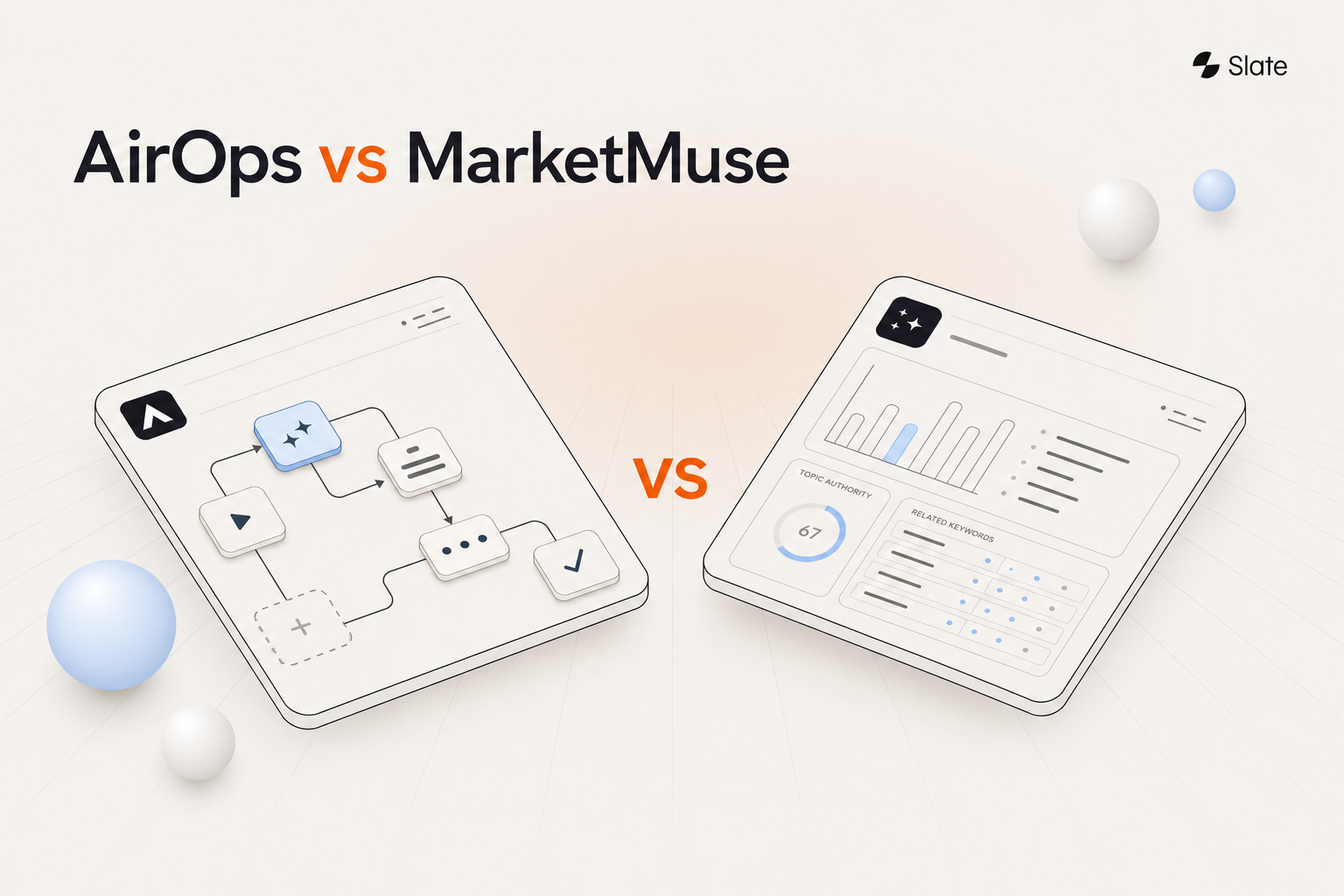
When you weigh up MarketMuse, the question that decides whether it pays off is which role on your team will use it every week. This review looks at MarketMuse as a content intelligence and optimization platform, then digs into workflow fit, pricing economics, and whether it keeps up with AI search visibility in 2026.
MarketMuse earns its price in 2026 for mid-sized content teams, agencies, and scaled editorial organizations running ongoing publishing and refresh programs. You get deep topic modeling, site-wide content inventory, and writer-ready briefs. Solo operators, low-volume publishers, and budget-strapped teams who just need simple on-page guidance will probably find it overkill.
Key takeaways
- Overall verdict: MarketMuse is a strategic content planning and optimization platform, heavy on research and light on autonomous writing.
- Best fit: Mid-sized content teams, agencies, and scaled editorial organizations with continuous publishing and refresh programs.
- Who should skip it: Solo operators, low-volume publishers, and budget-constrained teams that mainly need simpler on-page guidance.
- Pricing reality: A free plan offers 10 queries per month; paid tiers (Optimize, Research, Strategy) add users, tracked topics, briefs, and higher query limits. Public prices are not listed on the site.
- Standout strength: Topic modeling, content inventory, and brief generation are the core value areas.
- Biggest limitation: Learning curve and cost-to-value risk both increase when small teams adopt it without enough workflow volume.
- 2026 lens: MarketMuse is built for classic SEO content optimization and does not natively track AI search visibility or citation readiness.
- Top alternative: Slate is a strong fit for teams prioritizing AI search visibility plus end-to-end execution workflows.
TL;DR - our MarketMuse verdict for 2026
MarketMuse is worth it in 2026 if you run an ongoing content program and need help deciding what to create and refresh, with on-page scoring as one piece of that. Its topic modeling, briefs, and site-wide inventory genuinely shorten planning time for mid-to-large teams. For solo operators or low-volume publishers, the cost and learning curve usually outweigh the value.
Best for: Mid-sized to large content teams and agencies managing multiple client programs.
Skip if: You're a solo operator with low publishing volume or a tight budget.
Worth it if: You publish consistently and need a planning intelligence layer that prioritizes what to create and refresh, beyond grading a single draft.
The most useful way to read this review is by role. MarketMuse rarely pays for itself through a single feature; it pays off when a strategist, a writer, and an editor each touch it inside a repeatable weekly workflow.
What is MarketMuse and what is it built to do?
MarketMuse is an AI-powered content intelligence and optimization platform that helps teams decide what content to create and improve to rank higher in search. It analyzes your entire site and the SERP to surface content gaps, model topics, generate writer-ready briefs, and score drafts against top-ranking competitors.
MarketMuse sits in the content strategy and optimization category. It works as a planning intelligence layer for teams, going well beyond a quick on-page checker. Its differentiator is "Personalized Difficulty," which estimates ranking opportunity based on your domain's authority instead of a generic difficulty score.
Worth knowing what you're getting. MarketMuse goes deeper than keyword-density grading, and it keeps a human in the loop instead of writing fully on its own. Its in-editor AI writing (inside the Optimize app) exists, but the center of gravity is research, topic modeling, and inventory-level strategy.
That framing sets up the harder 2026 question this review returns to later: MarketMuse was engineered for classic SEO content optimization. As discovery moves toward AI answers, that origin shapes both where it excels and where it leaves gaps.
How we evaluated MarketMuse
We judged MarketMuse on how it holds up inside working content operations, not a feature spec sheet. The goal is to find where value appears in a publishing program: strategist research, writer execution, editor QA, and refresh velocity.
The evaluation covers nine criteria that map to how teams use the platform week to week.
This review is most relevant for in-house SEO leads, content leads, growth marketers, agencies, and scaled editorial teams in mid-to-late commercial evaluation.
MarketMuse features: where it adds the most value
MarketMuse's value concentrates in research and planning. The features that consistently earn their keep are topic modeling, content briefs, and site-wide inventory. AI writing and optimization scoring support the workflow but are not the reason most teams buy.
Content research and topic modeling
Topic modeling is the heart of MarketMuse. It analyzes your domain and SERP competitors to map a topic, surface related subtopics and questions, and identify gaps that are hard to spot in manual analysis. The strategist uses it to plan clusters and build topical authority over time. For teams comparing options here, our roundup of the best AI tools for topic clusters is worth a read.
Personalized Difficulty is the differentiator here. Instead of generic keyword difficulty, it estimates ranking opportunity for your specific domain, which makes prioritization decisions sharper. For teams replacing hours of spreadsheet research, this is where the most obvious time savings appear.
Content briefs and writer guidance
Briefs turn research into writer-ready direction. A MarketMuse brief typically includes a recommended outline of headings, key subtopics and entities to cover, questions to answer, and depth or word-count guidance benchmarked against top-ranking pages. Some briefs may also surface internal and external linking prompts.
This is where the platform earns repeat praise. A strong brief removes ambiguity for writers and editors, which is exactly the gap most spreadsheet-heavy teams struggle to close. The strategist or editor owns brief creation; the writer executes against it. If brief quality is your main need, compare dedicated content brief generators too.
Content inventory and audits
The inventory and audit functionality is a genuine upgrade over manual spreadsheets. MarketMuse crawls and categorizes your site, maps clusters, and shows what to create versus what to update, with prioritization signals like value-per-month and Personalized Difficulty layered in.
Where a spreadsheet gives you a URL list and exported metrics, MarketMuse gives you cluster-level gaps and refresh-versus-net-new recommendations. For SEO leads managing large libraries, this is the difference between guessing at priorities and seeing them. Tools built specifically for content gap analysis can complement this work.
Content optimization and scoring
The Optimize application scores drafts on topic-coverage completeness, comparing your content against top-ranking pages and suggesting related terms and missing sections. It looks at semantic coverage and topic depth instead of counting keyword frequency.
The benefit is coverage clarity while you draft. Writers get a clear, SERP-based picture of what comprehensive coverage looks like, which keeps writing grounded in reader intent instead of term stuffing.
AI writing and First Draft
MarketMuse does include AI writing. First Draft generates a structured initial article based on its topic research and brief inputs, which speeds rough drafting. It's metered by usage, and the drafts require human editing and SEO judgment before they are publishable.
So the honest answer to "does MarketMuse include AI writing or just optimization?" is both. It scores and it drafts, but drafting is a supporting feature. Strategy, nuance, and brand voice still depend on a human editor refining what the model produces.
How MarketMuse fits into a content team's workflow
Most reviews list MarketMuse's features. Fewer explain where it saves time inside a publishing program. The platform earns its cost when multiple roles touch it in a repeatable cycle. A single user logging in now and then won't get there.
The strategist workflow
The strategist lives in research and inventory. They use topic modeling and Personalized Difficulty to choose clusters, then build a roadmap of pages to create and pages to refresh, ranked by value and authority. This is where MarketMuse replaces the most manual spreadsheet work and where its strategic depth shows up first.
The writer workflow
The writer works from the brief into the Optimize editor. They may start from a First Draft, then write and refine against the content score, using the term and section suggestions as a coverage checklist. The brief removes guesswork at the start; optimization keeps the draft aligned with SERP expectations as it develops.
The editor and refresh workflow
For many teams, refresh velocity counts for more than net-new production. The editor uses inventory, content scores, and performance signals to decide what to update, consolidate, or expand, then uses Optimize as a QA lens. This is the governance layer most lightweight tools miss, and it's where MarketMuse keeps adding value over time. If refreshes drive your program, see our roundup of content refresh tools.
Team rollout and collaboration
On team fit, one SEO lead can pull some value out of it, but the economics rarely justify a single seat. The platform pays off when at least two roles use it regularly, typically a strategist plus a writer or editor, and when the team produces meaningful volume or runs continuous refreshes. Below that threshold, large parts of the inventory and planning layer go underused.
MarketMuse pros and cons
The biggest pro is strategic depth: deep topic intelligence, briefs, and site-wide inventory. The biggest con is the combination of a steep learning curve and cost-to-value risk, which hits small or low-volume teams hardest. Buyers feel the strength most when they publish volume, and the drawbacks most when they don't.
What MarketMuse does well:
- Strategic depth: Topic modeling and Personalized Difficulty produce genuinely actionable cluster plans.
- Brief quality: Detailed, writer-ready briefs cut down rework and ambiguity.
- Inventory and audits: Site-wide gap analysis replaces fragile spreadsheet workflows.
- Personalized metrics: Difficulty and value calibrated to your domain, not generic SERP averages.
- Research speed: Hours of manual topic research condense into minutes.
What buyers should consider:
- Learning curve: The interface is dense, and new users often feel overwhelmed early.
- Cost-to-value for small teams: The platform is enterprise-leaning and hard to justify at low volume.
- Usage constraints: Query-based limits can force trade-offs or upgrades as needs grow.
- AI search gap: It's built for traditional SEO and does not natively track AI-answer visibility.
Across review platforms, these themes recur consistently: praise for planning depth and brief quality, and caution around learning curve and value for smaller teams.
MarketMuse pricing in 2026: what you're actually paying for
MarketMuse offers a free plan with 10 queries per month and three paid tiers: Optimize, Research, and Strategy. Higher tiers add users, tracked topics, content briefs, strategy documents, and higher query limits. Public prices for the paid tiers are not listed on the site, so the entry cost depends on your configuration.
Query economics drive the cost more than the headline price. MarketMuse uses a usage-based model where queries, briefs, and tracked topics function as the practical ceiling. As a team scales briefs, optimizations, and inventory projects, query caps become the constraint that forces an upgrade decision.
That makes cost per usable workflow the number to watch. A single strategist on a lower tier with a focused domain may stay well within limits. A multi-writer team running net-new production and continuous refreshes will consume queries far faster, which is when a higher tier starts to justify itself.
What do you actually get on the free plan?
The free plan gives one user 10 queries per month. That's enough to explore the interface, run a few sample queries, and get a feel for how briefs and topic modeling look. It's not enough to test a full publishing workflow, evaluate refresh cycles, or stress the inventory at any realistic scale.
How many outputs can a typical team create per month?
Translating queries into capacity depends on how you spend them, since research, briefs, and optimization runs draw from the same pool. A focused solo strategist can plan and brief a modest content calendar within a lower tier. A mid-sized team running both net-new and refresh work will exhaust caps faster and should map expected brief and optimization volume against plan limits before committing.
Who MarketMuse is best for (and who should skip it)
MarketMuse is best for mid-sized to enterprise content teams, agencies managing multiple clients, and scaled editorial organizations with ongoing publishing and refresh programs. It assumes SEO maturity and staff who can operationalize its insights. Solo operators and low-volume publishers usually find it powerful but underused.
A realistic first 30 days looks like this: a strategist learns research and inventory, builds an initial cluster roadmap, and starts generating briefs while writers ramp on the Optimize editor. Value builds once that loop becomes a weekly habit.
MarketMuse for in-house SEO and content teams
For in-house SEO and content teams, MarketMuse fits best when there's a dedicated strategist and a steady publishing cadence. It turns scattered keyword research and audit spreadsheets into a single prioritization layer. Teams without a strategist to interpret the inventory tend to leave its strongest features unused.
MarketMuse for agencies and consultants
For agencies managing multiple client programs, the cluster-level planning and brief generation scale neatly across accounts. The ability to produce consistent, writer-ready briefs is a genuine lever for margin and quality control. Multi-domain work is where the planning depth justifies the cost most clearly.
MarketMuse for enterprise content teams
For enterprise content teams, MarketMuse functions as a governance and workflow layer across large libraries. Site-wide inventory, topical-authority strategy, and structured audits support content engineering at scale. Enterprise buyers should confirm seat limits, integration depth, and API access against their stack during procurement.
The 2026 lens - does MarketMuse help you win AI search visibility?
Discovery in 2026 no longer happens only on Google. AI Overviews, ChatGPT, Perplexity, and Gemini increasingly decide which brands get cited and summarized, and rankings alone are no longer a complete success metric. The right question for any optimization platform now is whether its output helps content become citation-ready and extractable. For a deeper look, our guide to the best AI search visibility tools breaks down the options.
MarketMuse helps indirectly. Comprehensive, well-structured, topically authoritative content is more likely to be cited by AI systems, and MarketMuse is genuinely strong at producing that kind of depth. Clear coverage, structured briefs, and explicit topic modeling all push content toward extractability.
But the platform was built for classic SEO content optimization. As of this review, it does not natively track AI search visibility, score citation readiness, or offer AEO-specific dashboards and citation readiness. It tells you how to cover a topic for the SERP; it does not tell you whether you're showing up inside AI answers. To compare dedicated options, see our list of the best AEO tools.
This is where a content engineering lens comes in. Citation readiness and extractability are review criteria most optimization tools still ignore, because they were designed for a links-and-rankings world. Platforms like Slate are built AI-search-first, tracking visibility across AI answer engines and tying that signal directly to execution. That's a different operating model altogether.
Best MarketMuse alternatives in 2026
The best alternative depends on the job to be done. For teams that want to track and act on AI search visibility, Slate stands out. For deep content planning, MarketMuse remains strong. For simpler optimization, Clearscope, Surfer SEO, and Frase each fit specific workflows and budgets.
Slate - best for AI search visibility plus content execution workflows
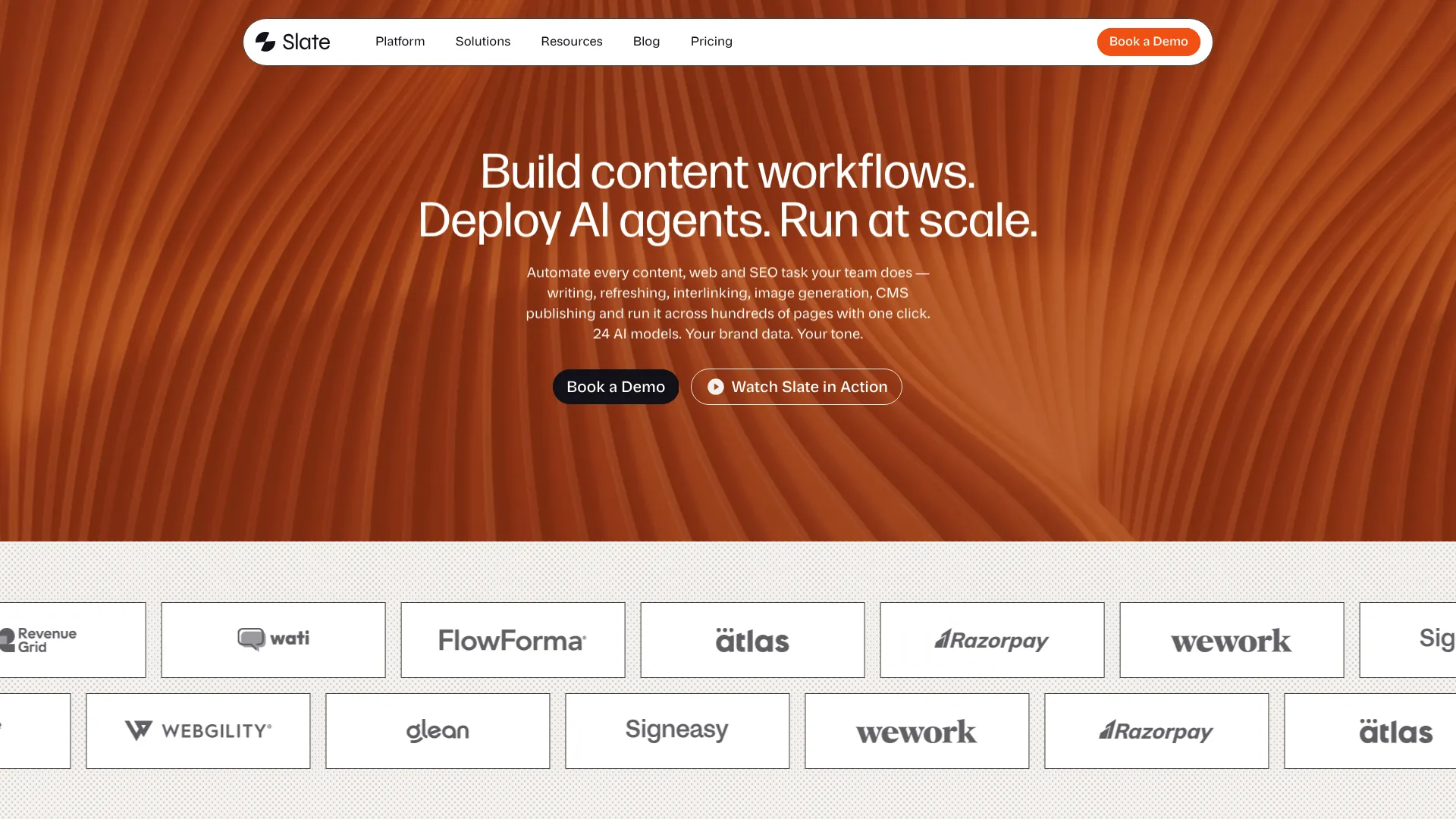
Slate is an AI search optimization and content engineering platform that connects insight to action in one system. Where MarketMuse stops at planning and optimization for the SERP, Slate is built AI-search-first, tracking how brands appear across ChatGPT, Google AI Overviews, Google AI Mode, and Perplexity, then turning that into execution.
The differentiator is end-to-end workflows. Slate combines AI search analytics with agentic workflows that research, write, refresh, interlink, and publish content at scale, all governed by brand kits and review steps so output stays citation-ready and on-brand.
- AI search visibility tracking: Monitor share of voice across major AI answer engines.
- Content engineering workflows: Run repeatable, multi-step content automation instead of one-off writing.
- Citation readiness: Tune content for clarity and extractability, beyond keyword coverage.
- Scale without chaos: Power Sheets handle bulk refreshes and audits across thousands of URLs.
This fits teams who want to track and act on AI search visibility, beyond ranking on Google.
Pricing: Starting at $199/month.
G2 rating: 4.9/5
Clearscope - best for simpler on-page optimization
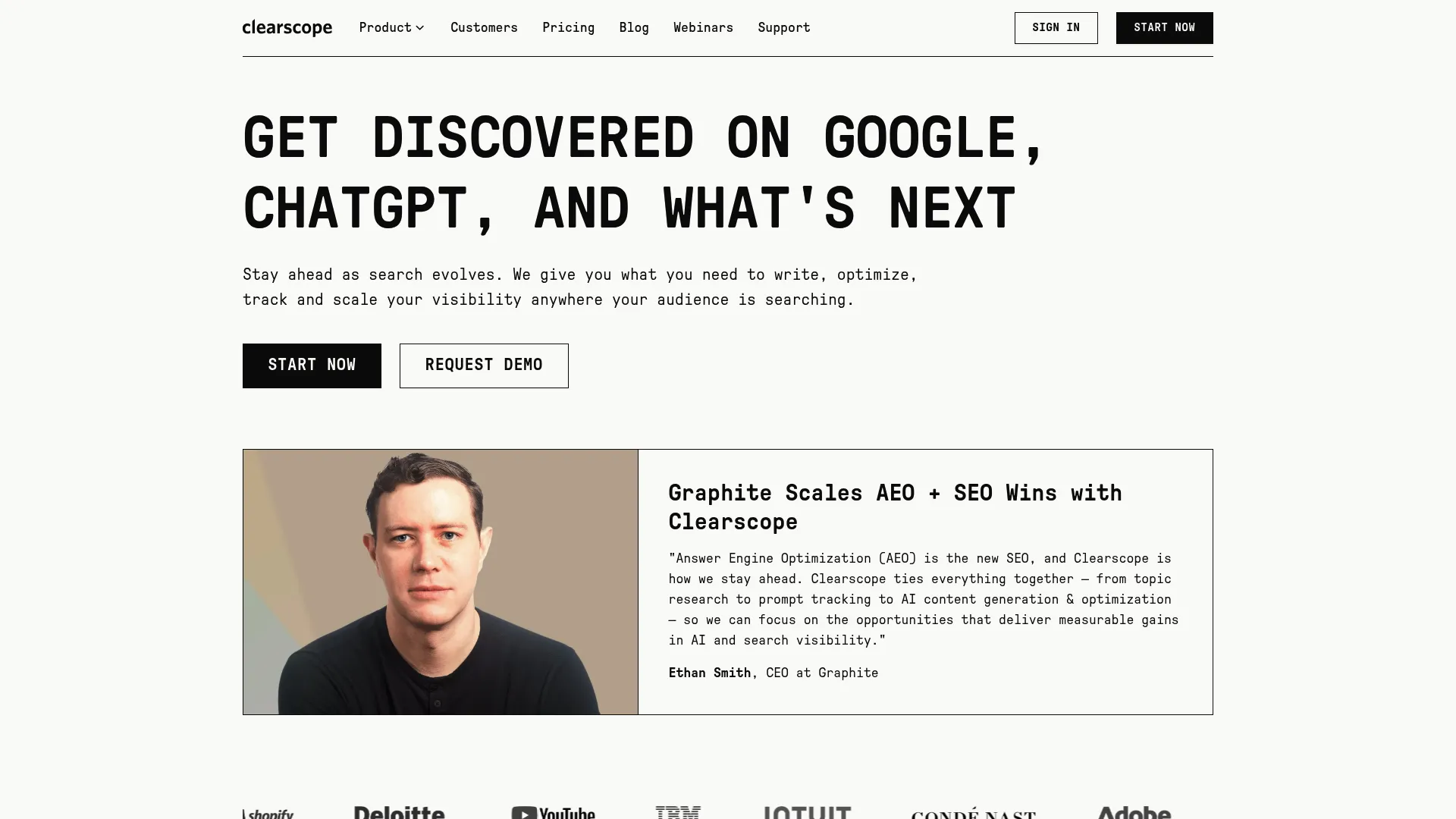
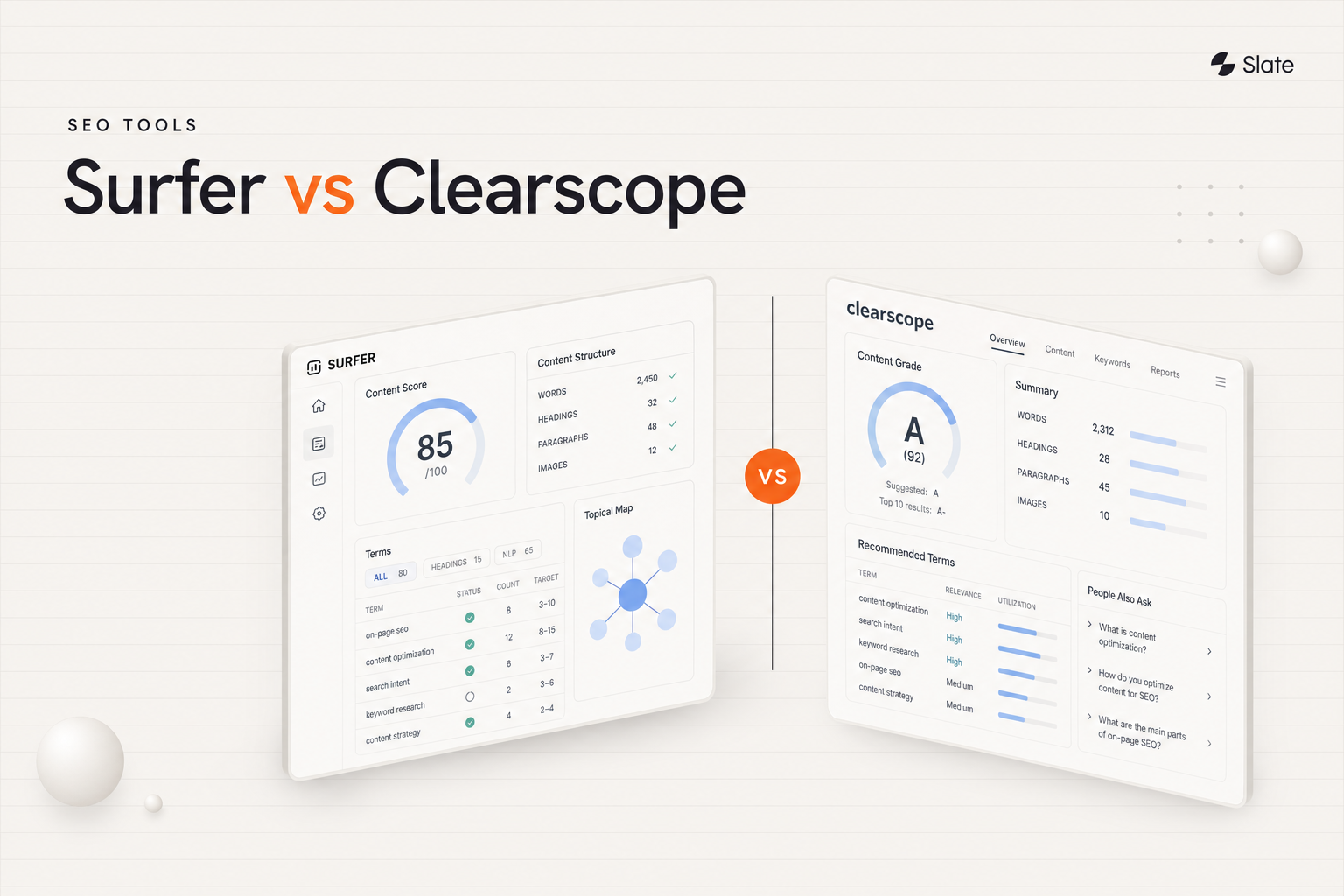
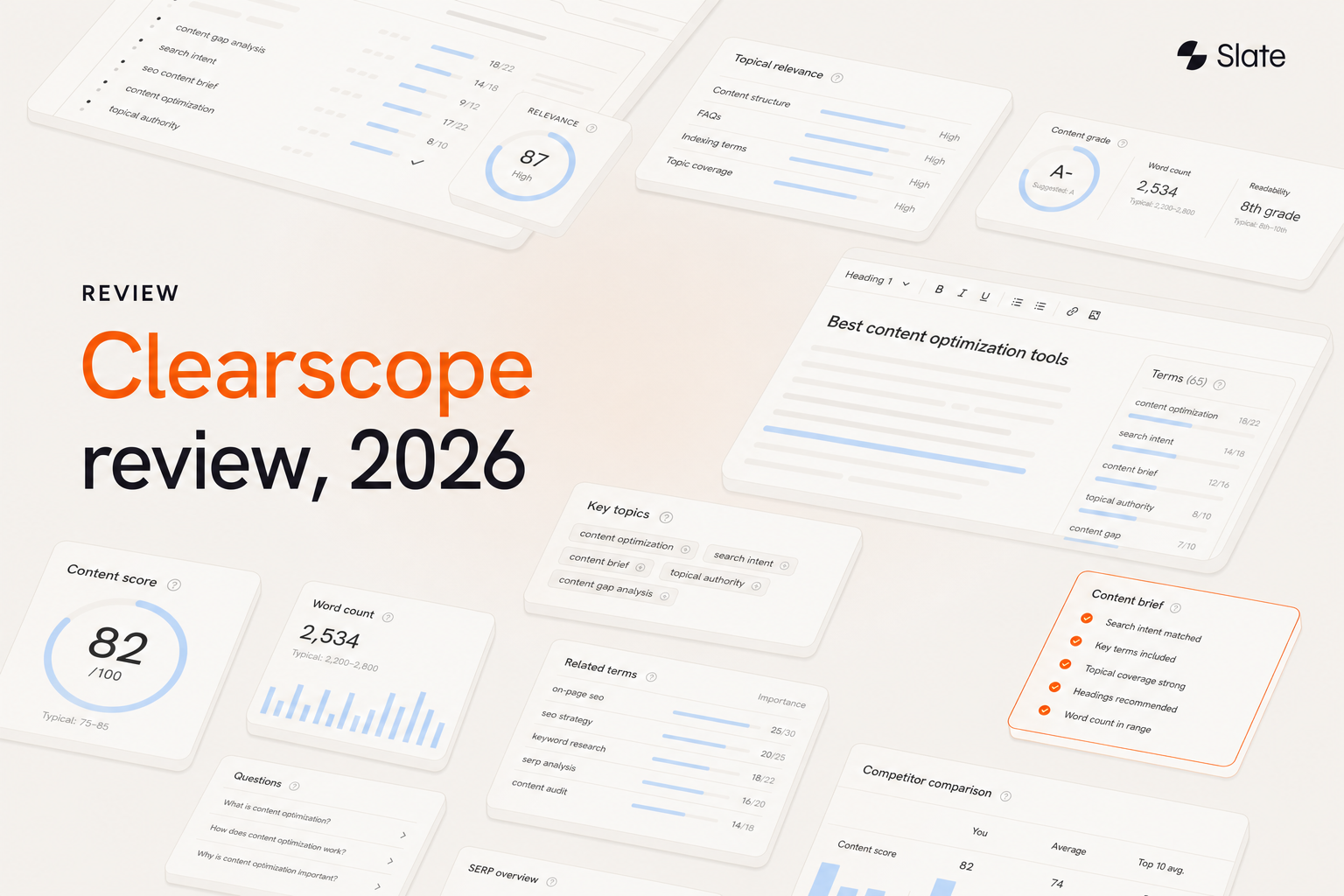
Clearscope is a content optimization platform focused on clean, fast on-page guidance, with prompt tracking that monitors visibility across Google and AI tools like ChatGPT and Gemini. Its low learning curve makes it a better fit for small-to-mid teams that want simple scoring without MarketMuse's strategic depth. See MarketMuse vs Clearscope in our full review.
Pricing: Essentials $129/month, Business $399/month, Enterprise custom. Monthly plans have no contracts, with add-ons for extra pages and drafts.
G2 rating: 4.9/5
Surfer SEO - best for speed and lightweight teams
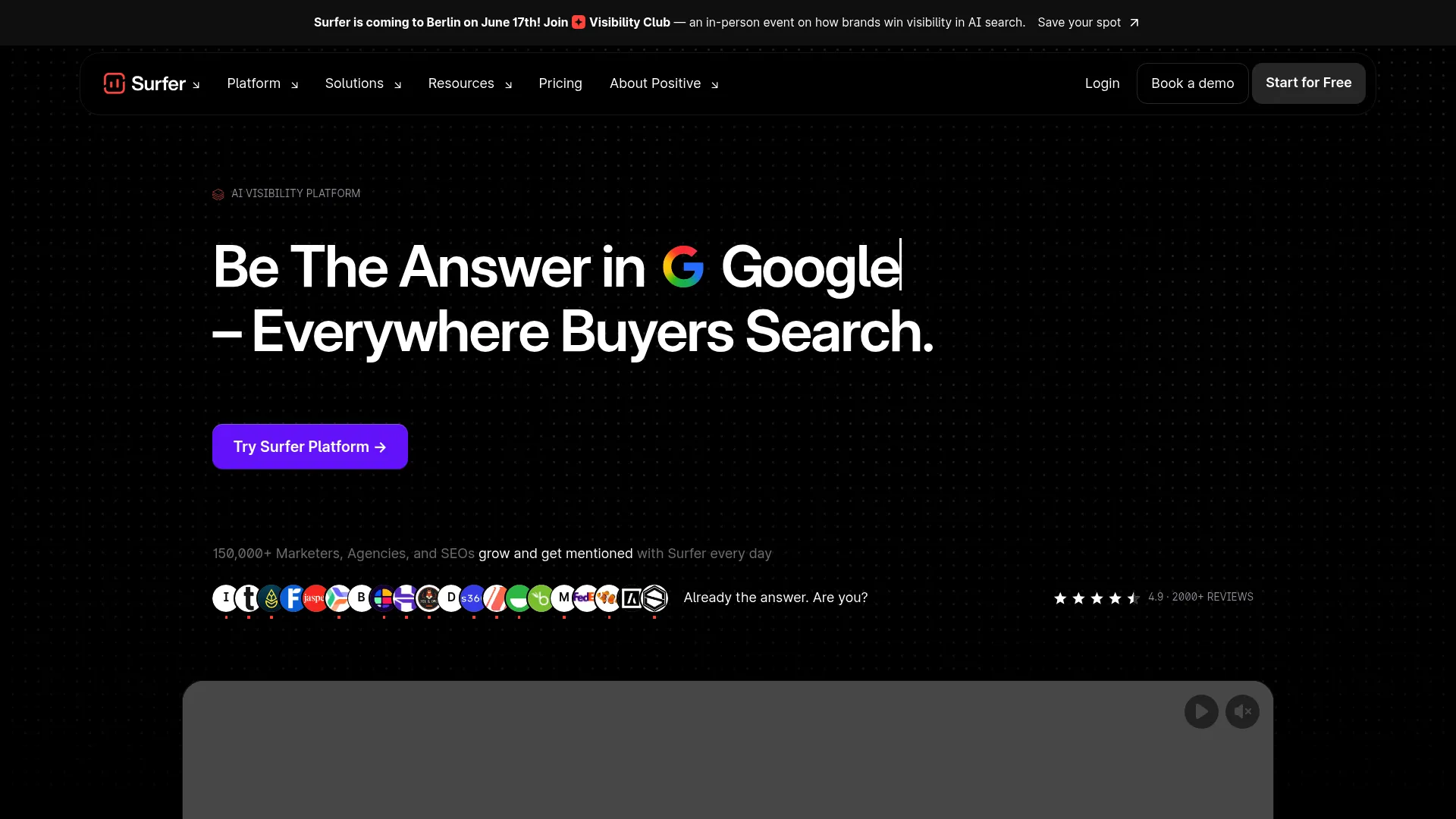
Surfer SEO is an AI search and content intelligence platform built for fast optimization using live SERP data. It creates and improves content using live SEO data and monitors AI search visibility, including how a brand appears in tools like ChatGPT. It fits smaller, execution-focused teams that prioritize speed over deep cluster planning. See more MarketMuse alternatives and review.
Pricing: Discovery $49/month, Standard $99/month, Pro $182/month, Peace of Mind $299/month, all billed yearly; Enterprise from $999/month.
G2 rating: 4.8/5
Frase - best for fast brief creation
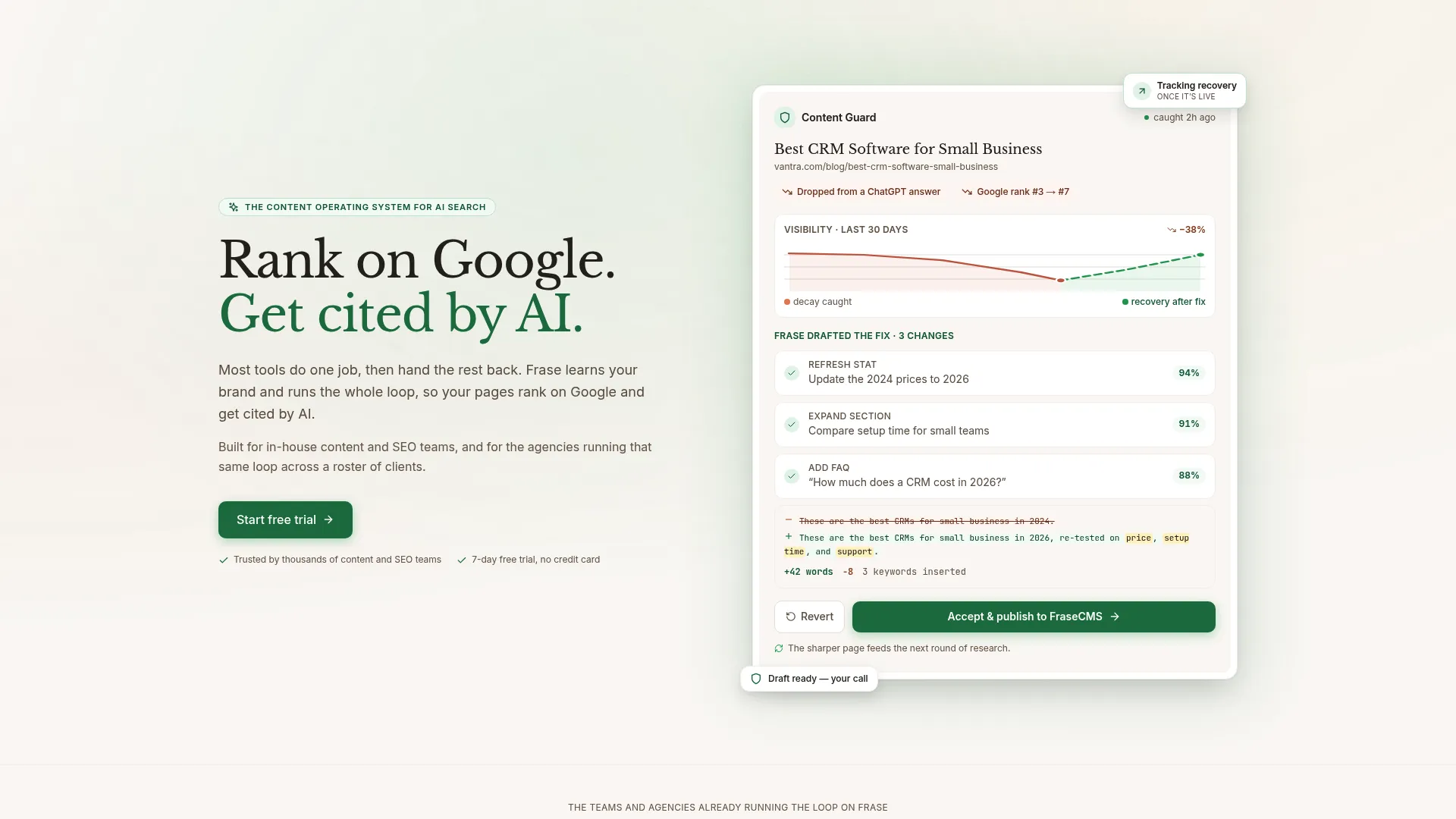
Frase is an agentic SEO and GEO platform that researches, writes, refines, publishes, and tracks content for both Google and AI search. It's best known for fast, SERP-based brief and outline creation, making it appealing to smaller teams that want a brief-first workflow. See more on MarketMuse features and use cases.
Pricing: Starter $39/month, Professional $103/month, Scale $239/month (billed yearly), Enterprise custom. Includes a 7-day free trial; annual billing saves 20%.
G2 rating: 4.8/5
For a broader view, see our roundups of the best AI content optimization tools and the full list of MarketMuse alternatives.
Is MarketMuse worth it in 2026? Final verdict
MarketMuse is worth it for teams that publish consistently and need a planning intelligence layer on top of on-page scoring. Its topic modeling, briefs, and inventory genuinely shorten the path from research to publish-ready direction. The value is genuine, but it depends on volume and roles.
The honest tradeoff is cost and complexity versus depth. If you have a strategist, ongoing publishing, and refresh programs, the depth justifies the investment. If you're a solo operator or low-volume publisher, lighter tools deliver most of the benefit at a fraction of the friction. For more options, browse our roundup of the best AI SEO tools.
Choose MarketMuse if: You run a mid-to-enterprise content program, have a dedicated strategist, and want deep topic intelligence and site-wide planning.
Choose an alternative if: Your priority is tracking and acting on AI search visibility, or you need faster, simpler optimization for a small team.
The 2026 measure of success goes beyond rankings. After you implement any platform, watch how your visibility moves across AI answer engines, alongside SERP positions. To see how an AI-search-first approach compares, book a demo.
Frequently asked questions
Is MarketMuse worth it in 2026?
Yes, for mid-sized content teams, agencies, and scaled editorial organizations with ongoing publishing programs. Its topic modeling, briefs, and inventory deliver strong strategic value. Solo operators, low-volume publishers, and budget-constrained teams that only need simple on-page guidance will likely find it overkill.
How much does MarketMuse cost?
MarketMuse offers a free plan with one user and 10 queries per month. Paid tiers (Optimize, Research, and Strategy) add users, tracked topics, briefs, and higher query limits, but public prices are not listed on the site. Usage limits shape the cost more than the headline price.
What are the pros and cons of MarketMuse?
The biggest pro is strategic depth: topic modeling, briefs, and site-wide inventory. The biggest con is the learning curve combined with cost-to-value risk for small teams. Heavy publishers feel the strength most; low-volume teams feel the drawbacks most.
Who is MarketMuse best for?
MarketMuse is best for in-house SEO and content teams with a dedicated strategist, agencies managing multiple client programs, and enterprise editorial organizations running continuous publishing and refresh workflows. It assumes SEO maturity and enough volume to use its planning depth fully.
What is the best alternative to MarketMuse?
For teams prioritizing AI search visibility plus execution workflows, Slate stands out: it tracks visibility across AI answer engines and runs content engineering workflows end to end. MarketMuse remains stronger for deep content planning, while Clearscope, Surfer SEO, and Frase suit lighter optimization needs.
Is MarketMuse good for small teams?
Usually not. MarketMuse is powerful but enterprise-leaning, and small teams often leave its inventory and planning depth underused. Without a dedicated strategist and steady publishing volume, the cost and learning curve tend to outweigh the value compared with simpler tools.
How hard is MarketMuse to learn?
The learning curve is moderate to steep. The interface is dense, and new users can feel overwhelmed early, especially without a strategist. It gets easier once a team establishes a weekly research-brief-optimize loop, but expect a genuine ramp before the value builds.
Does MarketMuse include AI writing or just optimization?
Both. MarketMuse includes a First Draft feature that generates structured initial drafts from its research and briefs, alongside its optimization scoring. Drafting is usage-metered and still needs human editing; strategy, nuance, and brand voice depend on a human editor.
Is the free plan enough to evaluate MarketMuse?
Not fully. The free plan offers one user and 10 queries per month, which is enough to explore the interface and sample briefs or topic modeling. It's not enough to test a complete publishing workflow, refresh cycles, or the inventory at realistic scale.