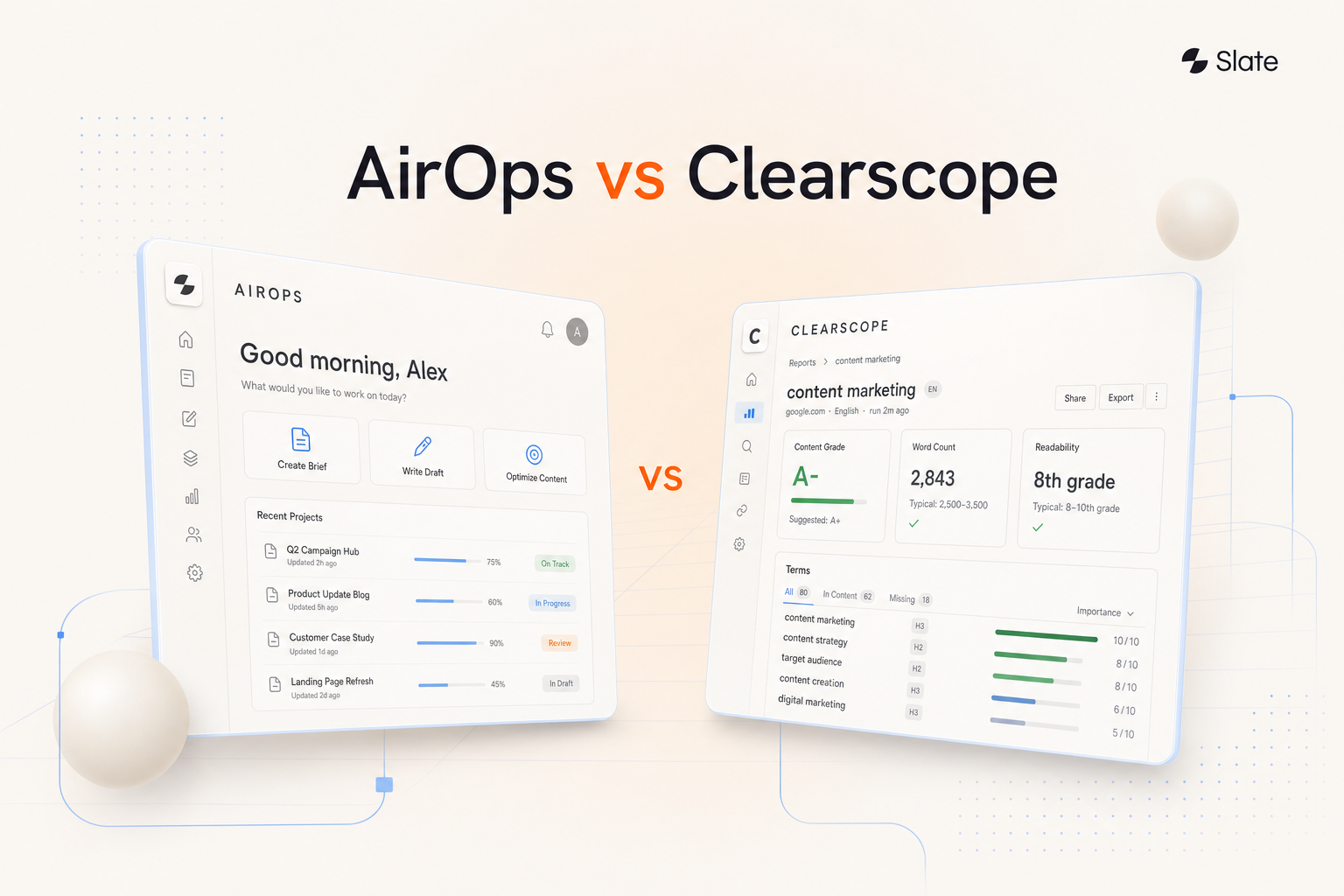
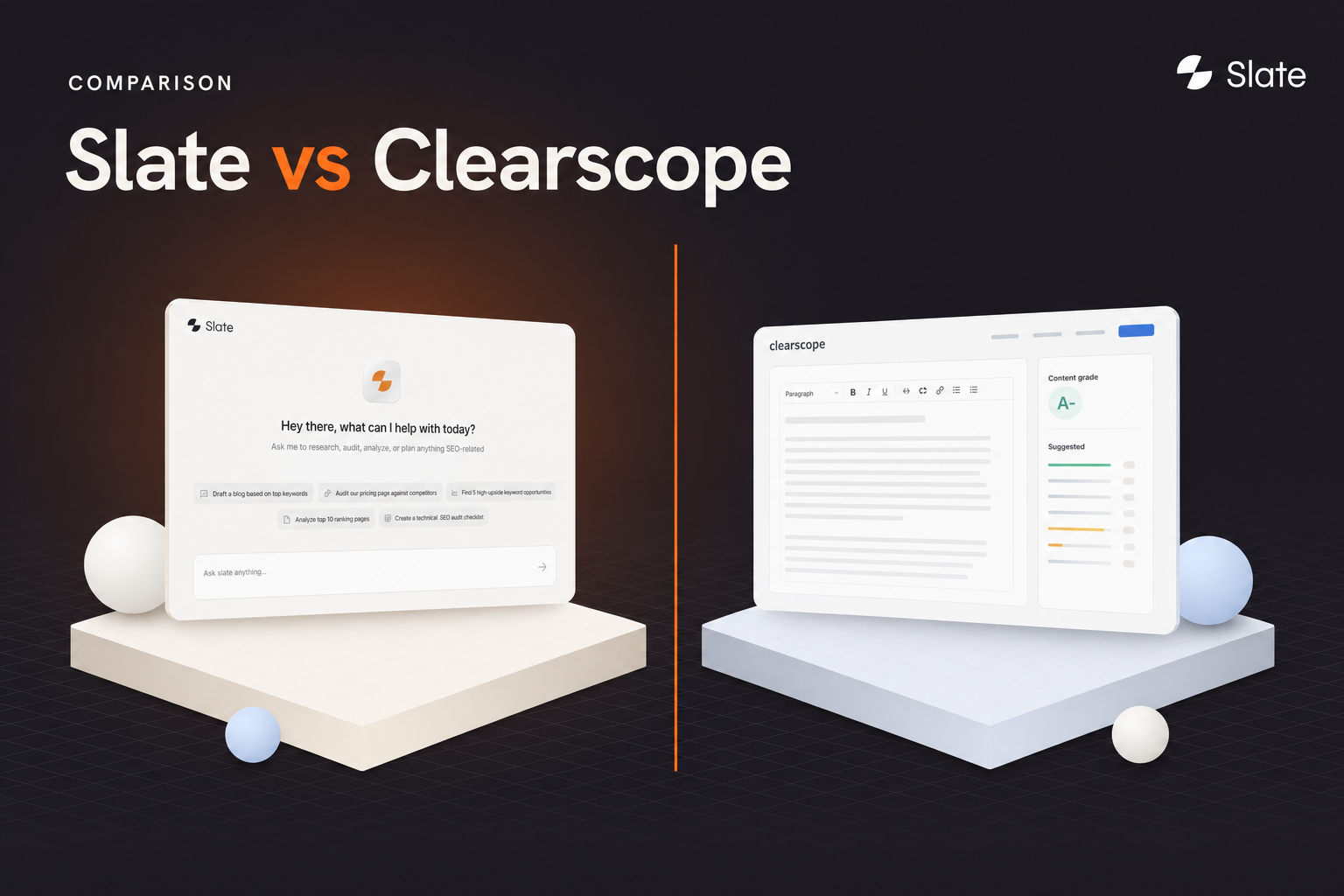
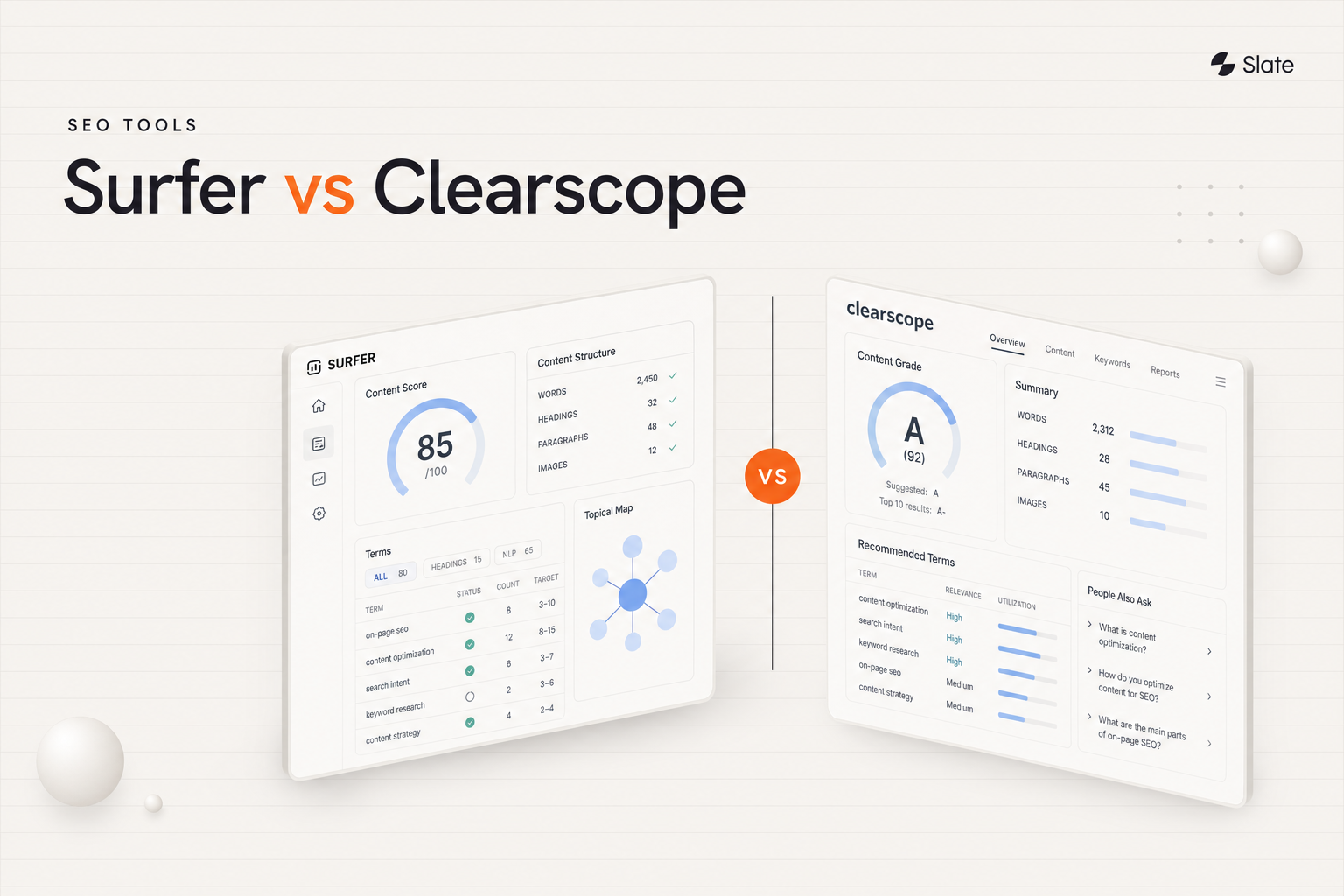
Slate and Clearscope both help content teams win visibility, but they solve different problems. Clearscope is a focused content optimization and visibility platform built around editor-led grading and topic research. Slate is a broader AI search optimization and content engineering system that connects visibility tracking to workflows, bulk refreshes, and CMS publishing.
This comparison is written for Heads of SEO, content marketing leads, organic growth leads, and content ops leaders at B2B SaaS and content-led companies who are choosing between an optimization layer and a full content operating system. It evaluates positioning, workflow fit, and publicly visible capabilities as of June 2026.
Key Takeaways
The core difference comes down to scope: Clearscope sharpens individual pages through grading and topic exploration, while Slate runs end-to-end content operations with AI search visibility tracking at the center.
- Clearscope is a focused content optimization tool; Slate is a broader AI search optimization and content engineering platform.
- Clearscope's strength is editor-led content grading, topic exploration, and AI-assisted draft guidance.
- Slate's strength is AI search visibility tracking plus repeatable workflows, bulk refreshes, and CMS publishing in one system.
- The 2026 buying decision is whether your team needs an optimization layer or a full content operating system.
- Pricing models differ: Clearscope centers on tracked topics, pages, topic explorations, and drafts, while Slate centers on workflow-driven content operations starting at $199/mo.
- Choose Clearscope for editorial optimization; choose Slate for execution at scale and AI-search visibility.
Slate vs Clearscope at a Glance (Quick Verdict)
If your bottleneck is producing higher-scoring pages, Clearscope is the cleaner fit. If your bottleneck is executing content at scale, monitoring AI search visibility, and connecting insight to publishing, Slate is the stronger operating model. Both track visibility across Google and AI engines, but they differ sharply in scope. For a wider view of options, see the best AI SEO tools for 2026.
Choose Slate if: You need AI search visibility tracking, scalable workflows, bulk refreshes, and integrated CMS publishing in one system.
Choose Clearscope if: Your bottleneck is editorial optimization and content scoring on individual pages.
Tool | Best for | Core strength | Main limitation |
| Slate | AI-search-first content teams | End-to-end execution plus AI visibility tracking | Broader scope may exceed pure-optimization needs |
| Clearscope | Editorial optimization teams | Content grading and topic exploration | Narrower scope; optimization-focused, lighter on orchestration |
The 2026 Shift: Why This Comparison Changed
Discovery no longer happens only on Google. AI Overviews now sit at the top of many SERPs, synthesizing answers from multiple sources and changing what content gets attention. Alongside them, answer engines like ChatGPT, Perplexity, and Gemini have become real discovery surfaces that decide which brands get cited.
That changes what buyers should evaluate. The old lens asked one question: which tool gives better content scores? The new lens asks something broader.
Old evaluation lens: Which tool produces higher-scoring drafts for target keywords?
New evaluation lens: Which platform helps a team see visibility across both classic SERPs and AI answers, find opportunities, execute updates, maintain quality, and scale without chaos?
This is a practical shift, not a threat. Enterprise adoption of generative AI in marketing and content has surged, and AI Overviews are reshaping click behavior depending on query type. The teams that win are building repeatable systems for citation readiness and extractable content, not chasing one-off optimizations. That's the difference between scoring and an operating model - and it's exactly where content engineering comes in.
How We Evaluated Both Platforms (Methodology)
This comparison reflects publicly visible product positioning and documentation as of June 2026, supported by third-party reviews for Clearscope. Each platform was assessed against the criteria that matter most to mid-to-bottom-funnel buyers:
- Content optimization and scoring depth
- AI search visibility tracking
- Workflow execution and automation
- Team collaboration and approvals
- Brand governance and quality control
- Integrations and CMS publishing
- Reporting and measurement
- Scalability and ideal team size
- Pricing transparency and time to value
Slate vs Clearscope: Full Comparison Table
The table below summarizes how the two platforms compare across the criteria that drive late-stage buying decisions. Read it as scope versus depth: Clearscope concentrates on optimizing individual pages, while Slate spans the full content lifecycle.
Criteria | Slate | Clearscope |
| Best for | AI-search-first content operations at scale | Editorial optimization on individual pages |
| AI search visibility tracking | Tracking across ChatGPT, Google AI Mode, AI Overviews, and Perplexity | Visibility tracking across Google, ChatGPT, and Gemini |
| Content optimization and scoring | Optimization within structured workflows | Real-time content grading and term coverage |
| Content briefs | Workflow- and template-driven | Report-based briefs from SERP analysis |
| Workflow automation and bulk runs | Visual workflows, AI agents, bulk Sheets operations | Report-level workflow; page-by-page |
| Content refresh at scale | Bulk refreshes across thousands of URLs | Page-by-page optimization and monitoring |
| Team collaboration | Workflows with brand controls | Unlimited users; editor collaboration |
| Brand governance | Brand Kit, knowledge base, review steps | Grading as a quality signal |
| CMS publishing | Direct publishing to Webflow and WordPress | Google Docs add-on, WordPress integration |
| Analytics integrations | AI search analytics, CMS, marketing data | Google Search Console |
| Pricing model | Workflow-driven, starting at $199/mo | Tracked topics, pages, topic explorations, drafts; from $129/mo |
| Ideal team size | Scaling B2B SaaS and enterprise teams | Freelancers to enterprise editorial teams |
Where Slate and Clearscope Differ Most
The two platforms overlap on visibility tracking, but their philosophies diverge in three meaningful ways.
Difference 1 - Scope: Clearscope is a point optimization tool that makes individual pages stronger. Slate is an end-to-end content operating system that connects strategy, creation, refresh, and publishing.
Difference 2 - AI search-first vs optimization-first: Slate is built around AI discovery and visibility as the operating model, with optimization embedded in workflows. Clearscope centers on on-page relevance and grading, with AI prompt tracking added on top.
Difference 3 - Insight vs execution: Clearscope guides the draft in real time. Slate connects insight to refresh, review, and publishing, reducing the handoffs between seeing an opportunity and shipping the update.
AI Search Visibility: Slate vs Clearscope
Both platforms recognize that visibility now spans Google and AI answer engines. Clearscope offers AI prompt tracking that monitors where a brand is mentioned and cited in ChatGPT and Gemini at the topic level. Slate centers its entire model on AI search analytics, tracking visibility across multiple answer engines over time. To go deeper, explore the best AI search visibility tools.
Clearscope's approach focuses on topic-level visibility: starting from a keyword or topic, it shows where you sit across search platforms and where your site is not being cited in AI-generated answers. That helps surface content gaps tied to specific topics.
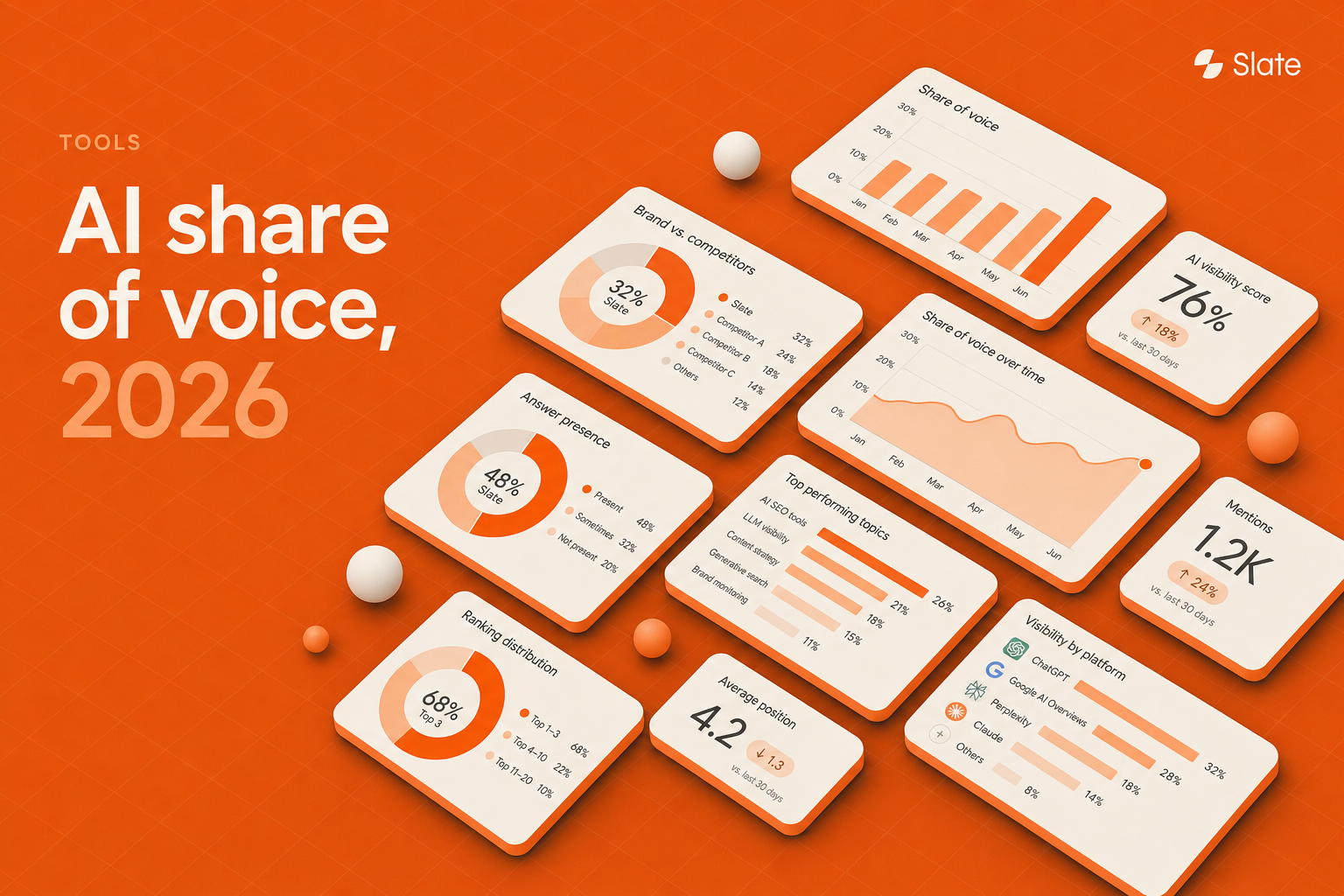
Slate's approach is built for ongoing monitoring. Its AI Search Analytics tracks visibility across ChatGPT, Google AI Mode, Google AI Overviews, and Perplexity, with share-of-voice and citation monitoring designed to feed directly into content workflows.
What matters most in 2026: Monitoring visibility across both classic SERPs and AI answer engines, then having a system to act on what you find. For teams that want insight and execution in one place, this is Slate's clearest differentiation.
Content Optimization and Scoring: Slate vs Clearscope
If the decision is purely about editorial optimization, weigh this section heavily. Clearscope's grading editor is mature and well-documented, while Slate embeds optimization inside broader workflows rather than offering a standalone grading-only experience.
Clearscope analyzes top-ranking Google results for a keyword, extracts semantic terms and entities, and grades content in real time as writers edit. It surfaces recommended terms, coverage frequency, and readability signals, and supports drafting from scratch, importing a URL, or generating an AI-assisted first draft. For teams whose primary need is a strong content editor, this is its core strength.
Slate approaches optimization as one step inside a larger system. Recommendations live within structured workflows that connect analysis, creation, and publishing, so optimization is paired with execution rather than ending at a score. A buyer focused only on page-level grading should weigh Clearscope's editor depth; a buyer who wants optimization plus follow-through should weigh Slate.
For broader context, see how Slate frames SEO content optimization software.
Workflows and Team Collaboration: Slate vs Clearscope
The biggest operational difference is orchestration. Slate is designed to move work from opportunity to published page in one system; Clearscope is designed to make each page better while collaboration happens in familiar editors.
Slate's workflow model follows a repeatable loop:
- Identify an opportunity using AI search analytics.
- Create or refresh content through visual workflows and AI agents.
- Review against brand controls and knowledge base.
- Publish directly to Webflow or WordPress.
- Measure visibility and repeat.
Clearscope's workflow runs through content reports: Generate a report for a keyword, draft or import content, optimize in the real-time editor, share with writers and editors, and track existing pages via content inventory and Search Console data. Unlimited users across plans make collaboration straightforward, though formal approval chains and orchestration live largely in the connected editors rather than the tool itself. For more on this, see content operations best practices.
For teams trying to reduce tool-switching, Slate's strength is keeping bulk runs, brand controls, and publishing inside one system. See more on how this works for the best content optimization tool for SEO teams.
Content Refreshes at Scale: Slate vs Clearscope
For high-volume refresh operations, Slate is built for the job. Clearscope supports refreshes effectively, but the workflow is largely page-by-page. The difference matters most when you're maintaining hundreds of URLs with consistency and governance.
Refreshing a large content library is where most teams feel the pain: Identifying which pages to update, doing it consistently, and keeping quality intact. Clearscope handles this one page at a time - pull a page from content inventory, open a report, re-optimize in the editor. That works well for focused, deliberate updates.
Slate's Power Sheets are designed for bulk refreshes, programmatic creation, and optimization audits across thousands of URLs inside a spreadsheet-style workflow. For teams running refreshes at scale rather than one page at a time, that's the operational edge. Explore more content optimization tool alternatives.
Brand Governance and Quality Control
As AI-assisted content scales, governance becomes a core 2026 buying criterion - and it's a category most comparisons skip. The faster a team produces content, the more important brand voice, accuracy, and review controls become.
Slate is built with governance in mind. Its Brand Kit and Knowledge Base hold style guides, tone rules, and source material so AI-generated content stays on-brand, and review steps keep human judgment in the loop. The principle is straightforward: Control builds trust, and scale without control erodes it.
Clearscope's governance comes primarily through its grading and relevance scoring, which act as a quality signal for each page. That works well at the page level, while heavier orchestration and approval logic typically live in connected editors. Industry research on responsible AI reinforces why governance now belongs in any serious tool evaluation.
Integrations and Publishing
The integration question comes down to one thing: Which platform reduces handoffs to your CMS? Slate is designed to publish directly; Clearscope is designed to optimize inside the editors writers already use. Review the full list of Slate integrations to see what connects.
Slate connects to the publishing and analytics layer:
- CMS publishing: Direct publishing to Webflow and WordPress from workflows and Sheets.
- AI and data: AI search analytics plus MCP integration for working with marketing data in Claude.
Clearscope connects to the writing layer:
- Editor integrations: Google Docs add-on and WordPress integration.
- Analytics: Google Search Console powers content inventory and performance insights.
For the marketing ops or CMS owner, Slate's direct publishing removes a manual export step. For writers who live in Google Docs, Clearscope's add-on keeps optimization where the drafting happens.
Slate vs Clearscope Pricing and Value
Think about value as the number of manual steps each platform replaces, not just the sticker price. Clearscope buyers are paying for an optimization layer; Slate buyers are paying for an operating system that spans visibility, creation, refresh, and publishing.
Clearscope buyers think in terms of tracked topics, pages, topic explorations, drafts, and content inventory workflows. Notably, users and projects are unlimited across plans, so spend scales with content volume rather than seats.
Pricing: Essentials $129/mo (20 tracked topics, 50 pages, 20 monthly topic explorations, 20 monthly drafts); Business $399/mo (higher limits plus a dedicated account manager); Enterprise custom (custom credits, crawler whitelisting, SSO).
G2 rating: 4.9/5
Slate buyers think in terms of workflow-driven content operations: Visibility tracking, automated creation and refresh, and direct publishing in one system. The value logic is consolidation - replacing several point tools and manual handoffs with a single platform.
Pricing: Starting at $199/mo.
G2 rating: 4.9/5
Compare full plan details on the Slate vs Clearscope pricing page.
Which Tool Is Best for Your Team? (Use-Case Fit)
Match the tool to your operating model, not just its feature list. The right choice depends on whether your bottleneck is scoring quality or executing at scale.
Team type | Recommended | Why |
| B2B SaaS team scaling output | Slate | Workflows and bulk refreshes execute across many pages |
| Editorial team wanting a better optimizer | Clearscope | Mature grading editor and topic exploration |
| Agency managing multiple clients | Depends | Clearscope for optimization depth; Slate for standardized, scaled execution |
| Enterprise SEO needing governance and scale | Slate | Brand controls, bulk operations, and AI visibility in one system |
| Small team needing only scoring | Clearscope | Focused optimization without system overhead |
For agencies, see how Slate supports agency SEO content tools. For larger operations, review enterprise content optimization software.
Pros and Cons: Slate vs Clearscope
Both tools earn strong reputations in their lanes. Here's an honest read on each.
Slate - Pros: AI search visibility tracking across major answer engines, end-to-end workflows, bulk refreshes via Power Sheets, brand governance, and direct CMS publishing.
Slate - Cons: Broader scope may be more than teams need if their only use case is page-level scoring, and adopting a system-level tool involves some change management.
Clearscope - Pros: Strong real-time content grading, mature editor experience, topic exploration, unlimited users, and a clean optimization focus.
Clearscope - Cons: Narrower scope with lighter workflow orchestration, approvals, and publishing depth compared with a full operating system; refreshes are largely page-by-page.
Best Clearscope Alternatives in 2026
If you're evaluating beyond Clearscope, judge alternatives on a 2026 rubric: AI search visibility, workflow execution, and governance - not scoring alone.
1. Slate - Best for AI-search-first content operations. Slate combines AI search visibility tracking across ChatGPT, Google AI Mode, AI Overviews, and Perplexity with visual workflows, bulk refreshes, brand-safe content generation, and direct CMS publishing. It's the strongest fit for teams that want insight and execution in one system. See how Slate stacks up.
2. MarketMuse - Best for topical authority. Strong for topic modeling, content inventory planning, and mapping out topical authority across a content surface. For a related rundown, see the best AI tools for topic clusters.
3. Surfer - Best for on-page SERP-driven optimization. Well known for its content editor and SERP-driven on-page recommendations.
4. Frase - Best for fast brief creation. Combines research, question extraction, and AI-assisted drafting for quick brief and draft production.
For more options, explore Slate's roundup of Clearscope alternatives.
Final Recommendation by Buyer Type
The decision is less about which tool scores content better and more about which operating model fits your team. If you primarily need to optimize individual pages, Clearscope is the cleaner choice. If you need to monitor AI visibility, refresh at scale, and connect insight to publishing, Slate is the stronger system. For teams weighing the broader category, the best AEO tools roundup adds useful context.
Choose Clearscope if: Your bottleneck is editorial optimization and content scoring on individual pages.
Choose Slate if: Your bottleneck is execution at scale, AI-search visibility monitoring, and connecting insight to publishing in one system.
Consider both if: A large team wants Slate for system-level operations while keeping Clearscope as a specialized editor for writers who prefer its grading.
See the full operating model in action. Book a demo → https://slatehq.com/book-a-demo
Frequently Asked Questions
What is the difference between Slate and Clearscope?
Slate is an AI search optimization and content engineering platform that combines visibility tracking with workflows, bulk refreshes, and publishing. Clearscope is a focused content optimization tool centered on real-time grading and topic exploration. Slate is an operating system; Clearscope is an optimization layer.
Is Clearscope worth the price compared with Slate?
It depends on scope. Clearscope (from $129/mo) is worth it if your main need is page-level optimization and a strong editor. Slate (from $199/mo) delivers more value if you need AI visibility tracking, scaled refreshes, and publishing in one system rather than scoring alone.
How does Slate compare to Clearscope for SEO teams?
For SEO teams, Clearscope helps optimize individual articles through grading and term coverage. Slate manages strategy, refreshes, governance, and publishing across many pages. The choice comes down to scoring versus an end-to-end operating model that connects insight to execution.
Which content optimization tool is best for SEO teams in 2026?
In 2026, weigh AI search visibility, workflow execution, and governance over content scores alone. Teams needing only an editor may prefer Clearscope, while teams scaling output and tracking AI answer-engine visibility get more from Slate's broader operating model.
Does Slate replace a traditional content optimization tool?
Slate embeds optimization inside workflows and AI search analytics, so it can serve as the primary system for many teams. Some organizations still pair it with a specialized grading editor like Clearscope for writers who prefer that experience, depending on their content stack.
Can you use Slate for content refreshes at scale?
Yes. Slate's Power Sheets are built for bulk refreshes, programmatic creation, and optimization audits across thousands of URLs inside a spreadsheet-style workflow. That makes it well suited to maintaining large content libraries consistently and with governance intact.
What is the best alternative to Clearscope?
For an AI-search-first, workflow-driven approach, Slate is the strongest alternative - it pairs visibility tracking across major answer engines with bulk refreshes and publishing. MarketMuse, Surfer, and Frase are also worth considering for topical authority, on-page optimization, and fast briefs respectively.
How important is AI visibility tracking in this comparison?
It's a core 2026 differentiator. As discovery shifts toward AI Overviews and answer engines, knowing where your brand is cited matters as much as Google rankings. Both tools track AI visibility, but Slate builds its entire operating model around acting on it.