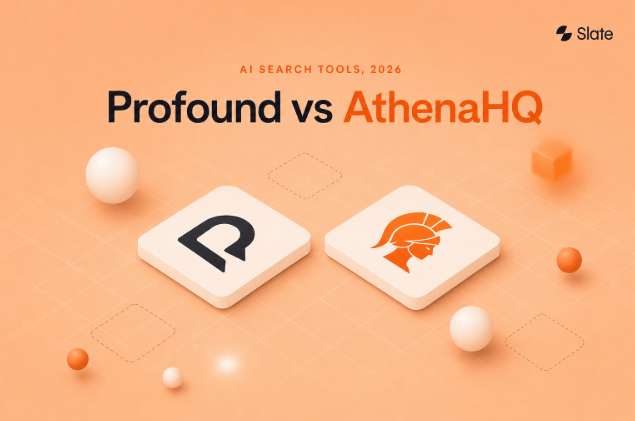
If you're comparing Profound vs AthenaHQ for GEO, the core question is what your team does after a visibility gap appears. Profound is an AI-search intelligence platform that now also drafts and publishes content through its Agents and Documents editor, while AthenaHQ pairs AI-search visibility tracking with a clearer self-serve entry model.
Generative engine optimization is centered on prompt tracking. But the work goes beyond that: prioritizing the opportunity, updating content, publishing, building authority, measuring the result, and refreshing the page when performance changes.
Slate enters the evaluation as an end-to-end execution alternative for teams that want AI search analytics, opportunity discovery, content workflows, CMS publishing, outreach, and measurement in one operating loop.
Key Takeaways
- Core difference: Profound centers on AI-search intelligence and has added content agents and CMS publishing, while AthenaHQ has a clearer self-serve pricing path and 11 tracked models on Starter.
- Engine count: More tracked models only help when prompt quality, markets, refresh cadence, and citation context are strong.
- GEO and SEO: GEO still needs keyword research, page performance analysis, technical SEO, content operations, and analytics workflows.
- Pricing comparison: AthenaHQ publishes a free tier, a $295/month Starter plan, and a custom Enterprise plan; Profound's public page shows a free trial and custom Enterprise, and its in-app checkout sells Starter ($99/month) and Growth ($399/month).
- Execution gap: Visibility dashboards surface problems, but teams still need production, CMS, approval, outreach, and reporting capacity.
- Slate’s role: Slate is built for teams that want the full loop from AI visibility and Opportunities to publishing, Outreach, measurement, and refresh.
- Best fit: The right choice depends on operating model, governance needs, usage scale, and who owns the work after insights appear.
Profound vs AthenaHQ At A Glance
If your team mainly wants enterprise-oriented answer intelligence, Profound belongs on the shortlist. If you want a lower-friction entry point with public pricing and response-based credits, AthenaHQ is easier to model before a sales process.
Slate goes furthest on execution, connecting visibility to the work that follows: AI Tracker, Opportunities, Cowork, Workflows, Sheets, SuperBlocks, Pages, and Outreach all support the operating loop after a gap is found.
Buyer takeaway: Monitoring is the first step. Ask whether the platform helps your team move from answer visibility to completed work.
Cost watch: Prompts, engines, markets, seats, refresh cadence, agent runs, exports, and supporting tools can all change the monthly cost.
Our Comparison Methodology
This comparison weighs how well each platform fits your team’s operating model. The evaluation weights five criteria:
- Visibility: Which AI engines, prompts, answers, brands, competitors, and citations can be tracked.
- Actionability: Whether the platform stops at reporting or helps teams prioritize and complete work.
- Workflow depth: How content, publishing, outreach, and refresh tasks are handled after discovery.
- Cost structure: How plans, credits, prompts, seats, engines, markets, and add-ons affect total cost.
- Enterprise readiness: How support, packaging, governance, security controls, and implementation needs shape fit.
The right GEO platform depends on how each team is staffed, measured, and governed.
What GEO Buyers Should Compare In 2026
A 2026 GEO platform should monitor AI answers, track brand mentions and citations, identify competitive gaps, prioritize opportunities, and connect activity to measurable organic outcomes. Strong evaluations also weigh workflow automation, content updates, CMS publishing, analytics integrations, governance, and a repeatable process for refreshing underperforming pages.
Many buyers treat GEO as a dashboard category. Dashboards can show that a competitor appears in ChatGPT or Perplexity while your brand does not, but your team still has to decide which page to update, which claim to strengthen, which source to pursue, and which workflow will survive editorial review.
AI Visibility Is Only The First Layer
Evaluate GEO in layers. Monitoring shows where and how the brand appears. Intelligence explains which competitors are cited, which sources shape answers, and which topics are changing.
Execution is where most teams feel the constraint. That includes briefs, refreshes, new pages, publishing, outreach, and internal approvals. Measurement then closes the loop by checking whether the completed work changed AI visibility, citations, rankings, clicks, CTR, traffic, or engagement.
Profound and AthenaHQ both belong in the visibility and intelligence conversation. Slate is built for teams that also want the execution layer connected to the same system.
The Post-Dashboard Problem
A team finds that it is absent from comparison prompts. The dashboard shows the cited competitor sources. The SEO lead opens a ticket. Content waits for a brief. Legal wants review. The CMS queue is full. Outreach sits in another tool. Three weeks later, no one knows whether the update went live.
GEO insights create value only when they become prioritized work. If your team already has mature editorial, CMS, outreach, and reporting operations, a monitoring-led platform may be enough. If those steps are the bottleneck, the buyer should evaluate execution as seriously as engine coverage.
Why GEO And SEO Workflows Should Stay Connected
AI visibility, citations, rankings, impressions, clicks, CTR, GA4 engagement, and content decay are different signals, but they describe the same organic growth system. A page can lose traffic before it loses AI citations. Another page can gain AI mentions without meaningful referral traffic.
So GEO and SEO should sit in the same workflow. The stronger operating model connects prompt insights to page-level decisions: Which content should be refreshed, which pages need clearer extractable answers, which competitors are displacing your sources, and which topics need authority-building support.
How Do Profound And AthenaHQ Measure AI Search Visibility?
GEO platforms measure AI visibility by running tracked prompts across selected AI engines and recording whether a brand appears, how it is described, which sources are cited, and how competitors are represented. Treat results as trends, because answers vary by model, prompt wording, location, and time.
This is where Profound and AthenaHQ are most directly comparable. Both help teams understand how their brand appears in AI-generated answers, but their public packaging and usage models differ.
AI Engine And Model Coverage
Profound’s public trial includes ChatGPT, Gemini, and Google AI Overviews. Its Enterprise packaging includes ongoing daily tracking and up to nine answer engines, with tailored prompt-tracking plans. In-app, Starter ($99/month) tracks ChatGPT only, and Growth ($399/month) tracks ChatGPT, Perplexity, and Google AI Overviews.
AthenaHQ’s Essential plan includes ChatGPT, Perplexity, Google AI Overviews, Gemini, and Copilot. Its Starter plan includes broader coverage, including AI Mode, Claude, Grok, DeepSeek, Meta AI, Mistral, and additional models by request.
Slate’s AI Tracker tracks ChatGPT, Google AI Mode, Google AI Overviews, and Perplexity on every plan. Claude and Gemini are add-on answer packs.
Raw engine count can mislead. A team selling in one market with a small prompt set may need depth and repeatability more than maximum model coverage. A global brand may need broader coverage, localized prompts, and governance around how each market interprets the data.
Prompt Tracking, Answer Monitoring, And Competitive Analysis
Prompt tracking is the foundation of GEO measurement, but prompt volume and prompt quality measure different things. Strong prompt sets include branded, category, comparison, use-case, pain-point, and buying-stage questions.
Profound’s trial includes 50 unique prompts with daily analysis over seven days. Its Enterprise prompt plans are tailored. AthenaHQ uses a credit model where one credit equals one AI response, so usage depends on prompts, engines, and response volume.
During evaluation, ask to see raw answers, cited sources, competitor presence, and how the platform groups prompts into topics. A platform that tracks thousands of weak prompts can still miss the questions buyers ask in buying situations.
Brand Mentions, Citations, Sentiment, And Source Intelligence
A brand mention means the AI answer names the company or product. A citation means the answer references a source as supporting material.
Those signals require different responses. If the brand is mentioned but not cited, the team may need stronger referenceable content or third-party authority. If competitors are cited instead, the task may be content refresh, digital PR, partner pages, review coverage, or outreach to sources already influencing answers.
Profound publicly references citation tracking, sentiment, rankings, and competitive presence. AthenaHQ documents brand visibility tracking, prompt and response analysis, sources, competitor insights, and content recommendations.
How To Interpret AI Visibility Data Before You Act
Read AI answer data as trends over time. Before acting on a result, use a consistent process:
- Standardize the prompt wording.
- Define the brand entity and competitors clearly.
- Compare engines separately instead of averaging too early.
- Use trend windows rather than one-off snapshots.
- Separate mention changes from citation changes.
- Avoid assuming that visibility creates traffic by itself.
- Cross-check with page performance, search data, and analytics where available.
Act faster when multiple signals point in the same direction.
Which Platform Makes It Easier To Act On AI Visibility Gaps?
After a GEO platform identifies a gap, someone must prioritize the page or topic, produce or refresh the content, publish it, build supporting citations or links, and verify the result. Monitoring platforms typically surface the recommendation; end-to-end platforms execute, publish, and measure within the same workflow.
This is where buyers should move beyond the Profound vs AthenaHQ feature matrix. A platform can be excellent at detection and still leave the operating burden on your team.
Content Updates, Automation, And Briefing
There is a clear ladder of actionability: Recommendation, brief, draft, updated asset, approved page, published page, measured result. Buyers should ask each vendor where its workflow stops.
Profound pairs answer intelligence with Agents, a Documents editor, and Profound Sheets for running Agents at scale. AthenaHQ pairs visibility tracking with content recommendations, a content optimization agent, and on-page and off-page actions. Slate supports Cowork, Workflows, Sheets, and SuperBlocks for teams that want repeatable content and SEO tasks handled inside one system.
One-off generation solves a single task. Templates help repeat similar tasks. Reusable agents and workflows are more useful when the team has recurring SEO and content operations work, such as refreshing pages, analyzing gaps, building briefs, or auditing many URLs.
Slate’s Workflows, Sheets, and SuperBlocks are designed for repeatable SEO and content processes. Opportunities help teams identify and prioritize recurring work.
For Profound and AthenaHQ, buyers should see how recommendations become assigned work. If execution happens outside the platform, include that handoff in the evaluation.
Publishing, Approvals, And Operational Handoffs
CMS publishing is where many GEO projects slow down. A content recommendation has limited value if it waits in a backlog, loses context during handoff, or goes live without follow-up measurement.
Slate supports CMS publishing to Webflow, Sanity, and WordPress.Profound publishes to Webflow and Contentful by chaining a Document into an Agent workflow. For AthenaHQ, check native CMS publishing with the vendor before assuming it exists.
Teams still need approval gates for brand voice, compliance, factual accuracy, and strategic prioritization. Agent-driven workflows should increase capacity while keeping human judgment in the process.
Outreach, Measurement, And Refresh
AI visibility often reflects the source layer around a topic. If AI answers consistently cite competitor pages, analyst resources, comparison pages, or third-party explainers, the work may require more than editing your own content.
A complete workflow can include competitor-source identification, opportunity research, contact enrichment, outreach, publication tracking, and re-measurement. Slate includes Outreach, and Opportunities covers third-party outreach targets. Check outreach execution with Profound and AthenaHQ directly.
A useful GEO operating loop looks like this: Monitor, prioritize, create, publish, build authority, measure, and refresh. The measurement layer should connect AI visibility changes with page-level performance wherever possible.
Slate’s Pages supports performance monitoring alongside the rest of the workflow. Profound and AthenaHQ can support AI visibility analysis, but buyers should confirm how far each platform goes in connecting answer data to SEO and analytics workflows.
Illustrative workflow: A B2B SaaS team detects absence from comparison prompts, identifies cited competitor sources, creates a prioritized brief, updates the page, publishes it, runs outreach, monitors citations and search performance, then refreshes based on results.
How GEO And Traditional SEO Data Work Together
GEO tools do not fully replace SEO tools, because AI search visibility and traditional organic performance are connected but measured differently. Most teams still need keyword research, rank tracking, technical SEO, traffic data, and page-level performance. Unified workflows reduce fragmentation by connecting AI visibility with content, publishing, outreach, and search analytics.
The teams that handle this well ask how AI visibility, citations, rankings, and traffic inform the next action.
Connecting Prompt Insights To Rankings, Clicks, CTR, And Traffic
A prompt insight can reveal a message gap before traditional traffic data shows a decline. Search data can show whether a page still earns impressions but loses clicks. Engagement data can indicate whether AI referral traffic, organic traffic, and page updates are attracting useful visitors.
Attribution remains imperfect. A citation may influence consideration without sending a click. A mention may improve familiarity without showing up as pipeline. Treat visibility, referral traffic, engagement, pipeline, and revenue as separate measurement layers.
Why GSC And GA4 Belong In Your AI Search Workflow
Google Search Console helps teams understand impressions, clicks, CTR, and query-level search behavior. GA4 helps analyze traffic and engagement once visitors arrive. Neither fully explains AI answer visibility by itself.
That is why AI search analytics should be connected to page performance. If a page loses citations and also shows declining CTR or traffic, it may deserve higher priority than a prompt fluctuation with no supporting signal. AthenaHQ lists GA4 and Google Search Console integrations on Starter, and Profound's Agent Analytics connects to Google Analytics, so confirm how each one feeds page-level decisions.
Finding Content Decay And Refresh Opportunities Before Traffic Drops
Content decay can show up as citation loss, sentiment changes, competitor-source displacement, ranking decline, CTR decline, or impression decay.
Slate’s Opportunities flags traffic decay, underperforming keywords, and AI-visibility topic changes. Refresh work should be prioritized by multiple signals, not by calendar age alone.
Pricing, Scale Risk, And Total Cost Of Ownership
Headline subscription price is only one part of GEO platform cost. Buyers should model priority prompts, engines, markets, refresh cadence, seats, credits, API access, agent runs, content production, CMS work, outreach, reporting, and review cycles before comparing plans.
Entry Pricing Versus Actual Usage
AthenaHQ has the clearer public entry model of the two direct competitors: Essential is free with 300 credits, and Starter is $295/month with 3,600 credits. API access and additional credits are optional paid add-ons on Starter.
Profound’s public packaging emphasizes a seven-day trial with 50 unique prompts and custom Enterprise pricing. Its in-app checkout also sells Starter at $99/month (ChatGPT only) and Growth at $399/month (ChatGPT, Perplexity, and Google AI Overviews). Enterprise includes ongoing daily tracking, up to nine answer engines, tailored prompt-tracking plans, dedicated support, SSO/SAML, and SOC 2 compliance.
Slate starts at $499/month. Growth includes 1 user. Scale is $999/month, Agency is $2,000/month, and Enterprise is custom. Annual billing provides 20% off, and a 14-day free trial is available.
Seats, Credits, Prompt Volume, And Geographic Coverage
Prompt counts and credits are not interchangeable. A simple model is:
Priority prompts × engines × markets × refresh cadence = monthly answer volume.
That number still does not include seats, workspaces, exports, API access, agent runs, historical retention, content production, approvals, or outreach. A team tracking five markets across many buyer personas may outgrow a plan faster than a single-market team with a tighter prompt set.
The Tools You Still Need After Buying A GEO Platform
If the platform stops at monitoring, buyers may still need keyword research, technical SEO, content briefs, writers, editors, CMS labor, outreach tools, contact data, reporting, and analyst time.
That is why total cost of ownership should include the operating system around the subscription. Lower entry pricing can be attractive, but it may not reflect the team capacity required to turn insights into published, measured work.
Which Platform Fits Your Team: Enterprise, Agency, And Content Ops
The better enterprise GEO platform depends on your operating model. Assess AI engine coverage, governance, international support, reporting, integrations, support requirements, and the ability to convert visibility data into published action. Enterprise buyers should also evaluate implementation effort, usage limits, cross-team access, and total cost beyond subscription price.
A good buying process starts with the team’s constraint. Some teams lack visibility. Others have visibility but cannot execute fast enough.
Enterprise SEO And Growth Teams
Enterprise buyers should prioritize governance, support, prompt strategy, reporting, security controls, and implementation fit. Profound’s Enterprise packaging includes custom pricing, dedicated support, SSO/SAML, SOC 2 compliance, ongoing daily tracking, and up to nine answer engines.
Slate’s Enterprise plan is custom and includes four AI Tracker engines. Teams should evaluate how content production, publishing, Outreach, and Pages fit existing review processes.
Content Operations Teams
Content ops teams should focus on brief-to-publish speed, backlog clearance, bulk refresh, brand consistency, and approval workflows.
Slate is relevant when a team needs Cowork, Workflows, Sheets, SuperBlocks, CMS publishing, and measurement connected. Profound and AthenaHQ should be evaluated on how recommendations move into editorial and CMS execution.
Agencies Managing Multiple Clients
Agencies need client workspaces, repeatable templates, reporting, usage controls, and margin protection. Profound’s Agency Growth plan includes 400 credits per month per client workspace.
Slate’s Agency plan starts at $2,000/month. Its fit is strongest when the agency wants to scale SEO, content, AI visibility, publishing, and outreach delivery without stitching together separate workflows.
Multi-Site, Multi-Market, And Multilingual Teams
Multi-market teams should prioritize localized prompts, market-specific competitors, language coverage, and source differences by region. Broad model coverage helps only if the prompt and market design reflect how buyers search and ask questions.
AthenaHQ’s Starter plan lists broad model coverage, including additional models by request. Profound’s Enterprise includes up to nine answer engines. Buyers should evaluate geographic and language needs in the trial or sales process.
Governance, Security, And Support Questions To Ask
Before procurement, ask about SSO, roles, audit logs, data handling, subprocessors, onboarding, support SLAs, approval controls, exports, API access, and implementation resources.
Profound publicly lists SSO/SAML and SOC 2 compliance for Enterprise. AthenaHQ’s custom Enterprise tier lists SAML and OIDC SSO, an organization audit log, multi-region support, and a 2-hour SLA.
Profound Vs AthenaHQ: Best-Fit Scenarios
The right choice in the Profound vs AthenaHQ for GEO comparison depends on whether your team needs deeper enterprise intelligence, a lower-friction tracking entry point, or a full execution system.
- Choose Profound if: Your priority is structured AI-answer intelligence across citations, sentiment, rankings, and competitive presence. It also fits teams that want custom Enterprise packaging, dedicated support, SSO/SAML, SOC 2 compliance, and tailored prompt-tracking plans.
- Choose AthenaHQ if: You want a clearer self-serve entry path, including a free Essential tier and a $295/month Starter plan. AthenaHQ is also attractive when a response-based credit model is easier for your team to forecast.
- Shortlist both if: Prompt strategy, engine coverage, market requirements, raw-answer access, cadence, or stakeholder needs are still unclear. Parallel evaluation is useful when the team needs to compare intelligence depth against ease of adoption.
- Consider Slate if: The main bottleneck is content production, CMS publishing, outreach, measurement, or refresh operations. In that case, an end-to-end platform such as Slate may be a better fit for the operating model.
Best GEO And AI Search Platforms To Evaluate In 2026
The best alternative depends on the gap you need to close. Some teams need deeper AI search monitoring; others need a system that connects opportunity discovery to content production, publishing, outreach, and measurement. Evaluate alternatives based on the operational work required after an AI visibility gap is identified.
1. Slate - Best End-To-End, Agent-Driven Platform For AI Search And Organic Growth Execution
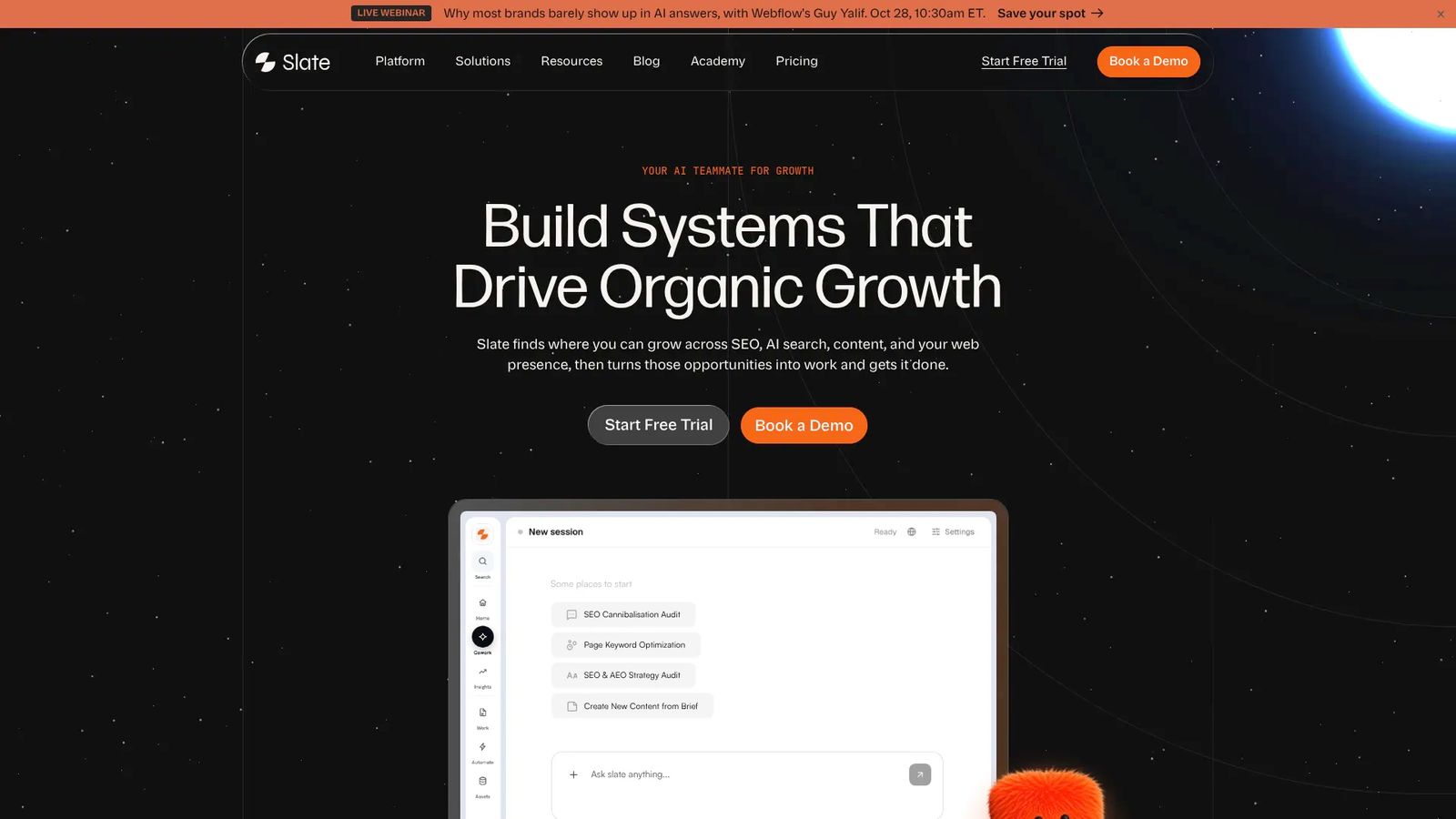
Slate is built for SEO, content, growth, and agency teams that want AI search visibility connected to execution. AI Tracker monitors ChatGPT, Google AI Mode, Google AI Overviews, and Perplexity on every plan, with Claude and Gemini available as add-on answer packs.
The operating system around that visibility is the differentiator. Opportunities identifies keyword gaps, AI visibility topic changes, suggested prompts, third-party outreach targets, and content decay. Cowork, Workflows, Sheets, and SuperBlocks help teams turn prioritized work into repeatable content and SEO workflows. Pages supports performance monitoring, while Outreach supports authority-building work.
Slate focuses on SEO, content, growth, and agency workflows; video, visual campaign, and creative review workflows are outside that focus.
Pricing: Growth $499/month; Scale $999/month; Agency $2,000/month; Enterprise custom. Annual billing saves 20%, and a 14-day free trial is available.
2. Profound - Best For Enterprise-Oriented AI-Search Intelligence
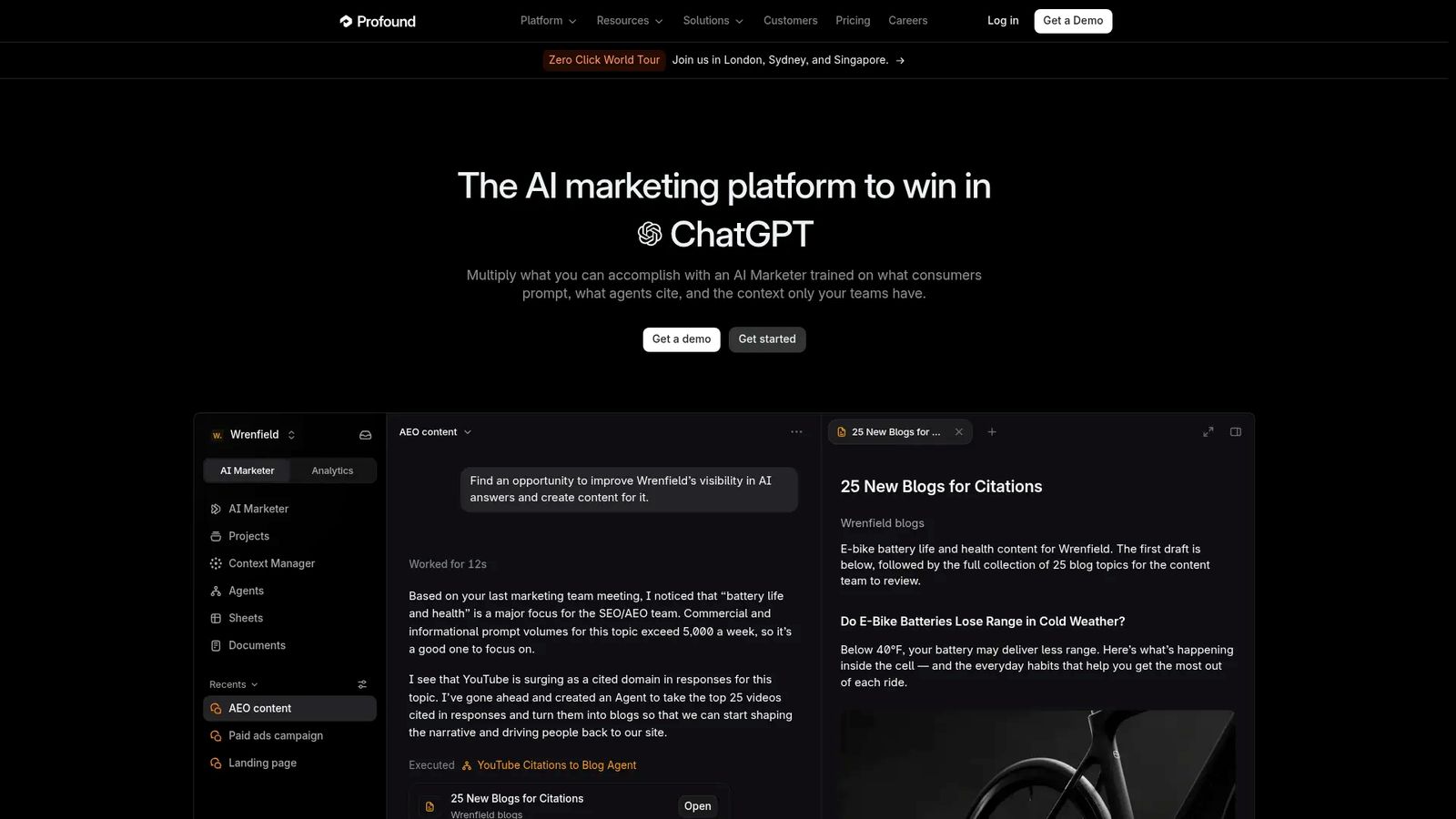
Profound covers AI-search intelligence, answer analysis, citation tracking, sentiment, rankings, and competitive presence, and its Agents and Documents editor now draft content and publish it to Webflow or Contentful. Its trial includes 50 unique prompts, daily analysis for seven days, and coverage across ChatGPT, Gemini, and Google AI Overviews. Enterprise buyers can evaluate custom packaging with daily tracking, up to nine answer engines, dedicated support, SSO/SAML, and SOC 2 compliance.
Pricing: Free trial; Starter $99/month and Growth $399/month in-app; Enterprise custom. Agency Growth includes 400 credits per month per client workspace.
3. AthenaHQ - Best For Lower-Friction AI-Search Tracking Entry
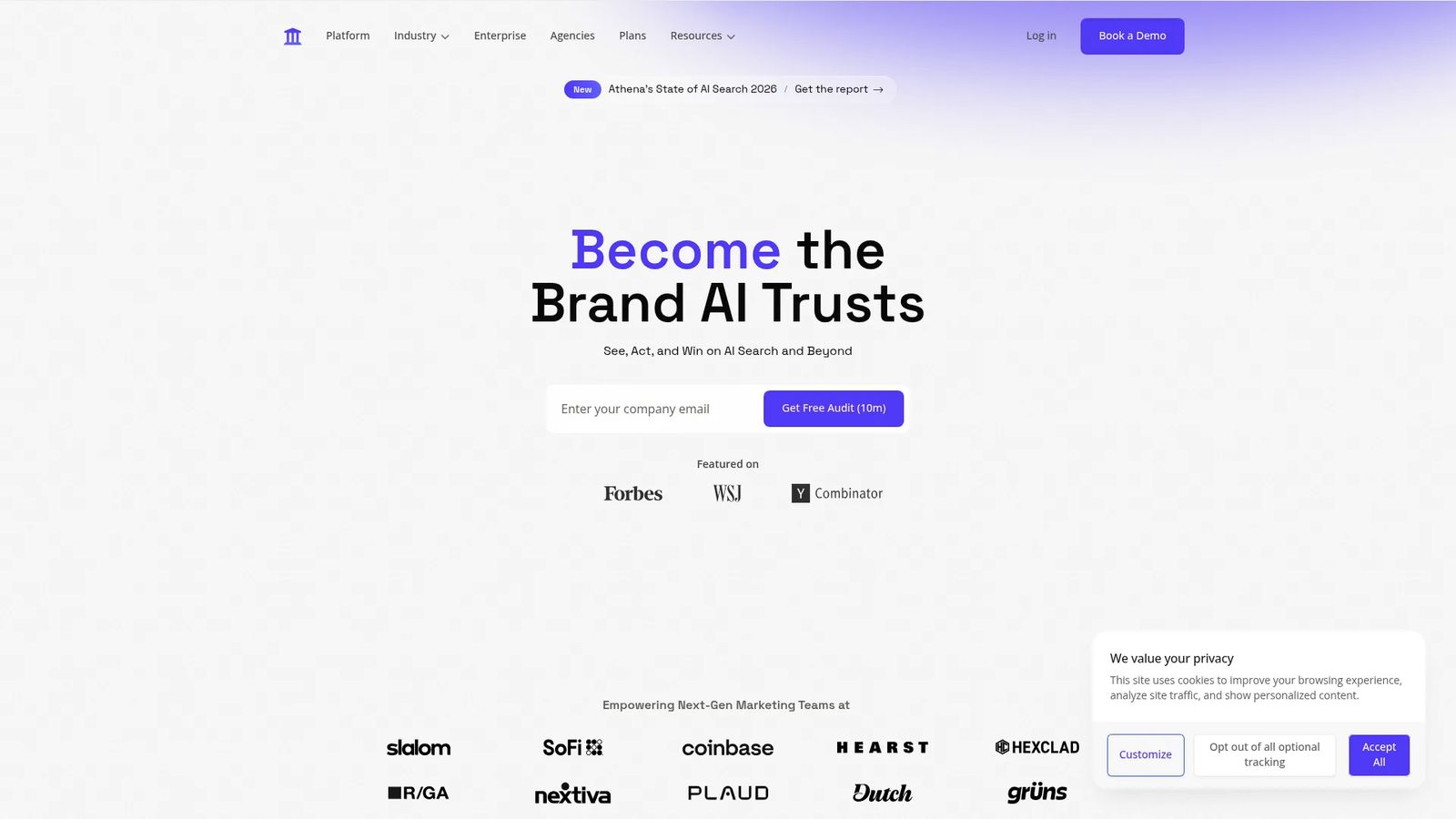
AthenaHQ tracks and helps improve brand visibility in AI search. Its public pricing makes it easier to model a first evaluation: Essential is free, and Starter includes broader model coverage with a response-based credit model. It fits teams that want to test AI-search visibility without starting from a custom enterprise quote.
Pricing: Essential free; Starter $295/month with annual billing available at a discount; Enterprise custom. API access and additional credits are paid add-ons on Starter.
When An End-To-End Platform Like Slate Makes More Sense
AI search visibility is most valuable when it becomes repeatable organic-growth action. If the team already has a strong execution system, a monitoring-led platform may be enough. If the gap is operational capacity, Slate is designed to shorten the distance between insight and completed work.
The Slate operating loop looks like this:
- Discover: Opportunities surfaces priority gaps and decay signals.
- Diagnose: AI Tracker monitors visibility across supported AI search experiences.
- Prioritize: Pages helps teams connect performance signals to the work queue.
- Create: Cowork and reusable workflows help teams produce and refresh content.
- Support bulk work: Sheets and Workflows support bulk SEO and content operations.
- Publish: CMS publishing supports Webflow, Sanity, and WordPress.
- Build authority: Outreach supports third-party authority workflows.
- Measure: Teams monitor performance and visibility signals after changes go live.
- Refresh: Decay and visibility changes feed the next cycle.
Human teams still own strategy, approvals, and brand standards. Slate gives them more capacity inside that process. For teams comparing Profound vs AthenaHQ for GEO because they want execution beyond tracking, Slate should be part of the shortlist.
Final Verdict
Profound and AthenaHQ solve overlapping problems, but they fit different buying decisions. Profound is the clearer fit when the requirement is enterprise-oriented AI-search intelligence, answer analysis, citations, sentiment, rankings, and competitive presence. AthenaHQ is easier to enter when public pricing, a free tier, and response-based credits are important.
The larger question is what happens next. If a team finds a visibility gap but still needs separate tools for SEO research, content creation, CMS publishing, outreach, and reporting, the platform cost is only part of the investment.
Decision rule: Choose the platform that matches your operating model and can support the work after insight appears.
For teams that want AI visibility connected to Opportunities, Cowork, Workflows, Sheets, SuperBlocks, Pages, Outreach, CMS publishing, and refresh workflows, Slate is the most complete execution alternative in this comparison.
Frequently Asked Questions
Is Profound or AthenaHQ better for GEO?
The better fit depends on governance needs, usage scale, workflow ownership, and execution capacity. Profound covers AI-search intelligence, citation tracking, sentiment, rankings, and competitive presence, plus content Agents and CMS publishing. AthenaHQ has a clearer self-serve path with a free Essential tier and $295/month Starter plan.
What is the difference between GEO and AEO?
GEO, or generative engine optimization, focuses on how brands appear in AI-generated answers. AEO, or answer engine optimization, focuses on being selected and represented in answer-style search experiences. In 2026, the terms often overlap because both involve prompts, citations, brand mentions, structured answers, and authority signals.
Which AI engines do Profound and AthenaHQ monitor?
Profound’s public trial includes ChatGPT, Gemini, and Google AI Overviews, while Enterprise includes up to nine answer engines. AthenaHQ Essential includes ChatGPT, Perplexity, Google AI Overviews, Gemini, and Copilot. AthenaHQ Starter includes broader coverage, including AI Mode, Claude, Grok, DeepSeek, Meta AI, Mistral, and additional models by request.
Do GEO tools replace SEO tools?
No. GEO tools do not fully replace SEO tools because AI visibility and organic search performance are measured differently. Teams still need keyword research, rankings, technical SEO, traffic analysis, page-level reporting, content operations, and refresh workflows. GEO data works best when connected to the broader SEO operating system.
How do prompt tracking and credit models work?
Prompt tracking usually measures how selected questions perform across AI engines. Credit models vary by vendor. AthenaHQ defines one credit as one AI response. Profound uses prompt-tracking plans and agent credits. Buyers should model prompts, engines, markets, refresh cadence, seats, API access, and agent runs before comparing costs.
Can Profound or AthenaHQ measure revenue from AI search?
They can support visibility analysis, but revenue measurement should be treated carefully. AI search reporting can show mentions, citations, answer presence, competitors, and sometimes referral traffic. Revenue attribution requires separate pipeline and conversion systems, and an AI answer can influence a buyer without producing a click.
Can GEO platforms publish directly to WordPress or Webflow?
Slate supports CMS publishing to Webflow, Sanity, and WordPress. Profound publishes to Webflow and Contentful through Documents and Agents. For AthenaHQ, check native CMS publishing with the vendor before assuming it’s available. Publishing is important because GEO insights lose value when content updates remain stuck in editorial or CMS backlogs.
Which GEO platform is better for agencies?
The better agency fit depends on client workspaces, credit controls, reporting, repeatable workflows, and delivery margins. Profound’s Agency Growth plan includes 400 credits per month per client workspace. Slate’s Agency plan starts at $2,000/month and fits agencies that want visibility, content, publishing, outreach, and measurement in one system.
What should enterprise teams ask before buying a GEO platform?
Enterprise teams should ask about engine coverage, prompt limits, refresh cadence, seats, SSO, roles, audit logs, data handling, SOC 2, support SLAs, exports, API access, onboarding, and approval workflows. Profound publicly lists SSO/SAML and SOC 2 for Enterprise. AthenaHQ lists SAML and OIDC SSO and audit logs on Enterprise.
How often should content be refreshed for AI search visibility?
Refresh content when multiple signals indicate a problem. Useful triggers include citation loss, competitor displacement, sentiment changes, ranking decline, CTR decline, impression decay, traffic drops, or outdated positioning. AI visibility changes should be validated against page and search performance before large-scale updates.