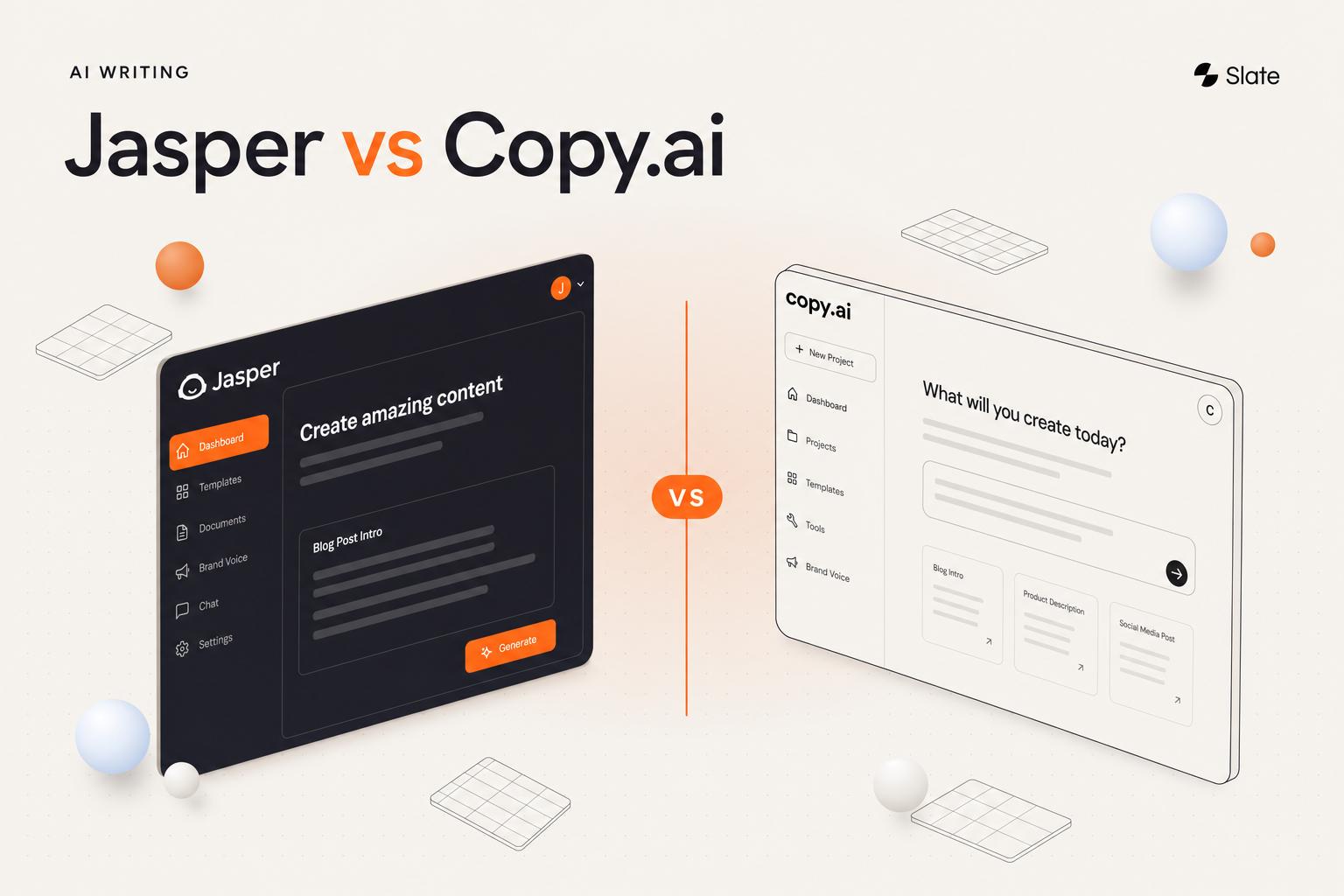
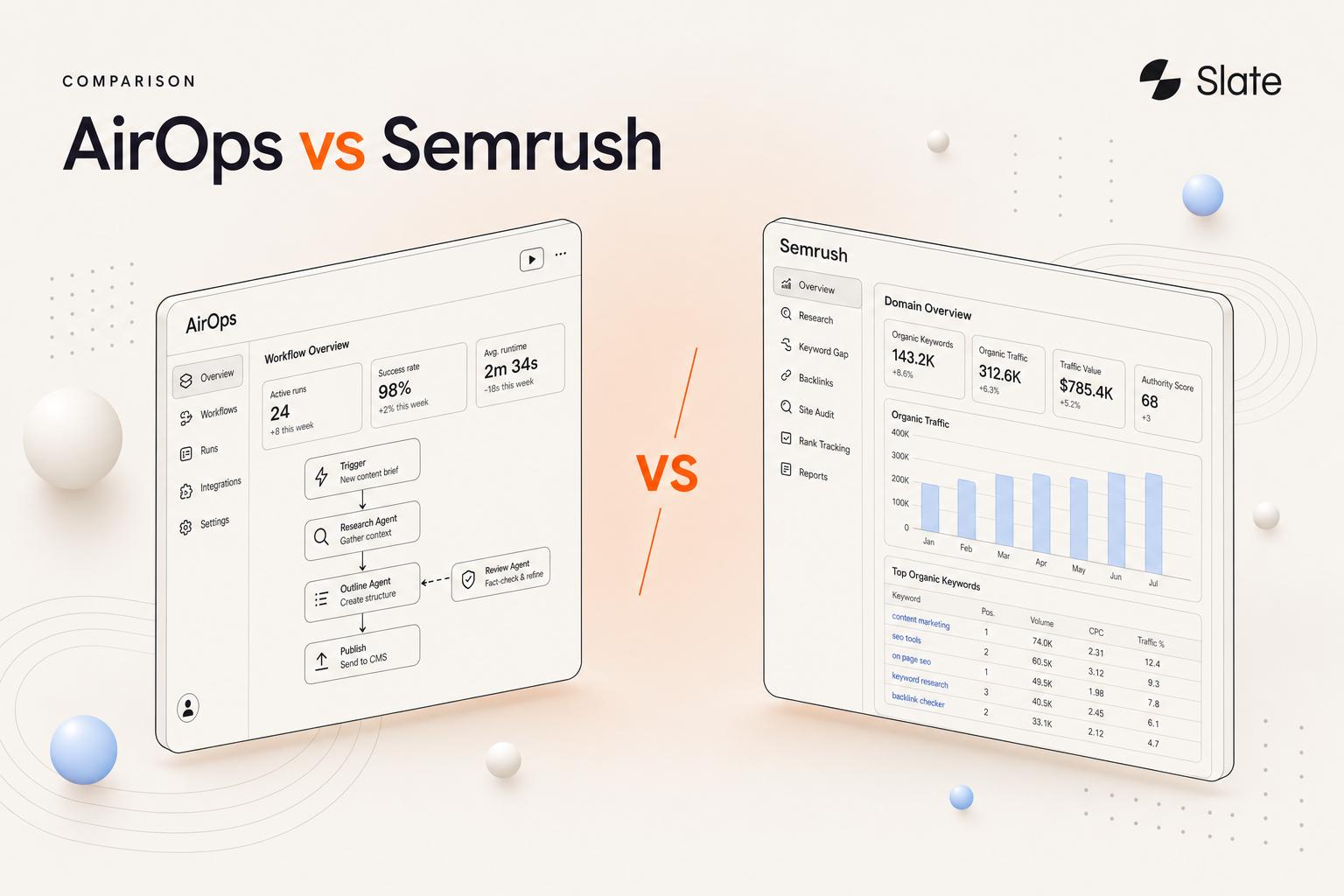
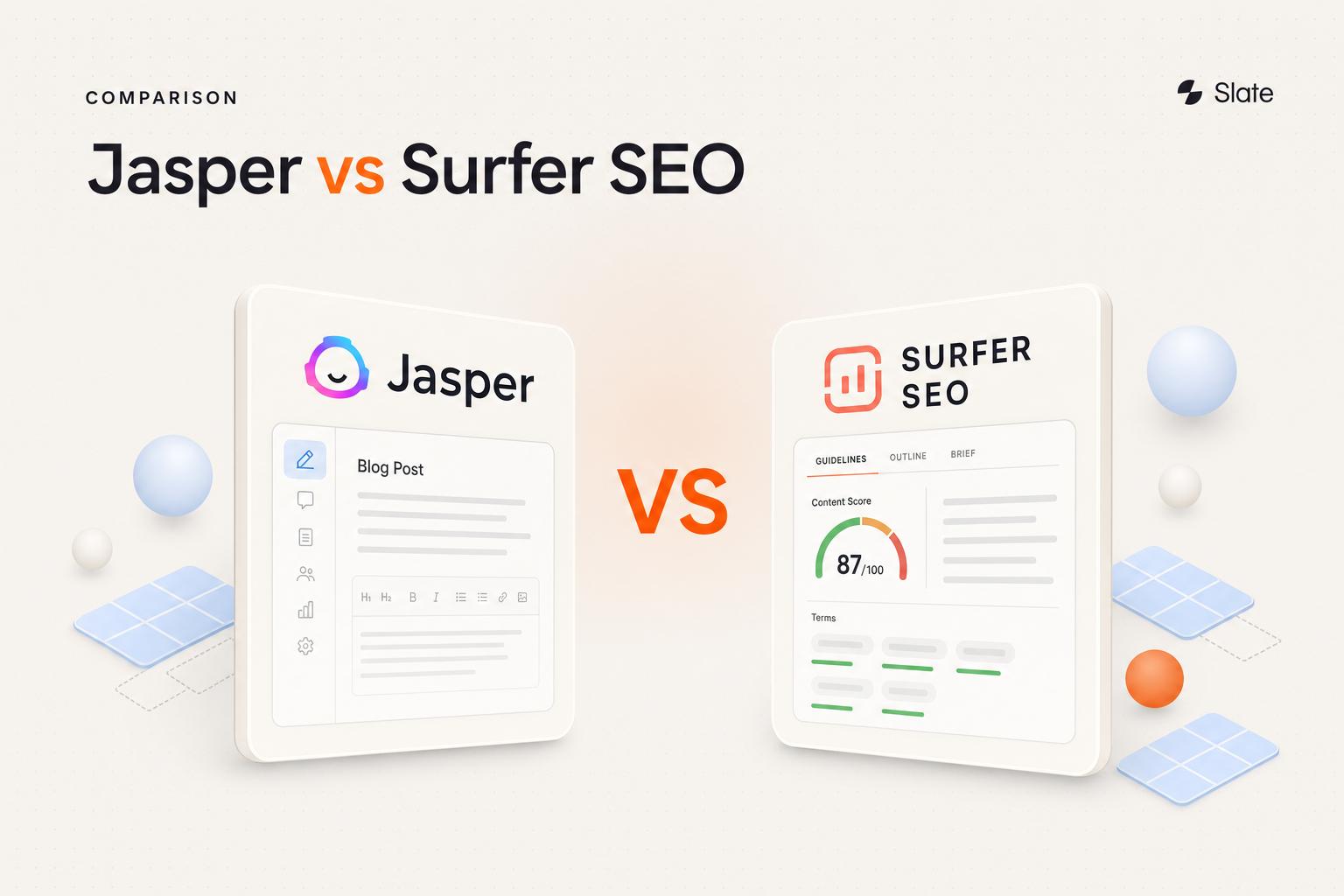
AirOps and Jasper sit in the same buying conversation but solve fundamentally different problems. Jasper is a marketer-first AI writing platform built around brand voice, campaigns, and fast on-brand output. AirOps is a workflow-first content operations platform built around multi-step pipelines, integrations, and SEO scale. The real 2026 question is not "which tool writes better" - it is which operating model fits your team, and whether either tool covers AI search visibility the way your KPIs now demand.
This page compares both products across features, pricing, implementation reality, and AI search readiness, then introduces a third lens - content engineering - for teams whose real bottleneck is visibility inside ChatGPT, Perplexity, Gemini, and Google AI Overviews.
Key Takeaways
- Jasper is best for marketing teams that prioritize brand voice, fast campaign output, and ease of use. It sits closer to an AI writing platform than an automation system.
- AirOps is best for SEO, growth, and content ops teams that need workflow automation, programmatic SEO, and deeper integrations.
- Jasper's entry pricing ($59/seat/mo billed annually) is lower than AirOps' publicly listed paid pricing, but total cost depends on seats, workflow complexity, and editorial review burden.
- Jasper is easier to adopt; AirOps requires more setup, workflow design, and operational maturity to deliver value.
- Neither tool is positioned primarily as a citation-tracking platform for ChatGPT, Perplexity, Gemini, and AI Overviews - AirOps now talks about AI search visibility, while Jasper remains marketing-execution focused.
- Teams whose KPI is AI search visibility, citation readiness, and large-scale refresh workflows should evaluate a content engineering platform like Slate alongside either tool.
AirOps vs Jasper At A Glance
The shortest honest summary: Jasper is a writing-first AI platform built for marketers; AirOps is a workflow-first platform built for SEO and content ops teams. Jasper wins on ease of use, brand voice tooling, and time-to-first-draft. AirOps wins on automation depth, integrations, and programmatic content production. Neither was originally built as a dedicated AI search visibility system.
What Is Jasper?
Jasper is an AI platform for marketing teams to create on-brand content and automate marketing workflows with AI agents. It sits closer to a writing and campaign-execution layer than a content operations system, and is typically owned by content marketers, brand teams, or campaign managers rather than SEO or ops leads.
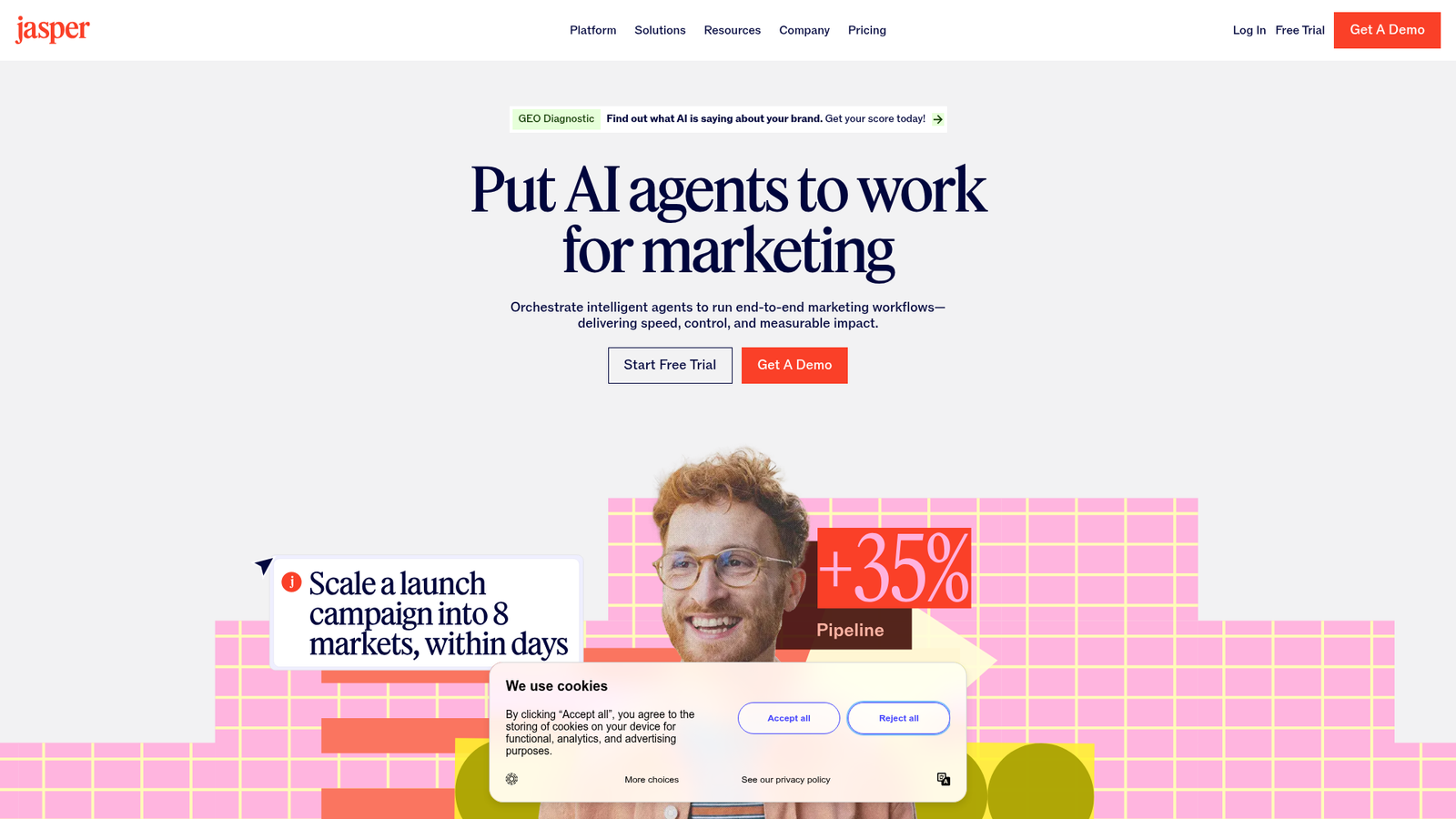
Best for: Marketing teams that need to scale on-brand content creation and campaign execution with AI.
Key features:
- Purpose-built AI agents for marketing workflows
- Content pipelines for end-to-end campaign execution
- Jasper IQ for brand voice, knowledge, and audience context
- Templates and apps across ads, social, email, and landing pages
- Canvas editor and team collaboration on higher tiers
Pricing: Pro $69/seat/mo billed monthly, or $59/seat/mo billed annually (1 seat, Canvas, Essential Agents, limited Brand Voice/Knowledge/Audiences); Business custom pricing with advanced agents, no-code AI app builder, Jasper Grid, unlimited customization, API access, and enterprise controls. 7-day free trial available.
G2 rating: 4.7/5
Who Jasper Is Built For
Jasper is built for marketers who think in campaigns and channels, not pipelines. Typical buyers include brand-focused marketing teams, demand gen and campaign managers, content marketers producing across blog, social, and email, and small-to-mid-market teams without dedicated content ops or SEO engineering capacity.
What Is AirOps?
AirOps is an AI search and SEO growth platform that helps teams monitor visibility, identify opportunities, create content, and publish at scale. It is workflow-first by design, so production happens inside multi-step pipelines rather than inside a single document editor. It is typically owned by an SEO lead, content ops manager, or technical marketer.
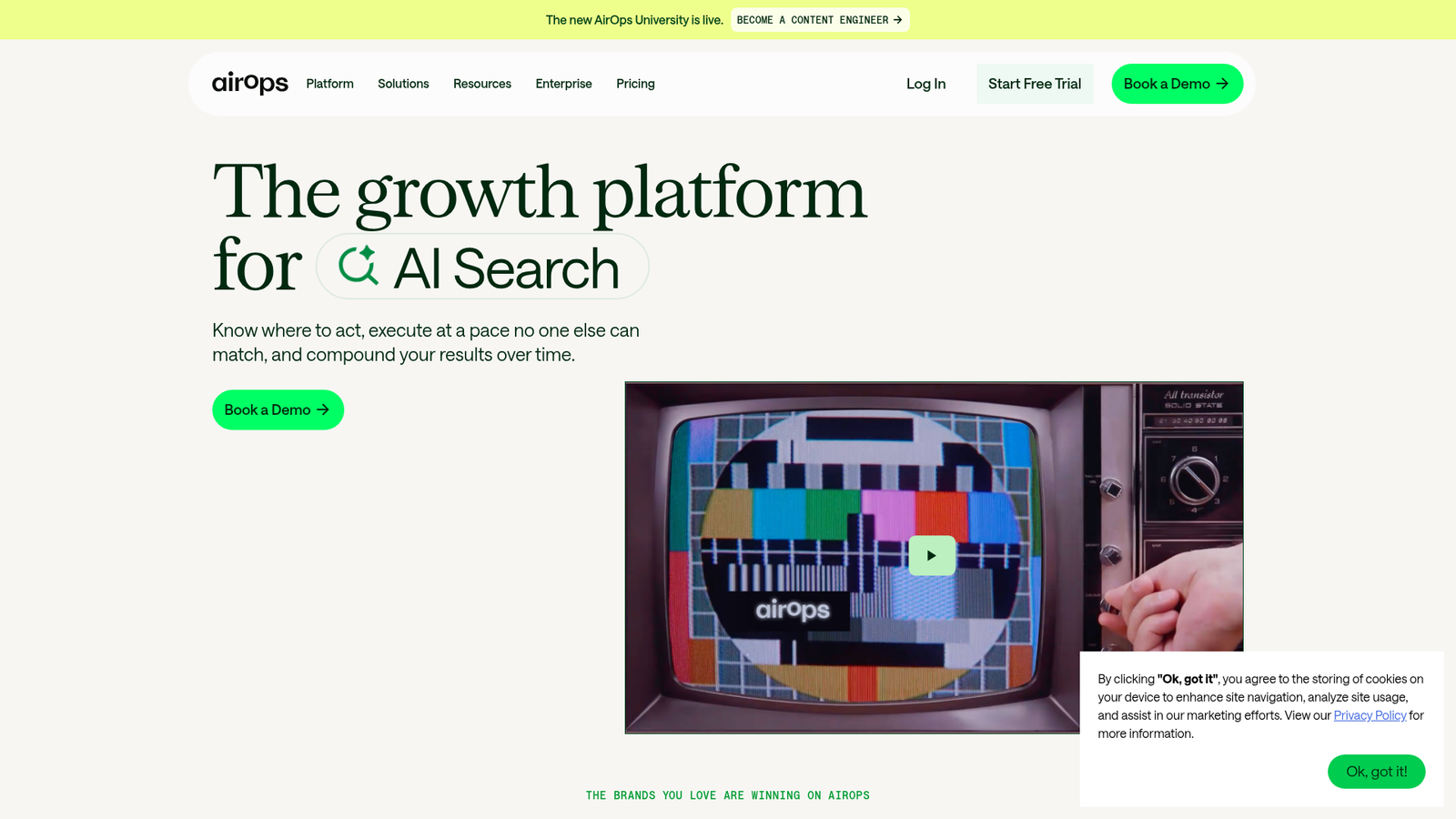
Best for: Content, SEO, and growth teams that want to turn AI-search visibility insights into on-brand content execution at scale.
Key features:
- AI search visibility tracking across platforms like ChatGPT, Gemini, Perplexity, and Google
- Workflow-based content creation and refresh with Brand Kits and knowledge bases
- Direct CMS and tool integrations for publishing and execution
- API-driven automation and developer-friendly extensibility
- Programmatic SEO support and bulk content workflows
Pricing: Insights starts at $0/mo; Pro is available with a free trial but no public monthly price is shown; Pages is custom; Enterprise is talk to sales. Pricing scales with workflow volume rather than per seat.
G2 rating: 4.6/5
Who AirOps Is Built For
AirOps is built for teams that think in systems. Typical buyers include SEO and growth leads, content ops managers, technical marketers running programmatic SEO, and agencies coordinating workflows across multiple client sites. Teams with lighter publishing volume often do not need the workflow design effort.
Feature-By-Feature Comparison
The honest version of this comparison is not "which tool is better." It is which dimension matters most to your team - writing UX, brand governance, SEO depth, automation, or AI search visibility - and which tradeoffs you can accept.
Content Creation And Writing Quality
Jasper feels like a writing tool. Its editor, templates, and brand voice context are designed for marketers who want to draft, polish, and ship. AirOps feels like a system. Output is generated through configured workflows rather than free-form composition, which is powerful at scale but less natural for writer-led teams.
Verdict: Jasper for writer-led teams; AirOps for system-led teams.
Brand Voice And Editorial Control
Both platforms take brand governance seriously, but through different mechanisms. Jasper enforces voice through model context - Jasper IQ holds brand voice, knowledge, and audiences, and applies them at the draft level. AirOps enforces voice through workflow rules: Brand Kits, knowledge bases, and review checkpoints embedded into pipelines.
Verdict: Jasper enforces voice in the editor; AirOps enforces it in the workflow. Teams with strict brand review cycles often prefer AirOps' structured approval steps.
SEO Capabilities
Jasper supports SEO-aware writing through integrations like Surfer SEO and SEO modes inside the editor. AirOps treats SEO as a first-class workflow concern, with native support for keyword inputs, SERP context, programmatic pages, and content refresh logic. AirOps also surfaces AI search visibility as part of its product positioning.
Verdict: AirOps for SEO depth and programmatic scale; Jasper for SEO-aware drafting inside a marketer-friendly editor. See more options in best AI SEO tools.
Workflow Automation And Integrations
This is AirOps' clearest win. Its workflow builder supports multi-step pipelines, conditional logic, web data, and direct CMS publishing - and it exposes an API for engineered automations. Jasper offers marketing-stack integrations and campaign-level orchestration, but its automation surface is shallower and more document-centric.
Verdict: AirOps wins on automation depth. For more on this dimension, see scalable content workflows.
Collaboration And Team Workflows
Jasper's collaboration model is document-centered: shared workspaces, comments, brand assets, and team seats on higher tiers. AirOps' collaboration model is workflow-centered: roles tied to pipeline steps, approval gates, and structured handoffs. Smaller marketing teams generally find Jasper more natural; larger ops-driven teams generally prefer AirOps' explicit review structure.
AI Search Visibility And Citation Readiness
This is where the comparison gets uncomfortable. Jasper's public positioning remains focused on marketing execution, with no prominent feature set around measuring AI search visibility across ChatGPT, Perplexity, Gemini, and Google AI Overviews. AirOps does track AI search visibility across major platforms and has moved its narrative toward AI search outcomes, but visibility tracking is one capability inside a broader workflow tool, not the system's center of gravity.
Verdict: For teams whose KPI is AI citation share and visibility-driven refresh cycles, AI search visibility belongs at the center of evaluation. See AI citations for context on what that means in practice.
AirOps vs Jasper Pricing Comparison
Yes, Jasper's entry price is lower than AirOps' publicly listed paid pricing. Jasper Pro starts at $59 per seat per month billed annually. AirOps offers a free Insights tier, while higher-volume plans are sales-led or not publicly priced. The two platforms are not priced on equivalent value - Jasper sells per-seat writing access; AirOps sells workflow capacity.
Jasper Pricing Breakdown
- Pro: $69/seat/mo billed monthly, or $59/seat/mo billed annually. Includes Canvas, Essential Agents, and limited Brand Voice, Knowledge, and Audiences.
- Business: Custom pricing. Adds advanced agents, no-code AI app builder, Jasper Grid, unlimited customization, API access, and enterprise controls.
- Free trial: 7 days.
AirOps Pricing Breakdown
- Insights: Starts at $0/mo for AI search visibility tracking.
- Pro: Free trial available; public monthly pricing is not shown.
- Pages: Custom pricing for content production at scale.
- Enterprise: Talk to sales for governance, SSO, and advanced controls.
Total Cost Of Ownership Beyond Sticker Price
List price is the wrong place to stop. Real cost shows up in:
- Implementation time and internal ownership - Jasper is near-immediate; AirOps requires workflow design before first value.
- Editorial review burden - Jasper can multiply drafts faster than editors can review them; AirOps centralizes review inside workflow gates.
- Volume scaling - Jasper scales with seats; AirOps scales with workflow volume, and workflow economics usually improve as volume rises.
- Workflow build effort - AirOps frontloads engineering time; Jasper frontloads almost none.
Pros And Cons Of Each Platform
Jasper Pros And Cons
Pros:
- Marketer-friendly UX with a familiar writing surface
- Strong brand voice tooling through Jasper IQ
- Lower entry price than AirOps' publicly listed paid pricing
- Fast onboarding and minimal setup
- Broad template and agent library for campaigns
Cons:
- Limited workflow automation compared with AirOps
- Less suited to programmatic SEO and bulk refresh
- Lighter integration depth for ops and data-heavy teams
- Not positioned around AI search visibility tracking
AirOps Pros And Cons
Pros:
- Deep workflow customization with multi-step pipelines
- API and integration depth for technical teams
- Strong fit for programmatic SEO and large content systems
- Approval and governance layers built into workflows
- Scales cleanly with content volume
Cons:
- Steeper learning curve, especially for non-technical marketers
- Higher effective cost once teams move beyond the free tier
- Requires technical or ops ownership to operate well
- More setup required before first useful output
See more comparable tools in best AirOps alternatives and Jasper AI alternatives.
Which Should You Choose? A Decision Framework
The honest decision is not feature-by-feature. It is operating model fit. Below are scenarios that map cleanly to each option, including when neither is the right answer.
Choose Jasper If…
- You need fast, on-brand content across multiple marketing channels.
- Your team has writers and marketers, not ops engineers or developers.
- Brand voice consistency outweighs workflow customization.
- You want to start producing within days, not weeks.
- Your content volume sits comfortably below the threshold where pipeline thinking pays off.
Verdict: If your bottleneck is producing on-brand drafts faster, Jasper is the cleaner fit.
Choose AirOps If…
- You need to scale large volumes of pages with repeatable workflows.
- You are running programmatic SEO benchmarks and case studies or operating a large content library.
- You have technical or ops capacity to design and maintain workflows.
- You need CMS publishing, data inputs, and integration plumbing.
- You want visibility tracking integrated with execution.
Verdict: If your bottleneck is scaling repeatable SEO and content ops, AirOps earns the complexity.
Choose A Content Engineering Platform Like Slate If…
- Your KPI now includes visibility inside ChatGPT, Perplexity, Gemini, and Google AI Overviews.
- You need to track AI visibility, identify content gaps, and refresh content at scale.
- You want AI search measurement and content execution in the same system.
- You need brand-safe execution with human review, governance, and structured workflows.
- You see content engineering as a category distinct from AI writing and AI workflow tools.
Slate is built specifically for AI search visibility and content engineering, with workflow automation, Power Sheets for bulk refresh, AI Search Analytics across major answer engines, and a Brand Kit and Knowledge Base layer for governance. Pricing starts at $199/mo, and Slate carries a 4.9/5 G2 rating.
When Neither Tool Is The Right Answer
- Teams publishing at very low volume often do not justify either platform's overhead.
- Teams without a content or SEO strategy should fix strategy before tooling.
- Teams whose primary need is technical SEO audits should look at dedicated crawl and audit tools first.
Implementation Reality: What It Actually Takes
Both tools require operational maturity to deliver ROI, but the shape of that maturity differs. Jasper requires editorial discipline and brand governance because it accelerates volume. AirOps requires workflow design and engineering thinking because it formalizes the production system itself.
Setup Time And Onboarding
Jasper teams typically reach useful output within hours. Templates, brand voice configuration, and the editor are designed for immediate productivity. AirOps teams typically need days to weeks per workflow before first production output - not because the tool is slow, but because configuring inputs, steps, and review gates is real design work.
Who Owns The Platform Internally
Jasper is usually owned by a content marketer, content lead, or campaign manager inside the marketing org. AirOps is usually owned by an SEO lead, content ops manager, or technical marketer who can think in pipelines. Misaligning ownership - putting AirOps under a writer-only team, or putting Jasper under a pure ops team - is one of the most common reasons either tool underdelivers. See content operations best practices for ownership patterns.
Editorial And Review Burden
Jasper accelerates drafting, which means review can become the bottleneck if editors are not staffed for the new volume. AirOps embeds review inside workflows, which standardizes governance but requires upfront workflow design. Neither tool removes the need for human judgment - it just changes where the judgment happens.
What "Customizable" Actually Means
Customization in Jasper means prompts, templates, brand voice, and agent configuration - flexibility at the draft level. Customization in AirOps means pipeline steps, model selection, data inputs, conditional logic, and approval gates - flexibility at the system level. Both are real; they just operate at different layers.
AirOps vs Jasper For AI Search Visibility In 2026
AI Overviews, ChatGPT, Perplexity, and Gemini now shape what brands get cited, summarized, and trusted — a shift detailed in Google's documentation on AI Overviews and how ChatGPT search surfaces and cites sources. That changes how content tools should be evaluated. Two questions matter: does the tool help you measure visibility across AI surfaces, and does it help you produce content that is more likely to be cited? Recent research on click-through declines from AI Overviews underscores why this evaluation now matters more than ever.
Jasper is built primarily for marketing execution. Public positioning emphasizes brand voice, campaigns, and content pipelines for marketers - not AI search visibility tracking or AI search analytics.
AirOps has moved decisively toward AI search framing. It tracks visibility across ChatGPT, Gemini, Perplexity, and Google, and connects those insights to content workflows. For teams operating in the AI search era, AirOps offers more native coverage than Jasper.
Neither tool, however, was originally built as a dedicated AI search optimization platform. That is the category Slate occupies: AI search visibility tracking plus content engineering workflows plus brand-safe execution, designed around the new operating model rather than retrofitted from older tooling — informed by Perplexity's approach to source citations and Gemini's documentation on grounding and source attribution. For seo and content teams whose KPIs now include AI citation share — a shift visible in research on B2B SaaS organic traffic trends in the AI search era — this distinction matters.
Can You Use AirOps And Jasper Together?
Some teams do. Jasper handles campaign and brand copy across social, email, and ads. AirOps handles SEO pipelines, programmatic content, and refresh workflows. The split can work cleanly when marketing and SEO/ops are organizationally separate and each owns its own tool.
It stops working when:
- The same small team owns both streams, leading to duplicated cost and context switching.
- Brand voice fragments across two governance systems.
- Reporting splinters across two systems of record.
In those cases, stacking signals that consolidation - toward a single content operating system - is overdue.
What Most AirOps vs Jasper Comparisons Miss In 2026
- The choice is usually framed as "writing vs workflow." The real missing layer for many teams in 2026 is content engineering for AI search - a category that sits next to both, not between them.
- Implementation burden is under-discussed. Both tools require operational maturity, and neither delivers ROI on autopilot.
- Pricing comparisons rarely model real total cost of ownership, especially editorial review burden and workflow build effort.
- Most comparison pages omit AI Overviews, ChatGPT, Perplexity, and Gemini visibility entirely - even though those surfaces increasingly influence organic outcomes.
- Governance and brand control get name-dropped without being operationalized. Brand Voice as a checkbox is not the same as brand-safe production at scale. Third-party validation via G2's content creation software category can help separate marketing claims from operational reality.
The takeaway: the strongest 2026 content stack is chosen against the operating model and the visibility KPI, not against the demo experience — including frameworks for measuring AI citation share.
Final Verdict
Choose Jasper if your bottleneck is volume of on-brand marketing content. It is the easier platform to adopt, the friendlier writing surface for marketers, and the lower entry price. For brand-led teams shipping campaigns across channels, it is a strong fit.
Choose AirOps if your bottleneck is scaling repeatable SEO and content ops. Its workflow depth, integrations, and AI search visibility tracking are well-suited to SEO leads and technical marketers running pipelines at meaningful volume.
Choose a content engineering platform like Slate if your real problem is AI search visibility, citation readiness, and refresh systems built for ChatGPT, Perplexity, Gemini, and Google AI Overviews. Slate combines AI Search Analytics, Power Sheets for bulk refresh, Workflows, and a Brand Kit and Knowledge Base layer for governance - designed as a system for AI-driven organic growth rather than a writing tool or workflow builder alone.
Book a demo with Slate to see how it fits alongside or in place of your current stack. For deeper context, see Slate vs AirOps and Slate vs Jasper.
Frequently Asked Questions
What Is The Main Difference Between AirOps And Jasper?
Jasper is a writing-first AI platform built for marketing teams, focused on brand voice, templates, and campaign execution. AirOps is a workflow-first content operations platform built for SEO, growth, and ops teams, focused on multi-step pipelines, integrations, and programmatic scale. They solve different layers of the content stack rather than competing as equivalent AI writers.
Which Is Better For SEO, AirOps Or Jasper?
AirOps is the stronger choice for workflow-heavy SEO and programmatic content. Its native workflows incorporate keyword data, SERP context, refresh logic, and AI search visibility tracking. Jasper is better for SEO-aware writing inside a marketer-friendly editor through integrations like Surfer SEO. Pick by team shape: SEO/ops teams lean AirOps; marketing-led teams lean Jasper.
Is Jasper Cheaper Than AirOps?
At entry, yes. Jasper Pro starts at $59 per seat per month billed annually. AirOps offers a free Insights tier, while higher-volume plans are sales-led or not publicly priced. Real cost depends on seats, workflow complexity, and editorial review burden, so list price alone does not tell the full story.
Who Should Use AirOps Instead Of Jasper?
SEO leads, content operations managers, technical marketers, and agencies running repeatable, high-volume workflows. Teams producing at higher volume, running programmatic SEO, or needing deep CMS, data, and API integration usually get more value from AirOps than from a writing-first tool. Teams without ops capacity often find AirOps' complexity outweighs its power.
Can AirOps Replace Jasper?
It depends on whether your team values editor UX or workflow depth more. AirOps can replace Jasper if your priority is automation, SEO scale, and structured production. It is a weaker swap if your team is writer-led and lives inside a campaign-style editor. Many teams keep both for different jobs rather than full replacement.
Does Jasper Track AI Search Visibility?
Jasper's public positioning centers on AI agents for marketing workflows, brand voice, and campaign execution - not AI search visibility tracking. There is no prominent feature set for measuring AI search visibility across ChatGPT, Perplexity, Gemini, and Google AI Overviews. Teams whose KPI is AI search visibility should evaluate platforms built specifically for that surface.
Is AirOps Harder To Use Than Jasper?
Yes - though "harder" is the wrong frame. AirOps is more customizable; Jasper is more straightforward. AirOps requires workflow design, integration setup, and pipeline thinking, which raises the learning curve. Jasper behaves like a familiar writing tool with templates and a brand voice layer, so marketers reach useful output faster.
What Are The Best Alternatives To AirOps And Jasper?
Alternatives depend on the job. For AI search visibility and content engineering, Slate is built for tracking brand presence across major answer engines while executing content workflows at scale, starting at $199/mo with a 4.9/5 G2 rating. For SEO-aware writing, tools like Surfer remain common. For broader options, see best AirOps alternatives and Jasper AI alternatives.