Choosing between Clearscope and MarketMuse usually comes down to one question most comparison pages skip: do you need a tool that helps writers optimize pages in real time, or a system that decides what to create and refresh across your whole site? The two platforms solve different problems, even though they get lumped into the same category.
The core difference: Clearscope is a writer-facing optimization tool built around real-time content grading, while MarketMuse is a strategist-facing planning platform built around topic modeling, content inventories, and prioritization. Clearscope helps writers improve a draft; MarketMuse helps strategists decide what to work on next.
Key Takeaways
Clearscope and MarketMuse both optimize content, but they serve different roles in the workflow. Here's the short version before the detail.
- Clearscope's core strength is real-time, writer-facing optimization with content grading and a familiar editorial workflow.
- MarketMuse's core strength is strategy-led planning with content inventories, topical authority modeling, and personalized metrics.
- Clearscope starts at $129/mo and MarketMuse offers a free tier; which is cheaper depends entirely on your usage and team size.
- Clearscope usually fits writer-centric teams; MarketMuse usually fits strategist-centric teams with deeper planning needs.
- Both tools optimize content scores, but neither was built as an end-to-end AI-search visibility and execution system.
- In 2026, the buying question is not just who scores content better, but which platform fits your workflow, scale, and visibility goals.
Clearscope vs MarketMuse at a Glance
The fastest way to read the difference: Clearscope is a real-time optimization editor writers adopt quickly, and MarketMuse is a planning and prioritization platform a strategist owns. Clearscope grades the page in front of you. MarketMuse maps your entire content surface so you know which page to build or refresh first. For a wider view of the category, our roundup of the best AI SEO tools places each option in context.
Our evaluation looked at brief depth, optimization UX, planning depth, internal linking, workflow fit, scalability, and AI-search readiness, so the comparison reflects how each tool behaves day to day, not just its feature list.
What Is Clearscope?
Clearscope is an SEO and content optimization platform that helps content teams write, optimize, and track discoverability across Google and AI-powered search surfaces.
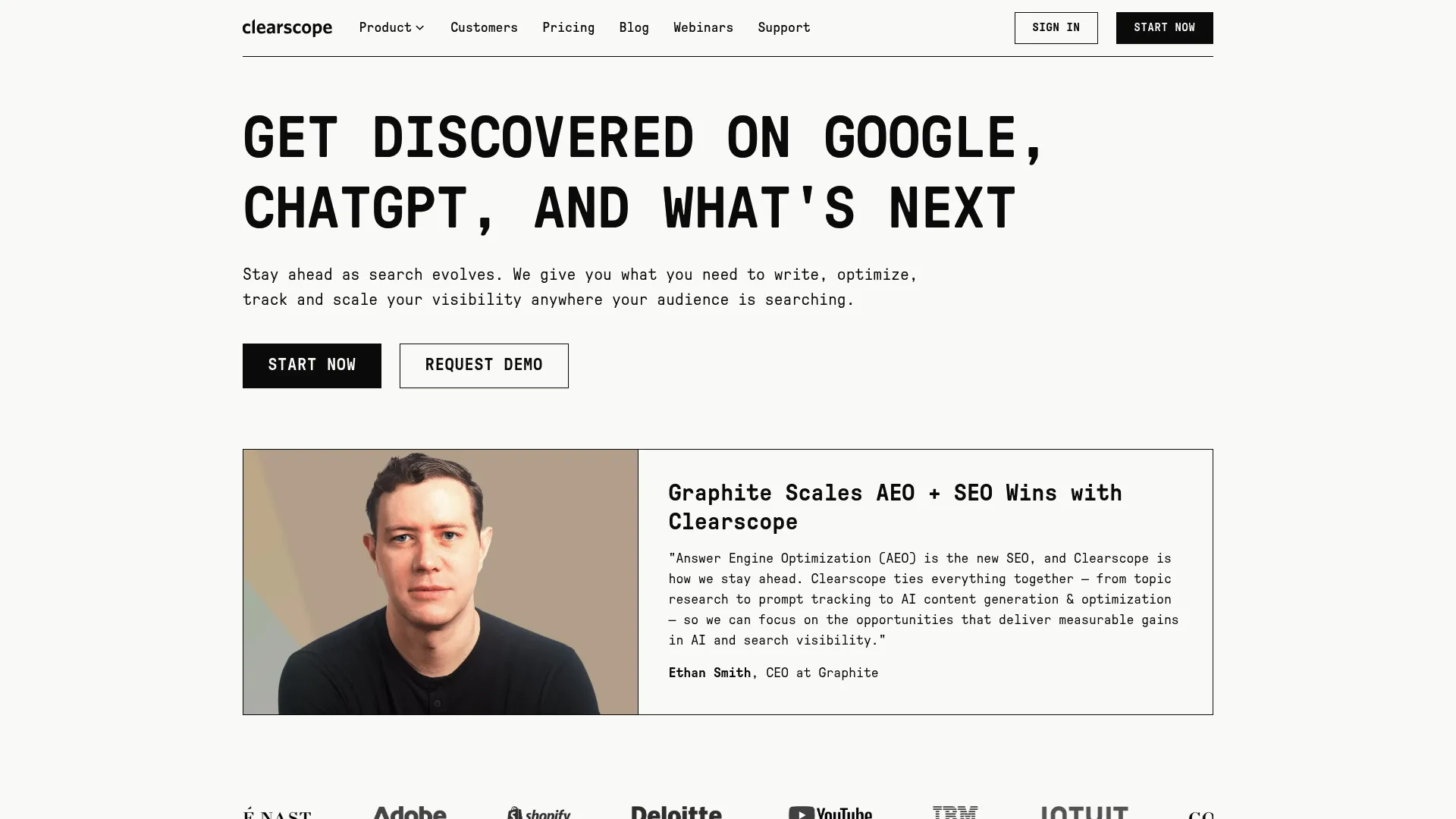
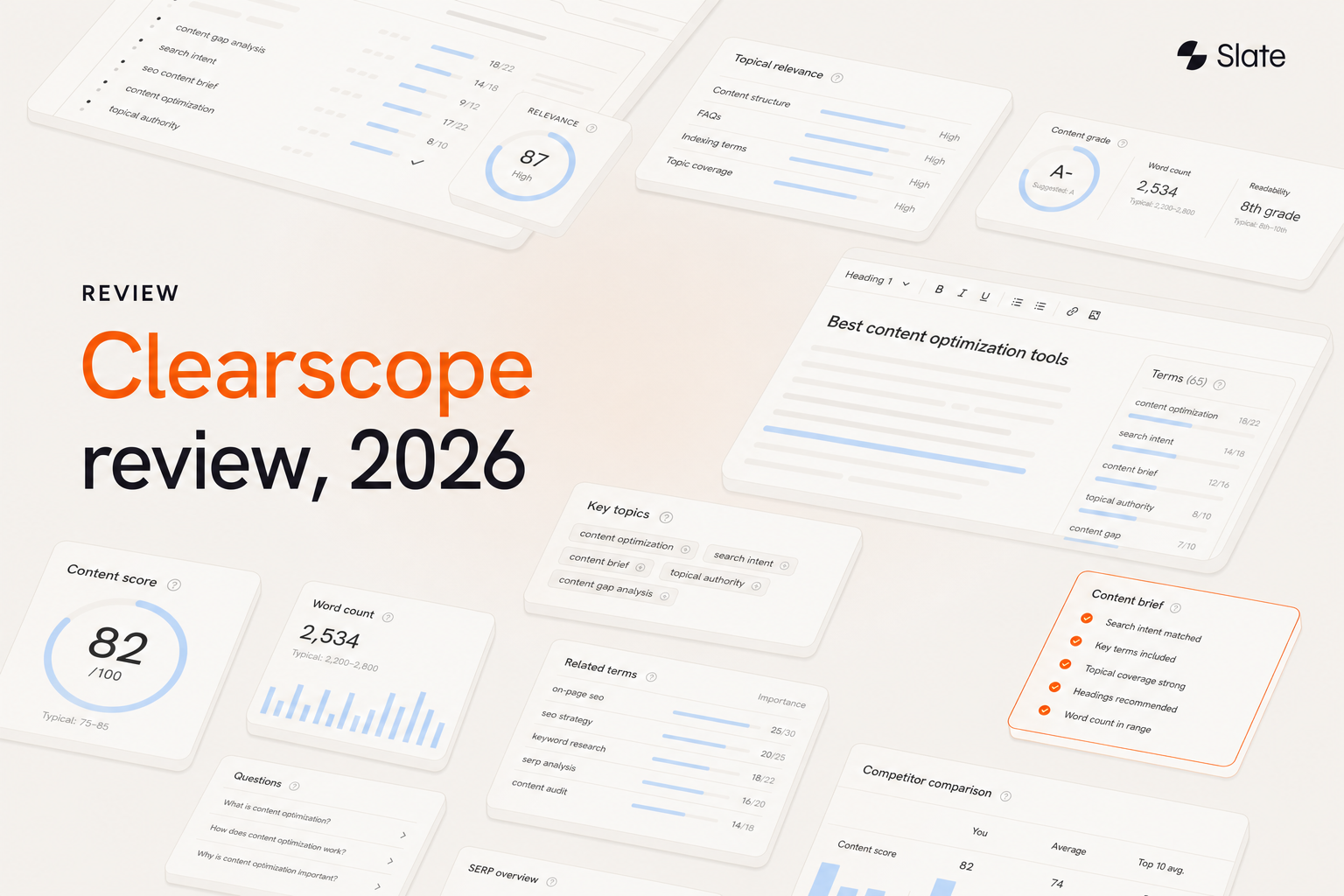
Clearscope works by building a topic model from the pages that currently rank for your target keyword, then grading your draft against those benchmarks. The grade reflects term coverage, content length, and readability relative to top-ranking content. Writers see a clean panel with a content grade, recommended terms with usage counts, heading suggestions, and competitor outlines while they draft.
The experience feels like a normal writing environment, which is why writers adopt it quickly. It plugs into the tools teams already use.
Integrations: Google Docs and WordPress, so writers can optimize without leaving their editor.
Best for: Writer-friendly teams that prioritize fast adoption and real-time, page-level optimization.
Key features: Real-time content grading, term recommendations, prompt and brand visibility tracking across Google, ChatGPT, and Gemini, and topic discovery for planning.
Pricing: Essentials $129/mo, Business $399/mo, Enterprise custom. All plans include unlimited users and projects; add-ons include extra pages and extra drafts.
G2 rating: 4.9/5
What Is MarketMuse?
MarketMuse is an AI-powered content planning and optimization platform that tells teams what content to create and how to improve it to rank better.
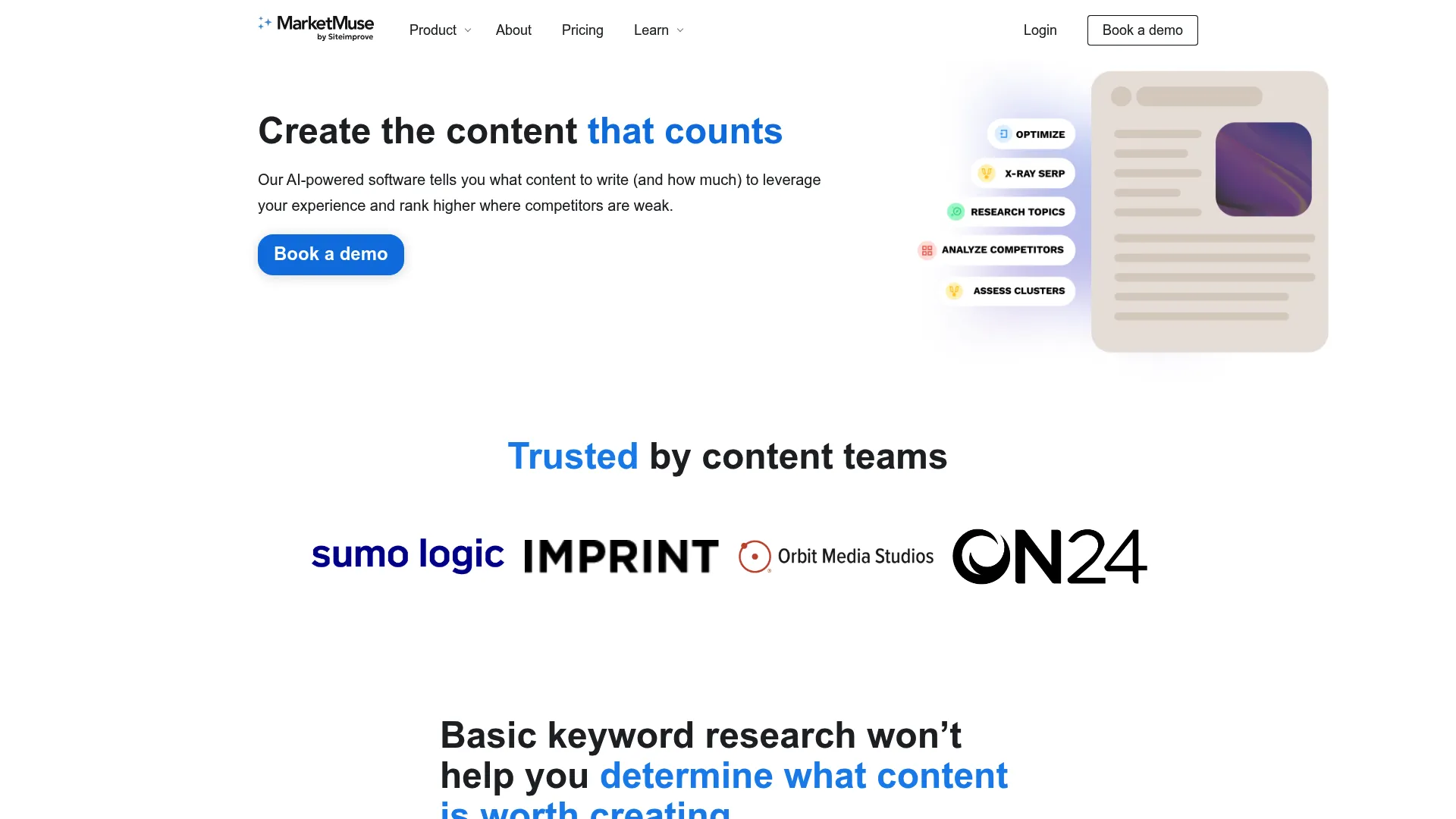
MarketMuse builds topic models by analyzing large sets of documents for a subject, then uses those models to identify topics, related concepts, user intents, and competitor coverage. It maintains a Content Inventory that maps topics to pages so teams can filter by authority, traffic potential, and content gaps. This is the planning layer Clearscope doesn't try to replicate. Teams focused on this work often compare dedicated content gap analysis tools alongside it.
Its personalized metrics are the differentiator. Personalized Difficulty shows how hard a topic is for your specific site, Topic Authority measures how authoritative your domain already is on a subject, and Competitive Advantage highlights where you can win with less effort.
Best for: Strategy-led teams that need site-wide prioritization and topical authority planning.
Key features: AI content planning and topic clustering, competitive gap analysis with personalized difficulty scoring, and content optimization with briefs, topic recommendations, and content scoring.
Pricing: Optimize, Research, and Strategy paid tiers (feature limits published, no public monthly price). Free tier includes 1 user and 10 queries/month.
G2 rating: 4.6/5
Clearscope vs MarketMuse: Feature-by-Feature Comparison
Feature lists tell you what each tool does. What matters more is who uses each feature and where the handoffs happen. Here's how they stack up on the decisions that actually shape a workflow.
Content Briefs and Optimization Guidance
Both tools generate briefs, but they aim at different readers. Clearscope briefs focus on term coverage, headings, competitor URLs, and length suggestions, designed for rapid, writer-friendly optimization. MarketMuse briefs go deeper, layering in subtopics, questions, SERP intent analysis, and cluster context tied to its topic model. If your bottleneck is writers producing optimized drafts, Clearscope is faster. If your bottleneck is connecting each piece to a larger strategy, MarketMuse gives more context.
Topic Modeling and Content Planning
This is where the two diverge most. MarketMuse builds site-wide topic models and a content inventory that knows where your pages stand, which makes cluster planning and gap analysis its strongest capability. Clearscope tracks which pages you've optimized but does not model topical authority across your site. For teams planning a category-wide content program, MarketMuse leads clearly. For teams optimizing pieces one at a time, Clearscope's lighter approach is usually enough. If clustering is central to your strategy, it's worth reviewing the best AI tools for topic clusters.
Editor Experience and Writer Adoption
Writers tend to adopt Clearscope faster because its editor mirrors a standard writing environment, with a content grade and term list right there in the draft. MarketMuse is more powerful but carries a steeper learning curve, since strategists must understand inventories, topic models, and proprietary metrics. In practice, MarketMuse is often owned by an SEO or strategist who translates its recommendations into briefs for writers.
Internal Linking and Clustering Recommendations
MarketMuse offers topic-based internal and external linking recommendations informed by its topic model, plus cluster visualization. Clearscope has no dedicated internal linking recommender; any linking is manual and left to the writer. If internal linking and cluster maintenance are part of your workflow, MarketMuse has a meaningful edge here.
AI Search and Visibility Features
This is the gap most buyers underestimate in 2026. Clearscope offers prompt and brand visibility tracking across Google, ChatGPT, and Gemini, which extends it beyond classic rankings. MarketMuse remains grounded in topics, inventory, and ranking-driven metrics. Both add optimization-layer features that help AI-readiness through better structure and coverage, but neither operates as a full AI-answer visibility and execution system. That distinction matters as discovery shifts toward AI SEO.
Clearscope vs MarketMuse Pricing: Which Is More Affordable?
There's no universal cheaper option. Clearscope starts at $129/mo with a clear, report-based structure, while MarketMuse offers a free tier and paid plans whose value scales with queries, pages, and domains rather than a flat per-article cost. Which one costs less depends on how many pieces you optimize and how large your site is.
Clearscope's Essentials plan is $129/mo, Business is $399/mo, and Enterprise is custom, with add-ons for extra pages and drafts. MarketMuse publishes Free, Optimize, Research, and Strategy tiers, with the Free tier limited to 1 user and 10 queries per month and paid tiers gated by feature limits rather than public monthly dollar figures. Frame the decision around value, not sticker price.
Real Cost at Publishing Volume
List prices rarely reflect what you'll actually pay. Clearscope's economics track to content reports, where roughly one report equals one optimized piece. A team publishing 10 pieces a month may sit comfortably on an entry plan, but 25 to 50 pieces pushes you toward higher tiers. MarketMuse's cost behavior is shaped more by queries, pages in inventory, and domains than by raw article count, so a small team researching many topics across a large site can hit higher tiers even at modest publishing volume. Map your real workflow against each tool's usage caps before committing.
Clearscope vs MarketMuse: Pros and Cons
Generic pros and cons don't help a buyer. Here's how each tool behaves on the operational dimensions that decide adoption: onboarding, writer adoption, strategist fit, and scale.
Clearscope Pros and Cons
Pros: Fast writer onboarding because the editor feels like a normal writing tool; strong real-time optimization UX with live grades and term recommendations; solid Google Docs and WordPress integrations; clear focus on page-level optimization rather than trying to be everything.
Cons: Limited strategic planning compared with a dedicated inventory tool; no native internal linking or clustering recommender, so prioritization happens elsewhere; report-based pricing can climb if you optimize many pages each month.
MarketMuse Pros and Cons
Pros: Deep planning and topic modeling for clusters, gap analysis, and prioritization; personalized metrics that make decisions site-specific; rich briefs tied to topic models and SERP intent; internal linking and clustering support through inventory views.
Cons: Steeper learning curve, since strategists must understand inventories and proprietary metrics; writer adoption friction, because writers often don't touch the platform directly; full value tends to live in higher tiers.
Who Should Use Clearscope, and Who Should Use MarketMuse?
There's no universal winner here, only a workflow match. The right call depends on who owns the tool, how your team is structured, and what stage your content program is in.
Choose Clearscope If…
- Your team is writer-centric and you want fast adoption with minimal training.
- Your bottleneck is writers producing optimized, on-page content quickly.
- You work with freelancers or external writers who live in Google Docs or WordPress.
- You already handle keyword research and planning with separate tools.
Choose MarketMuse If…
- You're a strategy-led team responsible for an entire content program, not single posts.
- You're building topical authority as a ranking concept across a category and need site-wide prioritization.
- You manage hundreds or thousands of URLs and a large backlog.
- You have a dedicated SEO or strategist to own the workspace and translate its output.
Best Fit by Company Stage and Team Structure
A solo SEO or a content lead working with freelancers usually gets faster value from Clearscope, since it keeps writers productive without heavy training. An in-house B2B SaaS team with one or two SEO specialists often runs Clearscope for writer workflow alongside separate planning tools, unless they want to centralize planning in MarketMuse. Mid-market growth orgs and publishers managing large inventories tend to favor MarketMuse for prioritization, sometimes pairing it with Clearscope for writer UX. For larger operations, see how the trade-offs play out for enterprise content teams and marketing agencies.
What Clearscope and MarketMuse Both Miss in 2026
Both tools are strong at what they were built for. But both were designed for a links-and-rankings era, and the buying question in 2026 has gotten wider than "which one scores content better?" Discovery now runs through answers and citations, not just ten blue links, and that exposes gaps neither tool was built to close.
The Execution Gap - Intelligence Without Action
Both platforms tell you what to do. Neither runs the full loop from opportunity discovery to brief to draft to review to publish to refresh. Clearscope grades the page in front of a writer. MarketMuse maps what to prioritize. But once the recommendation exists, the work of producing, approving, and shipping it at scale still falls back on your team and a patchwork of other tools. That's the difference between a recommendation layer and a content engineering system that actually executes.
AI Search Visibility and Citation Readiness
In 2026, content teams increasingly evaluate tools for extractability and AI visibility, not just rankings and content grades. Citation readiness is how well a page is structured, sourced, and formatted so AI systems can confidently quote it. Extractability is how easily a model can pull a clean definition, step, or table from your content. Neither Clearscope nor MarketMuse was built AI-search-first; their value remains anchored in ranking-oriented SEO, with AI features sitting on the optimization layer rather than measuring how answer engines surface your brand. Teams prioritizing this can explore dedicated AI search visibility tools to fill the gap.
Scaling Refresh Workflows Without Losing Quality
Refreshing dozens or hundreds of pages requires more than a score or a plan. It needs centralized state tracking, automated opportunity detection, multi-step approvals, and brand governance that enforces style and accuracy across AI-assisted drafts. MarketMuse gives you the inventory and prioritization; Clearscope gives you the editor. Neither orchestrates the production workflow itself. As volume grows, that gap turns into a bottleneck, which is why content operations best practices increasingly center on systems, not single-purpose tools.
Where Slate Fits - From Recommendation to Execution
The hidden buying question is simple: do you just need better recommendations, or a system that can act on them? Clearscope and MarketMuse answer the first. Slate is built for the second.
Slate is an AI search optimization and content engineering platform that connects insight to action in one system. It tracks AI search visibility across ChatGPT, Google AI Mode, Google AI Overviews, and Perplexity, surfaces content opportunities, and runs content through structured, repeatable workflows rather than ad-hoc writing. Its Power Sheets handle bulk refreshes, programmatic creation, and optimization audits across thousands of URLs, while CMS publishing pushes finished work directly to Webflow and WordPress.
The point isn't volume. Slate is built around governance and control, with a Brand Kit and knowledge base that enforce style, tone, and accuracy so scale doesn't erode quality. For teams that have outgrown a scoring editor or a planning layer, that's the gap it closes. Teams comparing options for SEO and content teams often find the real decision isn't Clearscope vs MarketMuse, but recommendation vs execution.
Pricing: Starting at $199/mo.
G2 rating: 4.9/5
You can book a demo to see how visibility tracking and governed execution work together.
Clearscope vs MarketMuse vs Other Alternatives
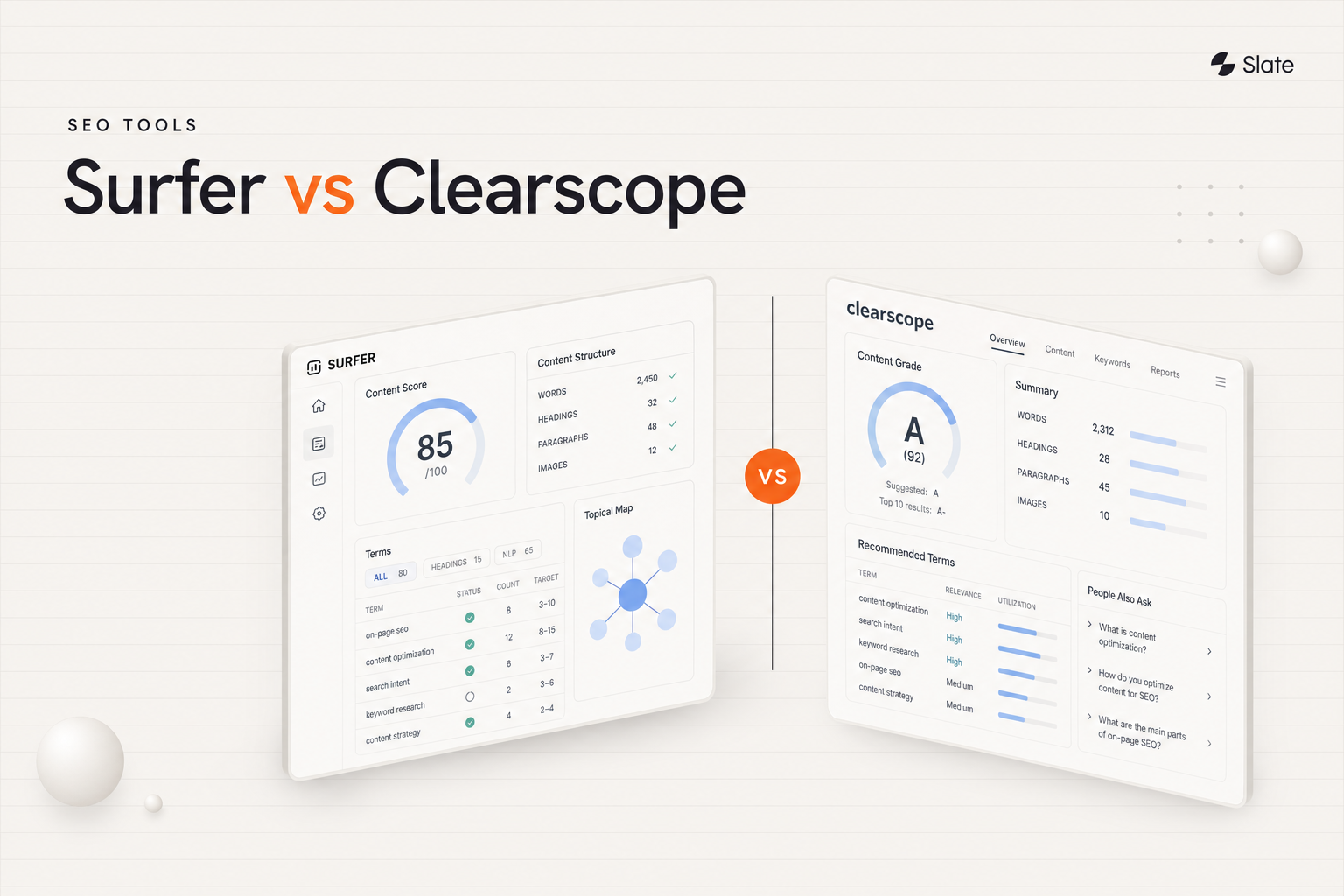
Clearscope and MarketMuse aren't the only names buyers weigh. Surfer is often grouped with Clearscope as a writer-first optimization tool, with broader on-page SEO features but less depth in topical intelligence than MarketMuse. MarketMuse generally sits at the deepest end of content planning and inventory, while Clearscope and Surfer compete more directly on editor UX and content scoring.
Slate occupies a different category entirely. Rather than scoring a draft or mapping a plan, it's a visibility-plus-execution system that orchestrates workflows and publishing. If you're weighing the writer-first editors against each other, Clearscope vs MarketMuse vs Surfer is a useful next read, and a broader scan of the best AI SEO tools helps place each one in context. For planning-heavy needs, compare options for topic clusters and content gap analysis.
Final Verdict - Clearscope vs MarketMuse
There's no single winner here, and choosing one as universally "better" misses the point. Clearscope wins for writer-friendly, real-time optimization and fast adoption. MarketMuse wins for strategic planning, topic modeling, and topical authority across a large site. The right pick is the one that matches where your workflow actually breaks down.
The bigger picture matters too. In 2026, the strongest move for many teams is a system that connects insight to execution and tracks AI visibility alongside traditional search, not just a tool that scores content. If your need is writers producing optimized drafts, choose Clearscope. If it's deciding what to build and refresh across a category, choose MarketMuse. If it's visibility tracking plus governed execution at scale, evaluate a content engineering platform like Slate and book a demo.
Frequently Asked Questions
What is the difference between Clearscope and MarketMuse?
Clearscope is a writer-facing tool focused on real-time, page-level content optimization and grading. MarketMuse is a strategist-facing platform focused on topic modeling, content inventories, and prioritization. Clearscope helps writers improve a draft; MarketMuse helps strategists decide what to create or refresh next across a site.
Is Clearscope better than MarketMuse for content optimization?
It depends on your workflow. Clearscope is stronger for real-time optimization and quick writer adoption, with a clean editor and content grades. MarketMuse is stronger for planning depth, cluster strategy, and site-wide prioritization. Neither is universally better; the right choice matches where your team's bottleneck actually sits.
Which is more affordable, Clearscope or MarketMuse?
Clearscope starts at $129/mo with report-based pricing, while MarketMuse offers a free tier and paid plans scaled by queries, pages, and domains. Which is cheaper depends on your publishing volume and site size, so map your actual usage against each tool's caps before deciding.
Who should use MarketMuse instead of Clearscope?
Strategy-led teams building topical authority across a category, running site-wide prioritization, and managing large inventories should lean toward MarketMuse, especially with a dedicated SEO or strategist to own the workspace. Its topic models and personalized metrics suit planning-heavy programs more than single-page optimization.
Which tool is easier for writers to use?
Clearscope is generally easier for writers to adopt because its editor mirrors a standard writing environment with a content grade and term list in the draft. MarketMuse is more powerful but carries a steeper learning curve, so strategists often own it and translate its output into briefs.
Can Clearscope or MarketMuse help with AI search visibility?
Clearscope offers prompt and brand visibility tracking across Google, ChatGPT, and Gemini, while MarketMuse stays focused on ranking-driven metrics. Both add optimization-layer features that support AI-readiness, but neither was built as a full AI-search-first visibility and execution system.
What should teams use if they need both strategy and execution?
Teams needing visibility tracking plus governed execution at scale should evaluate a content engineering platform like Slate. It connects AI search visibility, opportunity discovery, workflow automation, and CMS publishing in one system, so insights turn into shipped, brand-safe content without a patchwork of separate tools.