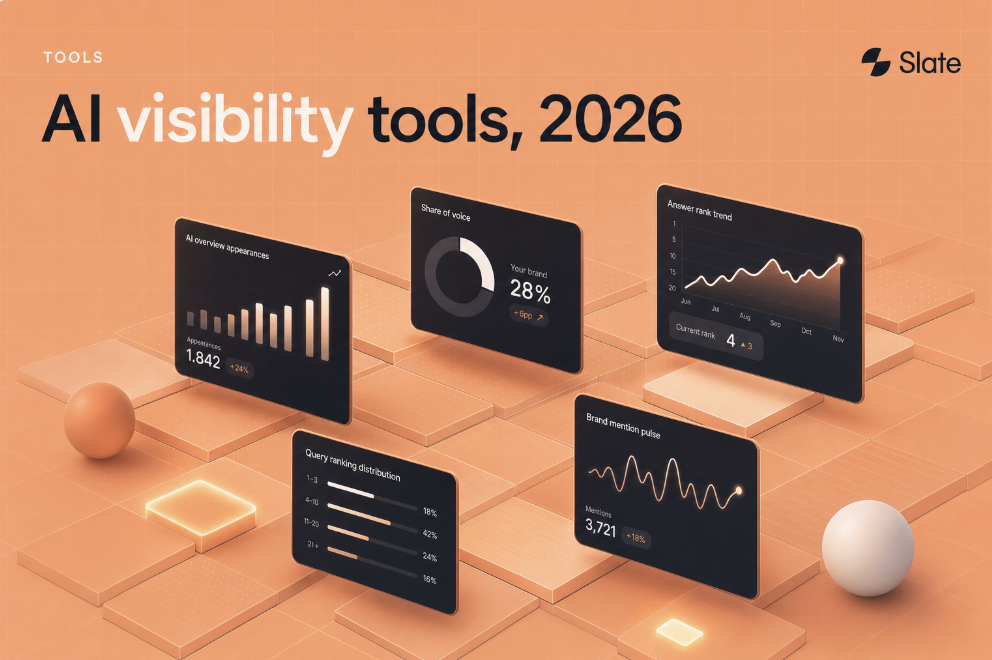
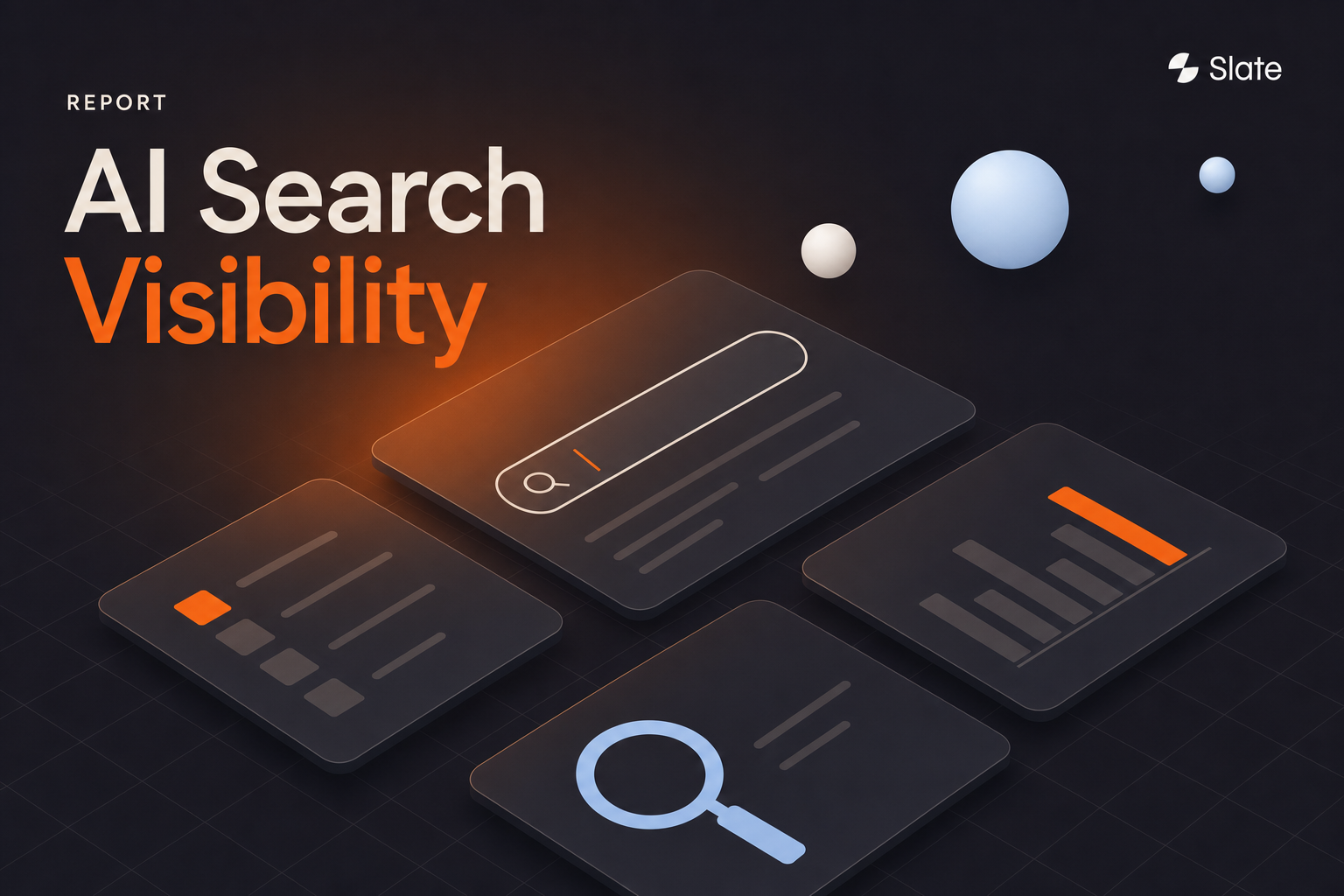
Search has split into two surfaces, and most marketing teams are still measuring only one of them. This report examines how brands appear, get cited, and compete inside AI-generated answers across engines like ChatGPT, Perplexity, Google AI Overviews, and Bing Copilot, and gives growth teams a measurement framework they can run on a cadence.
AI search visibility is the degree to which a brand is included, cited, mentioned, or summarized inside AI-generated answers across engines like ChatGPT, Perplexity, Google AI Overviews, and Bing Copilot. Unlike a ranking position, it measures whether your content becomes part of the answer itself, not just a link a user might click.
Key takeaways
- AI search visibility is now a distinct reporting layer from organic rankings, not a derivative of them.
- Citation behavior diverges across engines, so a single-platform snapshot is not a reliable benchmark.
- Freshness appears to correlate with citation retention over time, suggesting refresh cadence is an operational lever, not a vanity exercise.
- Query category materially affects whether a brand appears, gets cited, or loses visibility to third-party sources.
- The mix of owned versus third-party citations shifts by funnel stage and prompt type.
- Structured, extractable content shows up more consistently than loosely organized pages.
- A repeatable measurement framework matters more than any one-time snapshot, because visibility is volatile and changes between checks.
Why AI search visibility became a board-level question in 2026
For most of the last decade, the discovery conversation inside marketing teams was about rankings and links. In 2026, that conversation has moved up a level. When buyers ask an AI engine a question and get a synthesized answer with a handful of cited sources, the brands inside that answer win attention before a single blue link is considered.
This is why visibility is now a reporting line that CMOs and founders ask about directly. The question is no longer only "where do we rank," but "do we show up when an AI system answers the questions our buyers are actually asking." That shift reframes organic growth as a system of citations and entity authority, and it pushes the topic out of the SEO team's spreadsheet and into the leadership review. For teams new to this discipline, Slate's primer on AI SEO fundamentals lays the groundwork.
Discovery has split into two surfaces
The old surface still exists. People search Google, scan results, and click. But a second surface now sits in front of it, where an engine reads across many sources and returns one answer. On that surface, the unit of success is not a position, it is inclusion in the answer and attribution as a source.
The strategic consequence is uncomfortable for teams that think page by page. A site can rank well on the classic surface and still be absent from the answer surface, because the two systems select and reward content differently. Treating them as one channel is the fastest way to misread your own performance. For a longer view of how this plays out, see Slate's perspective on the state of AI search.
Why snapshots aren't enough anymore
A single check tells you almost nothing durable. The same prompt can return different cited domains across engines, and the same engine can return different sources from one week to the next. A snapshot captures a moment, not a trend, and moments are easy to misinterpret as wins or losses.
This report tracks visibility over time rather than in a single snapshot, because volatility is itself a finding. If your cited-source set churns, that is signal - it tells you which pages hold their place and which ones drift out of answers between refreshes.
What is AI search visibility?
AI search visibility is the degree to which a brand is included, cited, mentioned, or summarized inside AI-generated answers across engines like ChatGPT, Perplexity, Google AI Overviews, and Bing Copilot. It measures whether your content becomes part of the answer, not just whether a page exists in an index or ranks on a results page.
The important shift is conceptual. Classic SEO asks whether a page can be found. AI search visibility asks whether a brand gets used - pulled into the synthesized response, attributed as a source, or named as an option. Those are different outcomes that demand different measurement, and conflating them produces reports that look reassuring while missing where discovery actually happens. Slate's AI search visibility report tracking treats these as separate signals on purpose.
Citation vs mention vs inclusion - why the distinction matters
These terms are used loosely in most coverage, which makes benchmarks hard to compare. Reporting only holds up when each term means one specific thing.
How AI search visibility differs from SEO rankings
The two systems share inputs but reward different outcomes. Treating one as a proxy for the other is where most reporting goes wrong.
How Slate measured AI search visibility in 2026
Measuring an answer surface credibly requires fixed rules, because the surface is noisy. The standard that separates a usable benchmark from an anecdote is a defined prompt set, consistent scoring definitions, and repeated collection across the same engines. Anything less produces numbers that cannot be compared over time.
The methodology below sets out the shape of that approach. Slate's analysis is presented as the original contribution; where industry context is useful, it is drawn from published 2026 research on AI visibility and citation behavior.
Methodology snapshot
- Sample: A Fixed prompt set spanning multiple brands, domains, and query types
- Date range: A Repeated collection window designed to compare changes over time
- Engines tested: ChatGPT, Perplexity, Google AI Overviews, and Bing Copilot where available
- Prompt rules: Fixed phrasing, neutral intent, logged-out where possible, repeated on a set cadence
- Scoring: Answer inclusion, citation, mention, and top-citation share scored per prompt per engine
For teams building their own version of this, Slate's guidance on how to measure AI search visibility walks through the same principles applied to a smaller in-house prompt set.
How we built the prompt set
A prompt set is only useful if it mirrors how buyers actually ask. That means moving past one bucket of "AI search" prompts and into a taxonomy that reflects the buying journey. Each category behaves differently, so each is tracked separately.
- Informational: Definitional and how-to questions
- Commercial investigation: "Best tool for," "software for"
- Category comparison: "X vs Y" head-to-head prompts
- Alternatives and replacement: "Alternatives to X," "X replacement"
- Use-case and jobs-to-be-done: Outcome-led questions tied to a workflow
- Brand-led: Prompts that name a specific brand
Prompt counts per category: Balanced enough to compare categories without letting any single prompt type dominate the sample.
The visibility metrics we defined
A shared metric vocabulary is what makes the findings reproducible. These are the seven measures the report uses throughout.
Limitations and what this data does not mean
These benchmarks describe patterns, not guarantees. AI engines vary their output between sessions, personalize by account and location, and regenerate answers in ways that introduce noise. A single prompt rerun can return a different source set, which is why the report relies on repeated collection rather than one-time reads.
The figures should be read as directional ranges, not fixed scores. They indicate where visibility tends to concentrate and how it tends to move, and they are most useful as a baseline you re-measure rather than a verdict you cite once.
Benchmark findings: how often brands appear across AI search engines
The headline pattern is divergence. Engines do not select the same sources for the same question, which means a brand can be highly visible in one and nearly absent in another. This is consistent with published 2026 research showing weak correlation between classic ranking and citation rate across AI systems.
The table below frames the cross-engine view the report uses. Slate's first-party figures populate each cell once verified.
So what for marketers: A Strong inclusion rate in one engine does not transfer automatically to another. If leadership asks "are we visible in AI search," the honest answer is engine-specific, and your reporting should reflect that rather than averaging it into a single misleading number. Slate's AI search analytics benchmarks view is built to keep these engines separate.
Where engines agree - and where they diverge
Overlap tends to be stronger on straightforward factual prompts and weaker on commercial or comparison prompts, where engines often pull from very different source mixes. That divergence is the practical reason single-platform monitoring misleads - the engine you happen to check may be the one where you look strongest or weakest. Perplexity's approach to source citation illustrates this divergence.
Cross-engine source overlap: Directionally limited, which is why single-engine monitoring creates blind spots.
So what for marketers: Pick the engines your buyers actually use, then track all of them. Optimizing for the one engine you measure is how teams convince themselves they are winning while losing on the surfaces that matter. The right AI brand monitoring tools make cross-engine tracking practical.
What a realistic 2026 benchmark looks like for B2B SaaS
B2B SaaS sits in a harder spot than consumer categories because so many high-intent prompts are commercial or comparison-led, where third-party sources carry weight. Realistic targets are therefore lower and more category-specific than a blended "average visibility" number would suggest. Slate's overview of AI SEO tools for B2B SaaS maps this terrain in detail.
B2B SaaS visibility ranges: Best interpreted by engine and prompt category rather than as a single site-wide benchmark.
So what for marketers: Set Internal targets per prompt category and per engine, not as one site-wide percentage. A baseline that ignores category will reward the wrong work.
How AI visibility differs by query category
Treating "AI search" as one surface hides the most actionable finding in the dataset: visibility is largely a function of what is being asked. The same brand can dominate informational answers and disappear in comparison answers, because the engines weight source types differently by intent.
Informational prompts vs commercial prompts
Informational prompts tend to favor clear, well-structured explanatory content, which is why owned documentation, glossaries, and definitional guides do well there. Commercial prompts behave differently - they pull in review sites, listicles, and third-party roundups, so a brand's own page is competing against aggregators rather than just other brands.
Inclusion split informational vs commercial: Informational prompts usually give owned content a clearer path, while commercial prompts rely more heavily on third-party validation.
So what for marketers: Win Informational prompts with your own structured content, but accept that commercial prompts require off-site presence too. You cannot publish your way into a category answer that is built mostly from third-party sources.
Comparison and "alternatives" queries - the highest-stakes category
For SaaS pipeline, comparison and alternatives prompts are where deals are quietly shaped. When a buyer asks an engine "alternatives to [incumbent]," the answer becomes a shortlist, and being absent from it removes you from consideration before a demo is ever booked. How buyers use AI tools in B2B software research confirms this pattern.
Citation concentration on comparison queries: Often concentrated among a smaller set of review, directory, and roundup sources.
So what for marketers: These Prompts often concentrate citations in a few third-party sources, so visibility here usually depends on earned coverage, not just your own comparison pages. Slate's analysis of brands in AI search results shows how challenger brands break into these answer sets.
Brand-led prompts and discoverability before awareness
Brand-led prompts are the easiest to win and the least leveraged, because they assume the buyer already knows your name. The bigger opportunity sits upstream, in category prompts where visibility compounds into recall.
When you appear consistently in category answers, you train future brand-led searches. Discoverability before awareness is the mechanism - buyers meet you inside an answer, then come back and ask for you by name.
What signals correlate most with AI answer inclusion
The signals that drive inclusion are not new to SEO, but their relative weight has shifted. Across research on AI answer engine citation behavior, three themes recur: content needs to be current, it needs to be extractable, and the brand needs entity authority that extends beyond its own domain. One large 2026 dataset found editorial mentions were materially more predictive of inclusion than backlinks, which reframes where effort should go, a finding echoed by a study finding editorial mentions outperform backlinks for AI inclusion.
These signals do not operate in isolation. The teams that see consistent inclusion treat them as a system, not a checklist. Slate's breakdown of AI search ranking factors goes deeper on how engines weigh them.
Freshness and citation retention
Freshness shows up less as a ranking trick and more as a retention mechanism. Pages that are kept current appear to hold their place in answer sets longer, while stale pages drift out as engines refresh their source preferences. This echoes established findings on content freshness signals in search ranking. Recency alone is not the driver - a thin new page does not win - but a substantive page that is maintained tends to persist.
Refresh cadence vs citation retention: Maintained pages tend to hold visibility more reliably than neglected ones.
So what for marketers: Build A refresh cadence for your highest-value pages instead of treating publication as the finish line. Retention is earned by maintenance. Slate's guide to the best content refresh tools can help operationalize that cadence.
Structured, extractable content
Extractability is where content engineering earns its keep. AI systems pull passages, not whole pages, so content built as clear, self-contained units gets used more reliably than dense, meandering prose, which is grounded in how large language models retrieve and cite sources. The practical markers are consistent: a logical heading hierarchy, direct-answer blocks near the top of each section, modular facts that stand alone, and sequential structure an engine can lift without losing meaning, much like the role of structured data and schema for AI search.
A definitional sentence that answers the question in the first line of a section is far easier to quote than the same fact buried in paragraph four. The same applies to tables, ordered steps, and tight definitions - they are easy to extract, so they get extracted.
Structured vs unstructured citation rate: Structured, direct-answer formats tend to be cited more consistently than loosely organized pages.
So what for marketers: Engineer Pages for extraction before you scale volume. Slate's generative engine optimization report details the structural patterns that travel best across engines.
Entity authority and off-site signals
A brand's authority is not contained on its own site. Engines appear to weigh how often and how credibly a brand is discussed elsewhere - in editorial coverage, reviews, communities, and documentation - when deciding whether to trust it as a source. This is why purely on-site optimization hits a ceiling on commercial prompts.
Third-party mention density vs citation frequency: The relationship appears positive, especially where independent validation matters most.
So what for marketers: Treat Earned mentions as an inclusion input, not a brand-awareness afterthought. Off-site reinforcement is part of the visibility system.
How these signals interact (not compete)
The mistake is single-lever thinking - assuming one fix, like adding schema or publishing more, will move visibility on its own. In practice, freshness, structure, and entity authority compound. A well-structured page that is maintained and supported by credible off-site mentions outperforms any one of those signals working alone. Visibility emerges from the system, not from a single page.
Owned content vs third-party sources: what drives citations
The source behind a citation matters as much as the citation itself, because it tells you where you can actually intervene. Owned content you can engineer directly. Third-party sources you can only influence. The mix between them shifts by prompt type and funnel stage, which is why a single "citation count" hides the real story.
Source mix percentages: The balance shifts by query type, with informational prompts favoring owned sources more often and commercial prompts drawing more heavily on third-party coverage. Slate's AI search citations report tracking breaks these down by engine.
When third-party coverage outperforms owned content
On commercial and comparison prompts, third-party sources frequently outweigh anything a brand publishes about itself, because engines treat independent coverage as more trustworthy for buying decisions. No amount of owned comparison content fully substitutes for being named in a credible third-party roundup.
Query types where third-party sources dominate: Commercial investigation, comparison, and alternatives prompts.
So what for marketers: For High-intent buying prompts, invest in earned coverage and accurate third-party listings alongside owned pages. Owned content sets the narrative; third-party content validates it.
The role of documentation, glossaries, and original research
Where owned content does win, the pattern is consistent. Documentation, glossaries, and original research get cited because they are precise, self-contained, and hard to find elsewhere. Original research in particular earns citations because engines reward sources that supply a fact nobody else has.
Citation rate by content format: Documentation, glossaries, original research, and direct-answer guides tend to be the strongest owned formats.
So what for marketers: Prioritize Formats with high extractability and genuine information gain - definitions, structured docs, and first-party data - over thin posts that restate what already exists.
How much organic search overlap exists with AI visibility
The most consequential finding for SEO reporting is that AI-cited URLs and top-ranking URLs are not the same set. A page can be cited in an answer without ranking on the first page of Google, and a page can rank well without ever appearing in an answer. Published 2026 research on Google rank versus LLM citation rate points to weak correlation between Google rank and LLM citation rate, which aligns with this report's framing.
For the deeper view on this gap, see Slate's work on LLM search visibility.
Where non-ranking pages still win citations
Non-ranking pages that still get cited tend to share a trait: they answer a specific question cleanly even if they never accumulated the links to rank. Glossary entries, niche documentation, and focused FAQ pages often punch above their organic weight because they are easy to extract and precisely on-topic.
Examples of non-ranking content that gets cited: Glossary entries, niche documentation, focused FAQs, and tightly scoped explainers.
So what for marketers: Stop Dismissing pages with low organic traffic as low value. Some are doing visibility work that your ranking report cannot see.
What this means for SEO reporting in 2026
AI visibility does not replace ranking reports - it sits alongside them as a second layer. The teams reporting credibly in 2026 show both: where they rank, and where they get cited, with a clear note that the two do not always move together.
The practical implication is a reporting redesign. Add answer-surface metrics to the dashboard rather than retrofitting AI visibility into a column built for keyword positions.
What winning brands do differently
The brands that show up consistently are not running clever one-off tactics. They treat visibility as an operating system. Each trait below follows the same logic: what the data suggests, why it matters in answers, what to do on-site, what to reinforce off-site, how to measure it, and what to watch by engine.
They treat visibility as a system, not a one-off
The pattern in the data is that consistent performers run repeatable workflows rather than sporadic optimizations. It matters because answer surfaces are volatile, and only a system survives that churn. On-site, that means standardized page structures and refresh schedules; off-site, it means an ongoing earned-coverage motion. Measure it with a fixed prompt set re-run on a cadence, and watch for engines where your system holds versus drifts.
Anonymized answer-surface pattern: Consistent performers usually pair strong informational coverage with selective third-party validation on commercial prompts and lower source churn over time.
They engineer content for extraction
Winning brands write for extraction, not just for reading. They lead sections with direct answers, break facts into modular units, and use tables and ordered steps where they help an engine lift content cleanly. On-site, this is content engineering; off-site, it is making sure third-party descriptions of you are accurate. Measure it through citation frequency on structured versus unstructured pages, and watch engines that favor passage-level extraction most.
They track across engines, not one platform
They never trust a single engine's view. Because cited-source sets diverge, measuring one platform produces a distorted picture. On-site work stays the same, but reporting covers every engine the buyer uses. Measure with engine overlap and per-engine inclusion rates, and watch for engines where you are unexpectedly weak - those are the gaps competitors exploit. Comparing the leading AI citation tracking tools is a good place to start here.
They maintain refresh cadence on high-value pages
High performers keep their most important pages current as a standing process. Freshness supports citation retention, so a refresh cadence protects visibility you already earned. On-site, that means scheduled updates to priority pages; off-site, it means keeping listings and profiles accurate. Measure with volatility index on key pages, and watch for engines where stale content drops out fastest.
Worked example: A Common pattern is stronger inclusion on structured informational pages first, followed by improved comparison visibility after third-party coverage becomes more consistent.
What marketers should do in the next 90 days
The goal for the next quarter is not perfection, it is a baseline and a system. The sequence that works is measure first, prioritize by impact, engineer and re-check on a cadence, then build a reporting layer leadership trusts.
Measure first - establish your baseline
You cannot improve what you have not measured, and a one-time check is not a baseline. Build a fixed prompt set across your real buyer questions, run it across the engines your buyers use, and record inclusion, citation, and top-citation share per prompt per engine.
Minimum prompt set size: Large enough to cover each prompt category consistently and small enough to rerun on a fixed cadence.
The principle holds regardless of the exact number: enough prompts per category to see a pattern, not so many you cannot re-run them on schedule. Slate's view on share of voice in AI search covers how to weight that prompt set.
Prioritize pages and prompts by impact
With limited resources, sequence by revenue proximity. Commercial and comparison prompts sit closest to pipeline, so fixes there usually return faster than broad informational coverage. Cross that intent map with where you are currently absent, and the priority list builds itself.
Rank opportunities by two axes: how close the prompt is to a buying decision, and how far you are from being included. Start where both are high. Slate's framework for brand visibility in AI search helps structure that prioritization.
Engineer, publish, and re-check on a cadence
Treat this as a loop, not a project. Engineer the priority pages for extraction, reinforce them with off-site work where the prompt demands it, then re-run the prompt set on a set interval to see what moved. Monthly is a reasonable starting cadence for most teams, tightened for fast-moving categories.
The re-check is what turns activity into learning. Without it, you are publishing into a surface you cannot see.
Build an executive-ready reporting layer
Leadership does not need every prompt, it needs a clear story. A useful executive layer shows answer inclusion rate, top-citation share, engine coverage, owned versus third-party mix, and volatility trend, each tied to the prompt categories closest to revenue.
That set explains both where you stand and where you are exposed, in language a CMO or board can act on. Slate's AI search visibility report view is built around exactly these metrics.
AI search trends to watch through 2026
The durable trends are the ones already visible in the data, not the speculative ones. AI search market growth and adoption forecasts underscore why these trends matter now. Three stand out, and each is something teams can prepare for now rather than predict. Slate's roundup of AI SEO statistics collects the numbers behind these shifts.
Visibility volatility is becoming a tracked metric
Volatility is moving from an annoyance to a measured signal. As teams realize cited-source sets churn between checks, they are starting to track that churn deliberately, because a page that holds its citation is more valuable than one that flickers in and out.
Volatility and source churn over time: Meaningful enough to justify repeated measurement rather than one-off checks.
Reporting is shifting from rankings to answer surfaces
The reporting stack is being rebuilt around answers. Teams are adding answer-surface metrics next to ranking metrics, and the most mature ones lead with citation data when the audience is leadership. Slate's coverage of AI Overviews brand visibility tracks how this plays out inside Google specifically.
Governance and brand control in AI content workflows
As teams scale content to chase visibility, the risk is generic, off-brand, or inaccurate output diluting authority. The trend is toward governed workflows - style guides, knowledge bases, and review steps - that let teams scale without losing voice or accuracy. Volume without control erodes the very authority that drives citations.
Methodology, definitions, and research notes
This appendix restates the report's method and metric definitions so analysts and consultants can evaluate and reproduce the approach. The principle throughout is separation: industry context drawn from published 2026 research, Slate's first-party analysis as the original contribution, and recommendations grounded in measured findings rather than speculation.
Data collection process
Collection follows fixed rules so results can be compared across time and engines.
- A defined prompt set spanning the full taxonomy: informational, commercial, comparison, alternatives, JTBD, brand-led
- Consistent prompt phrasing with neutral intent, run logged-out where possible
- Repeated collection across the same engine set on a set cadence
- Per-prompt, per-engine scoring of inclusion, citation, mention, and top-citation share
Full sampling and collection detail: The report should document prompt inclusion rules, scoring logic, exclusions, rerun cadence, and any normalization choices so results can be compared over time.
Metric definitions glossary
Chart source notes and reproducibility
Each chart in the full report carries its own note: date collected, engine set, sample definition, and any exclusions. Slate's first-party figures are presented as directional ranges drawn from repeated collection, and industry context is attributed to published 2026 research on AI visibility and citation behavior. Where a figure is engine-specific, it is reported per engine rather than blended.
Frequently asked questions
What is AI search visibility?
AI search visibility is how often a brand is included, cited, mentioned, or summarized inside AI-generated answers across engines like ChatGPT, Perplexity, Google AI Overviews, and Bing Copilot. It measures whether your content becomes part of the answer itself, not just whether a page ranks or sits in a search index.
How do you measure AI search visibility?
Measure it with a fixed prompt set scored across engines on a cadence, using seven metrics: answer inclusion rate, citation frequency, top-citation share, prompt coverage, engine overlap, owned versus third-party mix, and a volatility index. A repeatable framework matters more than any single snapshot, because answer surfaces change between checks.
What does the 2026 state of AI search show for brands?
Three patterns hold. AI visibility is a distinct layer from organic ranking, citation behavior diverges sharply across engines, and query category strongly predicts whether a brand is included. The practical takeaway is to measure visibility by engine and by prompt type rather than as one blended score.
Which tools can track AI search visibility?
Look for tooling that tracks inclusion and citations across multiple engines, supports a repeatable prompt set, and reports owned versus third-party source mix rather than a single blended score. Slate's track AI search performance tooling is built around a cross-engine prompt set and an executive reporting layer.
Why can a brand rank in Google but not appear in AI answers?
Ranking and answer inclusion are decided differently. Ranking rewards links and relevance for a page; inclusion rewards extractable passages, entity authority, and freshness, and each engine selects sources on its own logic. A page can rank well yet be too dense or insufficiently authoritative to be pulled into an answer.
What is the difference between a citation and a mention?
A citation attributes your URL as a source for the answer, while a mention names your brand in the answer text without a linked source. Both signal visibility, but a citation is the stronger, more defensible outcome because it ties the answer directly to your content and tends to drive referral paths.
Which content types get cited most often in AI search?
Structured, extractable formats lead: documentation, glossaries, original research, and direct-answer guides, because they supply precise, self-contained facts. On commercial and comparison prompts, third-party sources like review sites often dominate. The exact mix still varies by engine and prompt type.
How often does AI search visibility change?
Frequently. The same prompt can return different cited sources across engines and from one check to the next, which is why volatility is tracked as its own metric. Most teams re-run their prompt set monthly, tightening the cadence in fast-moving categories where source sets churn quickly.
See how your brand appears across ChatGPT, Perplexity, Google AI Overviews, and Bing Copilot, then turn those findings into a repeatable system. Book a demo to map your AI search visibility and build the reporting layer your leadership team is already asking for.