Every startup marketer has lived this sequence of frustration:
You've built a better product.
You know your buyer deeply.
You could explain the problem you solve in your sleep.
And yet, you're somewhat invisible in Google.
The incumbents, the “Big Players” - they dominate page one.
Sheer content volume, domain authority accrued over a decade, and massive link portfolios - all of these are on their side.
But…
This was the old game. It structurally favored the big.
AI search is here to rewrite these rules.
ChatGPT, Perplexity, Claude, Gemini, and Google's AI Overviews barely care about “scale.”
And this is fantastic news for lean teams.
With AI Search, the playing field for organic marketing is finally levelled. Winning isn't ranking #1. It's also being cited by AI.
Past constraints (small team, limited budget, narrow focus) are starting to look a lot more like strategic assets.
In this piece, we explain why this is the case through these lenses:
- Why AI search advantages challengers
- Factors that drive AI visibility
- Actionable AI Search strategies
- Sustainable operating principles for small teams
And much more.
By “challengers,” we don’t mean a budding sports team, but the “underdogs” - essentially startups, scaleups, etc
And by “incumbents,” we refer to the larger players.
Why AI Search is a Goldmine for Challenger Brands
Google rewarded domain authority, backlink volume, and publishing frequency.
If you were a Series A company going up against an established player with 2,000 indexed pages and a DR of 80+, the math simply didn't work.
You could produce excellent content and still land on page three because the algorithm privileges signals that take years to build.
AI search engines work differently, however.
They construct an answer by drawing on sources they determine are most relevant, accurate, and clearly structured for the query.
The signals that you need to rank have changed:
- Semantic depth over keyword density
- Structured clarity over publishing cadence
- Genuine expertise over generic coverage
And more good news for challengers: AI search doesn't ask "how big is this brand?" It asks, "Does this content answer the question better than anything else available?"
Sharper positioning, deeper category knowledge, and more authentic expertise are what they care about, and they know how to present it to your audience.
With roughly 60% of Google searches now ending without a click to any website, the old click-through playbook is anyway losing ground.
Meanwhile, AI-referred traffic converts at 4x that of Google.
So, it's pretty clear where small teams have higher potential.
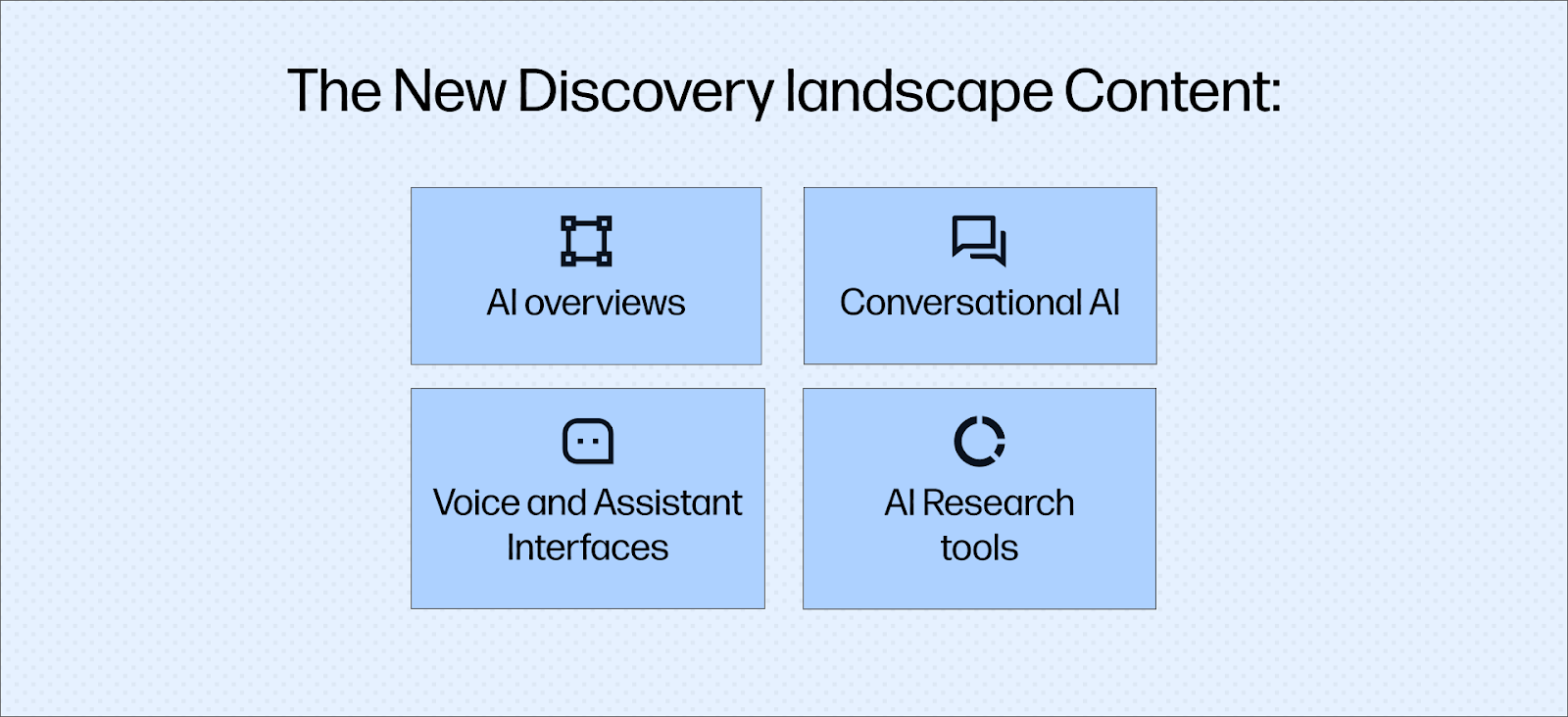
Here's the new discovery landscape that challenger brands need to master:
- AI Overviews (Google): AI-generated summaries appearing above traditional results, pulling from multiple sources. Your content can be cited here even if you don't rank in the traditional top 10.
- Conversational AI (ChatGPT, Claude, Gemini): Users ask direct buying questions and get synthesized recommendations. Brands are either mentioned in these conversations or they're invisible.
- AI-powered research tools (Perplexity): Buyers use these for product research and comparison. Citations here often link directly to the source, driving high-intent referral traffic.
- Voice and assistant interfaces: A growing share of discovery happens through Siri, Alexa, and Google Assistant, all powered by AI that selects a single answer. Being that answer is the new "position zero."
These platforms together generated 1.13 billion referral visits in June 2025 alone, a 3x year-over-year increase.
Hence, this is no longer an “emerging channel,” but one that is actively generating leads.\
What Gives Challenger Brands a True Advantage in AI SEO
In four ways, challengers are naturally positioned better for AI Search:
Agility & Speed to Execute
In traditional SEO, slow-and-steady content programs could gradually build authority.
In AI search, the landscape is very fast. AI models are always updating their indexes, and new citation patterns are always emerging.
In fact, 95% of URLs cited by AI were just 10 months old, so your content needs to be updated at a rapid pace as well!
With the right content creation tools, challenger brands with 1-5-person marketing teams can move from insight to published content in hours, not days. They don't need writer turnaround cycles.
Whenever there’s a new category question trending in AI conversations, a startup team can publish a definitive answer using tools like Slate before the incumbent even schedules the briefing.
Although startups can benefit from low-hanging fruit, the success in this goes beyond that.
The first clear, well-structured answer to an emerging question often becomes the one AI systems cite going forward for a long time.
So the “first mover advantage” is pretty huge!
Clearer Category POV
Incumbents spread their content across dozens of product lines, use cases, and buyer segments. This content often reads as generalist by necessity, covering broad topics to serve a much wider audience.
Challengers, by contrast, are usually built around a single sharp insight: a specific problem they solve better than anyone else.
This narrow focus naturally produces the depth and specificity that AI systems seek when selecting sources to cite.
And this leads to one thing that AI search rewards the most: Topical Authority.
Closer Customer Proximity
Challenger teams talk to customers weekly, sometimes daily.
They are deep into:
- The exact language buyers use
- The specific objections they raise
- The precise questions they Google at 11 pm before a decision
- Their favorite dog/cat species
This proximity is a content superpower that's nearly impossible for large organizations to replicate.
And this leads to the other thing AI search loves: Relatability.
Authentic Expertise
When a founder writes about the problem they spent three years solving, or a content engineering expert explains a concept from firsthand experience, that content carries a different signal than a blog post based on secondary research.
AI systems are smart enough to recognize genuine expertise from synthesized summaries.
Original frameworks, proprietary data, and first-person experience create content that can't be replicated, which makes it more likely to be cited as a primary source.
This is yet another aspect of the challenger's unfair advantage: the people who built the product are often the ones creating the content.
How Challengers Can Make Use of These Advantages for AI Search
By making four right choices consistently:
Topic Authority Over Volume
Topical authority isn't about pumping out 100 posts aggressively so that the algorithm sees you as a legend.
AI systems would rather recognize your brand as the definitive voice on that topic. This will likely be based on a tightly interconnected cluster of content around a specific problem space.
For example, a startup focused on accounts receivable automation doesn't need to write about "fintech trends."
Two years ago, that would have helped them; today, it’s a straight-out black mark. Google has confirmed this:
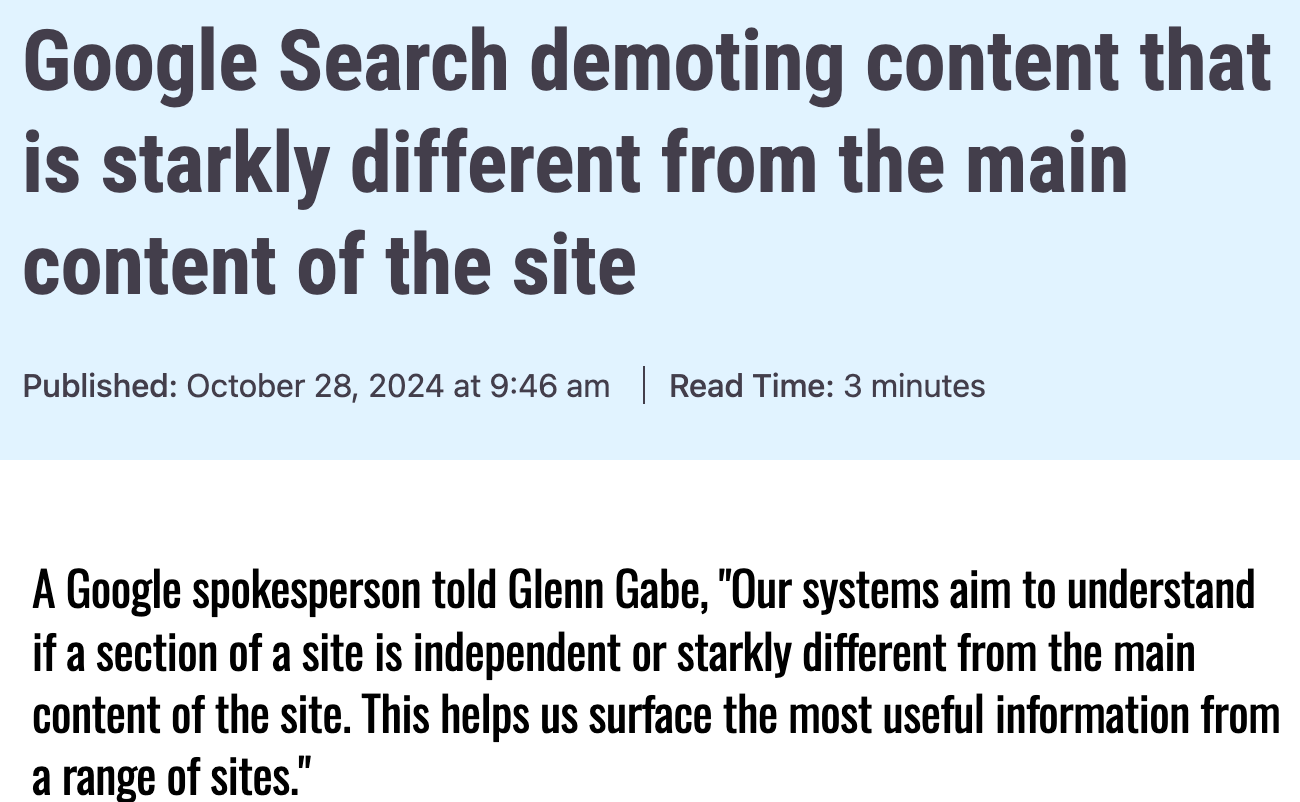
Hence, as a marketer, you must work towards building a knowledge graph around your core category and strive to improve authority over volume.
Expert Insight Over Generic Content
The content that is more likely to get cited must have some of these factors going for it:
- Introduces original frameworks
- Shares proprietary data
- Offers first-person practitioner perspectives
- Takes a clear stance on an industry debate
What gets likely skipped is:
- Content that summarizes what five other articles already said
- Roundup posts that compile publicly available information without adding insight
- Posts that define obvious terms without advancing the conversation
AI systems can generate that level of content themselves. They have no reason to cite it.
Structure Over Style
AI models parse content programmatically.
What does that mean?
That if AI were a person, they would love organising things around.
LLMs look for stuff like:
- Clear H2/H3 hierarchies
- Direct answers positioned near questions
- Well-defined entities
- FAQ sections that use schema markup
- Clean internal linking
A beautifully written piece that buries its key insight in the fifth paragraph of a narrative section is hard for AI to parse.
A clearly structured piece that leads with a direct answer and then expands with supporting evidence is easy.
For challenger brands, this is good news (again!), because structure is free!
Trust Over Tactics
Trust in AI search isn't just about backlinks, although they do play a considerable role in authority-building.
It's a composite of signals:
- Cited sources
- Named authors with verifiable credentials
- Customer testimonials
- Third-party mentions
- Consistent information across the web
- Transparent methodology
Challenger brands can build these signals deliberately and more quickly because they're closer to the evidence, as we discussed previously.
This is about becoming a "trust node," a source that AI models repeatedly cite because the information consistently proves accurate and useful.
Now that we understand the factors that AI search rewards, here are seven specific strategies challenger brands can deploy.
Seven Strategies for Challenger Brands to Win AI Search
1. Own a Focused Topic Niche
Start by identifying the one problem your product solves that your buyers care about most.
Most likely, this is already something you’re aware of. You just need to figure out how to mine content from it. Here’s how.
Build a content cluster:
- A cornerstone pillar page comprehensively defining the problem and your approach
- 8-12 supporting articles that cover specific angles, use cases, and comparisons
- Interlinking between every piece so AI crawlers can trace the topical relationship
- A consistent URL structure that signals the cluster to search engines
88% of queries that trigger AI Overviews are informational, meaning educational content is where the AI citation opportunity is highest. So while you put up your strategy, ensure you have that base covered.
Your goal is to become a sage in a clearly defined space.
2. Lead with Expert-Driven, Insight-Rich Content
Not every blog post needs to be penned by the CEO. But every piece should carry a real human perspective. Build a system that has these cadences:
- Founder POV pieces: A perspective on an industry shift, a contrarian take, or a lesson from building the company. These anchor your brand's thought leadership.
- Practitioner insights: Interviews of internal experts, solutions engineers, and customer success leads, where a 20-minute conversation is turned into practical how-to pieces.
- Case-based learning: Documented customer outcome with specific numbers, timeline, and methodology. These are citation gold for AI systems.
- Original frameworks: Well-defined, unique approaches to solving the problem. When AI encounters a named methodology, it treats it as a citable entity.
3. Structure Content for AI Discovery
Design every piece of content to be understood by AI systems, apart from being easily readable by humans:
4. Build Visible Proof & Trust Signals
AI systems assess content quality + credibility. Every trust-building investment serves double duty:
5. Refresh Before You Rewrite
Most content teams default to creating new content when they need results.
But for challenger brands with limited resources, refreshing existing content is almost always the smarter play.
More importantly, AI is much more likely to cite fresh content, so you must have a content refresh engine at play.
A page that already has some authority, some backlinks, and some indexed history can be updated with fresh data, better structure, and clearer answers in a fraction of the time it takes to produce a new piece.
Build a refresh discipline:
- Audit your top pages
- Identify which ones have decaying traffic or outdated information
- Prioritize refreshing those first
For those pages:
- Add FAQ sections
- Update statistics
- Improve heading structure
- Strengthen internal links
You can either do this manually or let a smart tool like Slate do it for you, error-free, 24/7!
6. Use AI for Efficiency, Not Replacement
AI tools are the challenger's force multiplier. But there is a trap in using AI to replace human thinking rather than to accelerate it.
Smart usage involves:
7. Pair Organic Content with Lightweight Amplification
Organic content alone can take months to gain traction. A small, targeted spend, even $200-$1,000/month, can really accelerate results:
- Promote your best content piece to a tightly defined audience on LinkedIn
- Run a small paid search campaign on the exact long-tail queries your content answers
- Syndicate your founder's POV piece to reach the specific personas who matter
These small investments serve three purposes:
- They validate which content resonates before you invest more in that topic
- They accelerate initial traction so organic algorithms pick up the content faster
- They signal relevance to search engines and AI platforms
Practical Content Operating Tips for Lean Teams
Common Mistakes to Avoid For Lean Teams
Winning with Focus, Insight & Trust
AI search hasn't eliminated competition, but it has changed what you're competing on.
The barriers that once made it nearly impossible to compete for visibility (limited budget, small team, narrow brand recognition) are becoming less relevant.
Build around the expertise your team genuinely possesses. Structure every piece for both human clarity and AI parsability. Refresh relentlessly.
And trust that in a world where AI selects answers based on quality, the brands that teach best will always be visible, regardless of size.
If you want to use a platform that helps growth-driven brands build, run, and scale their AI search visibility as a system, try out Slate.
Frequently Asked Questions
Can smaller brands really win in AI-driven search?
Yes. AI search evaluates content on relevance, depth, and trust, not domain age or publishing volume. Challenger brands with genuine expertise in a focused niche can earn AI citations faster than incumbents whose content is spread thin across hundreds of topics.
What should challenger brands prioritize first?
Choose a single topic niche where your expertise is deepest, and build a content cluster of 10-15 deeply interconnected pieces around it. Then ensure every piece is structurally optimized for AI parsability: clear headings, FAQ sections, schema markup, and internal linking.
How important is content volume?
Less important than content depth and structure. Twenty well-structured, expert-driven pieces on a single problem space will outperform 200 generic articles in AI citation rates.
Should lean teams use AI tools?
Yes, for research, outlining, structural QA, and efficiency. No, for replacing human insight, expertise, and editorial judgment. The value AI systems cite is the value AI tools can't produce on their own.
What KPIs should challenger brands track most?
Prioritize AI citation frequency, share of voice in AI conversations, branded search volume, and content freshness scores alongside traditional metrics like organic traffic and keyword rankings.