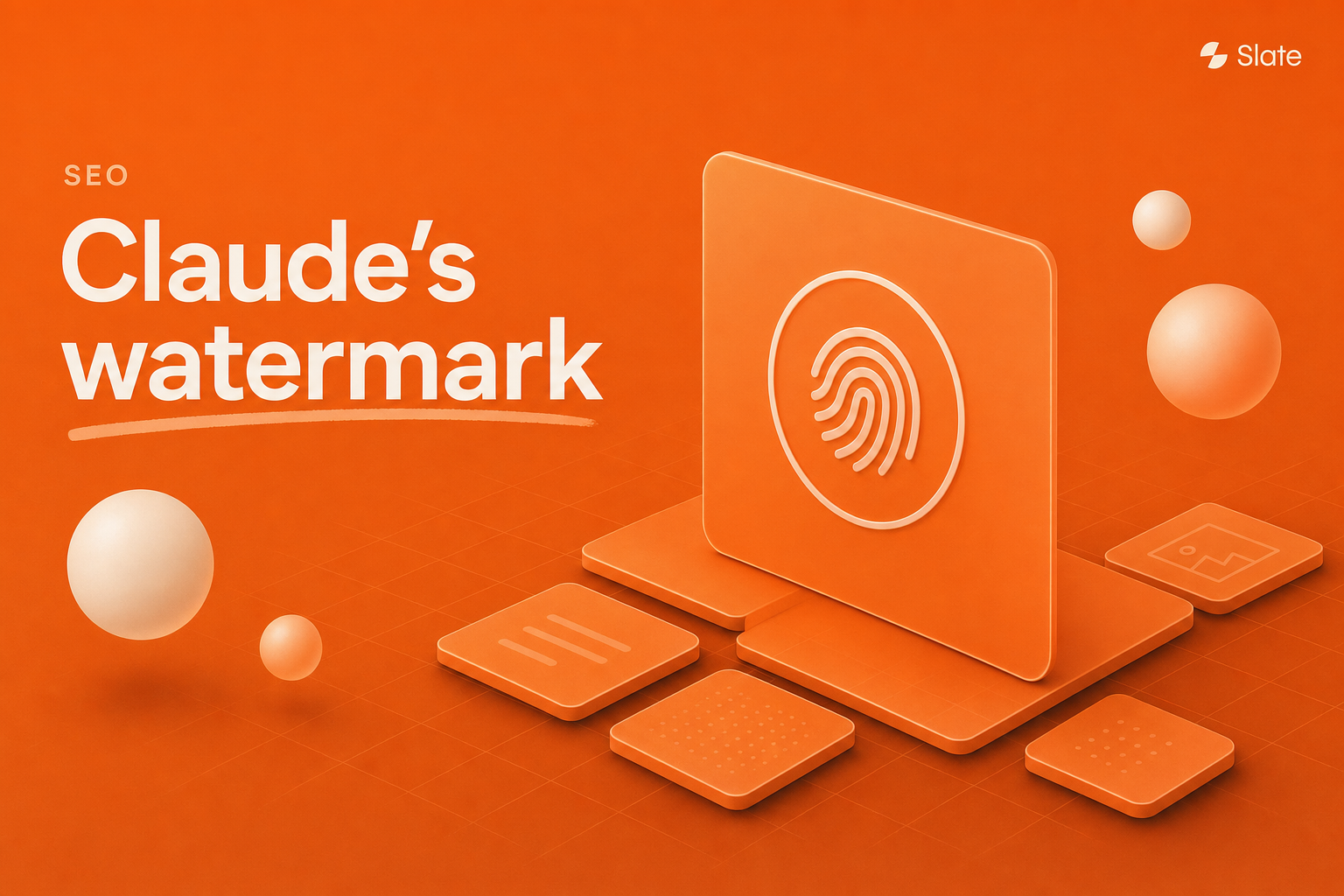
Claude now stamps a hidden watermark on the text it writes.
If you write content for a living, you're probably running the same three questions in your head.
Is Google going to find out? Is my traffic about to tank?
Should I stop using AI to write my content?
Before you panic, let's figure out what's actually going on, because most of what's being said about this online is wrong.
First, what the watermark actually is
Forget whatever you're picturing.
There's no invisible character sitting in your text.
No weird Unicode. No little tag saying "made by Claude."
You can copy it, paste it into Notepad, strip out every bit of formatting — and the watermark is still there.
This is very different from how an image watermark works. Image files get actual metadata attached, or pixels nudged. In fact, Claude does exactly that for images: .png, .jpg and .svg files get C2PA content credentials — a cryptographically signed note in the file's metadata. That's a completely separate mechanism from what happens to text.
With text, the watermark isn't in the words. It's in how the words got selected.
Here's how a language model writes. It doesn't compose a sentence start to finish. It writes one word, then picks the next most probable word, then the next.
Say it's written: "the story was really…"
Now it has to pick what comes next. Could be good. Could be great. Could be interesting. Could be enjoyable. Four different words, roughly the same meaning, roughly the same probability. The model genuinely doesn't care which one it grabs.
That gap is where the watermark lives.
Anthropic holds a private key. At every one of those coin-flip moments, the key, combined with the words that came just before, decides which option the model takes. Not toward better words. Not toward worse ones. Just toward certain words, in a pattern you'd never spot without the key.

It doesn't mean the same word repeats over and over. Every sentence still reads like a normal sentence. That's exactly what makes it clever.
The technique comes from SynthID-Text, published by Google DeepMind in 2024, which itself traces back to a proposal by Scott Aaronson in 2022.
Anthropic didn't invent it and, as we'll get to, Anthropic isn't even the first to ship it. (Anthropic)
So the watermark isn't a thing added to the text. It's a bias baked into the sequence of choices that produced it.
Which is why no amount of copying, pasting or reformatting will remove it — you'd have to change the choices.
Where it falls apart
The pattern needs room to show up.
It needs choices to hide in.
Take the choices away and there's nothing left.
Short text. A tweet, a headline, a meta description.cNot enough words for a signal.
Anthropic is explicit that detection works poorly on small samples and gets more confident as passages get longer.
Factual text. If Claude is writing "the capital of France is…", there's exactly one right answer. No choice, no watermark.
The more factual your content, the weaker the mark.

So what about editing?
Light editing survives it. Claude writes a piece, you fix a comma, tighten a line, the watermark mostly holds.
Heavy rewriting kills it. Swap words all the way through and the pattern breaks. Anthropic's own framing is worth quoting here: at that point "it's arguable whether the text can any longer be described as AI-generated."
And there's an easier way around it entirely. Flip the workflow. You write the draft; Claude proofreads. Nearly all the words are still yours — your choices, your decisions. Claude is just catching mistakes. There's almost nothing for the watermark to grab onto.
One caveat, though: translation. If a human writes something and Claude translates it, Claude is picking every single word in the output. Fully watermarked. Same logic applies to anything where Claude regenerates the text wholesale rather than touching it up.

Two more limits worth knowing, both stated by Anthropic directly:
- The watermark can't distinguish "Claude wrote this" vs "Claude heavily edited this." A hit is not proof of authorship.
- It can't be traced to a person, an organisation or a specific chat. It says "a Claude model was probably involved." That's it.
Why Anthropic is doing this
It's not a whim. The EU AI Act's transparency obligations took effect on August 2, 2026, and roughly 190 organisations signed the EU's Code of Practice on Transparency of AI-generated Content by the end of July.
Two corrections worth making, because both claims are doing the rounds.
Anthropic wasn't out in front on signing. The signatory list for the provider section includes Aleph Alpha, Anthropic, Black Forest Labs, Cohere, Google, Meta, Microsoft, Mistral, OpenAI and Synthesia — the Commission lists them alphabetically, with no signing order. Google announced its signature on July 24, ahead of Anthropic's rollout.
And Anthropic isn't the first to watermark text, either. Google DeepMind switched SynthID text watermarking on in the Gemini app back in May 2024. If you've drafted anything in Gemini in the last two years, it's already watermarked — with the same underlying technique Anthropic has now adopted.
Sit with that for a second, because it's the single most useful fact in this whole story.
Watermarked AI text has been ranking in Google for over two years.
Nobody noticed, because there was nothing to notice.
So does it mess with your SEO?
Here's the thing that pretty much ends the conversation.
Google can't read it
To read Anthropic's watermark, you need Anthropic's key. Anthropic hasn't released it.
They've said a detection API is coming, but as of now the details are still being worked out and nothing is public. (Anthropic)
Google's AI-content detection, whatever exists of it, works on Google's own models. There is no shared industry detection system sitting inside Google Search scanning your blog posts. That system does not exist.

Google has never been against AI content
Google's position hasn't moved since 2023. Its guidance on AI-generated content is headed, in as many words, "Rewarding high-quality content, however it is produced."
And its content documentation is explicit about what the ranking systems are for: they "prioritize helpful, reliable information that's created to benefit people, and not content that's created to manipulate search engine rankings." (Google Search Central)
That second half is the whole ballgame.
The line Google draws isn't human vs. AI. It's useful vs. manipulative.
What Google does go after is spelled out in its spam policies as scaled content abuse: "when many pages are generated for the primary purpose of manipulating search rankings and not helping users" — explicitly including "using generative AI tools or other similar tools to generate many pages without adding value for users." (Google Search Central)
Read that carefully. The trigger is volume without value, not the tool.
You'll see posts claiming watermarked content averages position 11 while non-watermarked content averages 6.
Ask one question: how did you know a piece was watermarked?
There is no open detector for Claude's watermark. Anthropic hasn't shipped one and hasn't released the key. (Google runs a SynthID Detector portal for its own watermarks, launched May 2025 — but it's waitlisted for journalists and researchers, and it isn't reading Anthropic's key.)
So what these studies actually did was look at a page, decide "this reads like AI," and label it watermarked.
That's not measurement. That's an assumption wearing a lab coat.
AEO is the same story
Answer engines cite what's clear, specific, well-sourced and easy to quote. Nobody has shown any evidence of citations being filtered by watermark — and they'd need a key they don't have to do it.
So as of today: the watermark isn't an SEO or AEO problem. Bad content is.
The one thing worth watching
Anthropic has said a detection API is coming but hasn't said how open it'll be. If it ships wide open and some platform decides to use it as a label — a CMS badge, a marketplace filter, a publisher policy — that's a different conversation. Nothing like that has been announced. Keep half an eye on it.
So should you stop using AI?
No. But change what you're worried about.
AI isn't the problem here. The quality of your content is.
Three things I'd actually do:
1. Don't buy a humaniser tool. It's AI rewriting AI. You're paying money and losing quality to dodge a signal Google isn't even reading.
And notice the irony: the rewriting pass that strips Claude's watermark just stamps a different model's watermark on instead.
If the humaniser runs on Gemini, it's been doing that since 2024.
2. Put things in your content a model can't invent.
Your own numbers. A screenshot from your own dashboard. A customer quote. An opinion you'd actually defend. That's what wins in search and in AI citations, and honestly it always did.
3. Don't let cheap content tempt you into volume. Pumping out a hundred mediocre pages is the one thing Google genuinely will come after you for — and it has nothing to do with watermarks.
The bottom line
The watermark is real. It's clever. And it's hiding in the choices, not the characters — which is precisely why you can't scrub it out with a copy-paste.
But it isn't coming for your rankings.
Sources
- How Claude's text watermarking works — Anthropic
- How Claude marks AI-generated content — Anthropic Help Center
- Quick facts: Transparency rules for AI systems — European Commission
- Strong backing for the Code of Practice on Transparency of AI-generated Content — European Commission
- Google is signing the EU AI Act Code of Practice on Transparency of AI-Generated Content — Google
- Watermarking AI-generated text and video with SynthID — Google DeepMind
- SynthID Detector — Google
- Google Search's guidance about AI-generated content — Google Search Central
- Creating helpful, reliable, people-first content — Google Search Central
- Spam policies for Google web search — Google Search Central
- Anthropic says it will watermark text generated by its AI models — TechCrunch
- Anthropic shares more details about how Claude's new watermarks will work — TechCrunch
- Anthropic adds AI text watermarking to Claude models worldwide — Search Engine Land