Agencies comparing Rankability alternatives need to answer one question first. Do you need another visibility dashboard, a broader SEO suite, or a platform that turns AI-search gaps into published content?
Clients used to ask where they rank. Now agencies need to know whether a client shows up in ChatGPT, Google AI Overviews, or Perplexity answers. Then they decide what to refresh, publish, and report.
Key takeaways
The core decision: Pick between AI visibility monitoring, an SEO suite with AI features, or a platform that also creates and publishes content.
Slate ranks first in this list: As of November 2026, Slate combines AI visibility tracking, SEO data, content production, publishing, and outreach.
Dedicated monitors fit reporting-first teams: Rankshift, OtterlyAI, and Peec AI fit when the main need is AI visibility tracking and execution already runs elsewhere.
SEO suites fit classic search operations: Semrush, Ahrefs, and SE Ranking fit when keyword research, backlinks, rank tracking, and site audits drive the work. As of November 2026, all three also include some AI visibility tracking.
Price needs context: Compare prompts, pages, seats, client workspaces, credits, included engines, and overage rules before you compare monthly fees.
Tracking is one part of the work: AI visibility tracking shows where a brand appears or gets cited. Content updates, publishing, outreach, and refresh cycles come next.
Agency operations count: Multi-client delivery depends on workspaces, permissions, repeatable workflows, and reporting that account managers can explain.
The 7 best Rankability alternatives at a glance
The best Rankability alternatives fall into three groups: dedicated AI visibility trackers, all-in-one SEO suites, and end-to-end execution platforms.
Why agencies look for Rankability alternatives in 2026
As of November 2026, Rankability calls itself an AI search visibility platform. Plans start at $97 per month for 100 tracked AI queries across 11 AI platforms and 20 content projects a month. Every plan includes unlimited workspaces and team members.
Rankability also sells done-for-you AEO services.
Agencies usually switch when their tools cover only part of the organic growth loop, or when plan caps don’t fit the client load. Decide whether you only need to see AI visibility, or also need a system to prioritize, produce, publish, and measure the work that follows.
Client questions have moved from rankings to AI answers
When a client asks whether the brand appears in AI answers, a keyword ranking report won’t answer it. Agencies need to separate several signals:
- Brand mention: The brand appears in the answer.
- Citation: The brand or page is used as a source.
- Answer inclusion: The brand is part of the recommendation or explanation.
- Sentiment: The answer frames the brand positively, negatively, or neutrally.
In Fractl’s 2026 survey of 343 US marketing decision-makers, 66% of marketers reported using AI-based tools to research marketing vendors. Search Engine Land published the findings on August 24, 2026. AI-search visibility is now part of client reporting.
Monitoring tools stop where the work begins
A monitor can show that a competitor is cited and your client isn’t. It won’t pick the page to refresh, the evidence to add, or the topic gap to close. Someone still has to get the approved update into the CMS.
The handoff often looks like this:
- Dashboard finding
- Export
- Brief
- Writer assignment
- Review
- CMS update
- Reporting
- Remeasurement
Every handoff adds delay. Across several clients, a useful visibility signal becomes one more item waiting in the production queue.
Agency economics break under tool sprawl
In AgencyAnalytics’ 2026 Marketing Agency Benchmarks Report, 51% of agencies were already working on AI-driven search beyond Google. In the same report, 40% were developing content specifically for AI search results. That work lands on teams already handling research, content, reporting, and client communication.
Plan price is only the start. Ask:
- How many prompts are tracked?
- How many client workspaces are included?
- Which engines are included?
- Are seats limited?
- Are exports usable for client reporting?
- Are credits shared or client-specific?
A low headline price can still cost more if the plan can’t support the agency’s delivery model.
Teams want one system of record
Fragmented workflows are manageable with a small client list. They get harder when account teams connect AI visibility, keyword movement, content decay, publishing, outreach, and performance across a portfolio.
The operating loop:
Measure → Identify → Create → Publish → Measure → Refresh.
A monitor helps with the first step, and a suite helps with research and auditing. An execution platform covers the work between the finding and the follow-up measurement.
How we evaluated these Rankability alternatives
A useful comparison separates visibility data from day-to-day delivery. Agencies buy software to support client work and cut handoffs.
The evaluation criteria are:
- AI visibility tracking: Supported answer engines, prompt tracking, mention tracking, citation context, and competitive visibility.
- Measurement precision: Clear separation between mentions, citations, answer inclusion, sentiment, prompt coverage, and share of voice.
- Competitive benchmarking: Where competitors appear, overlap, or win citations across prompts and topics.
- Content opportunity discovery: Ability to surface keyword gaps, content decay, citation gaps, and AI-visibility topic changes.
- Content workflows: Briefs, refreshes, bulk content operations, and approval paths.
- Publishing: Direct CMS publishing or export-only workflows.
- Outreach: Support for third-party outreach targets and contact workflows.
- Traditional SEO context: Keyword data, backlink data, site auditing, rank tracking, Google Search Console, and GA4 context.
- Agency operations: Workspaces, seats, permissions, exports, repeatable deliverables, reporting, and pricing predictability.
The ranking favors agencies that need AI visibility measurement connected to execution. If your agency already has a solid content, CMS, outreach, and reporting stack, a dedicated monitor or SEO suite may be enough.
1. Slate: Best for agencies that need AI visibility and content execution in one platform
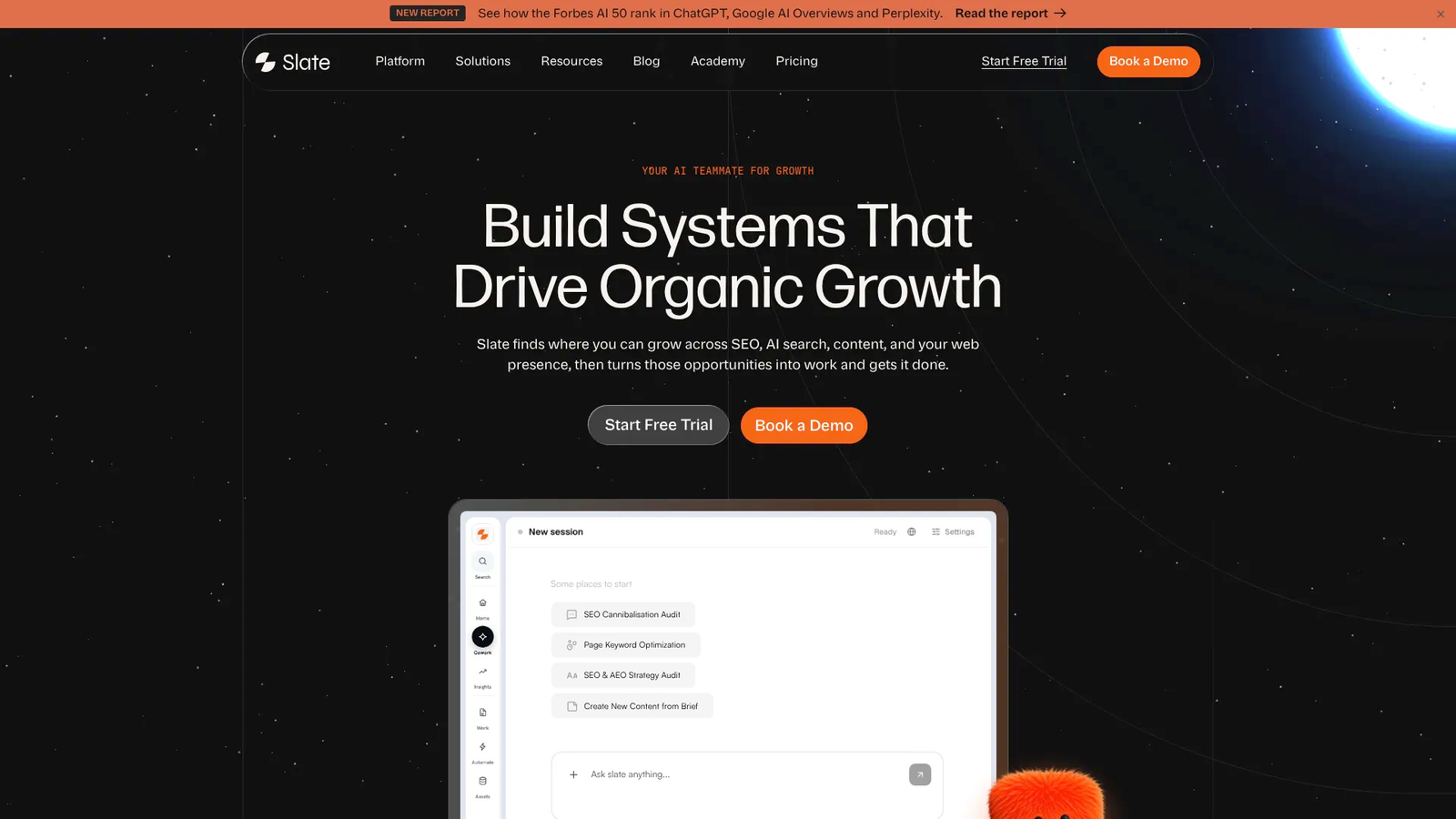
Category: End-to-end, agent-driven content, SEO, and AI search platform
Best for: Agencies and in-house teams that need to turn visibility findings into published, measured content work
Slate connects AI visibility tracking with the work that follows: finding gaps, producing or refreshing content, publishing, outreach, and measurement. For agencies, that shortens the path from knowing what should change to getting the work live.
Pricing: As of November 2026, Launch costs $99 per month for one brand, with multi-user access and one workspace. Growth costs $499 per month with five workspaces, and Scale costs $999 per month with custom seats. Agency & Enterprise pricing is custom, annual billing gives two months free, and the 14-day free trial needs no card (pricing).
The Agency & Enterprise plan adds client workspaces, and any agency can sign up for it. In Agency mode, each client gets its own workspace, and client users see only the workspaces they’re invited to.
As of November 2026, the AI Visibility Tracker covers ChatGPT, Google AI Mode, Google AI Overviews, and Perplexity on every plan. Claude and Gemini are add-on answer packs.
Opportunities surfaces gaps across content, citations, rankings, and social engagement, so account teams can decide what to work on first. A client may be missing from a prompt cluster because a comparison page is missing, content has decayed, or third-party sources shape the answer.
For execution, Workflows builds multi-step content and SEO processes, and Power Sheets handles bulk work across many URLs. SuperBlocks adds reusable templates for AI search work. Together they cover deliverables that repeat across clients, such as refreshing decaying pages or auditing a content library.
In Cowork, you can hand recurring tasks to Slate in plain language. Examples include a monthly prompt review, a quarterly content decay check, or a competitor prompt-coverage check. Approvals and publishing control stay with your team, and workflows can pause at a Human Review block until someone approves.
Slate publishes to WordPress, Webflow, and Sanity, and Ahrefs and Semrush data are built in. Pages adds Google Search Console and GA4 data, including clicks, CTR, and citations, so client reports can show what went live and how metrics moved.
Publishing is often where AI-search work stalls, waiting on copy, approval, CMS entry, and QA. Direct publishing shortens that chain once the agency’s approval process is in place.
When third-party sources drive a visibility gap, Outreach finds link and brand-mention prospects and lets you contact them from inside Slate.
Consider it if: Your agency needs AI visibility tracking and the work that follows in one place.
Choose another option if: You only need a monitoring dashboard, and your content, CMS, and outreach process already runs well elsewhere.
2. Rankshift: Best for broad AI engine coverage with unlimited seats
Category: AI visibility tracker with content tools
Best for: Teams that want wide engine coverage and unlimited seats at a lower price
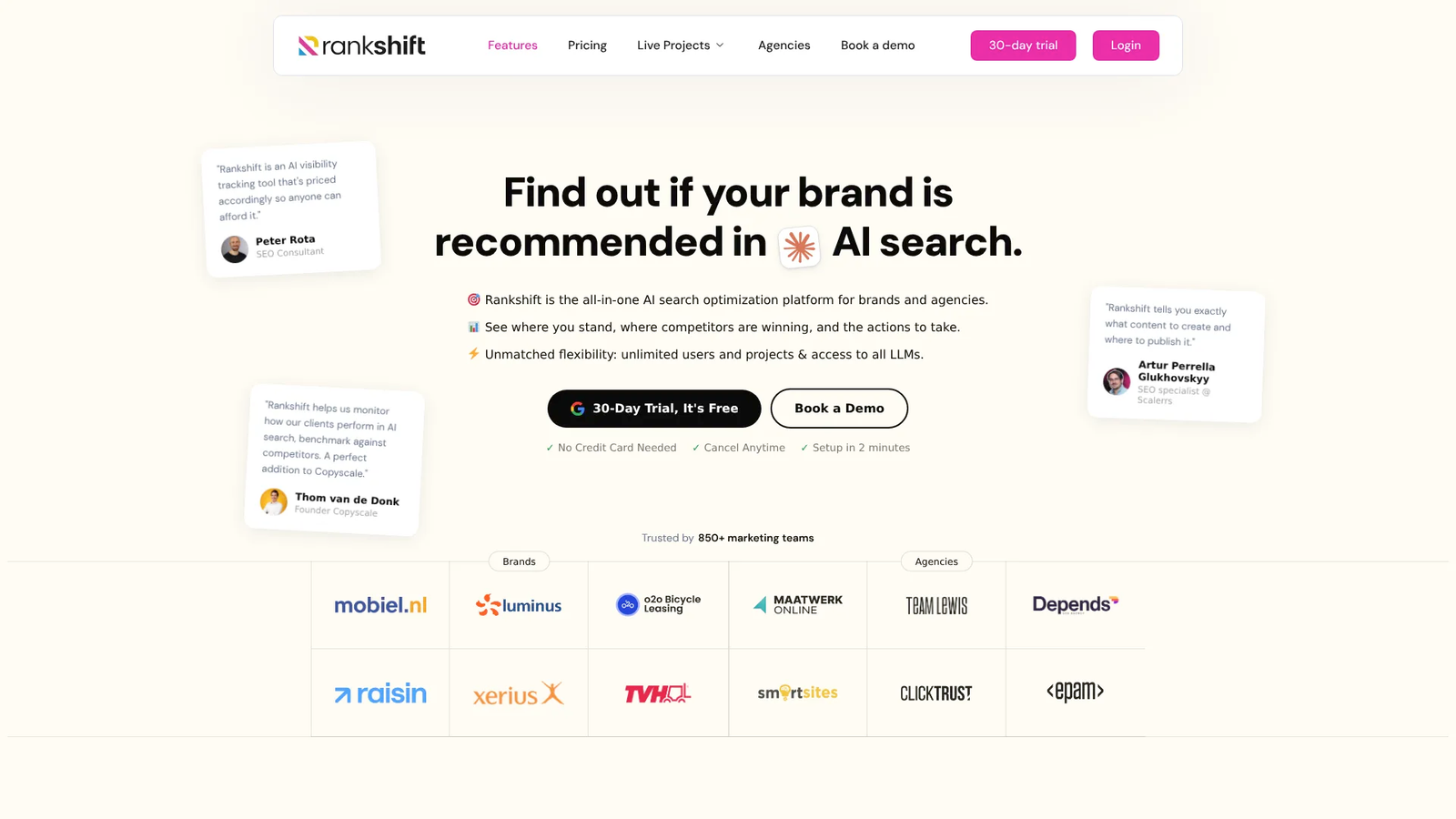
Rankshift suits agencies that want a focused tracking layer and keep production, publishing, and reporting in their existing stack. Its plans also include a content brief generator and an AI content writer.
Pricing: As of November 2026, Starter costs $92 per month, Professional $210, and Business $473 (pricing). Annual billing drops those to $82, $189, and $425, and there’s a 30-day trial. Every plan includes unlimited projects and seats.
A focused tracker works when the agency’s delivery setup is already strong. If briefs, writers, editors, CMS workflows, and reporting run well, the tracker only has to feed them reliable data.
For Rankshift, evaluate:
- Prompt tracking capacity
- Citation visibility
- Brand mention monitoring
- Competitor benchmarking
- Export options
- Client workspace support
- Reporting workflows
- How findings move into content production
Consider it if: Your agency mainly needs an AI visibility dashboard and already runs execution elsewhere.
Choose another option if: Your bottleneck is prioritizing, creating, publishing, and refreshing content across multiple clients.
3. Profound: Best for enterprise AI visibility and AI marketing agents
Category: AI marketing platform with visibility tracking and agents
Best for: Enterprise brands, and agencies serving them, that want visibility tracking and agent-run marketing work
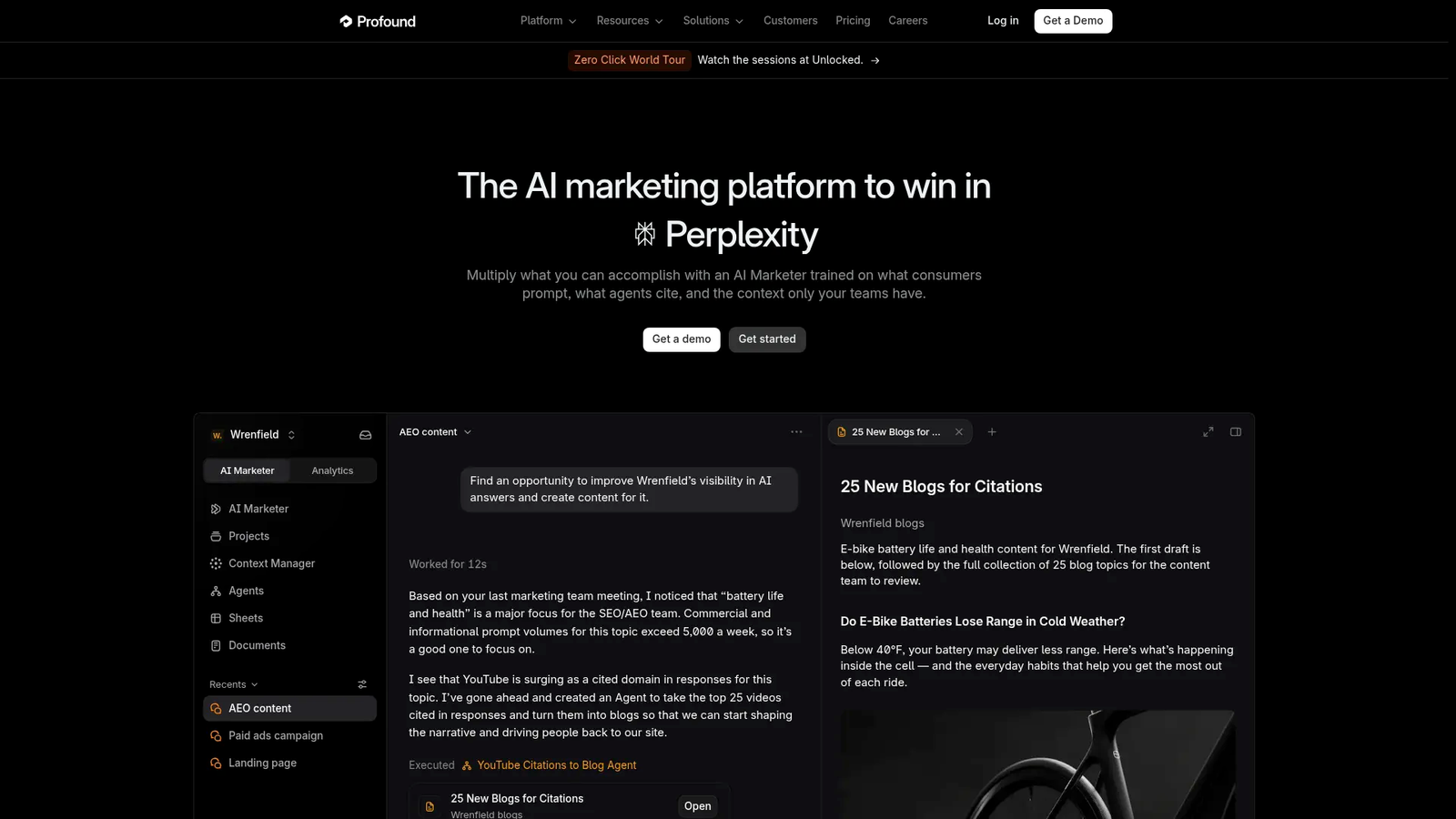
Profound fits larger organizations asking how the brand appears across AI answers. Those deals often involve research depth, governance, and several stakeholder groups.
Pricing: As of November 2026, Profound offers a seven-day free trial and custom-priced Enterprise plans (pricing). The trial runs 50 prompts a day across ChatGPT, Gemini, and Google AI Overviews. Profound retired its $399 Starter and $499 Growth plans for brands in September 2026.
It also lists a self-serve Agency Growth plan with credits per client workspace. Its website doesn’t show a price for that plan.
Enterprise buyers should look past engine coverage. Ask how the platform handles internal reporting and whether teams can split research by brand or market. Then ask how findings reach the content team.
For agencies serving enterprise clients, Profound fits when the engagement centers on intelligence and reporting. The agency should still decide who owns the execution work after the finding.
Consider it if: Your client needs enterprise AI-search research and internal visibility reporting across several stakeholders.
Choose another option if: Your agency needs predictable small-team pricing and a platform built around content execution, publishing, and refresh work.
4. OtterlyAI: Best budget-friendly AI search monitoring
Category: Budget AI visibility tracker
Best for: Small teams testing AI-search monitoring at a low entry price
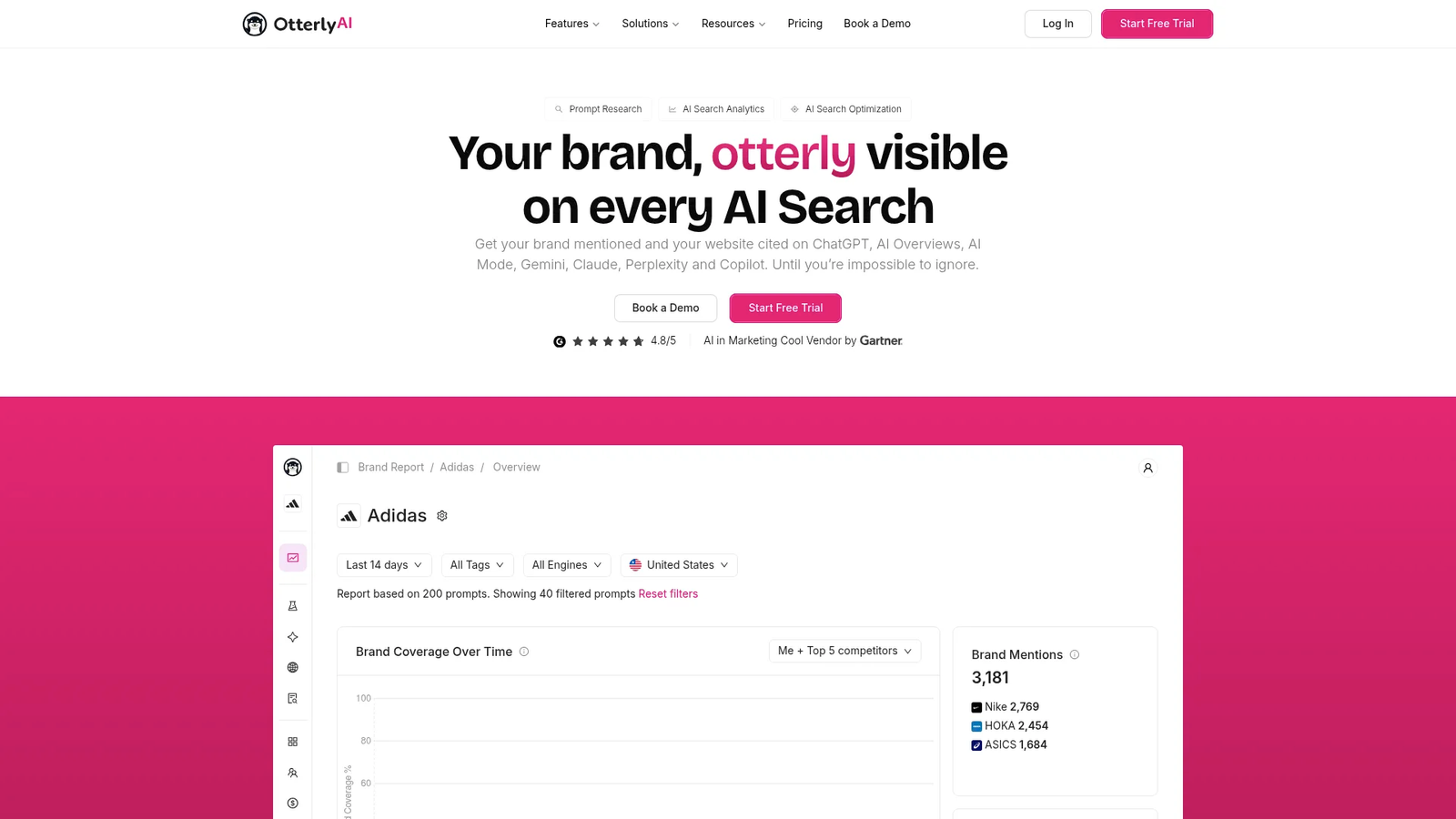
OtterlyAI suits agencies and small businesses looking for affordable Rankability alternatives. Check usable monitoring capacity before you assume the lowest headline price will carry an ongoing client program.
Pricing: As of November 2026, Lite costs $29 per month for 20 prompts, Standard $189 for 160 prompts, and Premium $489 for 535 prompts (pricing). Every plan includes unlimited brands, competitors, and team members, and a free trial is available.
For a small business or an early agency test, a lighter monitor shows whether the brand is mentioned and which sources get cited. It also shows how often competitors appear. That can be enough for an initial audit or a limited reporting package.
The limit is operational. Once a client asks what should change next, the agency still needs a way to prioritize, assign, approve, publish, and remeasure the work.
Is there a free Rankability alternative?
A free Rankability alternative usually means a trial or a limited free plan. Running prompts across several answer engines costs money, and agencies need enough volume to make the data useful.
As of November 2026, Slate, Rankshift, OtterlyAI, and SE Ranking offer free trials, and Semrush has a limited free plan. Check included prompts, engines, projects, and exports before you use any of them for paid client reporting.
Consider it if: You need a low-cost way to start monitoring AI search, and you’ll handle execution manually or in other tools.
Choose another option if: Your agency needs content workflows, publishing, outreach, and performance data in one place.
5. Peec AI: Best for agency AI search analytics across client brands
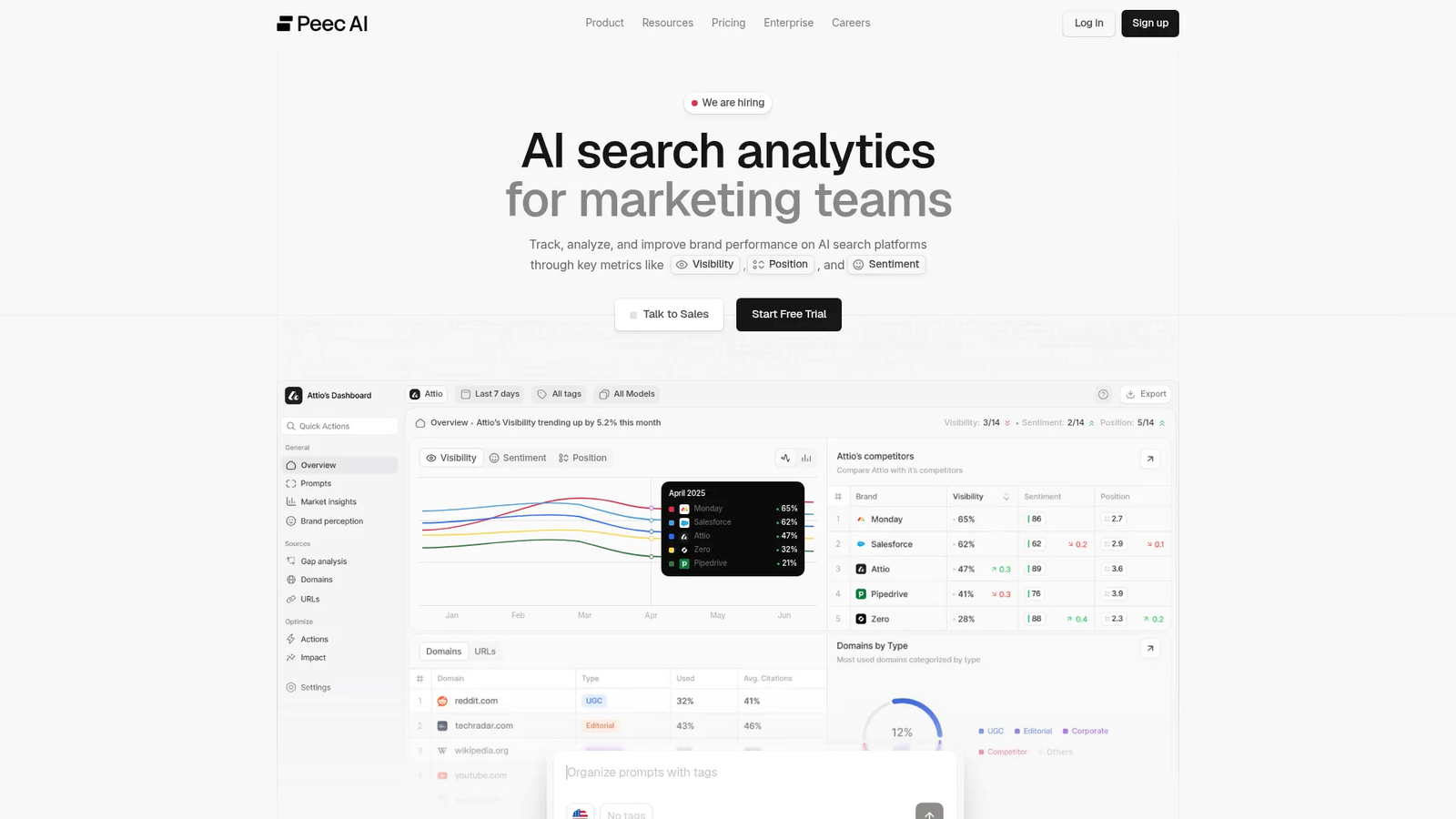
Category: AI search analytics for marketing teams and agencies
Best for: Agencies that report on AI visibility across several client brands
Peec AI suits agencies that want to judge AI visibility reporting through a client-delivery lens. Check whether it fits the way your agency separates clients, controls access, and turns findings into recurring deliverables.
Pricing: As of November 2026, Starter costs $95 per month, Pro $245, and Advanced $495, with 50, 150, and 350 prompts (pricing). Each plan tracks three models with unlimited users.
Peec AI’s agency plans cost $245 per month (Essential), $495 (Growth, for three to 10 clients), and $795 (Scale, for 11 to 25+ clients).
For agencies, workspace design can matter as much as engine coverage. A platform that works for one brand can get harder to run across many clients if permissions or usage controls don’t match account-team workflows.
Assess Peec AI on:
- Client workspace structure
- Permissions
- Export formats
- Reporting views
- Prompt and topic organization
- Competitor tracking
- Usage governance
- How insights reach content or outreach teams
Consider it if: Your main deliverable is AI visibility reporting, and you want strong agency workspace support.
Choose another option if: You need reporting and execution in one system, especially for recurring refreshes, CMS publishing, and outreach.
6. Semrush: Best all-in-one SEO suite with AI visibility added
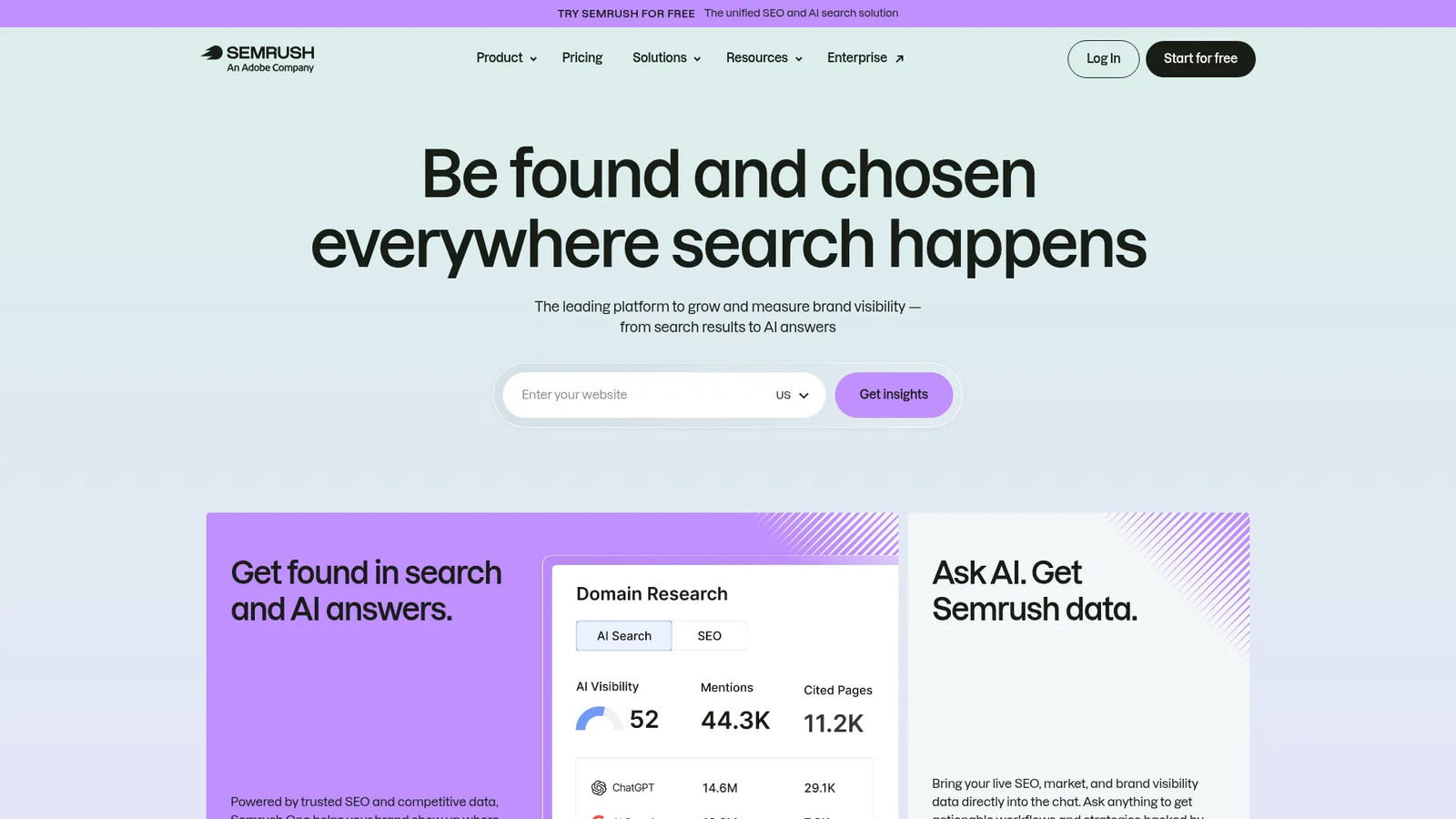
Category: All-in-one SEO suite
Best for: Teams that need broad SEO research, site auditing, and reporting alongside AI visibility
Semrush suits agencies that still need classic SEO depth: keyword research, competitive research, site auditing, reporting, and related search-marketing tools. For agencies looking for Rankability alternatives with site auditing, SEO suites are often the first place to look.
Pricing: As of November 2026, the SEO plan costs $139 per month, SEO + AI Search Starter $199, and Pro+ $299 (pricing). Annual billing saves up to 17%. Starter tracks 50 AI prompts daily.
Semrush also offers a limited free plan.
With an SEO suite, the agency is usually asking whether one platform can run SEO across clients and add AI visibility where needed.
Semrush fits when the agency’s core work is technical SEO audits, keyword strategy, competitive research, and recurring reporting. Execution is the tradeoff to check. Once the suite finds an opportunity, the agency still needs a process for content production, client approval, CMS publishing, and remeasurement.
Consider it if: Traditional SEO research and site auditing are central to your agency’s delivery model.
Choose another option if: You want AI-search measurement tied directly to content execution, publishing, and outreach.
7. Ahrefs and SE Ranking: Best for backlink intelligence and multi-client SEO
This last entry groups two SEO suites agencies often compare when traditional SEO stays central. Agencies usually evaluate Ahrefs for backlink-led work and SE Ranking for client management and reporting.
Ahrefs: For backlink intelligence and AI brand monitoring
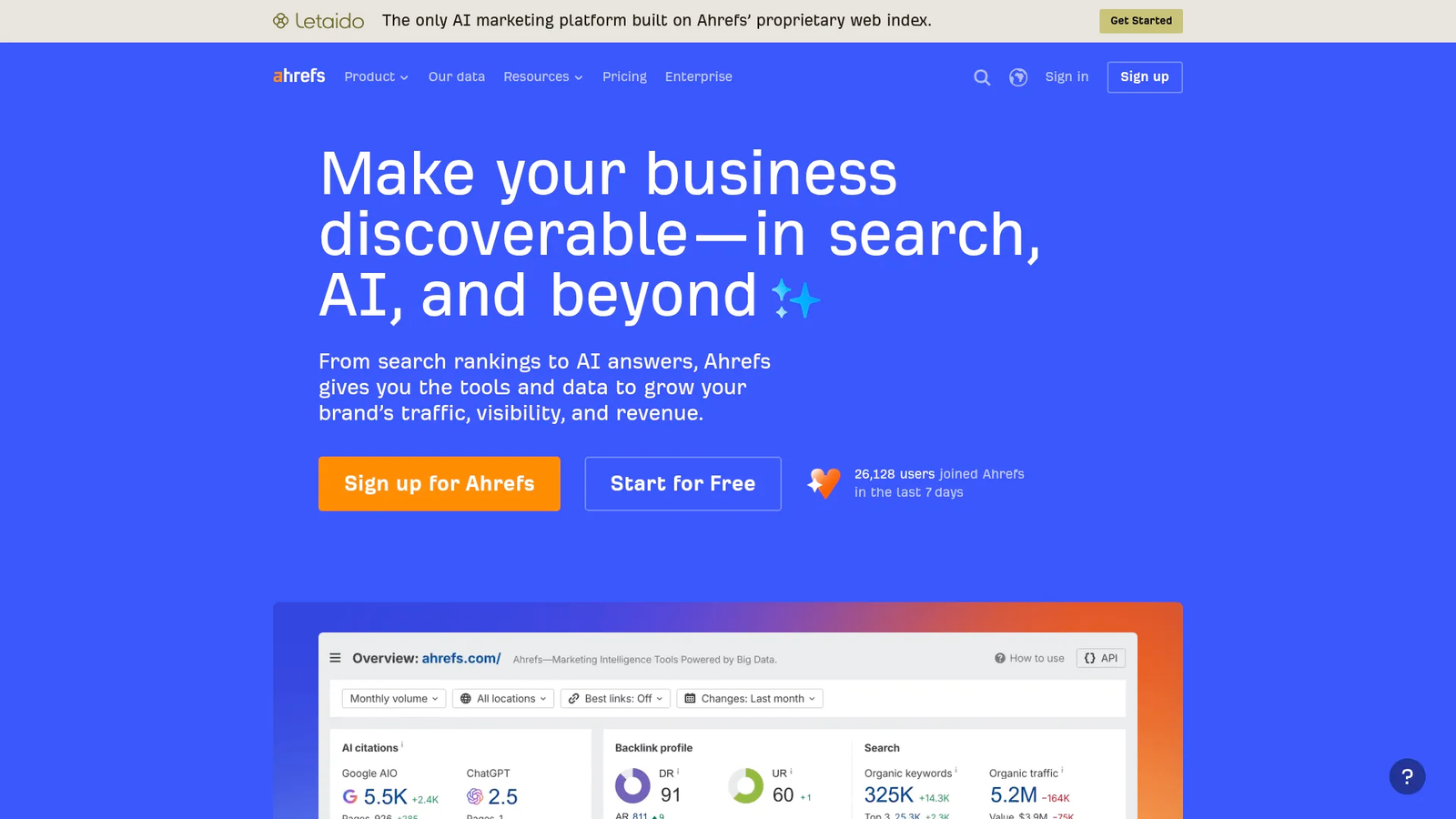
Category: SEO suite with AI visibility features
Best for: Teams where backlink intelligence is a major part of the SEO strategy
Pricing: As of November 2026, Lite costs $129 per month, Standard $249, and Advanced $449, each with one user included (pricing). Plans include Brand Radar and 150 to 600 AI prompt checks.
Ahrefs suits agencies whose edge comes from backlink analysis, keyword research, and site auditing. AI visibility can be part of the report, and traditional SEO data is still the main reason to buy.
The key question is what happens after the research finding. If backlink gaps, content gaps, and technical issues already flow through a delivery process, a traditional suite fits well. If the agency also needs to produce, publish, and refresh content, evaluate an execution platform alongside it.
Consider it if: Backlink intelligence and classic SEO research are core to your agency’s client work.
SE Ranking: For multi-client SEO with built-in AI visibility tracking
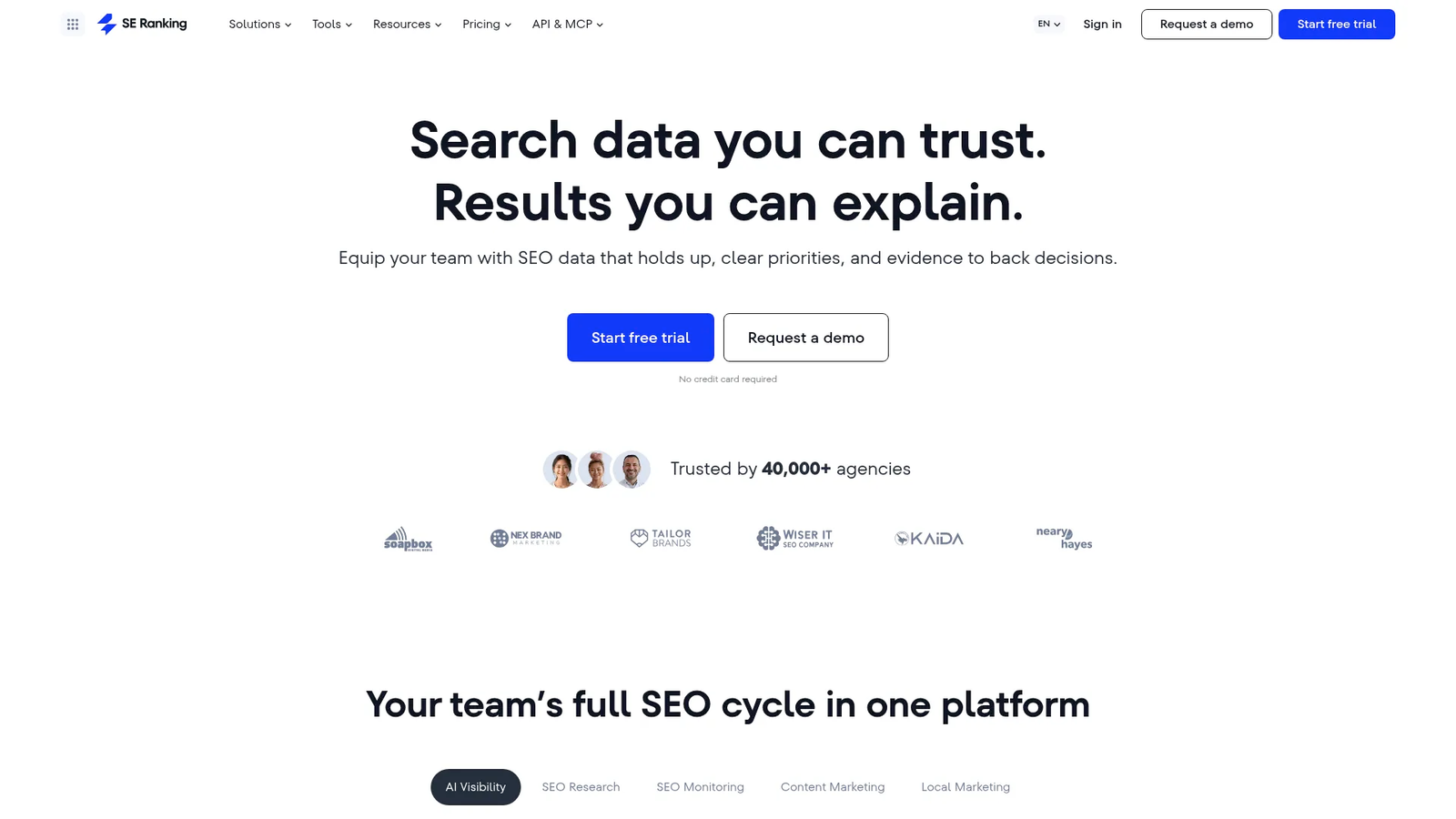
Category: SEO suite for client work
Best for: Agencies comparing multi-client SEO management, reporting, rank tracking, and site auditing
Pricing: As of November 2026, Core costs $129 per month (10 projects) and Growth $279 (30 projects), with a 14-day free trial (pricing). Annual billing saves 20%, and both plans track 25 AI prompts daily across five AI engines.
SE Ranking suits agencies that need structured client SEO operations. Focus the evaluation on client separation, reporting, rank tracking, site auditing, and team workflows.
If multi-client SEO management is the main need, SE Ranking belongs on the list. If the priority is turning AI visibility findings into content, publishing, and refresh cycles, compare it with an execution platform.
Consider it if: Your agency needs traditional SEO management and reporting across client accounts.
Dedicated AI visibility trackers vs. SEO suites vs. execution platforms
An AI visibility tracker measures how brands appear in AI answers. An SEO suite covers classic search work such as keywords, audits, rankings, and backlinks. An execution platform connects visibility data with content production, publishing, outreach, and remeasurement.
The lines are blurring as trackers add content tools and suites add AI prompts. Our Peec AI alternatives guide compares the same three categories in more depth.
What agencies should look for in an AI visibility platform
Look at AI engine coverage, prompt and citation tracking, competitor benchmarking, client workspaces, reporting, and pricing controls. Then check whether the tool helps you act on findings, since that decides how much manual work sits between the report and the published update.
Before you buy, map your delivery model: how many clients are active, how many sites you track, who reviews work, and who approves publishing. Our guide to AI visibility tools for agencies covers agency criteria in depth, and AI share of voice explains each visibility metric.
Why AI visibility tracking is one part of a GEO strategy
Tracking shows where a brand appears, which prompts it misses, and which sources get cited instead. Generative engine optimization (GEO) is the work of improving how AI answers represent a brand. It needs a repeatable process to update content, publish, build authority, and measure change.
Presence in an AI answer shows visibility, and it’s a separate measure from traffic, conversions, and revenue. Report it next to page-level performance and the work completed in the same period. Our GEO guide covers the full strategy.
How to choose the right Rankability alternative for your agency
The right choice depends on the work your agency has to finish after it finds an AI visibility gap. Choose a monitor for visibility reporting and a suite when classic SEO dominates. If execution is the bottleneck, choose a platform built to publish work.
A five-question decision tree
1. Do you only need to see AI visibility, or do you need to change it?
If you only need reporting, evaluate dedicated monitors. If you need to create, refresh, publish, and remeasure, evaluate execution platforms.
2. Do you manage more than one client or brand?
If yes, check workspaces, permissions, reporting, exports, and usage governance before price.
3. Do you already pay for an SEO suite?
If yes, check whether its AI visibility features cover your needs, or whether you need a separate monitor or execution layer.
4. Do you need to publish and refresh content at volume?
If yes, compare bulk operations, approvals, CMS publishing, and refresh workflows.
5. Do you need configurable automation without engineers?
If yes, evaluate agents, workflow builders, templates, and governance controls.
Before you compare pricing, compare these
Use this checklist before you pick the lowest-priced plan:
- Tracked prompts
- Tracked pages
- Tracked keywords
- Seats
- Client workspaces
- Credit consumption rules
- Exports
- AI platforms covered
- Included and add-on engines
- Overage policy
- Contract term
- Trial availability
The most affordable plan is the one that carries your client workload.
Choose Slate, a monitor, or a suite
Choose Slate if: You need AI visibility and execution in one workflow, with direct CMS publishing, outreach, and bulk content operations.
Choose a dedicated monitor if: Your content, CMS, outreach, and reporting process is already established, and the missing layer is AI visibility measurement.
Choose a suite if: Technical SEO, backlink analysis, keyword research, site auditing, and rank tracking are the agency’s main requirements.
Frequently asked questions
What is the best Rankability alternative for agencies?
Slate fits agencies that need AI visibility tracking plus execution. It connects the AI Visibility Tracker, Opportunities, Workflows, Power Sheets, SuperBlocks, Pages, Outreach, and CMS publishing in one platform. Dedicated trackers such as Peec AI or OtterlyAI may fit agencies that only need monitoring.
Is there a free Rankability alternative?
Free usually means a trial or a limited free plan. As of November 2026, Slate, Rankshift, OtterlyAI, and SE Ranking offer free trials. Semrush has a limited free plan.
Compare prompt limits, engines, and exports before you use free access for client reporting.
What is the difference between AI visibility tracking and GEO?
AI visibility tracking measures whether a brand appears in AI answers, which sources get cited, and how competitors compare. GEO is the work that follows: improving content, structure, authority, and refresh cycles so AI answers represent the brand accurately more often.
Do agencies need a separate AI visibility tool and an SEO suite?
Agencies may need both when their SEO suite’s AI features are thin, or their AI visibility tool lacks SEO data. As of November 2026, Slate combines AI visibility tracking, content execution, publishing, outreach, Pages, and built-in Ahrefs and Semrush data.
Which Rankability alternatives include site auditing tools?
Semrush, Ahrefs, and SE Ranking are the options in this list with native site auditing. Also check whether audit findings connect to content production, CMS publishing, and refresh workflows, or stay manual.
What should agencies track across ChatGPT, Perplexity, and Google AI Overviews?
Track brand mentions, citations, answer inclusion, sentiment, prompt coverage, competitor overlap, share of voice, engine-level results, and change over time. Each signal answers a different client question, so report them separately.
How much does an AI visibility platform cost?
Costs depend on tracked prompts, pages, engines, seats, workspaces, credits, and contract terms. As of November 2026, entry plans here run from $29 per month (OtterlyAI) to $139 (Semrush), and Slate’s Launch plan costs $99. Profound’s Enterprise plans are custom.
Compare usable capacity before monthly price.
Can AI visibility tools help improve and publish existing content?
Some tools focus on monitoring, and others support execution. As of November 2026, Slate runs content refreshes through Workflows and Power Sheets. It publishes approved updates to WordPress, Webflow, and Sanity.
Can agencies use Slate for both AI visibility reporting and content publishing?
Yes. Agencies can use the AI Visibility Tracker for visibility, Opportunities for priorities, and Workflows and Power Sheets for execution. CMS publishing handles deployment, and Pages adds Search Console and GA4 data.
What are the most affordable Rankability alternatives for small businesses?
The most affordable option is the lowest plan that carries the workload. As of November 2026, the lowest entry prices here are OtterlyAI ($29 per month), Rankshift ($82 billed annually), and Peec AI ($95). Slate’s Launch plan costs $99 per month and adds content execution, so compare prompt volume, engines, and exports first.