Writesonic in 2026 is no longer just an AI writer. It has reshaped itself into a bundled platform spanning AI writing, SEO tooling, and AI search visibility tracking - which makes the buying question harder, not easier. Writesonic is worth paying for in 2026 if you are a solo marketer, founder, or small team that wants faster first drafts and a baseline AI search visibility view in one tool. It is a weaker fit for content teams that need publish-ready long-form, strict brand governance, or citation-ready content engineering at scale.
This review is structured around the real decision: does the bundle save enough time and reduce enough workflow complexity to justify its cost, or are you better off pairing a general-purpose LLM with dedicated SEO and visibility tools?
Key Takeaways
- Writesonic in 2026 is positioned as a bundle of AI writing, SEO optimization, and AI search visibility tracking (GEO), not a pure AI writer.
- Strongest use cases: First-draft speed, ideation, short-form marketing copy, and SEO-assisted drafting.
- Biggest tradeoffs: Editing burden on long-form, brand voice drift, limited team governance, and outputs that are not citation-ready by default.
- AI search visibility tracking begins on the Starter tier with ChatGPT-only tracking; the Basic tier ($199/mo billed annually) expands coverage to Gemini and Google AI Overviews.
- Pricing should be evaluated by caps - articles per month, tracked prompts, seats, and audits - not by headline price alone.
- For teams whose job-to-be-done is AI search visibility plus citation-ready content engineering at scale, Slate is the strongest alternative by job fit.
Quick Verdict: Is Writesonic Worth It In 2026?
Writesonic is worth it in 2026 if speed and breadth in a single tool matter more than polish and governance. Solo marketers, founders, and small teams will get real value from faster drafts, templates, and a baseline AI visibility view. Teams needing publish-ready long-form, strict brand control, or citation-ready content engineering will outgrow it quickly.
Best for: Solo marketers, founders, and small content teams wanting fast drafts plus a bundled SEO and visibility workflow in one tool.
Not ideal for: Multi-writer content teams needing publish-ready long-form, strict brand governance, citation-ready content for AI search, or scaled refresh workflows.
The tradeoff is consistent across every section that follows: Writesonic accelerates the start of the work and shortens stack complexity, but the human editing burden remains real - especially on long-form. If your team already has a strong AI writing tool workflow, the marginal value depends on whether GEO and SEO bundling matter to you.
How We Tested Writesonic For This Review
A review is only as useful as the work behind it. This evaluation is based on hands-on use across multiple content types, scored against a consistent rubric rather than a feature checklist.
Content types tested:
- Long-form SEO blog post (1,800–2,200 words)
- Short product explainer / landing page copy
- Ad copy variations (search and paid social)
- Outline-only generation for a comparison article
- AI search-oriented article written to target citations in ChatGPT and Google AI Overviews
Evaluation rubric (1–10):
- Ease of use
- Output quality on first draft
- SEO usefulness
- Brand voice control
- Team collaboration and governance
- Citation readiness and AI search extractability
- Value for money
Test environment: Basic tier, which is the practical entry point for the GEO (AI search visibility) module. Lower tiers were used briefly to evaluate the SEO Checker and article writer in isolation.
What was measured: Time-to-first-draft, editing effort to reach publish-ready quality, frequency of factual errors and generic AI phrasing, and how outputs handled structural elements (definitions, lists, source-backed claims) that AI engines tend to extract.
What Is Writesonic In 2026?
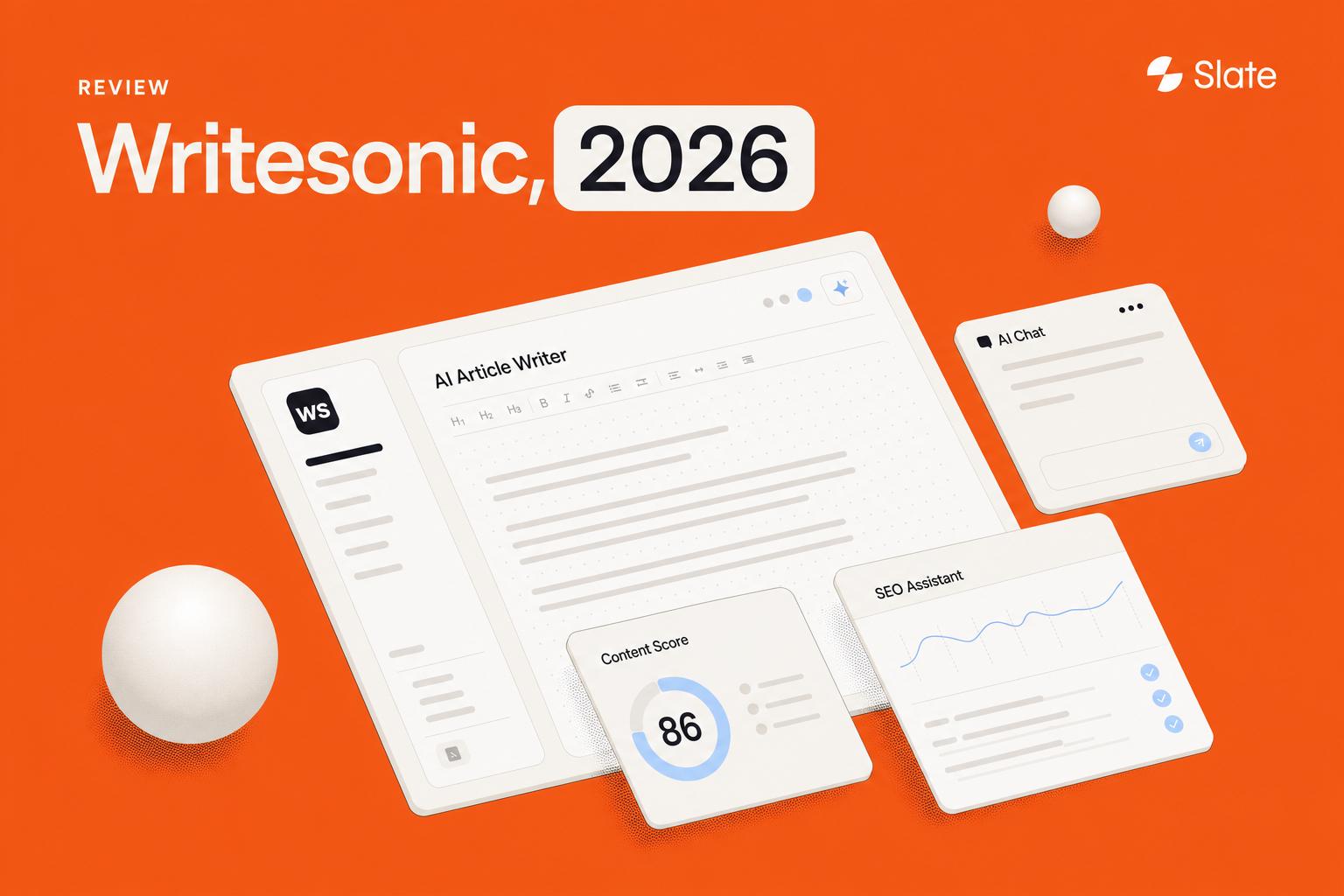
Writesonic in 2026 is an AI search visibility, SEO, and content platform that helps brands track how they appear in AI search and improve it through content, citations, and technical fixes. It bundles an AI Article Writer, Chatsonic, an SEO Checker and Optimizer, and a GEO module for tracking brand visibility across ChatGPT, Perplexity, Gemini, and Google AI Overviews.
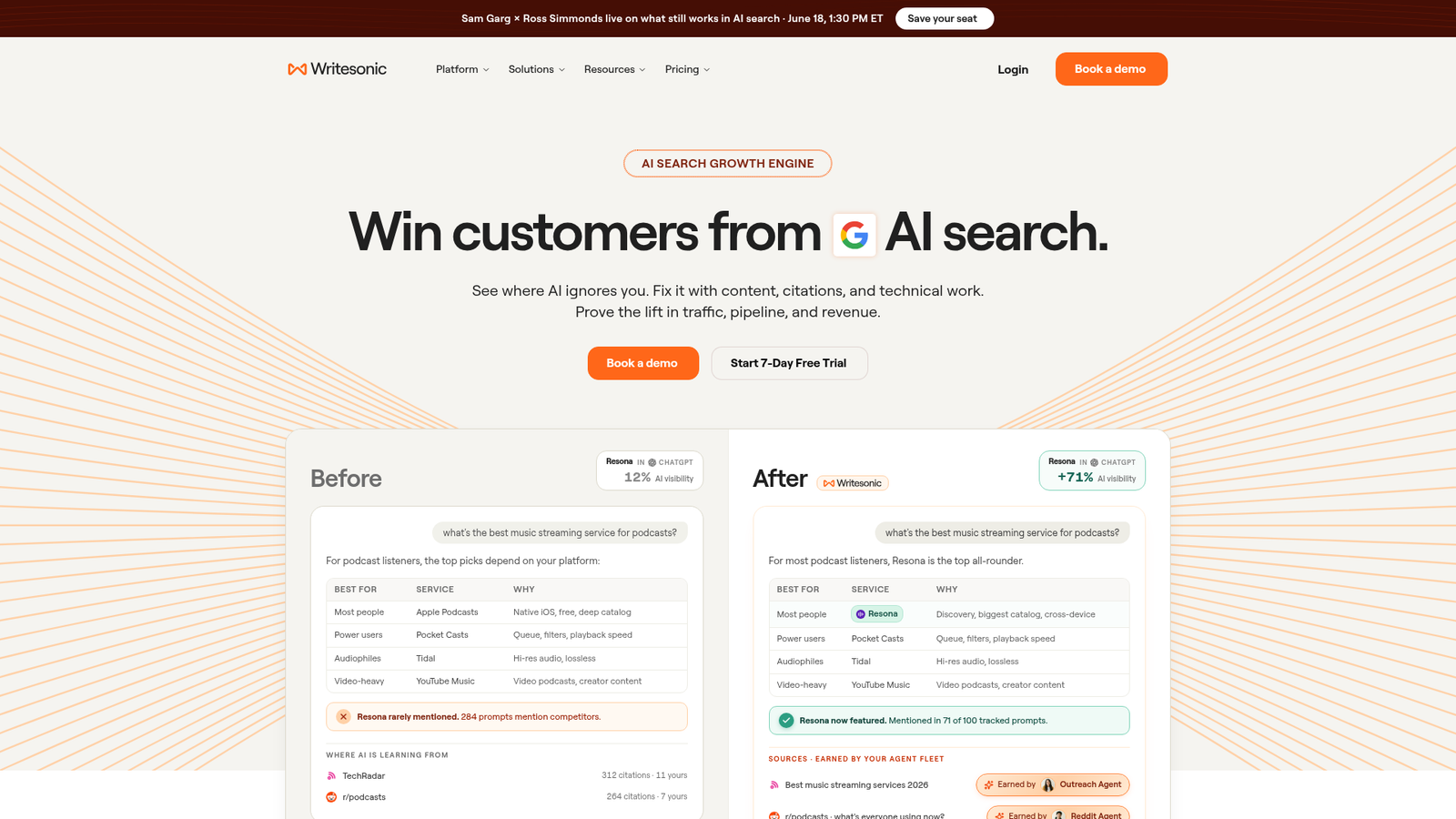
What changed in 2026: The strategic shift is the centerpiece. Writesonic has moved from "AI writing assistant" to "AI search visibility plus content platform." For buyers, this changes the question. You are no longer just comparing it to ChatGPT or Jasper for drafting - you are comparing it to dedicated AI visibility platforms and content engineering systems.
Who Owns Writesonic And How It Has Evolved
Writesonic launched in 2020 as an AI writing tool focused on templates and short-form copy. It expanded into SEO content workflows in 2023, then added its GEO module in 2024 to track brand appearance inside ChatGPT, Perplexity, Gemini, and Google AI Overviews. By 2026, those layers are consolidated into a single platform with AI agents for SEO, content, and LinkedIn - plus an Action Center that prioritizes remediation tasks based on visibility impact.
Writesonic's Core Features (What You Actually Get)
What Writesonic sells and what you use day-to-day are not always the same thing. The features below are grouped by job-to-be-done, with a note on where plan gating kicks in.
AI Article Writer
The Article Writer is the gateway feature. You select a content type - listicle, how-to, news-style article, or general blog - generate an outline, edit it, and then let the editor draft sections. You can train a brand voice and adjust tone, and there is a Chrome extension for in-page writing.
First-draft structure is competent for short and medium content. Long-form drafts feel coherent at the sentence level but routinely need structural reordering, fact correction, removal of repetitive phrasing, and tightening of generic AI-isms. Treat the output as a fast first draft, not a publish-ready article. See Writesonic AI writer review context for how this compares to broader AI-driven SEO workflows.
Chatsonic
Chatsonic is Writesonic's conversational interface, but in 2026 it is wired into agents rather than positioned as a standalone chatbot. The SEO agent surfaces real-time SEO analytics. The Content agent handles generation. The LinkedIn agent focuses on that channel. An Auto mode picks an agent based on the question.
The differentiator vs ChatGPT is integration: Chatsonic can pull in real keyword data from Ahrefs, GA, and GSC, so its answers are grounded in your site's actual SEO context. For pure brainstorming, ChatGPT remains more flexible. For SEO-aware drafting inside a marketing workflow, Chatsonic earns its place.
SEO Tools And Audits
The SEO Checker and Optimizer is one of Writesonic's stronger features. Inside the editor, you get a live content score, suggested terms pulled from top-ranking pages, and one-click refinements to apply optimizations.
Capabilities include:
- Site audit coverage that starts smaller on entry plans and scales on paid tiers
- Keyword research and topic discovery
- Keyword clustering for pillar and supporting content planning
- Performance reporting via GA, GSC, and Ahrefs integration
Compared with dedicated SEO platforms, it is best described as useful baseline guidance inside a writing tool rather than a full SEO stack replacement. For deeper SERP analysis, most teams will still pair it with a tool like Surfer. For broader context on Writesonic for SEO content, the bundling argument holds only if you do not already pay for a dedicated SEO platform.
AI Search Visibility Tracking (GEO)
This is the 2026 differentiator. The GEO module tracks how your brand and pages appear across ChatGPT, Perplexity, Gemini, and Google AI Overviews. You can see:
- AI citations and which of your pages are cited
- Brand mentions in AI outputs
- Suggested prompts by niche plus your own custom prompts
- Topics and prompts analysis for prompt research
- AI Bot Analytics via a WordPress plugin
- An Action Center that ranks remediation tasks by impact
GEO is gated. On the free tier and Starter plan, it is not the main value driver. Basic is the practical entry point for AI visibility tracking, and higher tiers expand tracked prompts and usage limits. The data is useful as a baseline, but reviewers consistently note that tracking is shallower than dedicated AI search visibility tools, and there is no programmable layer to automate recurring tasks. This is the section where Slate's positioning becomes relevant - tracking visibility is necessary but not sufficient; engineering content to be cited is a separate job.
Templates, Short-Form, And Brand Voice Controls
Writesonic's template library spans 100+ formats covering ad copy, landing pages, product descriptions, and social posts. You can configure brand voice by uploading samples or describing tone. In testing, brand voice holds well on short-form (ads, social, headlines) and drifts more on long-form and technical content, where the underlying model's default cadence resurfaces.
Integrations And CMS Publishing
Integrations cover Ahrefs, Google Analytics, and Google Search Console for data, plus a WordPress plugin for AI Bot Analytics. CMS publishing flows are lighter than a workflow-driven platform - most teams will export drafts and finalize them in their CMS rather than publish from Writesonic. For more on Writesonic features and where they fit a broader AI search checklist, the integration layer is the main place team-scale workflows hit friction.
Hands-On Performance: What Writesonic Is Actually Good At
Writesonic's strengths cluster around speed and breadth. The biggest gains come from removing blank-page friction and giving marketers a starting point that is faster to edit than to draft from scratch.
In testing, output was strongest on:
- Short-form marketing copy. Ad copy variations, social posts, and meta descriptions came out usable with light editing.
- Outlines and ideation. Outline generation for SEO articles consistently produced a defensible structure quickly - useful even when the body draft needed heavy editing.
- SEO-assisted drafts. The combination of the Article Writer and SEO Checker produced drafts that already addressed target keywords and related terms.
- Landing page copy. Templates with clear constraints (hero, value props, CTA) produced clean first drafts.
- Reducing tool count for small teams. For a solo operator who would otherwise juggle ChatGPT, a separate SEO tool, and a separate visibility tracker, the bundle has real workflow value.
"Good" here means a usable foundation, not publish-ready. That distinction matters and shows up next.
Where Writesonic Falls Short
The most common Writesonic drawbacks are an outsized editing burden on long-form, inconsistent brand voice across content types, limited team governance, and outputs that are not structured for AI citation by default. None of these are unique to Writesonic, but they shape whether the platform fits your workflow.
Editing Burden On Long-Form Content
Long-form is where the AI feel surfaces most. In testing, a generated article still required substantial editing before it felt publish-ready. The work broke down across four categories:
- Structural reorganization. Section order often did not match the strongest narrative; transitions needed rewriting.
- Fact correction. Statistics, dates, and product claims required verification or replacement.
- Tone cleanup. Repetitive phrasing ("In today's fast-paced world...") and hedged sentences had to be cut.
- Removing AI-isms. Generic transitions and filler clauses appeared throughout.
The point is not that editing is needed - it is needed everywhere with AI writing. The point is that "usable first draft" and "publish-ready output" remain meaningfully different things, and Writesonic does not collapse that gap.
Brand Voice Consistency Across Outputs
Configured brand voice holds on short-form. On longer articles and technical content, it drifts back toward the model's default cadence. For multi-writer teams where consistency matters, expect editorial review to handle voice cleanup rather than relying on configuration alone.
Team Governance And Workflow Limitations
Writesonic is built for individuals and small teams. Approval flows and collaboration controls are lighter than what content operations leads typically expect at scale - especially when multiple stakeholders need structured handoffs between research, writing, editing, and review. The question of is Writesonic worth it for content teams running at scale usually lands on "not by itself."
Citation-Readiness And AI Search Extractability
This is the gap that matters most in 2026. GEO tracks where you appear in AI answers. It does not, however, engineer default outputs to be more citable. AI engines tend to extract clear definition blocks (40–60 words), scannable lists, source-backed claims, and structured comparisons. Writesonic's default outputs do not consistently produce those structures without explicit prompting. Tracking tells you where you stand; engineering determines whether you get cited next time. They are related questions, but they are not the same job.
Writesonic Pricing In 2026: Plans, Caps, And Real Value
Writesonic costs $79/mo on the entry Starter tier (billed annually) and scales to $399/mo for Growth. The numbers that matter, though, are the caps - articles per month, tracked GEO prompts, seats, and audit pages - because those are what force upgrades.
Pricing: Starter $99/mo ($79/mo billed annually); Basic $249/mo ($199/mo billed annually); Growth $499/mo ($399/mo billed annually); Enterprise custom. Free tier available for SEO and AI content tools.
G2 rating: 4.7/5
Which Writesonic Plan Is Best Value?
Plan fit by buyer type:
- Solo marketer or founder. Starter handles most short-form drafting and baseline SEO. You will feel the limits sooner if you want AI visibility tracking or higher usage.
- Startup growth team. Basic is the practical floor because it brings Writesonic's AI visibility positioning into the package. Watch the usage limits closely.
- Content-led SaaS team. Growth is the more realistic option if you need more room for article volume and AI visibility usage. Expect to still pair Writesonic with a dedicated SEO platform or content engineering tool for scale.
- Agency. Growth or Enterprise depending on client count and workload. Usage math matters more than headline price at this tier.
- Enterprise content team. Enterprise is the only realistic option for custom limits, support expectations, and broader operational needs - though most enterprise content teams will evaluate dedicated platforms in parallel.
For broader context on Writesonic pricing relative to other generative engine optimization tools, the headline price is rarely the decision driver. Caps and feature gating are.
Writesonic Pros And Cons
Every bundled platform makes tradeoffs. Writesonic's balance is clear: speed and breadth on the upside, depth and governance on the downside. The Writesonic pros and cons below reflect the patterns observed across testing and consistent reviewer feedback.
Pros:
- Fast first drafts across short and medium content
- Bundled SEO and AI visibility reduces tool count for small teams
- Strong template breadth for marketing copy
- Useful for ideation, outlines, and SEO-assisted drafting
- Live content scoring inside the editor accelerates SEO drafts
- GEO module gives a real baseline view of AI search visibility
- Free access and entry pricing lower the barrier for solo users
Cons:
- Heavy editing burden on long-form to reach publish-ready quality
- Brand voice drifts on longer and more technical content
- Plan caps create upgrade pressure faster than headline pricing suggests
- Limited governance, approvals, and workflow controls for teams
- Outputs are not structured for AI citation by default
- GEO depth is shallower than dedicated AI search visibility platforms
- No programmable layer for recurring content operations
The pro/con balance favors solo operators and small teams that value speed over polish. Larger teams that have already invested in SEO and content systems will find the bundle overlaps with tools they already use, while leaving the citation-engineering gap unaddressed.
What Real Users Say About Writesonic
User sentiment across review sites and community discussions clusters into consistent themes.
Recurring praise themes: Reviewers consistently call out speed, ease of use, and the breadth of templates. The clean interface and short ramp-up time come up often, especially from solo marketers and small agencies. Users appreciate that the SEO Checker and Optimizer give real-time guidance inside the editor rather than requiring tab-switching, and the all-in-one convenience of writing plus SEO plus baseline visibility is frequently cited as a reason to choose it over a stack of separate tools.
Recurring complaint themes: The most common frustration is long-form output quality - reviewers describe it as "reads like AI" and note that it needs significant editing before publication. Plan caps and the upgrade jump to access GEO show up in complaints about value. Users on higher tiers question whether GEO depth justifies the cost compared to dedicated AI search platforms.
Onboarding patterns: New users frequently report being surprised that AI search visibility tracking sits on higher paid plans. The split between content-focused plans and GEO-focused value is the most common onboarding confusion.
Vs. free alternatives: Users comparing Writesonic to ChatGPT or Claude tend to say the differentiator is templates, the SEO Checker, and GEO - not the writing itself. Those who already have a strong manual SEO workflow often conclude that a general-purpose LLM is more flexible and cheaper for pure drafting.
Who Should Use Writesonic - And Who Should Skip It?
Writesonic is best for solo marketers, founders, and small teams that want fast drafting plus baseline SEO and AI visibility in one tool. Skip it if you need publish-ready long-form with minimal editing, strict brand governance for multi-writer teams, citation-ready content engineering, or scaled refresh workflows across thousands of URLs.
Writesonic is a strong fit if you:
- Are a solo marketer or founder needing drafting speed
- Want bundled SEO, writing, and baseline AI visibility to reduce stack complexity
- Produce high volumes of short-form copy (ads, landing pages, social)
- Are early in your content operation and need to ship volume
- Want one platform to evaluate AI search visibility without committing to a dedicated tracker
Writesonic is a weaker fit if you:
- Need publish-ready long-form with minimal editing
- Run a multi-writer team needing governance, approvals, and brand consistency at scale
- Prioritize citation-ready content engineering for AI search
- Refresh existing content at scale (the workflow is not optimized for this - see content refresh tools built for this job)
- Need deep CMS integration and structured handoffs across roles
- Already pay for a dedicated SEO tool and an AI search visibility tracker
Best Writesonic Alternatives In 2026
The right Writesonic alternatives depend on the job you are hiring the tool to do - drafting speed, brand consistency, SEO depth, AI search visibility, or scalable content operations. The best alternative to Writesonic in 2026 depends on the job: Slate for AI search visibility plus citation-ready content engineering at scale, Jasper for brand voice and marketing workflow consistency, ChatGPT for flexible general-purpose drafting, Copy.ai for short-form GTM automation, and Surfer for deep SEO and content optimization.
1. Slate - Best For AI Search Visibility And Scalable Content Engineering
Slate is an end-to-end AI search optimization and content engineering platform built for B2B SaaS marketing teams, content-led growth companies, and SEO leads adapting to AI search. Where Writesonic tracks AI visibility, Slate connects tracking to action - engineering content for citation-readiness through structured, repeatable workflows.
Best for: B2B SaaS marketing teams, content-led growth companies, and SEO leads who need AI search visibility tracking tied directly to citation-ready content workflows.
Key features:
- AI Search Analytics across ChatGPT, Google AI Mode, Google AI Overviews, and Perplexity
- Workflows with 24+ AI models, conditional logic, web scraping, and CMS publishing
- Power Sheets for bulk content refreshes, programmatic creation, and optimization audits across thousands of URLs
- SuperBlocks: Pre-built workflow components and templates for AI Search Optimization
- Brand Kit and Knowledge Base for brand-safe AI content generation
- Direct CMS publishing to Webflow and WordPress
- MCP integration for working with marketing data inside Claude
Pricing: Starting at $199/month.
G2 rating: 4.9/5
Why teams choose Slate over Writesonic: Visibility tracking plus the engineering layer to act on it, content engineered for citation-readiness rather than just drafted, structured workflows for scale without losing brand control, built-in governance through style guides and review steps, and content refresh workflows - not just net-new generation. See how Slate engineers content for AI search visibility - Book a demo.
For teams weighing Writesonic vs Jasper, Slate's positioning sits one layer above both: less about generating copy, more about operating a system that wins AI citations.
2. Jasper - Best For Brand Voice Consistency
Jasper is an AI platform built for marketing teams to create on-brand content and run end-to-end marketing workflows. It earns its spot when brand voice consistency across a multi-writer team is the priority.
Best for: Marketing teams that need brand-consistent AI content creation, campaign execution, and workflow automation at scale.
Key features: Purpose-built AI agents for marketing workflows, Content Pipelines for repeatable idea-to-launch execution, and Jasper IQ for brand voice, style guides, audiences, and product knowledge.
Pricing: Pro $69/month/seat ($59/seat/mo billed yearly); Business custom pricing. Pro includes a 7-day free trial.
G2 rating: 4.7/5
Choose Jasper over Writesonic if brand voice fidelity across many writers matters more than bundled SEO and GEO tracking.
3. ChatGPT - Best For Flexible General-Purpose Drafting
ChatGPT is the most flexible general-purpose AI assistant for writing, research, analysis, and coding. If you already run a strong manual SEO and editorial process, ChatGPT can replace Writesonic's drafting layer at a fraction of the cost.
Best for: Individuals and teams that need a general-purpose AI assistant for everyday work, research, writing, coding, and analysis.
Key features: Chat-based answers with search and deep research, file uploads, data analysis, image generation, voice, projects, custom GPTs, and business workspaces with admin controls.
Pricing: Go $8/mo; Plus $20/mo; Pro from $100/mo; Business $25/user/mo ($20/user/mo billed annually, 2-seat minimum); Enterprise custom. Free tier available.
G2 rating: 4.6/5
ChatGPT loses to Writesonic when you want templates, an SEO Checker, or visibility tracking built in - but wins on flexibility, cost, and prompt control.
4. Copy.ai - Best For Short-Form GTM Workflows
Copy.ai is an AI-native go-to-market platform for automating sales, marketing, and operations workflows. It is the better choice when the job is automating GTM motions - prospecting, lead processing, campaign content - rather than writing SEO articles.
Best for: B2B go-to-market teams that want AI to automate prospecting, content, lead processing, and other revenue workflows.
Key features: AI-powered workflows for GTM processes, Copy Agents and Actions for task automation, and Brand Voice, unified data, and integrations for consistent outputs.
Pricing: Chat $29/mo ($24/mo billed annually); Growth $1,000/mo ($12,000/yr); Expansion $2,000/mo ($24,000/yr); Scale $3,000/mo ($36,000/yr); Enterprise custom.
G2 rating: 4.7/5
Pick Copy.ai over Writesonic when revenue workflow automation matters more than SEO content depth.
5. Surfer SEO - Best For SEO-Driven Content Optimization
Surfer is an AI search optimization and content intelligence platform for creating, optimizing, and monitoring content visibility across Google and AI search. Teams that want SEO depth often pair Surfer with a separate writing tool - or use it as a Surfer alternative consideration alongside platforms like Slate.
Best for: SEO teams, agencies, and content marketers that want to optimize articles and track brand visibility in both traditional and AI search.
Key features: Create and optimize content with real-time SEO guidance, track AI search visibility across tools like ChatGPT, Perplexity, and Google AI results, plus content opportunity discovery and page audits.
Pricing: Discovery $49/mo; Standard $99/mo; Pro $182/mo; Peace of Mind $299/mo; Enterprise $999/mo (billed yearly). Free Surfer account available.
G2 rating: 4.8/5
Choose Surfer over Writesonic when SEO depth - SERP analysis, content scoring, and competitor-aware optimization - is the priority over writing breadth.
Final Verdict: Should You Buy Writesonic In 2026?
Writesonic in 2026 is a capable bundle for buyers who want speed and breadth in a single tool. It is a strong fit for solo marketers and small teams that need fast drafts plus a baseline AI visibility view. It is a weaker fit for content teams that need publish-ready long-form, strict governance, or citation-ready content engineering at scale.
Buyer-segmented recommendation:
- Buy Writesonic if you are a solo marketer, founder, or small team that values speed, templates, and bundled tooling.
- Pair Writesonic with a dedicated SEO platform if you are a growth team that needs deeper optimization.
- Skip Writesonic if you are a content-led B2B team prioritizing citation-ready content, brand governance, and scalable refresh workflows.
If the goal is AI search visibility plus scalable, citation-ready content workflows, see how Slate approaches content engineering - Book a demo.
Frequently Asked Questions
Is Writesonic Worth It In 2026?
Writesonic is worth it in 2026 for solo marketers, founders, and small teams that want faster first drafts plus a bundled SEO and baseline AI visibility view. The tradeoff is editing burden on long-form and limited governance for teams. Larger content-led teams typically outgrow it and pair it with dedicated platforms.
How Much Does Writesonic Cost?
Writesonic pricing starts at $79/mo on Starter (billed annually), then Basic at $199/mo billed annually, Growth at $399/mo billed annually, and custom Enterprise pricing. A free tier exists for SEO and AI content tools. Plan caps - articles per month, tracked GEO prompts, and seats - matter more than the headline price when evaluating value.
Is Writesonic Better Than ChatGPT?
It depends on the job. Writesonic wins on templates, SEO Checker integration, and AI search visibility tracking built into one workflow. ChatGPT wins on flexibility, prompt control, lower cost, and general-purpose use. If you already have a strong SEO stack and editorial process, ChatGPT often delivers more value per dollar.
Does Writesonic Help With SEO?
Yes, with caveats. The SEO Checker and Optimizer provide live content scoring, competitor-aware term suggestions, and one-click refinements inside the editor. Site audits and keyword research are included. SEO assistance is not the same as guaranteed ranking content - human review and structural editing remain necessary for publish-ready, performance-grade pages.
Can Writesonic Create Citation-Ready Content For AI Search?
Not by default. Writesonic's GEO module tracks where your brand appears in AI answers, but its outputs are not engineered to produce citation-friendly structures - clear definition blocks, scannable lists, source-backed claims - without explicit prompting. Tracking visibility and engineering content for citation are related but distinct jobs, and Writesonic addresses the first more than the second.
What Is The Best Writesonic Alternative?
It depends on the job-to-be-done. For AI search visibility plus citation-ready content engineering at scale, Slate is the strongest alternative. For brand voice consistency across marketing teams, Jasper is the better fit. For flexible general-purpose drafting at lower cost, ChatGPT wins. For deep SEO optimization, Surfer is the practical choice.
Who Should Not Use Writesonic?
Skip Writesonic if you need publish-ready long-form with minimal editing, strict brand governance for multi-writer teams, citation-ready content engineering for AI search, or scaled refresh workflows across thousands of URLs. Enterprise content teams and content-led B2B SaaS companies typically need a dedicated AI search optimization and content engineering platform instead.
Does Writesonic Offer A Free Trial?
Writesonic offers a free tier for SEO and AI content tools with limited usage, allowing new users to test core features before upgrading. GEO (AI search visibility) outside ChatGPT is reserved for paid plans starting at Basic.
What Changed In Writesonic In 2026?
The biggest 2026 shift is strategic positioning. Writesonic has moved from "AI writing tool" to "AI search visibility plus SEO and content platform." The GEO module - tracking brand appearance in ChatGPT, Perplexity, Gemini, and Google AI Overviews - is now central, supported by AI agents for SEO, content, and LinkedIn, plus an Action Center that prioritizes remediation tasks.