If Search Atlas no longer fits your SEO workflow, focus on what you want to replace.
Maybe it’s the content editor. Maybe it’s rank tracking. Maybe it’s local reporting, AI visibility, technical deployment, or backlink research.
That choice cuts the shortlist fast:
For AI search visibility tied to execution, Slate is the best fit. Semrush and SE Ranking cover traditional SEO suite work. Surfer is best for editor-led content scoring. BrightLocal is built for local SEO. Alli AI handles on-site SEO deployment. Ahrefs is strongest for backlink and competitor research.
If you want more context on Search Atlas first, see our Search Atlas review and Slate vs. Search Atlas.
Key Takeaways
- The best Search Atlas alternative depends on the workflow you’re replacing: suite coverage, content, local SEO, reporting, rank tracking, AI visibility, or research.
- Slate fits teams that want AI search visibility, opportunity discovery, content production, publishing, outreach, and measurement in one system.
- Semrush and SE Ranking are the closest traditional suite alternatives.
- Surfer is a focused content scoring tool for writers and editors.
- BrightLocal is the local SEO specialist.
- Alli AI is best for technical SEO deployment when developer time is scarce.
- Ahrefs is the pick for backlink research and competitor analysis.
- Entry price can mislead you. Seats, credits, keywords, pages, prompts, add-ons, and contract terms decide the bill.
Quick Picks: Best Search Atlas Alternatives By Use Case
For a wider category view, see our roundup of the best AI SEO tools.
How We Compared Search Atlas Alternatives
We looked at vendor documentation, published pricing pages, product pages, and G2 ratings.
Evaluation Criteria
What Are You Replacing In Search Atlas?
Most teams use only a few Search Atlas modules heavily.
So don’t shop for “a Search Atlas replacement” in the abstract. Shop for the workflow that creates the most drag.
Search Atlas Alternatives Comparison Table
Feature And Workflow Coverage
Pricing And Capacity
Before you buy, check projects, tracked keywords, pages, prompts, seats, credits, overages, add-ons, contract length, and renewal terms.
That’s where the bill lives.
1. Slate: Best For End-To-End AI Search Visibility And SEO Execution
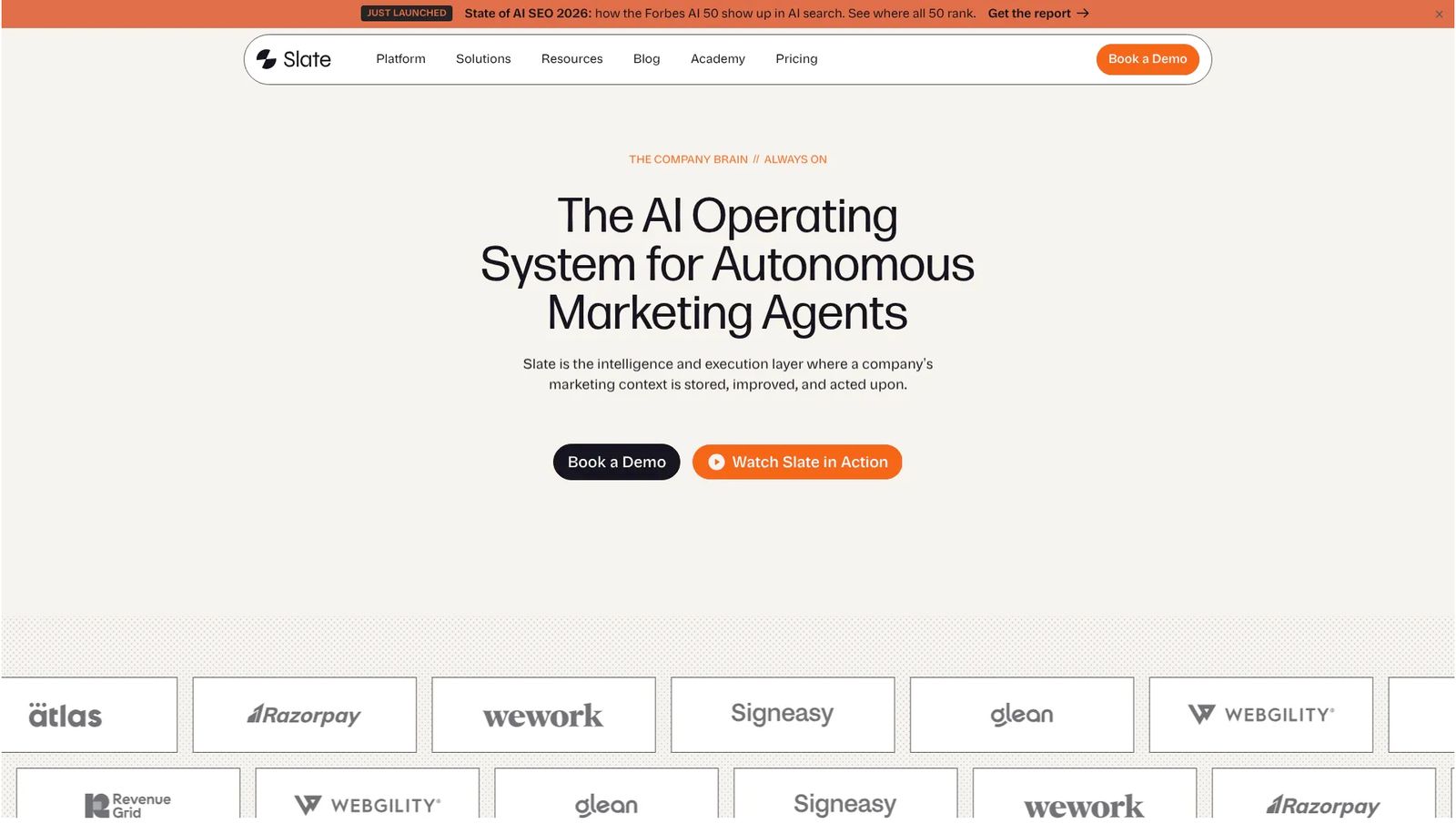
Slate is built for teams that want to move from AI visibility data to published work without duct-taping seven tools together.
It tracks where your brand appears in AI answers, finds content and citation gaps, helps create or refresh pages, publishes to your CMS, runs outreach, and measures lift.
Best For
Slate fits SEO leaders, content ops teams, organic growth marketers, and B2B SaaS teams that already publish often.
It’s strongest when the bottleneck is the handoff from insight to page update.
Key Capabilities
AI Search Analytics: Tracks brand presence across ChatGPT, Google AI Mode, Google AI Overviews, and Perplexity.
Opportunities: Finds gaps across rankings, citations, content, traffic, and social signals.
Agents: Lets marketers delegate repeatable SEO and content work in plain language.
Workflows And Power Sheets: Combines a visual workflow builder with a spreadsheet-style workspace for bulk content work.
Native Ahrefs And Semrush Access: Includes access to Ahrefs and Semrush data inside Slate.
CMS Publishing: Publishes directly to Webflow and WordPress.
Pages: Pulls together Google Search Console and GA4 data for page-level performance.
Outreach: Finds link and brand-mention opportunities, enriches contacts, and supports sending.
Brand Kit And Knowledge Base: Keeps content aligned with voice, facts, style, and company context.
Pricing
Pricing: Slate starts at $499/month, including 15,000 credits, 10,000 prompt answers tracked, and 1,000 web pages tracked.
Agency and Enterprise plans are available. A free trial is available.
G2 rating: 4.9/5.
Choose Slate If
Choose Slate if AI search visibility needs to turn into content, publishing, outreach, and reporting.
It’s a fit when your team can see the opportunity but keeps losing time between the spreadsheet, writer, CMS, and reporting deck.
Consider Another Option If
Pick a narrower tool if you only need backlink research, local SEO, or draft scoring.
For a direct comparison, see Slate vs. Search Atlas. For AI citation tracking, see our guide to AI citation tracking tools.
2. Semrush: Best For Broad Traditional SEO Suite Coverage
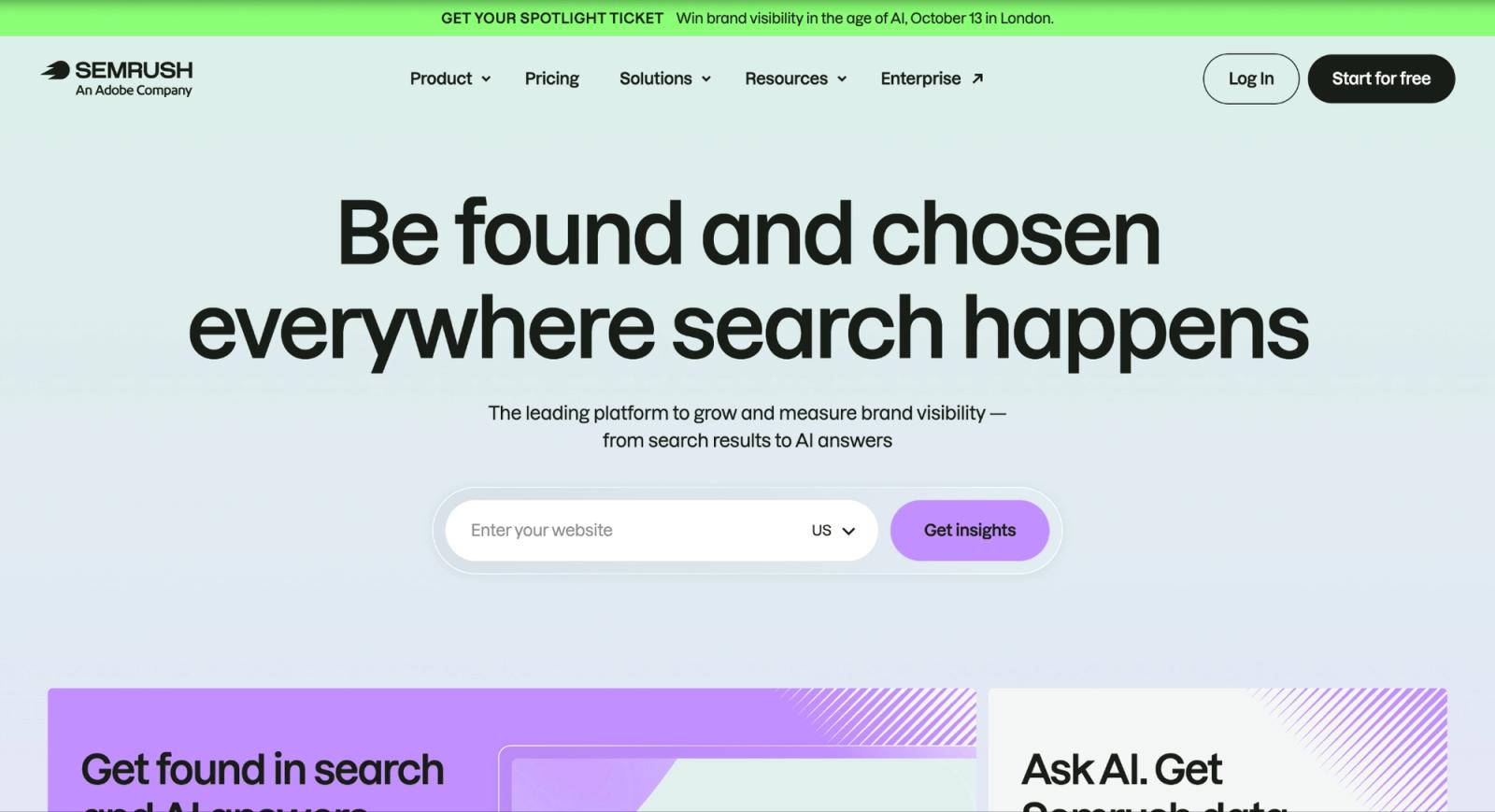
Semrush is the closest pick if your Search Atlas usage centers on research, audits, rank tracking, and competitive analysis.
It also includes AI visibility and brand sentiment monitoring.
Best For
Semrush fits marketing teams and agencies that need one research platform for SEO, paid search, competitor tracking, and reporting.
Key Capabilities
Keyword And Competitor Research: Researches organic and paid search opportunities.
Site Audits And Rank Tracking: Crawls sites and tracks positions over time.
AI Visibility And Brand Sentiment: Tracks how a brand appears in AI-generated answers.
Pricing
Pricing: Free $0/month; SEO $117.33/month, Starter $165.17/month, Pro+ $248.17/month, and Advanced $455.67/month when billed annually.
Enterprise is custom. Extra users start at $45/month on plans that include the SEO Toolkit. Annual billing saves up to 17%.
G2 rating: 4.5/5.
Choose Semrush If
Choose Semrush if your team needs wide research coverage and stakeholders already expect Semrush data in reports.
Consider Another Option If
Choose another platform if the pain is content production, publishing, or closing the loop after research.
See our Semrush alternatives roundup for a deeper comparison.
3. SE Ranking: Best For Budget-Conscious All-In-One SEO Teams
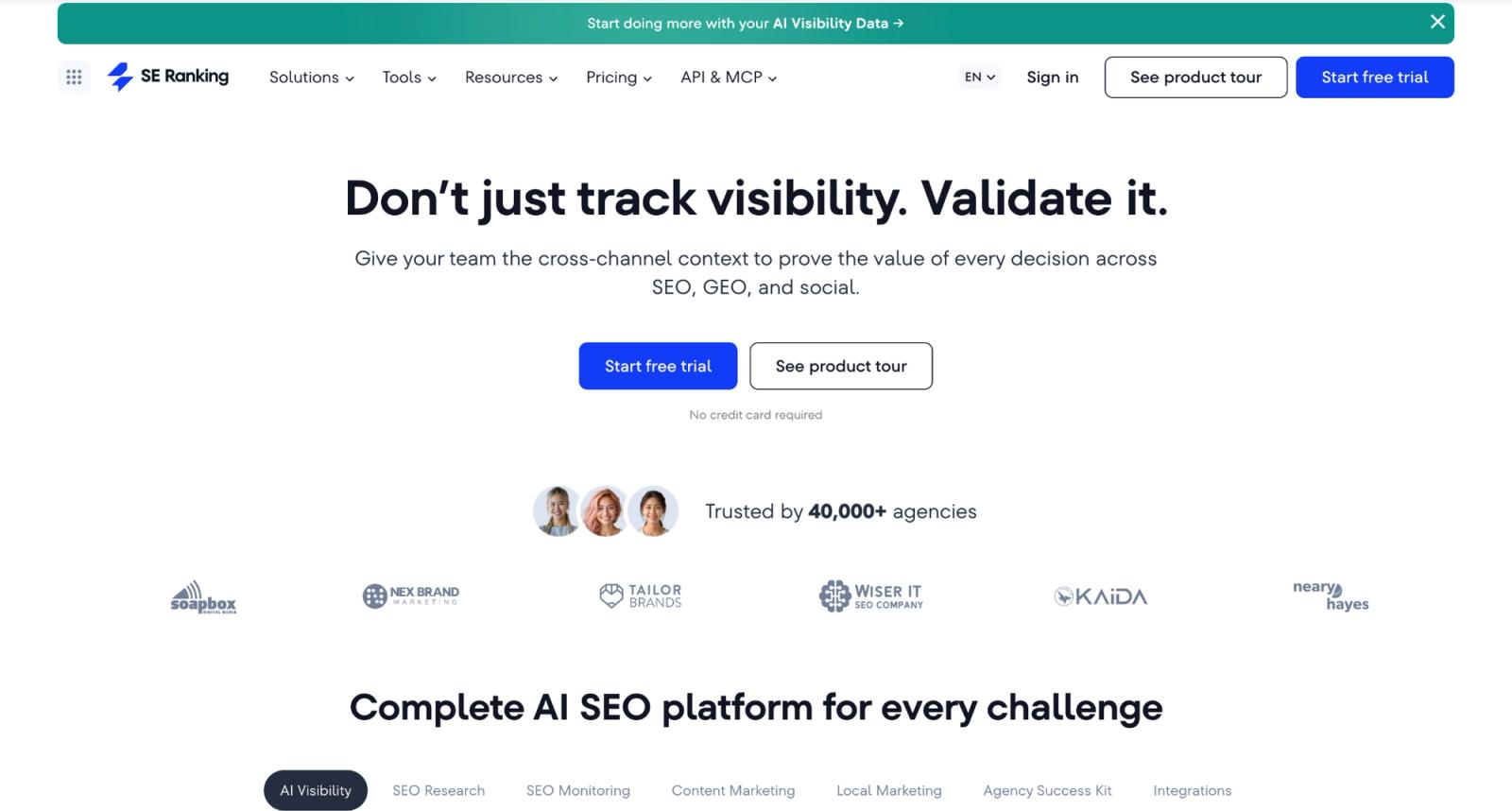
SE Ranking covers rank tracking, audits, keyword research, competitor research, backlink analysis, and client reporting.
Its entry price makes it attractive for small teams and agencies.
Best For
SE Ranking fits consultants, agencies, and lean in-house teams that need dependable SEO coverage without enterprise pricing.
Key Capabilities
Rank Tracking And Audits: Tracks positions and crawls sites for SEO issues.
Keyword, Competitor, And Backlink Research: Covers the core research layer for most SEO programs.
AI Search Visibility: Available through the AI Search add-on.
Pricing
Pricing: Core starts at $103.20/month. Growth starts at $223.20/month.
Add-ons include Agency Pack, AI Search, and API. A 14-day free trial is available.
G2 rating: 4.7/5.
Choose SE Ranking If
Choose SE Ranking if you need core SEO tools, client reporting, and a lower published entry price.
Consider Another Option If
Choose another platform if AI visibility is the main purchase driver, since AI Search is an add-on.
4. Surfer: Best For Editor-First Content Optimization
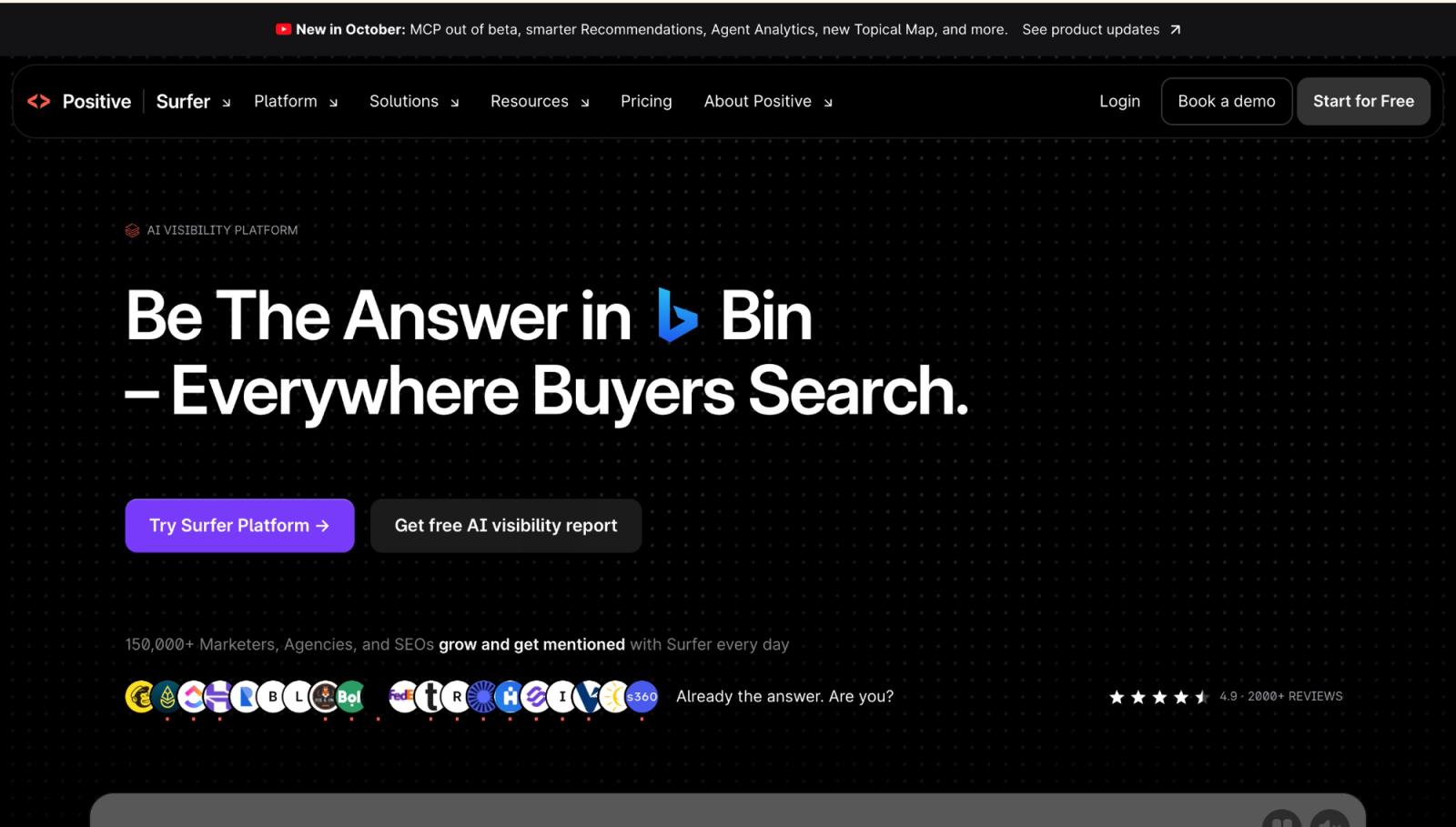
Surfer is best when writers need live scoring while drafting.
It’s a focused content tool for teams that care about briefs, SERP comparisons, and consistent on-page standards.
Best For
Surfer fits content marketers, SEO teams, and agencies that need writers to produce better-scored drafts with less senior-editor time.
Key Capabilities
Live Content Guidelines: Gives writers scoring and suggestions inside the draft.
Content Audits: Finds pages that need updates and compares them with competing pages.
AI Search Visibility Tracking: Monitors visibility in AI-driven search surfaces.
For adjacent options, see our guide to content gap analysis tools.
Pricing
Pricing: Discovery €49/month, AI Search Analytics €82/month, Standard €99/month, Pro €182/month, and Peace of Mind €299/month, all shown with annual billing.
Enterprise is custom.
G2 rating: 4.8/5.
Choose Surfer If
Choose Surfer if writers and editors are the main users.
It’s a strong fit when the job is improving each draft before it leaves the editorial queue.
Consider Another Option If
Choose another platform if you also need broad keyword research, backlink data, technical audits, publishing, or outreach.
See our roundup of content optimization tools.
5. BrightLocal: Best For Local SEO And Multi-Location Reporting
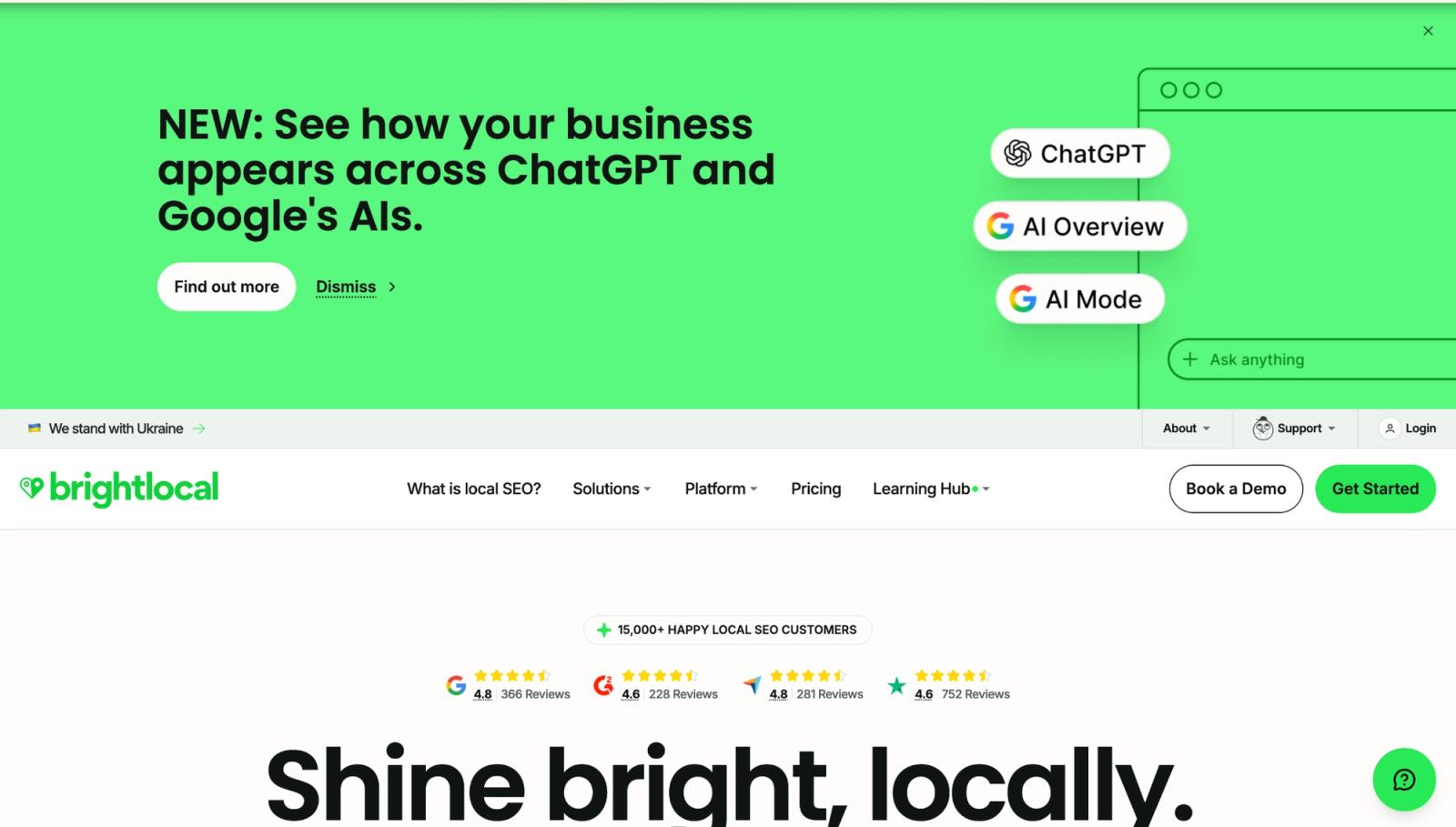
BrightLocal is purpose-built for local SEO.
If your Search Atlas work revolves around locations, listings, reviews, and local reports, BrightLocal belongs high on the list.
Best For
BrightLocal fits local businesses, franchises, multi-location brands, and agencies that report to location managers.
Key Capabilities
Geo-Grid Rank Tracking: Maps rankings across local search grids.
Listings And Citations: Manages business listings and NAP consistency.
Reviews: Monitors reviews, supports responses, and helps run review generation campaigns.
Pricing
Pricing: Track, Manage, and Grow plans are priced on request.
Citation Builder is pay-as-you-go, starting at $2 per citation. A free tier is available.
G2 rating: 4.6/5.
Choose BrightLocal If
Choose BrightLocal if local revenue is the scorecard.
Geo-grid tracking, listings, citations, and reviews are central to the product.
Consider Another Option If
Choose another platform if you need national keyword research, content production, or backlink intelligence.
One reporting note: local business citations and AI citations are different animals. A local citation is a directory listing with your name, address, and phone number. An AI citation is a source link or attribution inside an AI answer.
6. Alli AI: Best For Automated Technical SEO Deployment
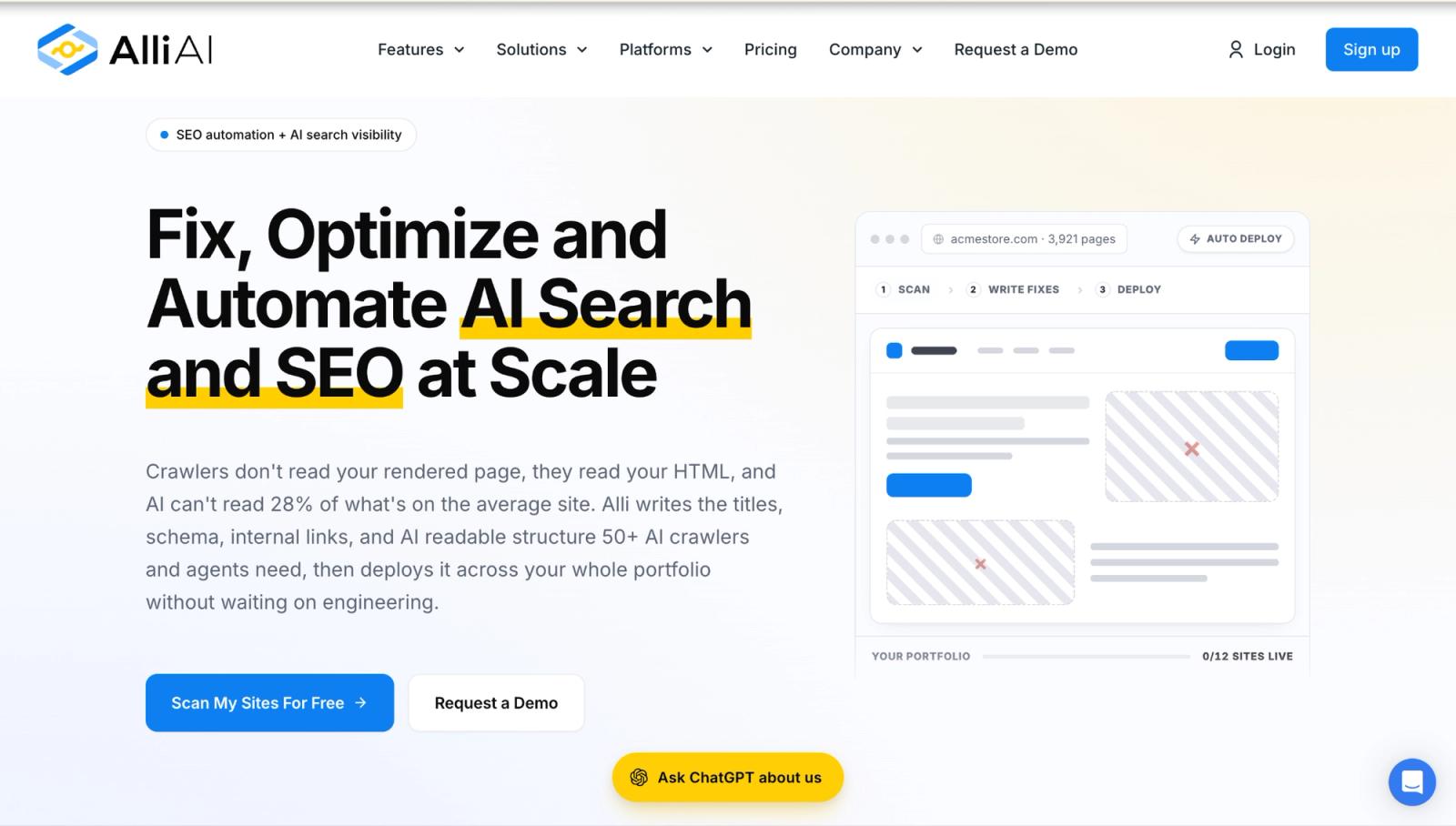
Alli AI is a deployment layer for SEO changes.
It’s useful when your team knows which on-page changes need to happen, but engineering time is booked three sprints out.
Best For
Alli AI fits agencies, ecommerce teams, and marketers managing multiple sites with limited developer help.
Key Capabilities
AI Crawler Pre-Rendering: Supports pre-rendering for 50+ AI crawlers.
Bulk On-Page Changes: Applies rules-based changes across many pages.
Live Visual SEO Editor: Lets users edit SEO elements through a visual interface.
Pricing
Pricing: Business is $299/month for 5 sites. Agency is $599/month for 15 sites.
Enterprise has individual pricing for 50 sites. A 10-day free trial is included.
G2 rating: 3.9/5.
Choose Alli AI If
Choose Alli AI if your team has a backlog of on-page changes and needs a way to push them live without waiting on developers.
Consider Another Option If
Choose another platform if you need keyword research, content production, backlink data, or client reporting.
Deployment tools can trigger security reviews because they require scripts or site access, so plan that before the trial clock runs out.
7. Ahrefs: Best For Backlink And Competitor Research
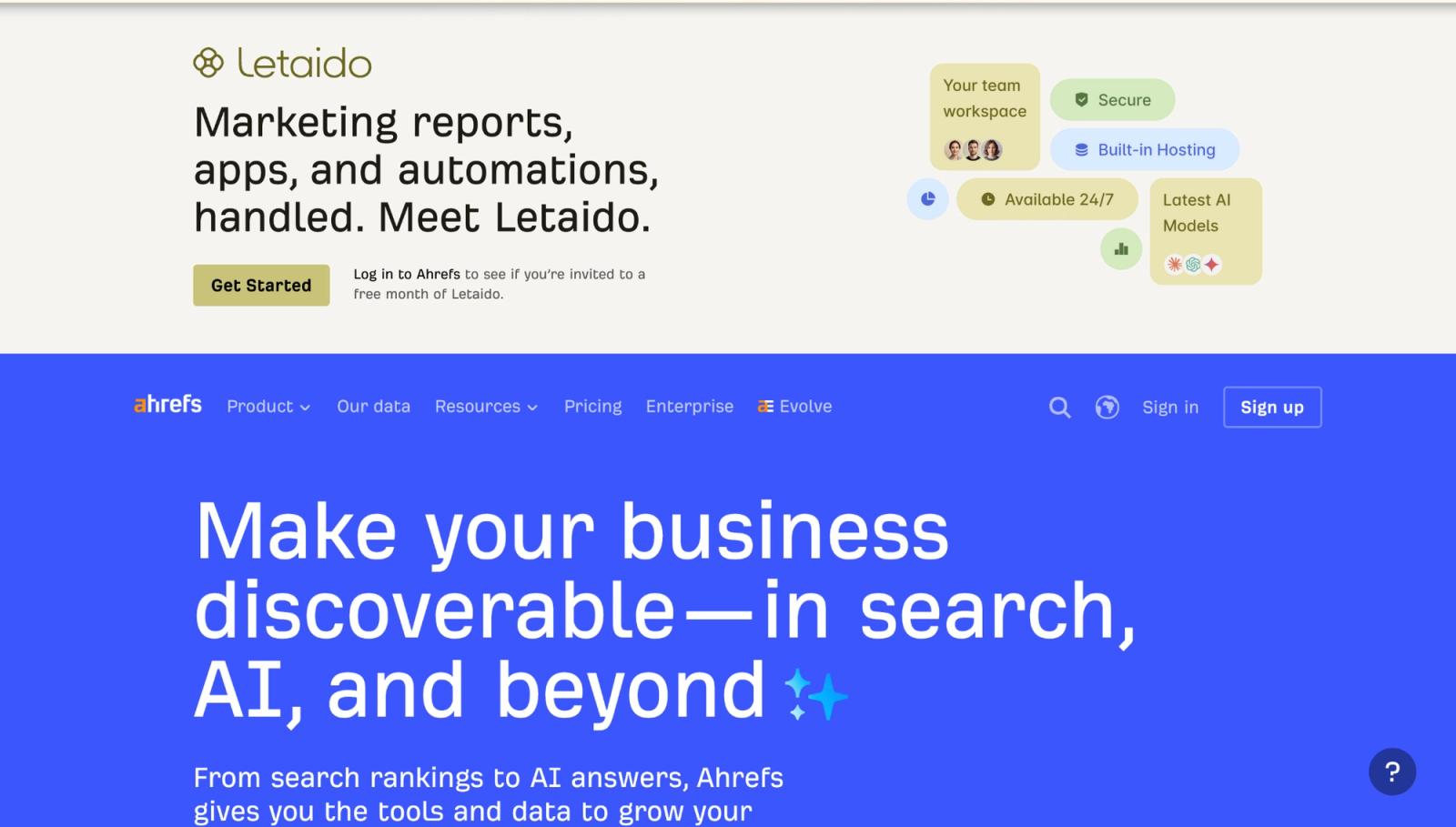
Ahrefs is strongest when your SEO strategy runs through backlinks, referring domains, competitor content, and keyword research.
It also covers rank tracking, site audits, and AI visibility.
Best For
Ahrefs fits SEO teams, agencies, link builders, and competitive analysts who need deep research data every day.
Key Capabilities
Site Explorer: Shows backlinks, referring domains, organic pages, and traffic estimates.
Keywords Explorer And Content Explorer: Helps with keyword research and content discovery.
Site Audit And Rank Tracker: Adds crawling and position tracking to the research stack.
Pricing
Pricing: Starter €27/month; Lite €119/month, Standard €229/month, Advanced €419/month, and Enterprise €1,394/month with annual commitment.
Ahrefs Free includes limited Site Explorer and Site Audit access.
G2 rating: 4.5/5.
Choose Ahrefs If
Choose Ahrefs if link intelligence and competitor research drive your SEO program.
Consider Another Option If
Choose another platform if you need content production, CMS publishing, or outreach sending in the same system.
Slate includes native Ahrefs and Semrush access, which can change the math for teams paying for multiple research tools. See our Ahrefs comparison.
Best Search Atlas Alternative By Use Case
Best For AI Search Visibility
Slate is the pick when AI visibility needs to turn into action.
It tracks brand presence across ChatGPT, Google AI Mode, Google AI Overviews, and Perplexity, then turns gaps into opportunities your team can execute inside Slate.
Semrush, Surfer, SE Ranking, and Ahrefs all have AI visibility features. The difference is whether the tool stops at measurement or carries the work into content, publishing, outreach, and reporting.
See our roundup of the best AI visibility tools.
Best For Content Optimization
Surfer is best for editor-led scoring inside the draft.
Slate is better when the workflow includes creating, publishing, refreshing, and measuring content at volume.
Best For Technical SEO And Site Audits
Semrush and SE Ranking are good picks for audits and issue discovery.
Alli AI fits when the issue list already exists and the team needs to push on-page changes live.
Best For Local SEO Agencies
BrightLocal is the specialist choice for location tracking, listings, citations, reviews, and local reports.
Check per-location pricing, geo-grid density, Google Business Profile coverage, client seats, and white-label terms.
Best For Link Research And Competitor Analysis
Ahrefs is the cleanest pick for backlink and competitor content research.
Semrush may fit better if you also need paid search and broader competitive reporting in the same account.
Slate fits when you want to act on brand-mention and link opportunities inside the same system.
Best For Agency And Multi-Client Reporting
SE Ranking and BrightLocal are strong agency picks.
Slate has Agency plans for teams delivering AI visibility and content execution across multiple accounts. The big variables are client seats, report branding, and cost per account.
See our guide to all-in-one marketing automation platforms.
Best For B2B SaaS Content Operations
Slate fits B2B SaaS teams with long buying cycles, comparison content, strict brand requirements, and large libraries that need refreshes.
Brand Kit and Knowledge Base help keep AI-assisted content aligned with your company facts and voice. Power Sheets helps teams update large URL sets without rebuilding every page by hand.
See our guide to AI SEO tools for B2B SaaS.
How To Evaluate AI Search Visibility
Almost every SEO tool now claims some kind of AI visibility tracking. The details count.
AI Search Visibility Vs. AI Search Optimization
Visibility is measurement: how often your brand appears in AI-generated answers, where it’s cited, and how it’s described.
AI search optimization is the work that improves those outcomes: content updates, source coverage, authority signals, and corrections to outdated information.
No platform can guarantee inclusion or citation in an AI-generated answer. Retrieval varies by model, prompt wording, and session.
The Metrics To Track
Track these separately:
Answer presence: Does your brand appear in the answer?
Citation: Is your domain listed as a source?
Brand mention: Is your brand named in the answer body?
Sentiment and accuracy: Is the description favorable, neutral, negative, or wrong?
Rolling everything into one score can hide problems. You might gain mentions while losing citations. Or you might get cited often with outdated pricing, which is the kind of detail that makes sales teams twitch.
Build A Baseline
Use prompts that buyers would type.
Segment them by funnel stage and competitor comparison. Keep the prompt set stable, because changing the prompts changes the trend line.
Document the date, prompt set, platforms covered, and results for answer presence, citation, brand mention, and sentiment. Log major model releases and platform changes next to the data.
Then connect movement back to Search Console, GA4, and pipeline where you can.
Turn Visibility Data Into Published Work
AI visibility data earns its keep when it changes what gets published.
The loop is simple: find the gap, prioritize it, update or create content, publish, run outreach, and measure again.
This is where many stacks slow down. The tool finds the gap, then the work sits in a spreadsheet while someone writes a brief, routes a draft, asks for CMS help, and rebuilds the report.
For deeper measurement coverage, see our guide to AI search analytics tools.
All-In-One SEO Suite Or Specialist Stack?
Suites reduce admin work. Specialist stacks give you more depth in the one area you care about most.
When A Suite Makes Sense
A suite makes sense for small teams that need one login, one vendor, and one reporting surface.
It also helps when leadership wants a single dashboard every month and your team can’t spend half a Friday reconciling numbers across tools.
When A Specialist Stack Makes Sense
A specialist stack makes sense when one discipline drives growth.
A link-led agency may get more from Ahrefs. A multi-location brand may get more from BrightLocal. A content team may only need Surfer.
If your team already has years of history in one tool, switching costs can eat the benefit fast.
Where The Cost Hides
The subscription is the visible cost.
The hidden cost is the handoff: exporting, importing, checking mismatched numbers, duplicating keyword lists, training new hires on five systems, and rebuilding reports before every client call.
Agent-driven workflows are another path. Instead of choosing between one tool and five tools, ask how many times work changes hands between insight and publication.
See our guide to the best content automation tools.
What To Compare Beyond Starting Price
Entry price is a filter. It’s rarely the purchase decision.
Pricing Models To Check
Pre-Purchase Checklist
Run every finalist through this:
- Seats: How many users are included?
- Projects: What are the domain or client caps?
- Tracking: How many keywords, pages, locations, and prompts are included?
- Credits: What does each content run, audit, or workflow consume?
- Overages: Does the platform throttle, block, or auto-bill?
- Add-ons: Which expected tools cost extra?
- Exports And API: Can you get your data out?
- Integrations: Confirm GSC, GA4, CMS, and permission scope.
- White Label: Which plan includes branded reports?
- Contract: Check term length, renewal, and cancellation notice.
- Support: What’s included at your tier?
- Trial Scope: Confirm the trial includes the workflow you’re testing.
Price the whole workflow: research, content, publishing, outreach, reporting, AI visibility, and staff time.
A higher monthly price can be cheaper if it removes two handoffs and one weekly reconciliation meeting.
How To Migrate From Search Atlas Without Losing Momentum
Keep both systems active for four weeks if you can.
That parallel run protects reporting, baselines, and team output while you rebuild.
Week 1: Baseline And Export
Export keyword lists with tags, project settings, historical rankings, completed audit findings, backlink records, outreach history, and contacts.
Save the reports as clients or executives saw them. A PDF from last month can save you an awkward meeting later.
Document GSC and GA4 connections, permissions, and properties.
Record your AI visibility baseline: prompt set, platforms, answer presence, citations, mentions, and sentiment.
Week 2: Connect Integrations And Rebuild Tracking
Connect GSC and GA4 first.
If the new tool publishes to your CMS, test with a low-stakes draft before using it for production content.
Rebuild keyword groups, tags, location targets, user roles, client access, and AI prompt sets. Keep the structure identical at first so you can compare systems cleanly.
Week 3: Rebuild Workflows And Reports
Recreate reports with the same metrics, date ranges, and layout stakeholders already know.
Then rebuild alerts, content brief templates, approval routing, and automated workflows.
Run one complete test from opportunity discovery to content update, publishing, and measurement.
Week 4: Validate And Retire The Old Tool
Run both platforms side by side.
Rankings, traffic numbers, and audit issues may differ because tools crawl and calculate differently. Learn the variance before you present the new report.
Cancel the old platform only after one full reporting cycle works in the new system.
Migration Risks
Historical ranking data may fail to transfer.
AI visibility baselines may be impossible to recreate later.
Mid-quarter migrations can confuse reports, so quarter boundaries are cleaner when your timeline allows it.
Verdict: Which Search Atlas Alternative Should You Choose?
Pick the tool that replaces the workflow causing the most drag.
Run one workflow during the trial: find a content gap, create the update, publish it, and measure the result.
The tool that makes that path shortest is probably the right one.
See How Slate Turns AI Search And SEO Opportunities Into Published Work
Slate connects AI search visibility, SEO opportunities, content creation, CMS publishing, outreach, and reporting.
It tracks ChatGPT, Google AI Mode, Google AI Overviews, and Perplexity. It also ties that AI visibility data to Google performance, content gaps, citation gaps, and pages your team can update.
Slate starts at $499/month, including 15,000 credits, 10,000 prompt answers tracked, and 1,000 web pages tracked. Agency and Enterprise plans are available.
Book a demo to see Slate run on your own opportunities, or read Slate vs. Search Atlas.
Frequently Asked Questions
What Is The Best Search Atlas Alternative?
Slate is best for AI visibility plus SEO execution.
Semrush and SE Ranking are best for traditional SEO suite coverage. Surfer is best for content scoring. BrightLocal is best for local SEO. Alli AI is best for on-site deployment. Ahrefs is best for backlink research.
Is There A Cheaper Alternative To Search Atlas?
Yes. Ahrefs Starter starts at €27/month, Surfer Discovery starts at €49/month, SE Ranking Core starts at $103.20/month, and Semrush SEO starts at $117.33/month.
Check seats, tracked keywords, tracked pages, credits, prompts, and add-ons before calling any tool cheaper.
What Is The Best Search Atlas Alternative For AI Search Visibility?
Slate is the best fit when AI visibility needs to connect to execution.
It tracks brand presence across ChatGPT, Google AI Mode, Google AI Overviews, and Perplexity, then helps teams turn findings into content, publishing, outreach, and measurement.
What Is The Best Search Atlas Content Genius Alternative?
Surfer is the closest fit for editor-first content scoring.
Slate is better when the workflow includes content creation, CMS publishing, outreach, measurement, and large-scale refreshes.
What Is The Best Search Atlas Alternative For Local SEO?
BrightLocal is the best specialist choice for local SEO.
It covers geo-grid rank tracking, listings, citations, reviews, and multi-location reports.
What Are The Best Search Atlas Alternatives For Agencies?
SE Ranking, BrightLocal, Alli AI, and Slate all fit agency use cases.
SE Ranking has Agency Pack. BrightLocal is strong for local clients. Alli AI prices by site count. Slate has Agency plans for AI visibility and content execution across accounts.
Can One Platform Fully Replace Search Atlas?
Yes, if your Search Atlas use is narrow enough.
Teams using Search Atlas mainly for research should compare Semrush and SE Ranking. Teams using one module heavily may get better results from a specialist.
Does Search Atlas Have A Free Trial?
Trial terms change, so check Search Atlas directly.
Among the alternatives here, SE Ranking has a 14-day free trial, Alli AI has a 10-day free trial, Slate has a free trial, and Semrush, BrightLocal, and Ahrefs have free tiers with limited access.
Will Switching SEO Platforms Hurt My Rankings?
Switching tools won’t hurt rankings by itself.
The risks are operational: lost historical data, broken reports, and stalled execution while the team learns the new system.
What Data Should I Export Before Switching From Search Atlas?
Export keyword lists, tags, project settings, historical rankings, audit findings, backlink records, outreach contacts, and delivered reports.
Also save your AI visibility baseline: prompts, platforms, answer presence, citations, mentions, and sentiment.