Discovery in 2026 no longer happens only on Google. It happens inside ChatGPT, Perplexity, Gemini, and AI Overviews - which means a content score in a Google Doc is no longer enough to judge whether a page will actually get found. The best AI content optimization tools in 2026 combine SERP-aware content scoring, structured briefs, workflow automation, and, in newer platforms, AI search visibility tracking so teams can engineer visibility across both classic search and AI-driven discovery.
This guide compares 12 platforms - Slate, Clearscope, MarketMuse, Frase, Surfer SEO, Semrush, Ahrefs, Peec AI, Rankability, Outranking, Dashword, and PageOptimizer Pro - so SEO leads, content teams, and agencies can shortlist by use case rather than treating every "AI SEO" tool as interchangeable. For the broader category context, see the AI SEO landscape.
Key Takeaways
- The buying criteria changed in 2026. Content score alone is no longer enough. Buyers should evaluate whether a tool improves visibility across both Google and AI answer engines.
- Slate leads this roundup for B2B SaaS and content-led teams that need AI search visibility tracking and scalable content workflows in one platform.
- Use case beats feature count. Solo marketers, enterprise editorial teams, refresh-heavy programs, and AI visibility trackers all need different tools.
- Practical evaluation criteria win: content scoring depth, brief quality, SERP analysis, workflow automation, CMS publishing, governance, and pricing transparency.
- AI writing tools are not AI content optimization tools. Writers generate text. Optimizers engineer visibility.
- Pricing models still differ widely across seats, credits, tracked topics, and add-ons. Total cost of ownership matters more than headline price.
What Are AI Content Optimization Tools
AI content optimization tools analyze the SERP, top-ranking pages, and increasingly AI answer engines to recommend how a piece of content should be structured, scoped, and written to win visibility. They typically combine content scoring, brief generation, topic coverage analysis, internal linking suggestions, refresh workflows, and - in newer platforms - AI search visibility tracking.
What used to be a simple keyword-density grader has expanded into something closer to a visibility operating layer. The category now stretches across:
- SERP analysis and competitor content patterns
- Content briefs that include entities, headings, and questions
- Real-time content scoring as writers draft
- AI search visibility tracking across ChatGPT, Perplexity, Gemini, and AI Overviews
- Refresh detection across existing libraries
- Governance controls for brand voice and review
This is also why generative engine optimization has emerged as a distinct discipline alongside classic SEO.
How They Differ From AI Writing Tools
AI writers like ChatGPT or Jasper generate prose. They are not SERP-aware, do not track citations, and do not measure visibility. AI content optimization tools start from the search and AI-answer evidence - what ranks, what gets cited, what questions get asked - and translate that into structured guidance writers (or agents) execute against.
One generates output. The other engineers outcomes.
How We Evaluated the Best AI Content Optimization Tools
This guide combines hands-on use of several tools, vendor documentation, public product demos, and third-party reviews. Pricing and plan structures were checked against official sites and current vendor materials in May 2026; enterprise and custom plans change frequently, so treat figures as directional.
Eight criteria shaped the evaluation:
- Content scoring methodology - is the score defensible or just keyword counting?
- Brief quality - entities, questions, structure, and competitor patterns
- SERP and competitor analysis depth
- AI search visibility tracking across ChatGPT, Perplexity, Gemini, and AI Overviews
- Workflow automation and team collaboration
- CMS publishing and integrations
- Governance, brand voice, and review controls
- Pricing transparency and total cost of ownership
The reviewer fit: this guide is written for B2B SaaS and content-led teams, scale-ups, and agencies, not solo bloggers running a single hobby site.
Best AI Content Optimization Tools at a Glance
The Best AI Content Optimization Tools in 2026
1. Slate - Best for AI Search Visibility and Scalable Content Execution
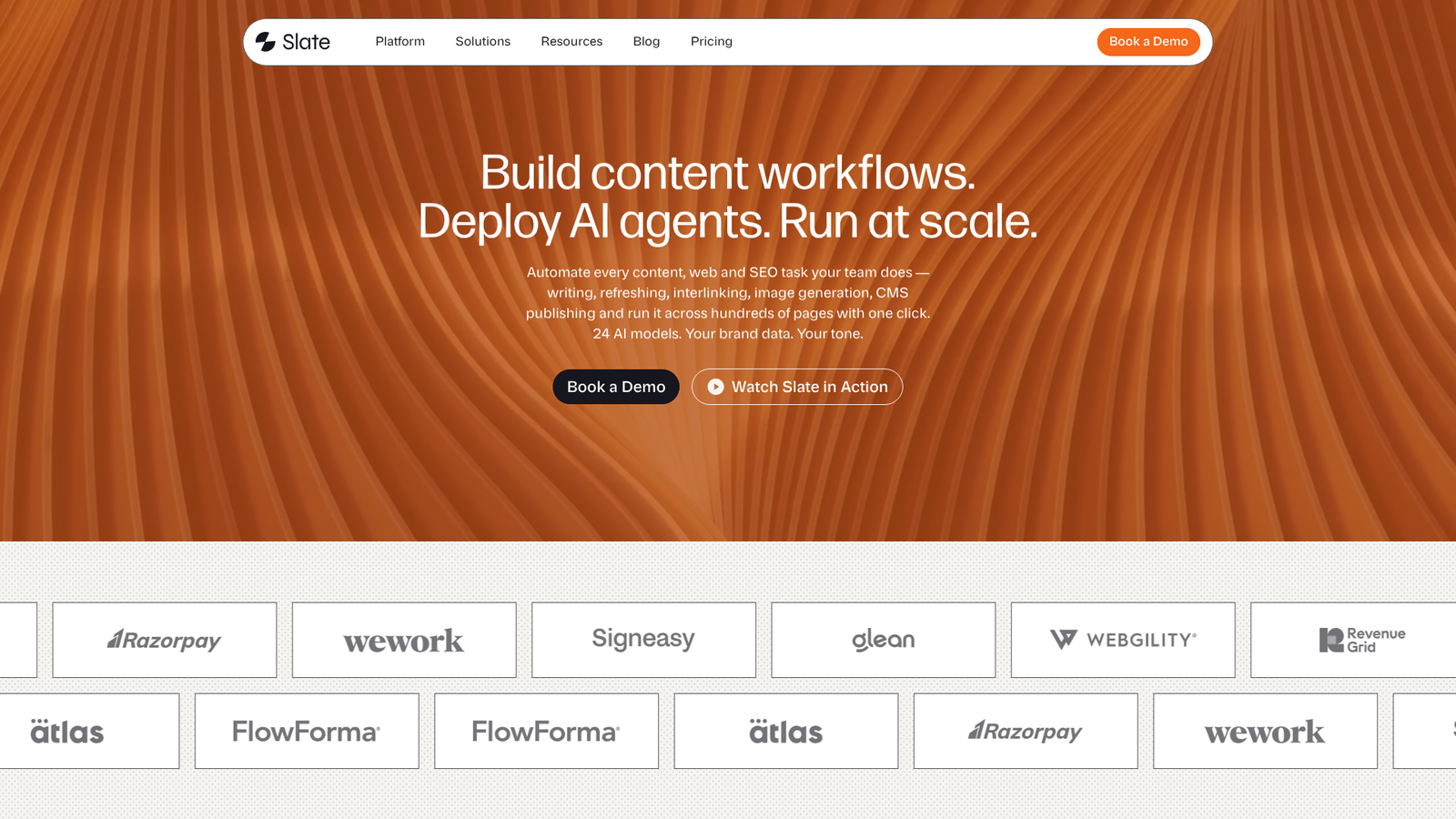
Slate is an automation platform for SEO, web, and content teams that tracks AI search visibility and runs AI-powered content workflows at scale. It's designed as an AI-search-first system rather than a keyword tracker with AI features bolted on.
Best for: B2B SaaS and content-led teams that need to track AI search visibility and execute content workflows in one platform.
Why it stands out: Most tools in this list optimize a single document. Slate connects the layers above and below that document - visibility tracking, opportunity discovery, agent-driven content creation, brand governance, and direct CMS publishing - so the system runs without constant manual lifting.
Key features:
- AI Search Analytics across ChatGPT, Google AI Mode, Google AI Overviews, and Perplexity
- Visual Workflows with 24+ AI models, conditional logic, web scraping, and CMS publishing
- Power Sheets for bulk refreshes and programmatic content across thousands of URLs
- SuperBlocks: pre-built workflow components for AEO
- Brand Kit and Knowledge Base for brand-safe AI output
- Direct CMS publishing to Webflow and WordPress
Pricing: $199/mo.
Pros:
- End-to-end: insight → content → publish in one platform
- Built specifically for AI search, not retrofitted from legacy SEO tooling
- Governance and brand controls suited to larger teams
- 4.9/5 on G2
Cons:
- Best fit for teams publishing regularly, not one-off use cases
- Heavier setup than a single-document optimizer
Verdict: The strongest pick for content-led B2B SaaS teams treating AI search as a primary growth channel.
2. Cognizo - Best for Content Generated From AI Visibility Gaps
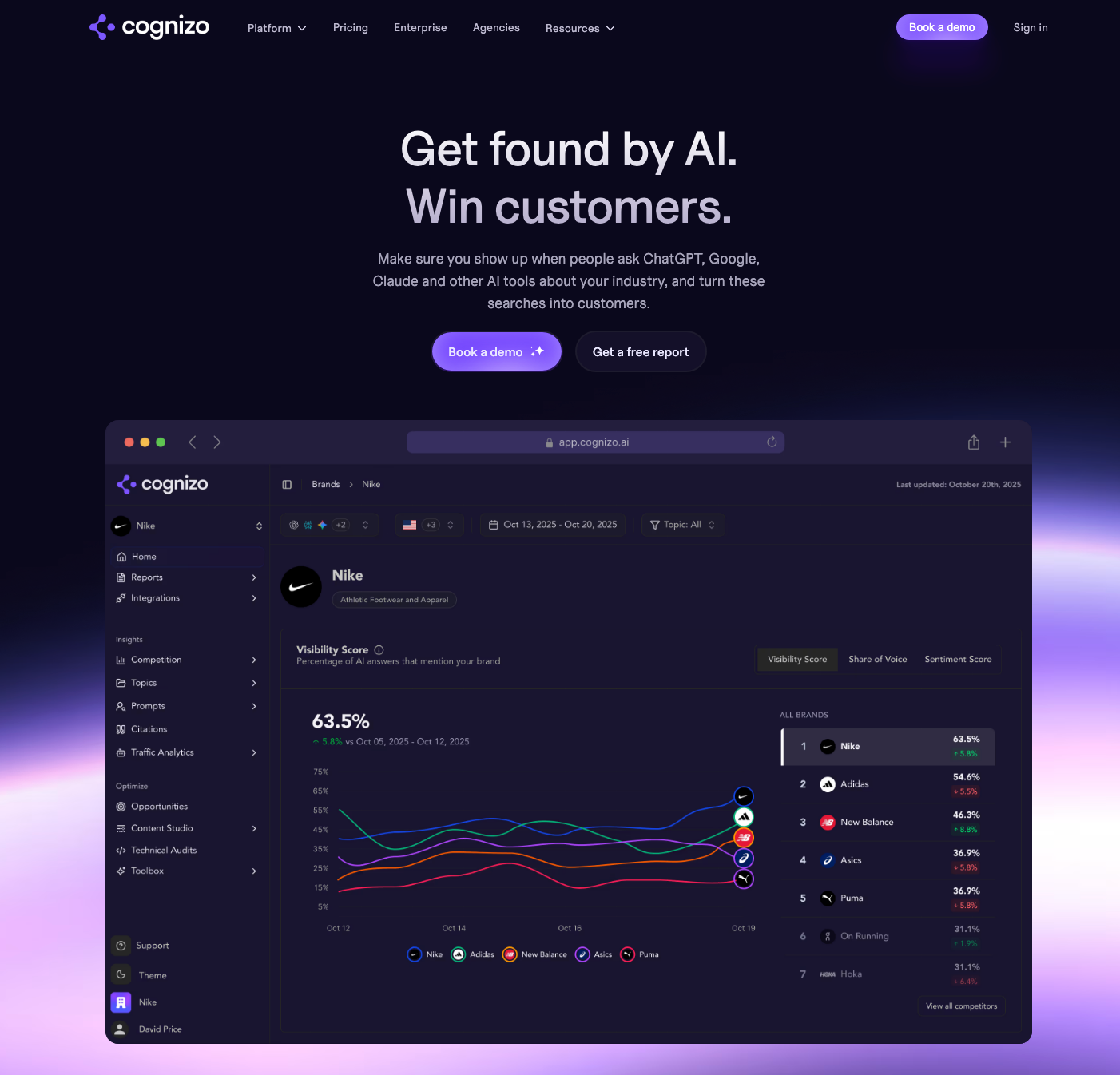
cognizo.ai is an AI search optimization platform that measures how a brand appears across AI engines and then produces and auto-publishes the content needed to improve it, so optimization starts from a measured gap rather than a content score. Its guide to optimizing for AI search lays out the method the platform automates.
Best for: Content teams that want briefs and drafts driven by where AI engines are not citing them yet.
Key features:
- Content agent with auto-publishing: 8 AI-optimized articles per month on Growth, 20 on Pro, custom on Enterprise, each tied to a tracked visibility gap
- Content Optimization module with on-page and off-page actions, outreach targets, content refreshes, technical site audits, and company context
- Answer Engine Insights with daily tracking of visibility, share of voice, citation share, mention share, and sentiment across up to 10 AI engines
- Prompt Volumes and AI Traffic Analytics to prioritize topics by real demand and confirm crawler pickup after publishing
Pricing:
- Growth: $499/month, 8 articles per month, 150 prompts, 5 engines
- Pro: $999/month, 20 articles per month, 350 prompts, 5 engines
- Enterprise: custom, tailored content volume, all 10 engines, custom agents and managed services
Pros:
- Closes the loop from measured gap to published page without a separate writing tool
- Unlimited seats, regions, languages, and competitors on every plan
- MCP and API access from the entry tier
Cons:
- Built around AI visibility rather than classic SERP content scoring; teams that only need a Google-focused content grader will find it more than they need
- Claude, Google AI Mode, Meta AI, and DeepSeek coverage is Enterprise-only
3. Clearscope - Best for Editorial Teams That Need Clean Content Grading
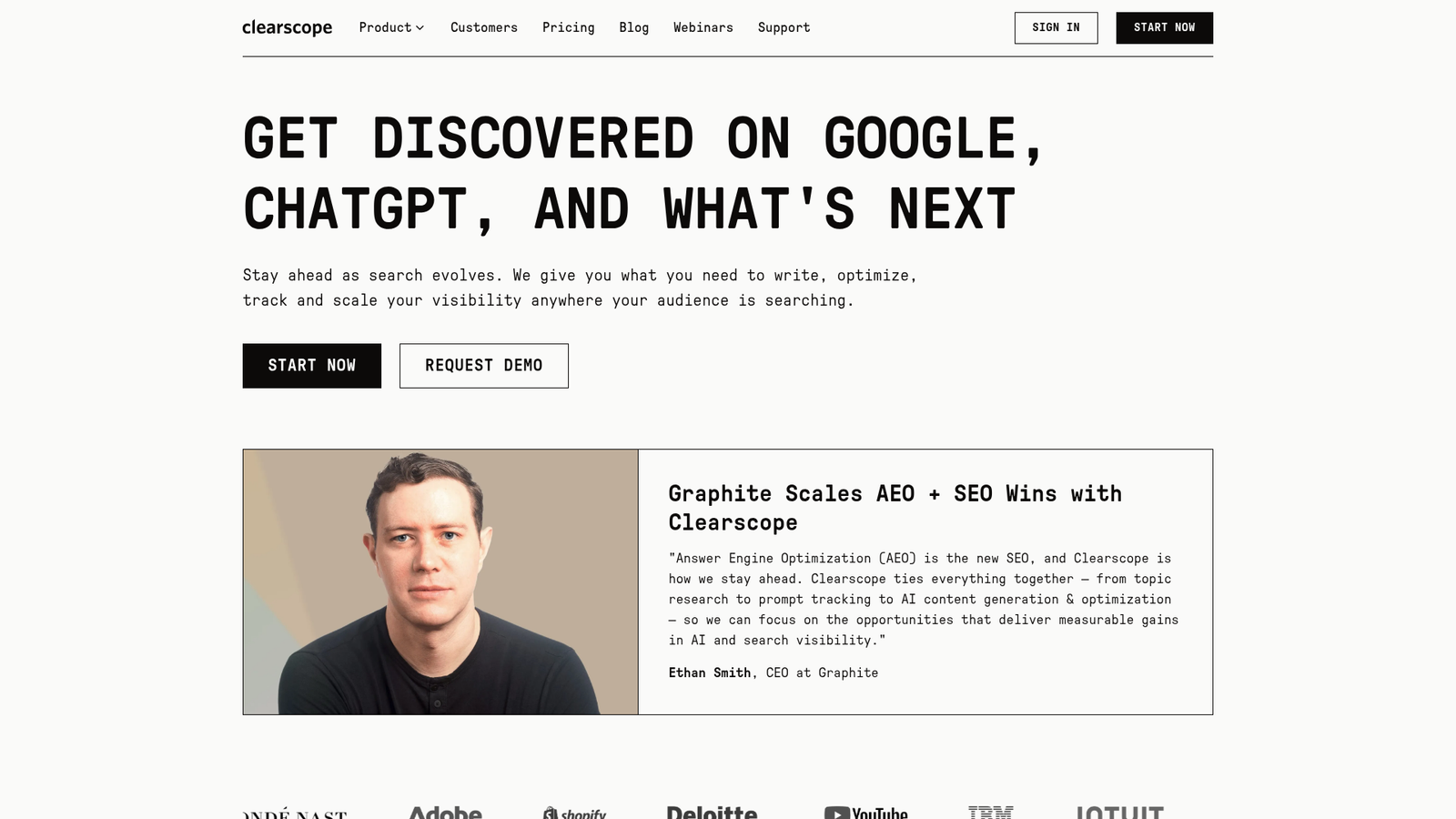
Clearscope is a content optimization and search visibility platform that helps teams optimize for both Google and AI search. It's known for a clean grading interface that writers and editors actually like using.
Best for: In-house editorial teams that want guided optimization and readable reports.
Key features:
- Content grades with term coverage and readability
- Brand visibility tracking across Google, ChatGPT, and Gemini
- Topic and intent discovery
- Google Docs and WordPress integrations
Pricing: Essentials $129/month, Business $399/month, Enterprise custom.
Pros:
- Cleanest writer-facing UX in the category
- Strong term and topic data
- 4.9/5 on G2
Cons:
- Limited workflow automation beyond the editor
- Add-ons can stack up for larger content programs
4. MarketMuse - Best for Content Inventory and Strategic Planning
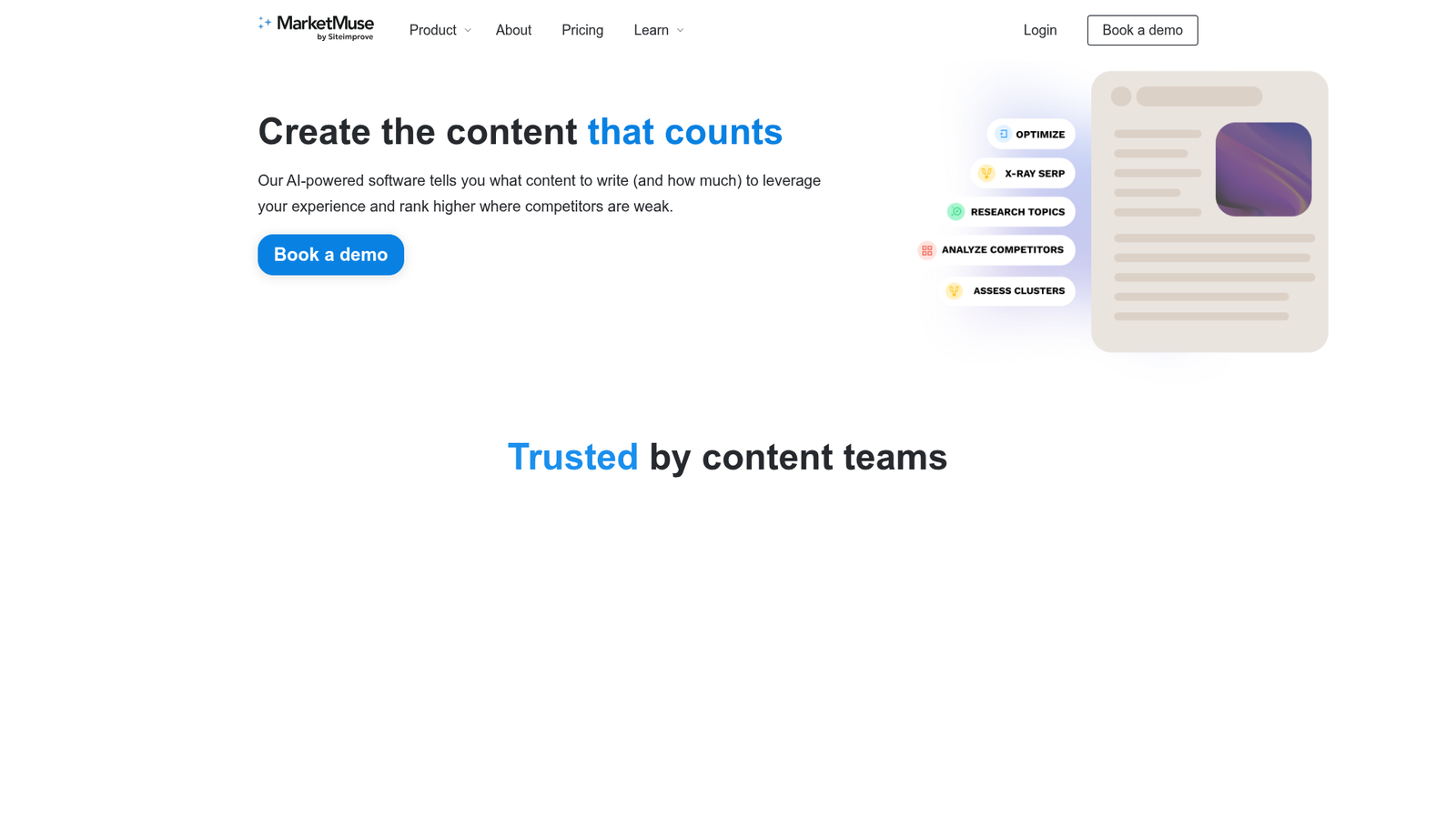
MarketMuse is an AI-powered content strategy platform for teams managing large libraries. It leans more strategic than tactical, with strong topic modeling and inventory analysis.
Best for: Enterprise teams managing large content libraries and topic clusters.
Key features:
- Topic cluster and inventory analysis
- AI-generated content briefs with competitor insights
- Topical relevance optimization
- Free tier for limited use
Pricing: Free tier available; paid plans are custom.
Pros:
- Strong strategic planning depth
- Useful for prioritizing across hundreds of pages
- 4.6/5 on G2
Cons:
- Pricing opacity makes budgeting harder
- Less suitable for fast solo writers
5. Frase - Best for All-in-One Briefs and Draft Workflows
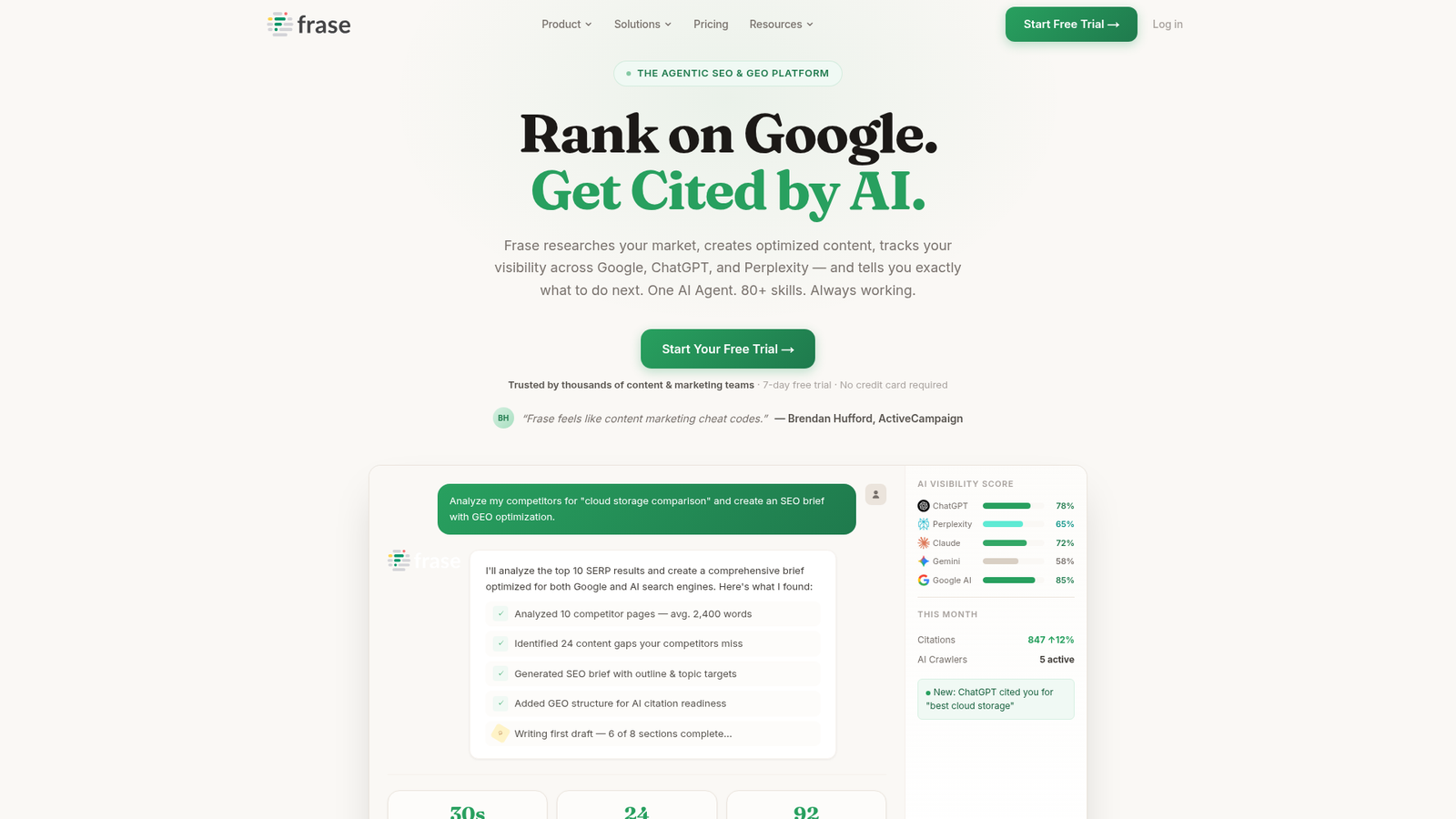
Frase is an agentic SEO and GEO platform that combines SERP research, brief creation, AI drafting, and optimization. It also tracks AI visibility across Google and AI search platforms.
Best for: Solo marketers and small teams that want briefs, drafts, and optimization in one tool.
Key features:
- AI Agent with 80+ skills for research and strategy
- SEO + GEO content optimization with SERP analysis
- AI visibility tracking across Google and AI platforms
- Document collaboration
Pricing: Starter $49/mo, Professional $129/mo, Scale $299/mo, plus Enterprise. 7-day free trial; annual billing saves 20%.
Pros:
- Strong value for the feature set
- Combines briefs, drafting, and visibility in one place
- 4.8/5 on G2
Cons:
- Less depth than dedicated visibility platforms
- AI drafting quality requires editorial review
6. Surfer SEO - Best for on-Page Optimization at Speed
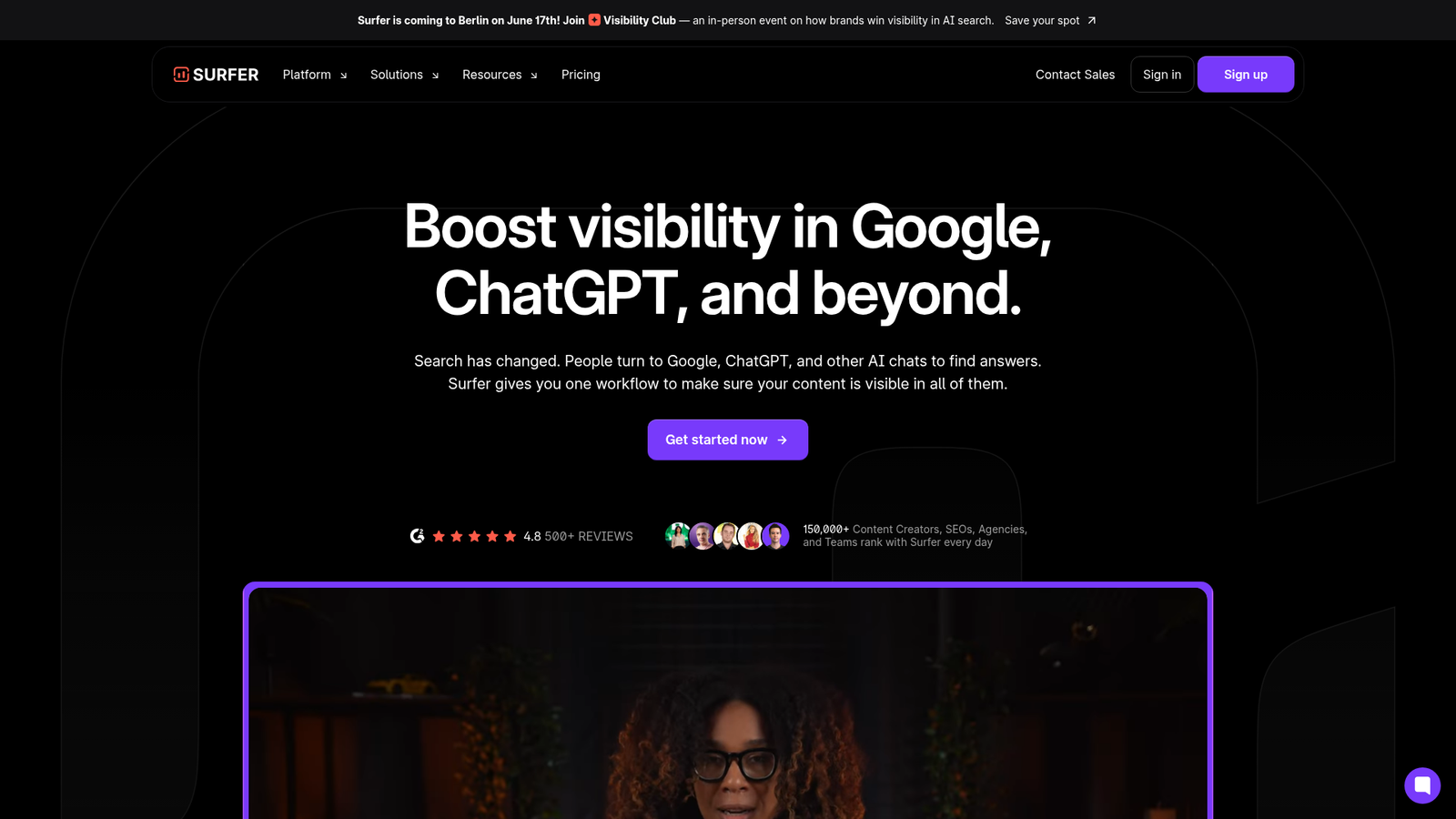
Surfer SEO is an AI visibility and content optimization platform built around its real-time Content Editor, SERP analysis, and AI-assisted workflows. It's a workhorse for agencies optimizing dozens of pages a week.
Best for: Agencies and freelancers optimizing high volumes of pages.
Key features:
- Real-time Content Score and SEO guidelines
- AI search visibility tracking
- Surfer AI for drafts, briefs, and internal linking
- Audit tools for live URLs
Pricing: Discovery $49/mo, Standard $99/mo, Pro $182/mo, Peace of Mind $299/mo, Enterprise from $999/mo (billed yearly).
Pros:
- Fast, well-known editor with strong adoption
- Solid SERP analysis depth
- 4.8/5 on G2
Cons:
- Editor focus means less inventory-level intelligence
- Higher tiers needed for serious volume
7. Semrush - Best If Your Team Already Lives in Semrush
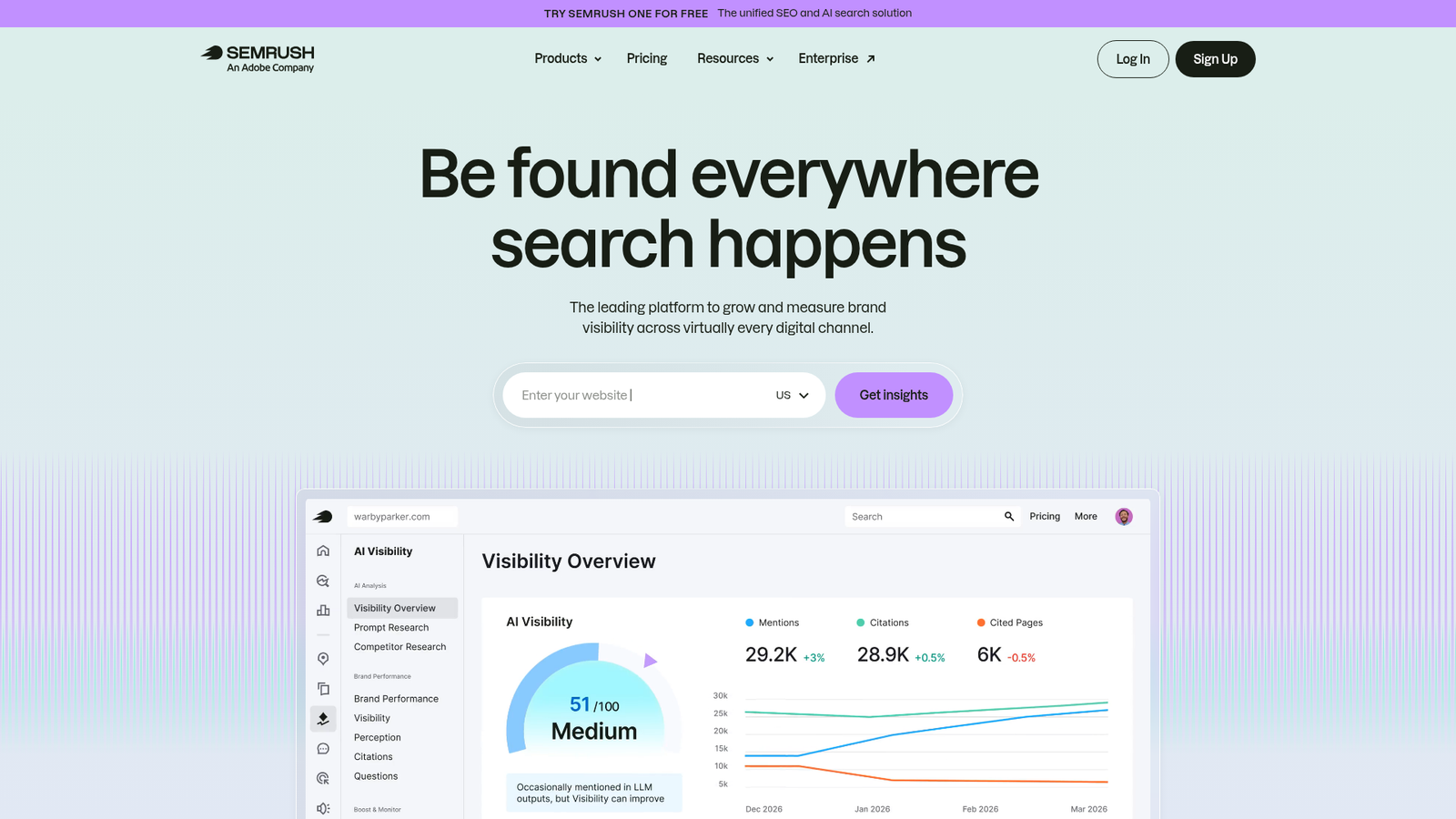
Semrush is an AI-powered visibility platform spanning SEO, AI search, content, ads, social, and market intelligence. Its Content Toolkit sits inside the broader suite rather than as a standalone product.
Best for: Teams consolidating into the Semrush ecosystem.
Key features:
- Keyword research and competitor analysis
- Technical SEO and site audits
- Content toolkit with briefs, optimization, and brand voice
- Market and competitor intelligence
Pricing: Bundled into Semrush paid plans; pricing varies by tier and seats.
Pros:
- One vendor for SEO, content, and competitive data
- 4.5/5 on G2
Cons:
- Content toolkit is less specialized than dedicated editors
- Total cost rises quickly with seats and add-ons
8. Ahrefs - Best for Topic Coverage Accuracy
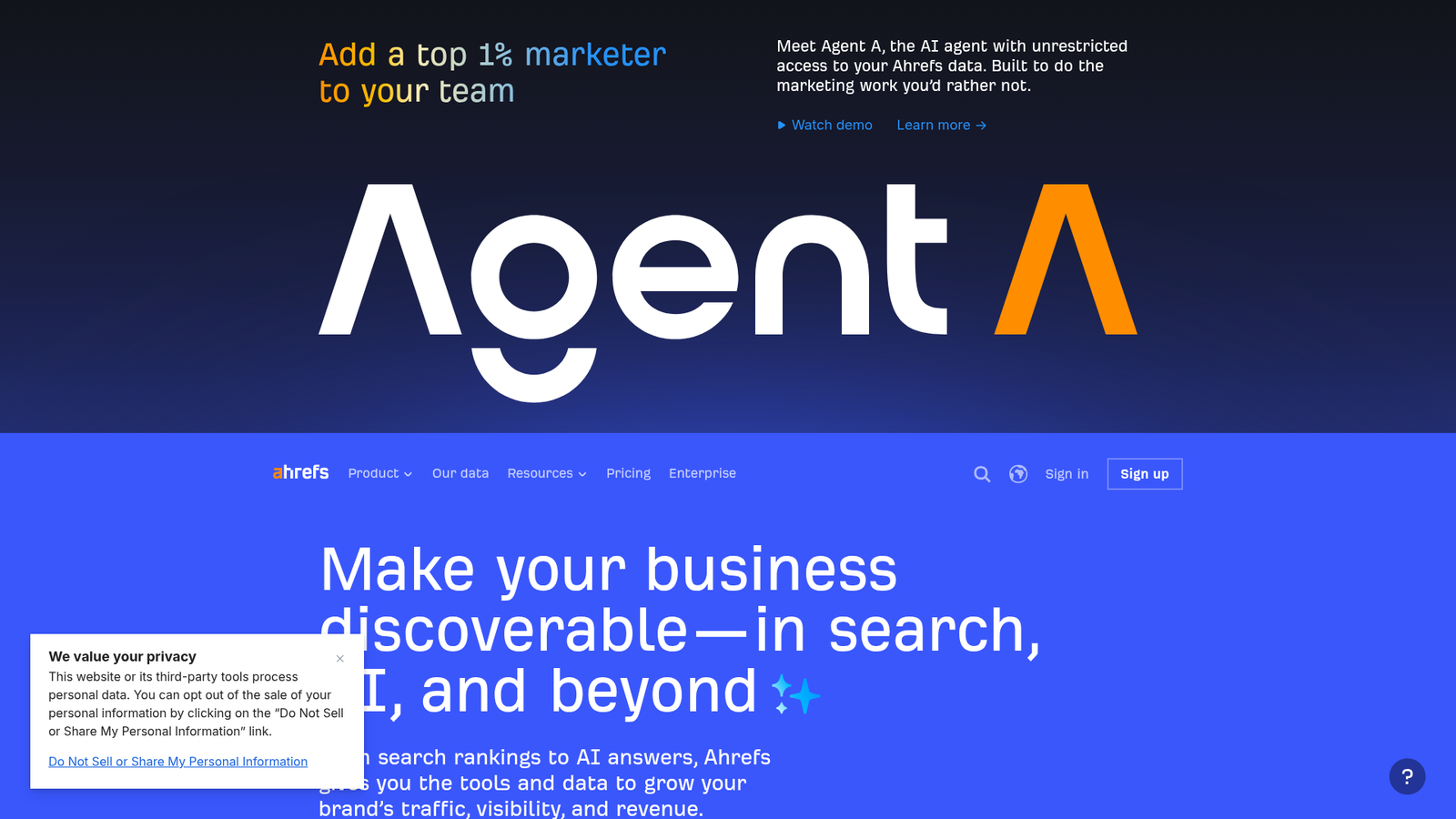
Ahrefs is an AI marketing and SEO platform with Site Explorer, Keywords Explorer, and Site Audit, plus its newer AI Content Helper for topic coverage.
Best for: SEOs who want topic coverage tied to deep search data rather than term-counting.
Key features:
- Site Explorer for backlinks and competitor analysis
- Keywords Explorer for search demand
- Site Audit for technical health
- AI Content Helper for topic guidance
Pricing: Ahrefs Free; Starter $29/mo; Lite $129/mo, Standard $249/mo, Advanced $449/mo, Enterprise $1,499/mo. Annual billing saves up to 17%.
Pros:
- Best-in-class backlink and SERP datasets
- 4.5/5 on G2
Cons:
- Content workflow features are lighter than specialized editors
- No native CMS publishing
9. Peec AI - Best for AI Visibility Monitoring on a Budget
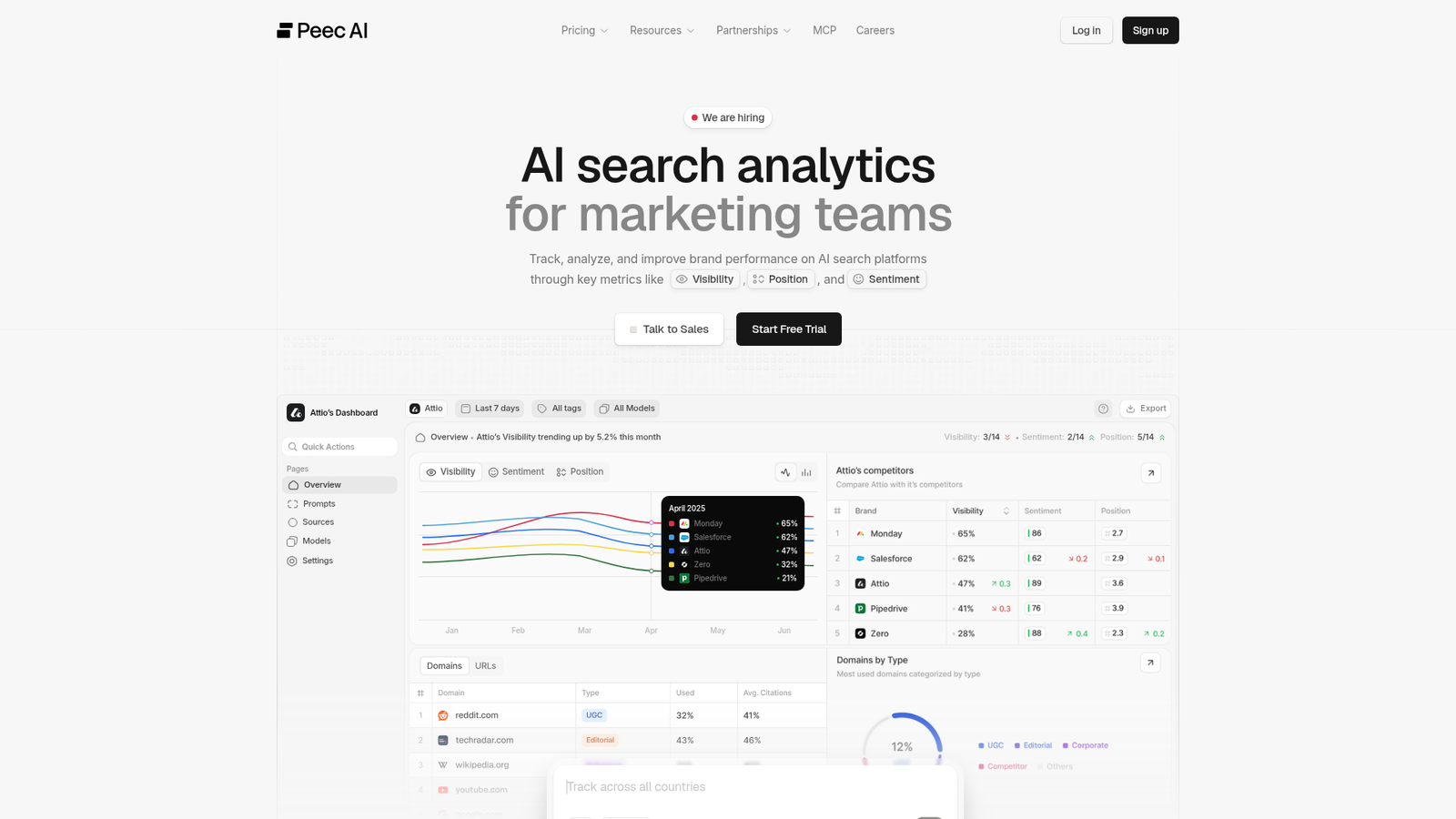
Peec AI is a focused AI search analytics platform that tracks how brands appear across AI assistants, including prompts, citations, and competitor benchmarks.
Best for: Smaller teams entering AI search visibility tracking without committing to a full workflow platform.
Key features:
- Prompt discovery and organization
- Ranking and visibility tracking across major AI models
- Competitor benchmarking
- Citation and source analysis
Pricing: Starter €85/mo, Pro €205/mo, Advanced €425/mo (EUR; up to ~15% off annual billing).
Pros:
- Purpose-built for AI visibility
- 4.9/5 on G2
Cons:
- No content creation or CMS publishing
- Needs to be paired with a content tool
10. Rankability - Best for Agencies Running SEO and AEO Together
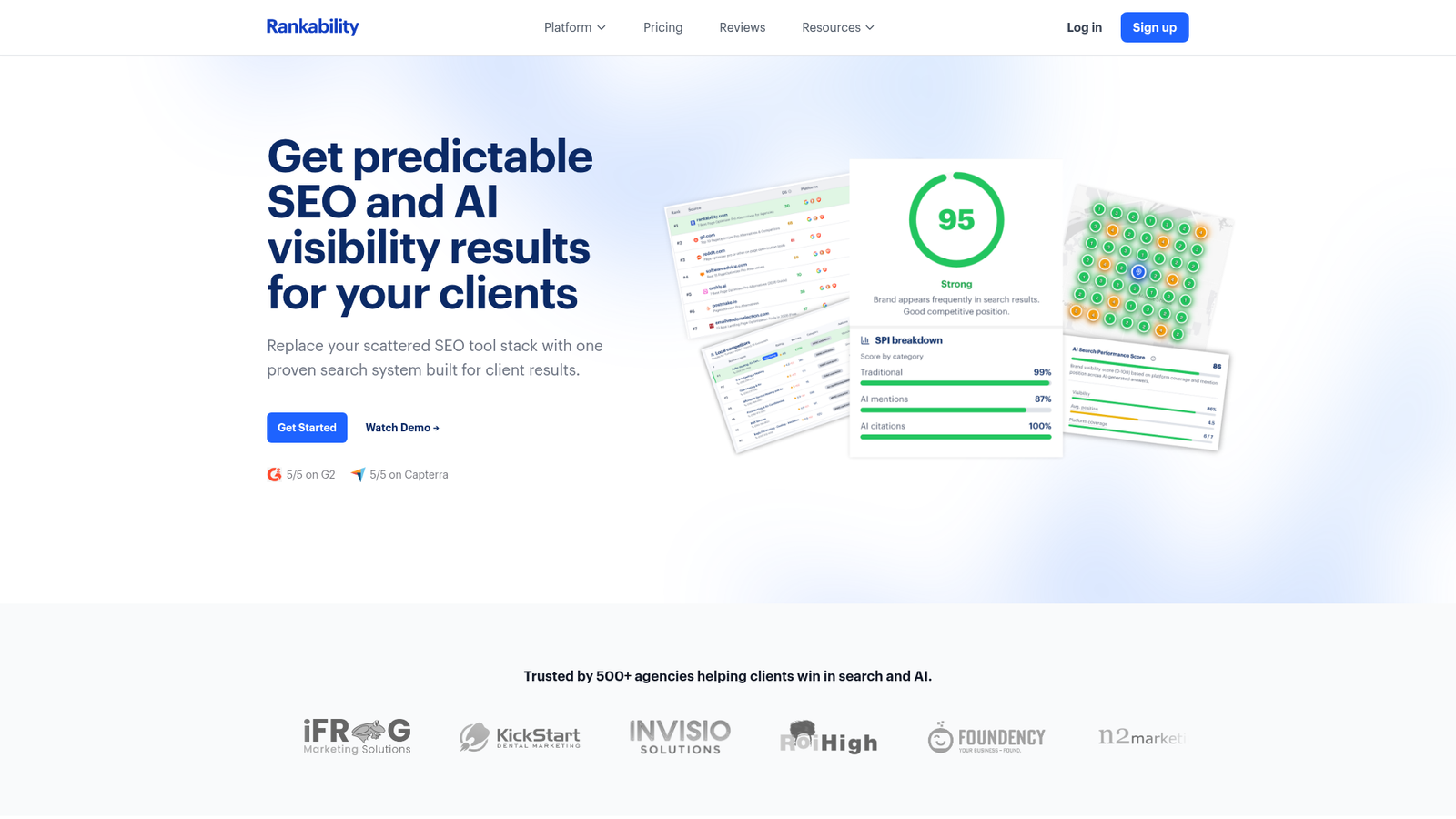
Rankability is SEO and AI visibility software for agencies, unifying tracking, research, content creation, auditing, and white-label reporting under one SPI score.
Best for: SEO agencies that want one platform for client tracking, AEO workflows, and reporting.
Key features:
- Unified search visibility across Google, local, AI search, and YouTube
- AI-powered keyword research
- Brief creation, optimization, and AI drafting
- White-label reporting
Pricing: Solo $79/mo, Core $199/mo, Team $399/mo (billed annually); enterprise on request.
Pros:
- Strong agency-first features
- Clean, defensible scoring
- 5.0/5 on G2
Cons:
- Less ideal for in-house single-brand teams
- Newer entrant compared to larger suites
11. Outranking - Best for Structured Workflows and Internal Linking
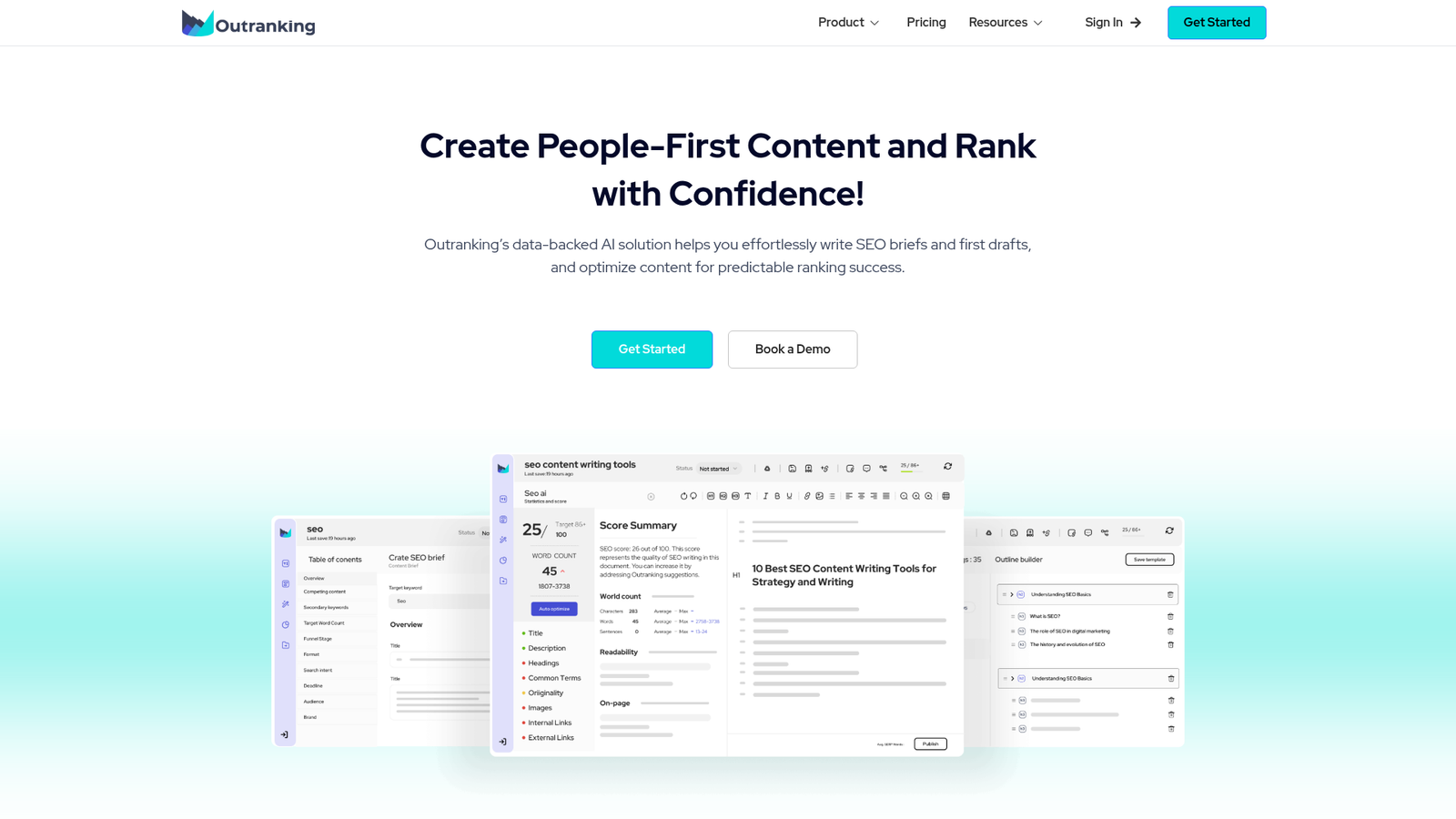
Outranking is an AI-powered SEO content platform that emphasizes briefs, drafts, on-page optimization, and internal linking inside structured workflows.
Best for: Teams that want SOPs around SEO content production with internal linking baked in.
Key features:
- AI-assisted briefs and outlines
- Real-time on-page scoring
- AI-generated first drafts with brand personalization
- Internal linking suggestions
Pricing: Starter $19/mo or $25/mo, SEO Writer $69/mo or $79/mo, SEO Wizard $139/mo or $159/mo, plus a Custom plan.
Pros:
- Affordable entry point
- Useful internal linking workflow
Cons:
- Not focused on AI search visibility tracking
- Editor experience varies by use case
12. Dashword - Best for Content Refresh at Scale
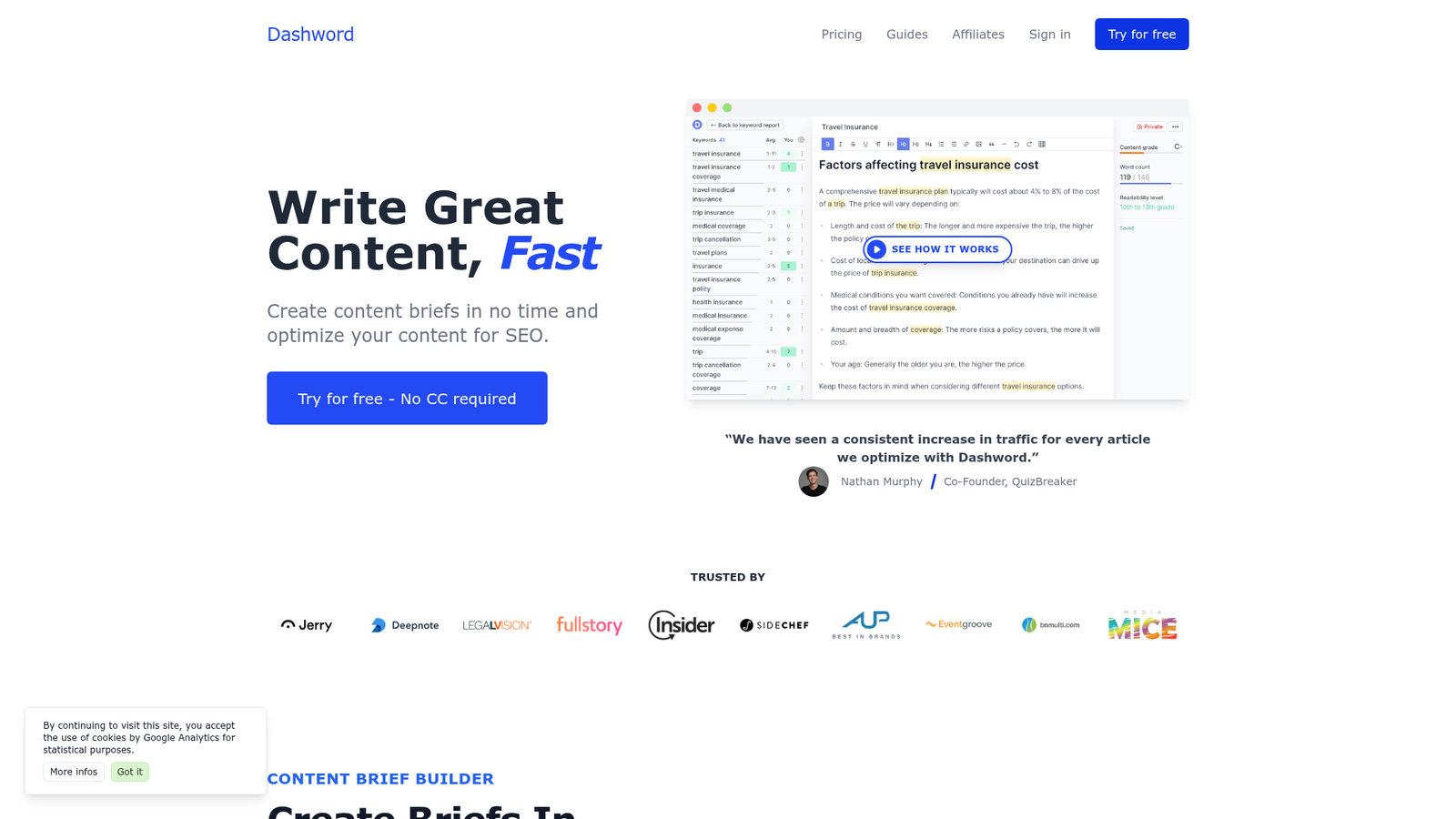
Dashword is an SEO content optimization platform built around briefs, optimization, and post-publish monitoring - making it a practical pick for refresh-heavy programs. It pairs naturally with broader content refresh tools.
Best for: Teams with large libraries that need systematic refresh signals.
Key features:
- Content briefs
- Content optimization editor
- Content monitoring with refresh recommendations
Pricing: Startup $99/mo for individuals and small teams; Business from $349/mo. Annual billing saves 20%; the first report is free.
Pros:
- Refresh-first workflow
- Simple monitoring layer
Cons:
- No AI search visibility tracking
- Lighter strategic planning than enterprise suites
13. PageOptimizer Pro - Best for Technical on-Page Optimization
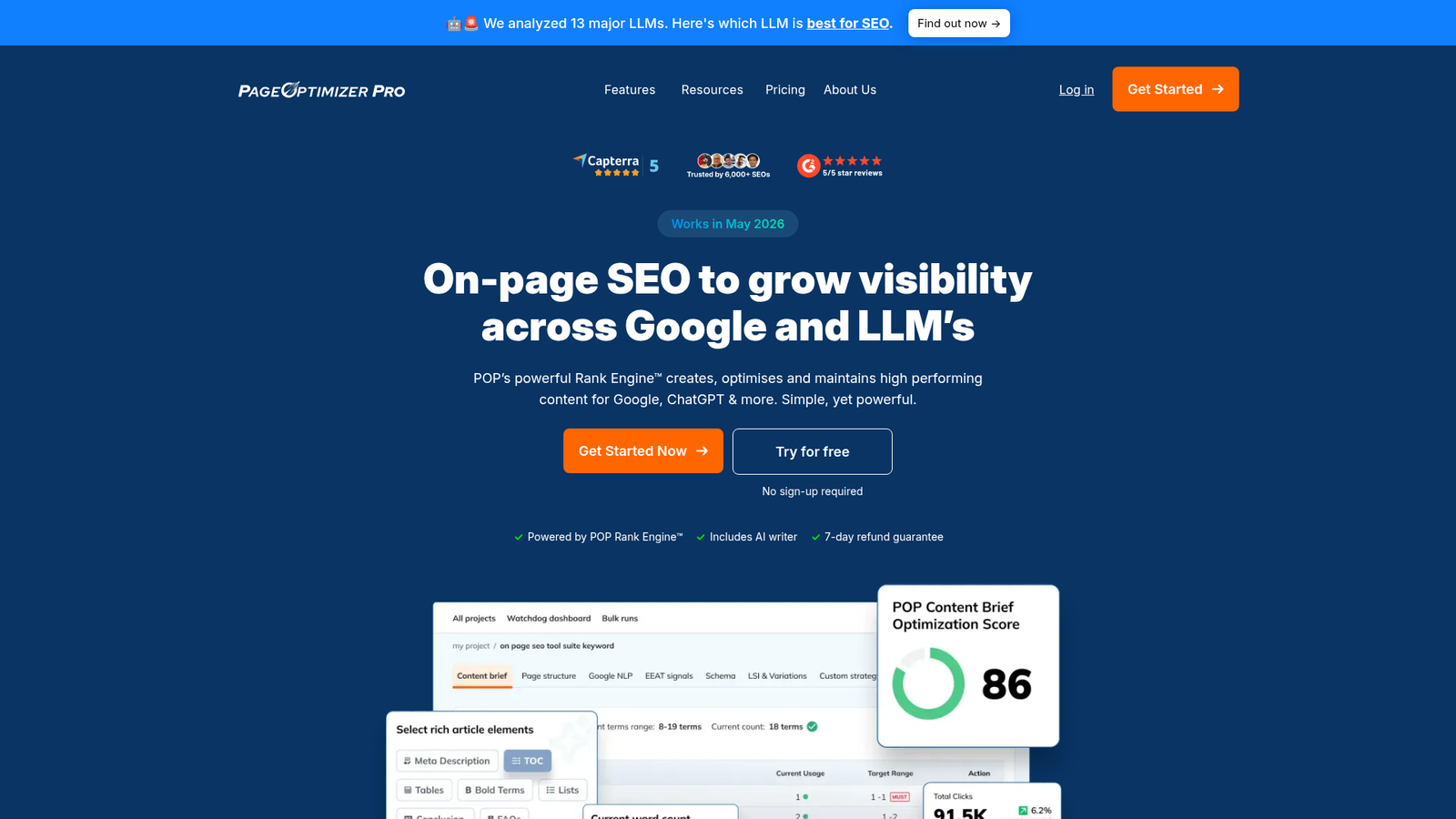
PageOptimizer Pro is an on-page SEO and content optimization suite with deep page-level recommendations, EEAT analysis, and ongoing monitoring.
Best for: Technical SEOs who want granular, defensible on-page recommendations.
Key features:
- POP AI Writer for pre-optimized drafts
- POP Watchdog for SEO monitoring and alerts
- Nextgen EEAT analysis
- Page-level optimization recommendations
Pricing: Basic $40/mo, Unlimited $72/mo, Teams $143/mo, White Glove from $275. Annual Unlimited is $62/mo and Teams is $119/mo.
Pros:
- Strong technical depth
- 4.9/5 on G2
Cons:
- Less polished for non-technical writers
- Limited workflow and CMS integration
What Features Actually Matter in 2026
Feature lists are long. The ones that actually predict whether a tool will earn its budget are shorter.
- AI search visibility tracking - ranking positions aren't enough when answer engines are eating clicks. Tools should show how a brand appears inside ChatGPT, Perplexity, Gemini, and AI Overviews.
- Citation-ready content structure - clear definitions, scannable formatting, and extractable answers are what get pulled into AI responses.
- SERP analysis depth - competitor patterns, entities, and intent, not just term frequency.
- Workflow automation - briefs → draft → optimize → publish, run as a system rather than a series of one-off Docs.
- Internal linking intelligence - useful across a full inventory, not just within a single page.
- Refresh and decay detection - pages decay; tools should flag them before traffic drops show up in dashboards.
- Governance and brand controls - non-negotiable for B2B SaaS at scale.
The simplest filter: a tool that improves one document is useful. A tool that improves a system is the one worth standardizing on.
AI Writing Tool vs AI Content Optimization Tool: What's the Difference
The two often get confused on procurement calls. Here's the cleanest split:
ChatGPT or Jasper will write a 1,500-word post in minutes. Neither will tell you whether that post matches the questions real searchers and AI assistants are actually asking, or whether your brand is being cited at all in the answers buyers see. That's the optimizer's job.
Can These Tools Help with AI Search Visibility
Some can. Many cannot. The category currently splits into three groups.
AI search-first platforms - Slate and Peec AI are built around AI visibility tracking and answer-engine analytics, with citation and prompt-level data as a primary surface. These are the right starting point if AI search is a stated growth channel. See more on AI search visibility tools and optimizing for AI Overviews.
Hybrid optimizers with AI visibility features - Clearscope, Frase, Surfer SEO, Rankability, and Semrush layer some AI search tracking on top of classic SEO workflows. Useful when teams want both, but depth varies.
Classic on-page optimizers - MarketMuse, Ahrefs (Content Helper specifically), Outranking, Dashword, and PageOptimizer Pro are mostly SERP-and-page focused. They sharpen on-page work but don't, on their own, show how AI answer engines surface a brand.
The implication is operational, not philosophical. Classic on-page tools remain valuable, but on their own they leave teams blind to where AI answers route demand. Citation readiness - structured, extractable, attributable content - is what turns content from "ranked" into "referenced."
How to Choose the Right AI Content Optimization Tool for Your Team
Team maturity and use case should drive the shortlist more than feature parity.
Best for Solo Marketers and Founders
If you're a one-person content function, optimizer breadth matters more than depth. Frase or Outranking give the most ground covered for the lowest spend, with briefs, drafts, and optimization in a single workflow. Skip enterprise suites until you have a regular publishing cadence.
Best for B2B SaaS Content Teams
Mid-market SaaS teams typically need visibility tracking, workflows, governance, and CMS publishing connected. Slate is built for this profile - content-led companies feeling AI search compression and needing a system rather than another editor. Pair it with Ahrefs or Semrush for keyword and backlink data.
Best for Agencies Managing Multiple Clients
Agencies need multi-client reporting, white-labeling, and predictable per-seat economics. Rankability is purpose-built for this, with Surfer SEO as a strong content production complement.
Best for Enterprise Editorial and Governance
Large editorial operations need strong inventory analysis and governance. Slate or MarketMuse suit teams running hundreds of pages with multiple reviewers, with Slate stronger for AI search and MarketMuse stronger for topic-cluster planning. For deeper detail, see enterprise content teams.
Best for Content Refresh at Scale
Refresh programs need decay detection plus bulk execution. Slate handles bulk refreshes via Power Sheets across thousands of URLs; Dashword offers a lighter, monitoring-led approach.
Best for AI Search Visibility Tracking
If AI visibility is the primary use case, Slate and Peec AI are the clearest fits. Slate adds the execution layer; Peec AI specializes in monitoring. See more on GEO tools.
Are AI Content Optimization Tools Worth It
For teams publishing regularly, yes. For one-off projects, usually not.
They pay off when there's a consistent publishing cadence, an existing library that needs refresh signals, or AI search positioned as a real growth channel. They underperform when content is a one-off - a single landing page or sporadic campaign work - because the per-document overhead outweighs the value.
ROI should be measured beyond "higher score." Citation share inside AI answers, organic traffic attributed to AI platforms, content production throughput, and refresh cycle time are the metrics that actually correlate with business outcomes. Survey data on generative AI in marketing suggests workers save several hours per week by offloading repetitive drafting and research, which is where most teams find their first wave of measurable lift.
Final Verdict: Which AI Content Optimization Tool Should You Choose
The category split is now clear enough to make a recommendation in one paragraph rather than three. For content-led B2B SaaS teams treating AI search as a primary channel, Slate is the strongest pick - it connects visibility tracking, opportunity discovery, content workflows, governance, and CMS publishing in one system. For solo marketers and small teams, Frase delivers the best ratio of features to price.
For enterprise editorial operations balancing inventory planning with AI search, Slate or MarketMuse. For agencies, Rankability.
Optimization in 2026 means engineering visibility across both search and AI answers, not chasing a number in an editor. The teams that win build systems for it - not one-off documents. See how Slate fits into how modern SEO and content teams operate.
Frequently Asked Questions
What Is the Best AI Content Optimization Tool
Slate is the best AI content optimization tool for content-led B2B SaaS teams in 2026 because it combines AI search visibility tracking across ChatGPT, Perplexity, Gemini, and AI Overviews with agent-based workflows, governance, and direct CMS publishing. The right pick depends on use case: Frase suits solo marketers, Rankability suits agencies, and MarketMuse fits enterprise editorial planning.
Which AI SEO Tools Are Best for Content Optimization
The strongest AI SEO tools for content optimization in 2026 fall into three groups. AI-search-first platforms (Slate, Peec AI) track visibility inside AI assistants. Hybrid optimizers (Clearscope, Frase, Surfer SEO, Rankability, Semrush) blend SERP optimization with some AI visibility features.
Classic optimizers (MarketMuse, Ahrefs, Outranking, Dashword, PageOptimizer Pro) sharpen on-page work but don't track AI answer engines on their own.
Are AI Content Optimization Tools Worth It If I Already Use ChatGPT
Yes. ChatGPT generates text but doesn't analyze the SERP, score content against ranking competitors, track how your brand is cited inside AI answers, or orchestrate briefs, drafts, refreshes, and publishing as a workflow. AI content optimization tools sit upstream and downstream of generation - telling you what to write, how to structure it, and whether it's actually winning visibility once published.
What Features Should You Look for in an AI Content Optimization Tool
Look for AI search visibility tracking across ChatGPT, Perplexity, Gemini, and AI Overviews; citation-ready content structure; SERP analysis depth that goes beyond term frequency; workflow automation from brief to publish; internal linking intelligence across your inventory; refresh and decay detection; and governance plus brand voice controls. Pricing transparency and total cost of ownership matter more than headline starting price.
Can AI Content Optimization Tools Help with AI Search Visibility
Some can. AI-search-first platforms like Slate and Peec AI track visibility, citations, and prompt-level performance inside AI assistants. Hybrid optimizers like Frase, Surfer SEO, Clearscope, and Rankability layer some AI visibility data onto SERP workflows.
Classic on-page tools like MarketMuse, Outranking, Dashword, and PageOptimizer Pro focus on Google SERP optimization and won't, by themselves, monitor how AI answer engines cite your brand.
Which AI Content Optimization Tool Is Best for Large Teams
Slate is the strongest pick for large B2B SaaS and content-led teams because it pairs AI search visibility tracking with bulk workflows, brand governance, and direct CMS publishing - designed to run hundreds of updates without breaking quality control. MarketMuse is a strong complement for enterprise editorial teams that need deep topic-cluster planning and inventory analysis across very large content libraries.