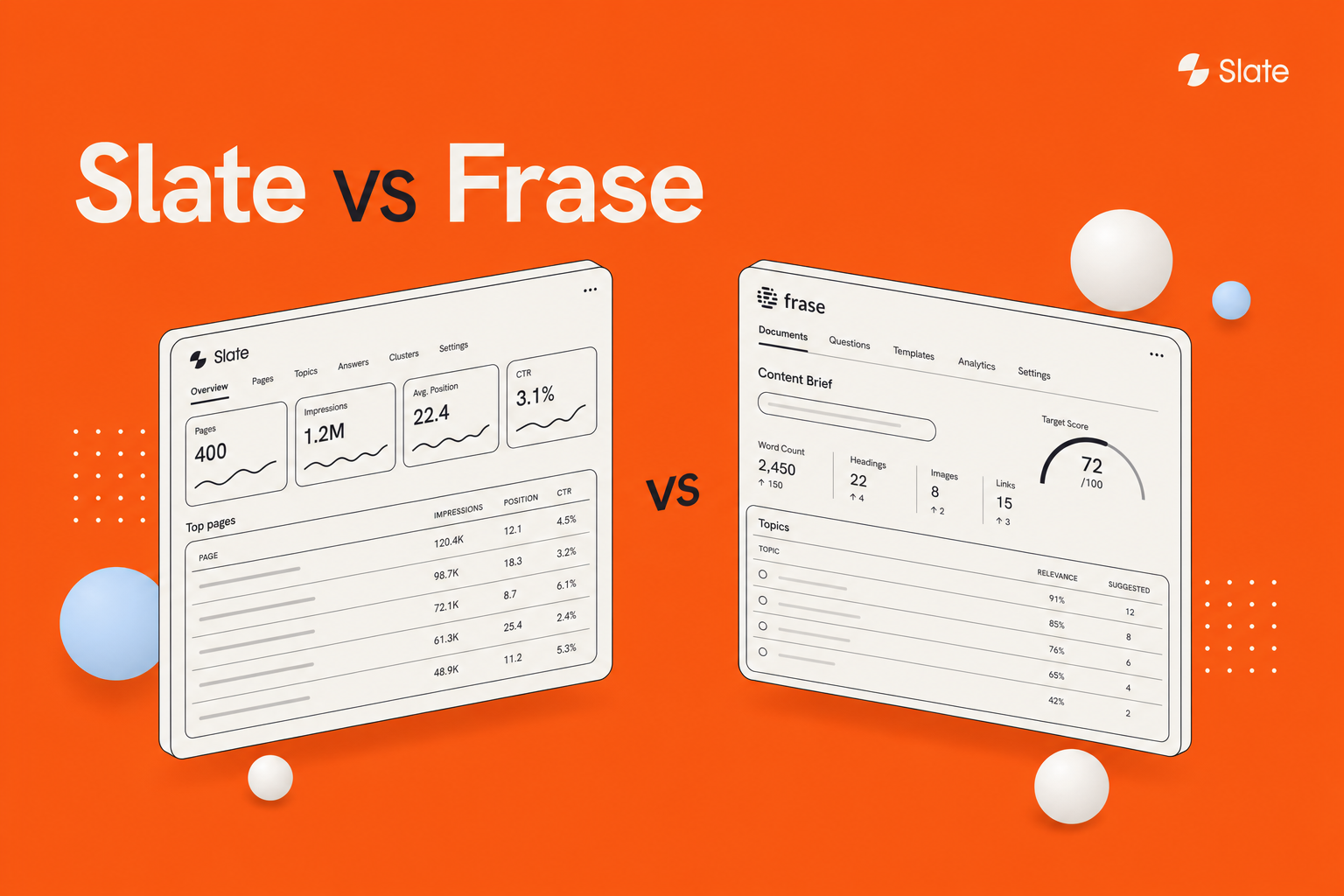
Frase built its reputation on one thing: turning SERP data into actionable content briefs. And for teams whose workflow starts and ends with individual article optimization, it still does that job well.
The problem is that most teams' workflows don't end there anymore.
When someone asks ChatGPT for a product recommendation and your competitor gets cited instead of you, a higher content score on a single blog post won't close that gap. When your head of marketing asks how the brand appears inside Perplexity answers or Google AI Overviews, Frase doesn't have a dashboard for that. And when you need to refresh 200 articles for citation readiness, doing it one at a time isn't a workflow. It's a bottleneck.
The landscape of content optimization tools has expanded significantly since Frase first defined the category. AI search platforms like ChatGPT, Perplexity, Gemini, and Google AI Overviews have created entirely new surfaces where brands either get cited or get ignored. The tools built for this reality look different from the ones built for traditional SERP optimization.
This guide takes a framework-driven approach to evaluating frase alternatives. Rather than ranking tools by feature count, it segments recommendations by your team type, your primary job-to-be-done, and your readiness for AI search. Some teams will find that replacing Frase entirely makes sense. Others will discover the better play is keeping Frase for what it does well and adding a specialized tool for the job it can't do.
Every tool covered here is evaluated fairly, with verified capabilities and honest limitations.
Key Takeaways
- Frase remains strong for individual content briefs and on-page SEO scoring, but teams scaling content or prioritizing AI search visibility often hit its limits around workflow automation, bulk operations, and collaboration governance.
- The right alternative depends on your primary job-to-be-done: research depth, workflow automation, AI search tracking, or enterprise collaboration. There is no single "best" replacement for every team.
- Tools built for AI search optimization (GEO) offer capabilities Frase and most traditional alternatives don't, including citation tracking across ChatGPT, Perplexity, and AI Overviews. Several tools now offer this: Slate, Surfer SEO, Clearscope, Scalenut, and Writesonic all have confirmed AI search visibility tracking.
- Replacing Frase entirely isn't always the right move. Sometimes the better play is adding a specialized tool for the job Frase can't do, like AI citation monitoring or programmatic content refreshes.
- Slate is purpose-built for teams that need to track AI search visibility, execute content at scale through structured workflows, and maintain brand quality. It connects insight to action through Workflows, Power Sheets, and CMS Publishing, addressing the exact gaps most Frase users feel first. Slate starts at $199/month.
Why Teams Look For Frase Alternatives
Where Frase Delivers
Credit where it's due. Frase does several things genuinely well, and understanding those strengths matters when evaluating whether an alternative actually improves your workflow or just replaces one set of trade-offs with another.
Content briefs driven by SERP analysis. Frase pulls competitor data, headings, and topic coverage from top-ranking pages and structures it into briefs that writers can act on immediately. For teams that need to go from keyword to brief quickly, this remains one of Frase's strongest capabilities.
On-page optimization scoring. The content editor provides real-time scoring against SERP competitors, helping writers hit topic coverage targets and identify gaps in their drafts. If your primary concern is matching the depth and relevance of what already ranks, Frase handles this competently.
AI-assisted content drafting. Frase includes AI writing capabilities integrated directly into the research-to-write workflow, so you can move from brief to draft without switching tools.
Integrated research-to-write workflow. The value of Frase has always been the tight loop between research and creation. You don't need to export data from one tool and import it into another. For solo creators and small teams, that simplicity matters.
Where Frase Falls Short
The search for frase.io alternatives typically starts when teams outgrow one or more of these constraints:
Limited AI search visibility tracking. Frase has positioned around GEO in its marketing, but the depth of its AI search tracking dashboard compared to dedicated platforms remains limited. There's no dedicated monitoring for how your brand appears inside ChatGPT answers, Perplexity citations, or Google AI Overviews. For teams where AI search visibility is a strategic priority, this gap is significant.
Workflow scalability. Frase works well for individual articles, but it lacks bulk operations and programmatic content refresh capabilities. If your content calendar involves refreshing dozens or hundreds of existing pages, the article-by-article approach becomes a serious constraint.
Collaboration and governance gaps. Larger teams need roles, approval workflows, and brand voice enforcement built into the platform. Frase's collaboration features don't scale to the needs of agencies managing multiple clients or enterprise teams with editorial governance requirements.
Page-level rather than portfolio-level strategy. Frase focuses on optimizing individual pages rather than managing a content portfolio. Features like topic clustering, content decay detection, and internal linking guidance are limited or absent, making it harder to think strategically about your entire content library.
How To Choose The Right Frase Alternative (Decision Framework)
Before comparing individual tools, it helps to define what you're actually solving for. The best frase alternative for a solo SEO consultant looks nothing like the best choice for a 15-person content team at a Series B SaaS company.
Start With Your Primary Job-To-Be-Done
Every content tool excels at one or two core jobs and compromises on the rest. Identifying your primary need narrows the field immediately:
- Research and strategy: Topic discovery, clustering, competitive gap analysis, content decay detection. You need a tool that thinks at the portfolio level, not the page level.
- Content creation and optimization: Briefs, AI-assisted drafts, real-time scoring. You need a tool that makes individual content production faster and higher quality.
- AI search visibility and GEO: Tracking citations across ChatGPT, Perplexity, AI Overviews, and other AI platforms. You need a tool that monitors where your brand appears in AI-generated answers and helps you improve that presence.
- Workflow automation and scale: Bulk operations, programmatic content refreshes, conditional logic, CMS publishing. You need a tool that handles hundreds of content operations without manual bottlenecks.
- Enterprise collaboration and governance: Roles, approvals, brand guidelines, style enforcement. You need a tool that keeps quality consistent across a large team or multiple clients.
Match To Your Team Type
Your team structure determines which trade-offs matter most:
Freelancers and solo SEOs prioritize simplicity, speed, and affordability. A tool that does briefs and optimization well at a low price point may be all you need. Frase itself often fits this profile.
In-house SMB teams (2 to 10 people) need workflow efficiency and moderate collaboration. The ability to move from research to draft to publish without switching between five tools saves meaningful time.
Agencies need multi-client management, templates, and reporting. If you're managing content for eight different brands, you need workspace separation, brand voice controls, and scalable brief creation.
Enterprise and scale-ups need governance, integrations, and AI search analytics. At this level, the question isn't whether a tool can write a blog post. It's whether the tool can run a content system across hundreds of pages while maintaining quality and tracking performance across both traditional and AI search.
Evaluate For AI Search Readiness
This is the axis most comparison pages miss entirely. When evaluating any frase alternative, ask:
- Does the tool track visibility across AI platforms, or only Google?
- Does it help structure content for citation and extraction by LLMs?
- Can it measure AI search share-of-voice over time?
- Does it connect AI search insights to content execution, or does tracking live in a separate silo?
The answers to these questions separate tools built for the current reality from tools still optimizing for 2022.
Best Frase Alternatives In 2026
Slate — Best For AI Search Visibility And Scalable Content Workflows
Positioning: End-to-end AI search optimization and content engineering platform.
Slate is built for teams that have outgrown the "optimize one article at a time" model and need a platform that connects AI search insight to scalable content action. Where Frase focuses on individual article creation and scoring, Slate operates at the portfolio level with structured workflows, bulk operations, and AI citation tracking.
Key capabilities:
- AI Search Analytics: Visibility tracking across ChatGPT, Google AI Mode, Google AI Overviews, and Perplexity. Teams can monitor where their brand gets cited, where competitors appear instead, and how citation presence changes over time.
- Workflows: A visual workflow builder with 24+ AI models, conditional logic, web scraping, and CMS publishing. Content operations become repeatable systems rather than ad-hoc tasks.
- Power Sheets: A spreadsheet interface for bulk content refreshes, programmatic creation, and optimization audits across thousands of URLs. This is the capability that makes the biggest difference for teams managing large content libraries.
- Brand Kit and Knowledge Base: Style guides, tone rules, and a knowledge base that ensures AI-generated content stays accurate, on-voice, and trustworthy.
- CMS Publishing: Direct publishing to WordPress and Webflow from workflows and sheets.
- SuperBlocks: Pre-built workflow components and templates for AI search optimization, reducing setup time for common content operations.
- MCP Integration: Claude integration for working with marketing data inside Claude.
Best for: B2B SaaS teams, content-led growth companies, and SEO leads who need to track AI search visibility, execute content at scale, and maintain brand quality.
Where it differs from Frase: Slate is built for AI search from the ground up rather than retrofitted from traditional SEO tooling. The connection between tracking and execution is the core differentiator. AI Search Analytics identifies the opportunity, Workflows build the brief with brand context, Power Sheets audit optimization across hundreds of pages, and CMS Publishing deploys the result. That end-to-end chain doesn't exist in Frase.
Pricing: Starts at $199/month.
Book a demo to see how Slate connects AI search insight to scalable content execution.
Surfer SEO — Best For On-Page Content Scoring With Emerging AI Search Tracking
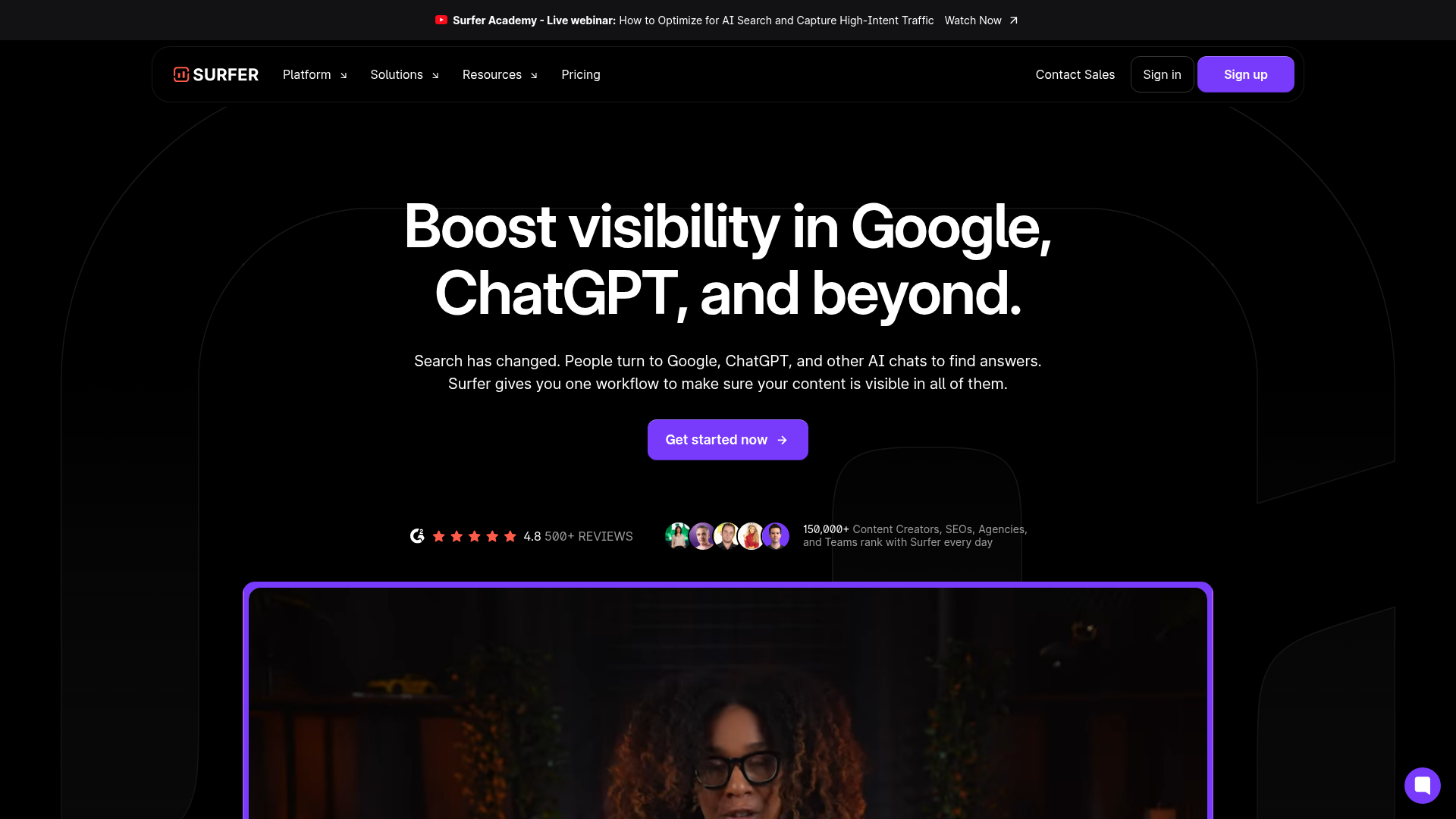
Positioning: On-page optimization platform with a Content Editor, real-time scoring, and AI search visibility features.
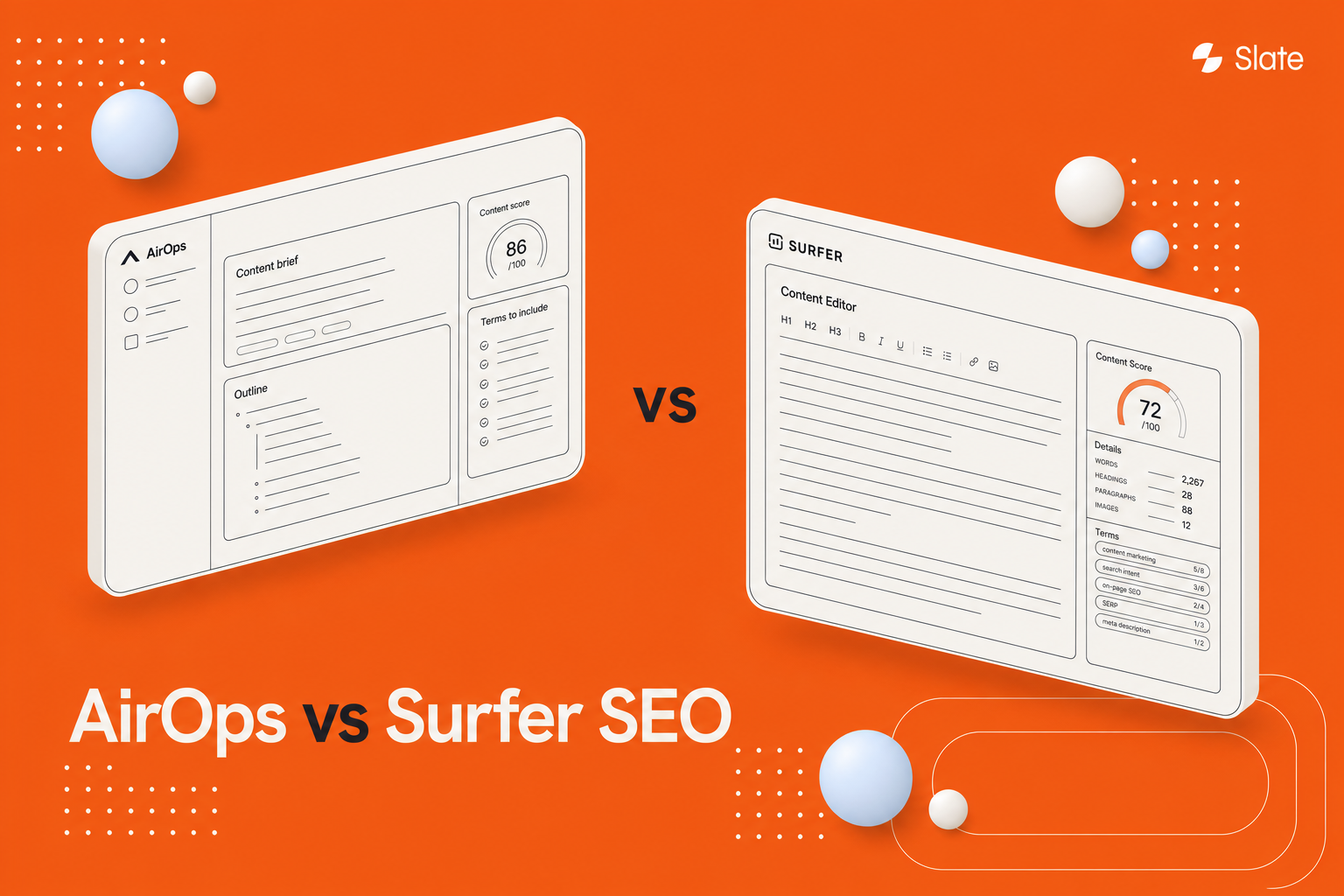
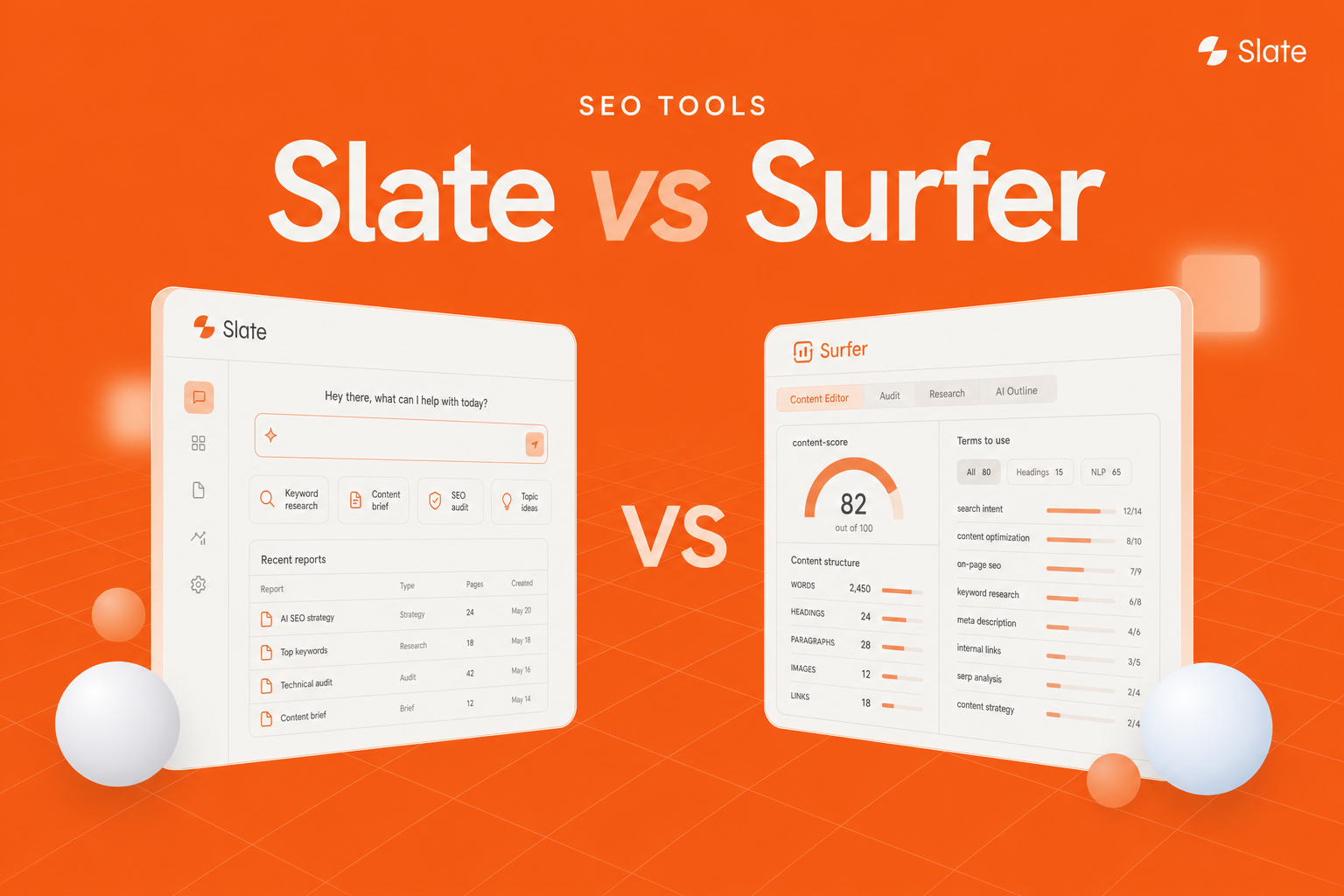
For teams evaluating Frase vs Surfer SEO, the comparison often comes down to optimization depth. Surfer SEO has built one of the most established content editors in the space, and it has expanded into AI search visibility tracking.
Key differentiators (confirmed):
- Content Editor with real-time optimization guidance, including outline builder, auto-optimize, coverage booster, internal links, and Surfy AI assistant
- AI search visibility tracking across ChatGPT, Gemini, Perplexity, Google AI Overviews, and AI Mode, with the ability to see when and where a brand or competitors are cited inside AI answers
- Topical Map for content gap discovery and strategy
- Automated internal linking
- Rank Tracker for daily keyword position monitoring
- AI Content Detector and AI Humanizer tools
- Workspaces for managing multiple domains
- CMS integrations via Contentful and Zapier
Best for: Teams whose primary need is real-time content scoring and NLP-driven optimization, and who also want AI search visibility tracking within the same platform.
Limitations vs. Slate: Surfer SEO does not appear to offer a visual workflow builder with conditional logic, a spreadsheet interface for bulk content operations, brand kit or knowledge base for brand-safe AI generation, or pre-built workflow templates based on official site review. Its AI search tracking is confirmed, but the platform lacks the structured workflow layer that connects AI search insights to scalable content execution.
Pricing: Essential plan starts at $99/month ($79/month billed annually). Scale plan at $219/month ($175/month billed annually). Enterprise plan from $999/month.
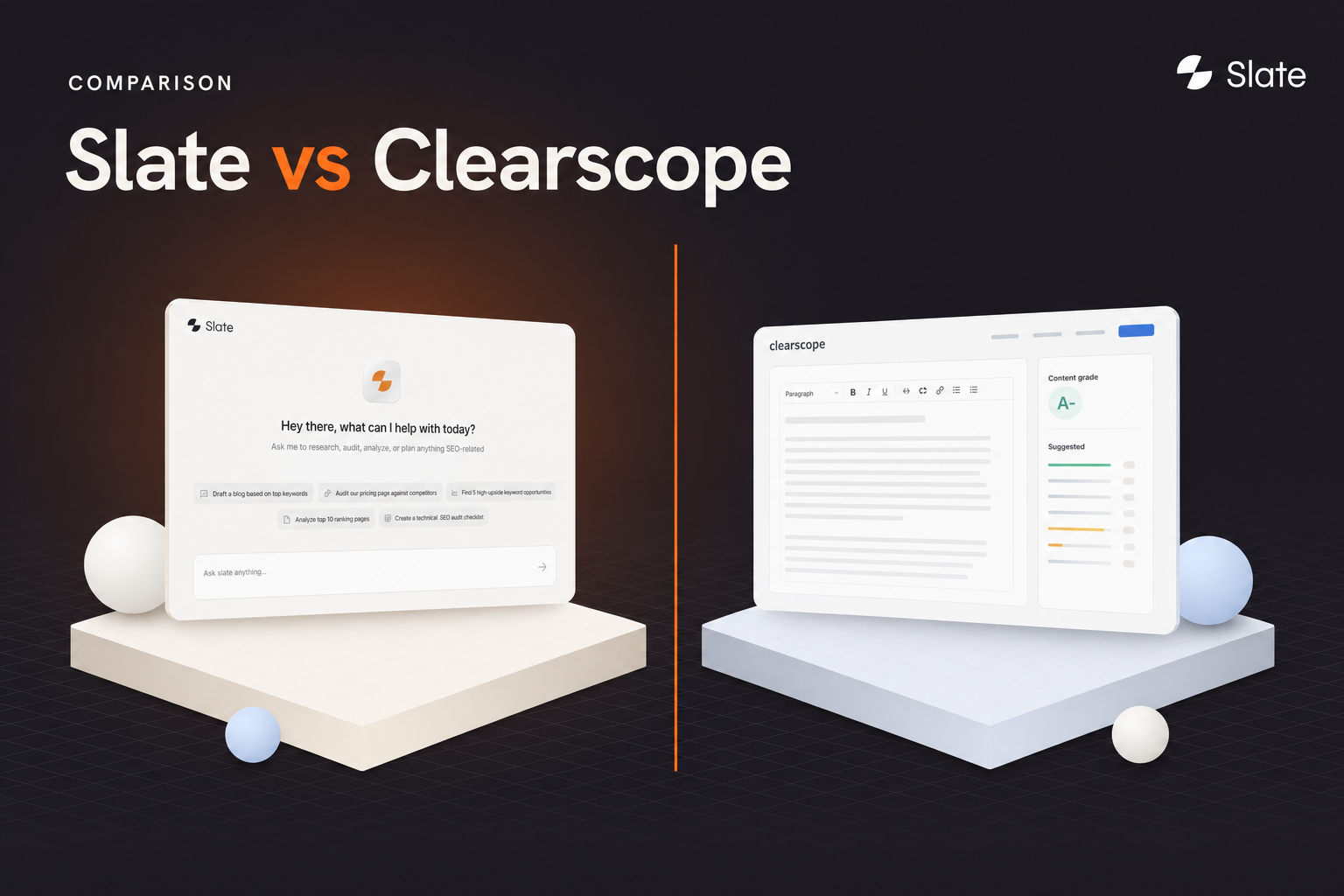
Clearscope — Best For Editorial Teams Focused On Content Quality And AI Citation Tracking
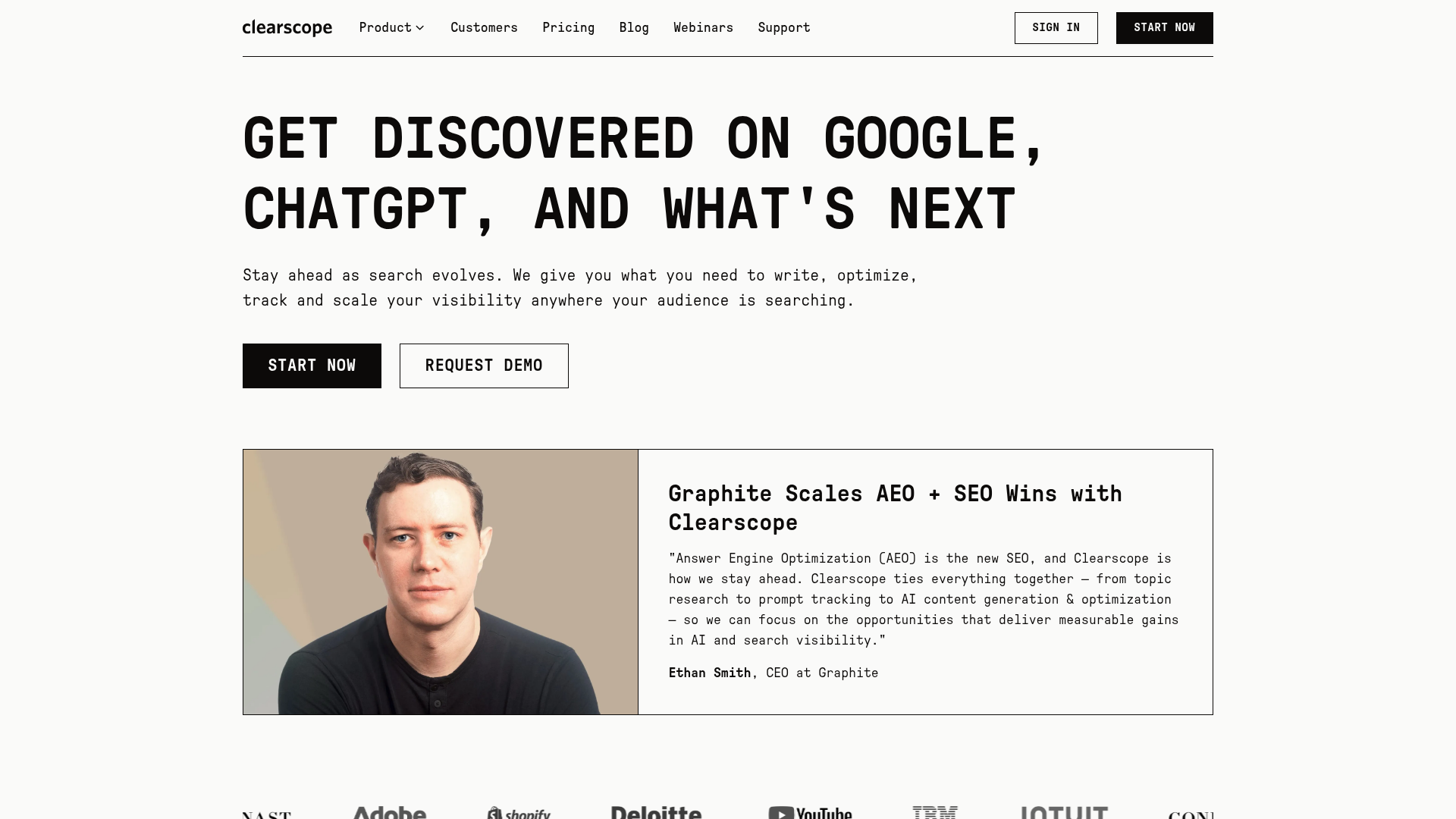
Positioning: Content optimization platform built for editorial quality, with AI search visibility features.
Clearscope has long been the choice for editorial teams that care deeply about content quality and topic coverage. Its recent addition of AI citation tracking makes it relevant for teams thinking about AI search visibility.
Key differentiators (confirmed):
- AI Citations Content View tracking citations, engines, and previews across Google and AI chatbots
- Tracked Topics feature for monitoring AI mentions and citations over time
- Topic Exploration for building topical authority
- Search Intent Analysis
- AI drafting and editing workflow
- Content analytics for published content
Best for: Editorial-heavy teams that prioritize readability, topic coverage, and want AI citation tracking integrated into their content quality workflow.
Limitations vs. Slate: Clearscope does not appear to offer a visual workflow builder, bulk operations or programmatic content refresh capabilities, brand kit or knowledge base, or CMS publishing integrations based on official site review. Its AI citation tracking is confirmed, but it lacks the execution layer (workflows, bulk operations, CMS publishing) that turns citation insights into scaled content action.
Pricing: Essentials plan at $129/month. Business plan at $399/month. Enterprise plan at custom pricing.
MarketMuse — Best For Content Strategy And Topic Authority Planning
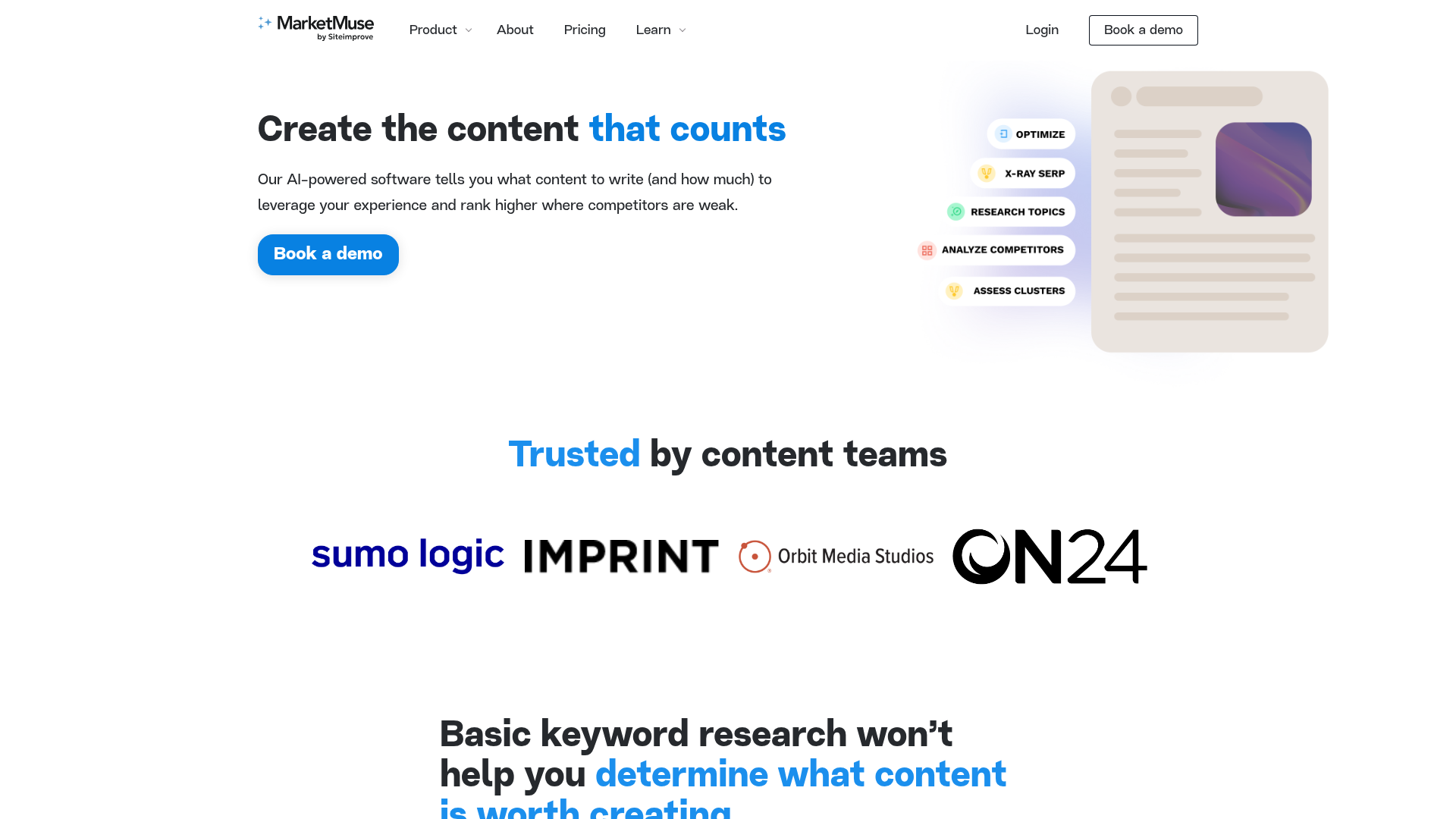
Positioning: Content strategy platform focused on portfolio-level planning, topical authority, and content inventory management.
For teams evaluating Frase vs MarketMuse, the distinction is strategic depth. Where Frase optimizes individual pages, MarketMuse thinks about your entire content library. It supports portfolio-level strategy including topic clustering, content decay detection, and internal linking guidance, making it a genuine strength for teams managing large topic surfaces.
Key differentiators (confirmed):
- Content briefs driven by SERP analysis
- On-page optimization scoring (Content Score, Topic Authority), though without GEO or AI search visibility scoring
- Portfolio-level strategy including clusters, content decay detection, and internal linking guidance
- Integrated research-to-write workflow
- MarketMuse appears to support AI-assisted drafting based on its marketing materials, though a dedicated feature page for this capability was not found
Best for: Teams building topical authority across large content libraries who need portfolio-level planning, content gap analysis, and decay detection.
Limitations vs. Slate: MarketMuse does not appear to offer AI search visibility tracking (ChatGPT, Perplexity, AI Overviews citation monitoring), bulk operations or programmatic content refresh capabilities, collaboration and governance features (roles, approvals, brand voice enforcement), or CMS publishing integrations based on official site review. It excels at strategy and planning but lacks the AI search tracking and workflow execution layer.
Pricing: Pricing is not publicly listed. Contact MarketMuse for current plans.
Semrush Writing Assistant — Best For Teams Already In The Semrush Ecosystem
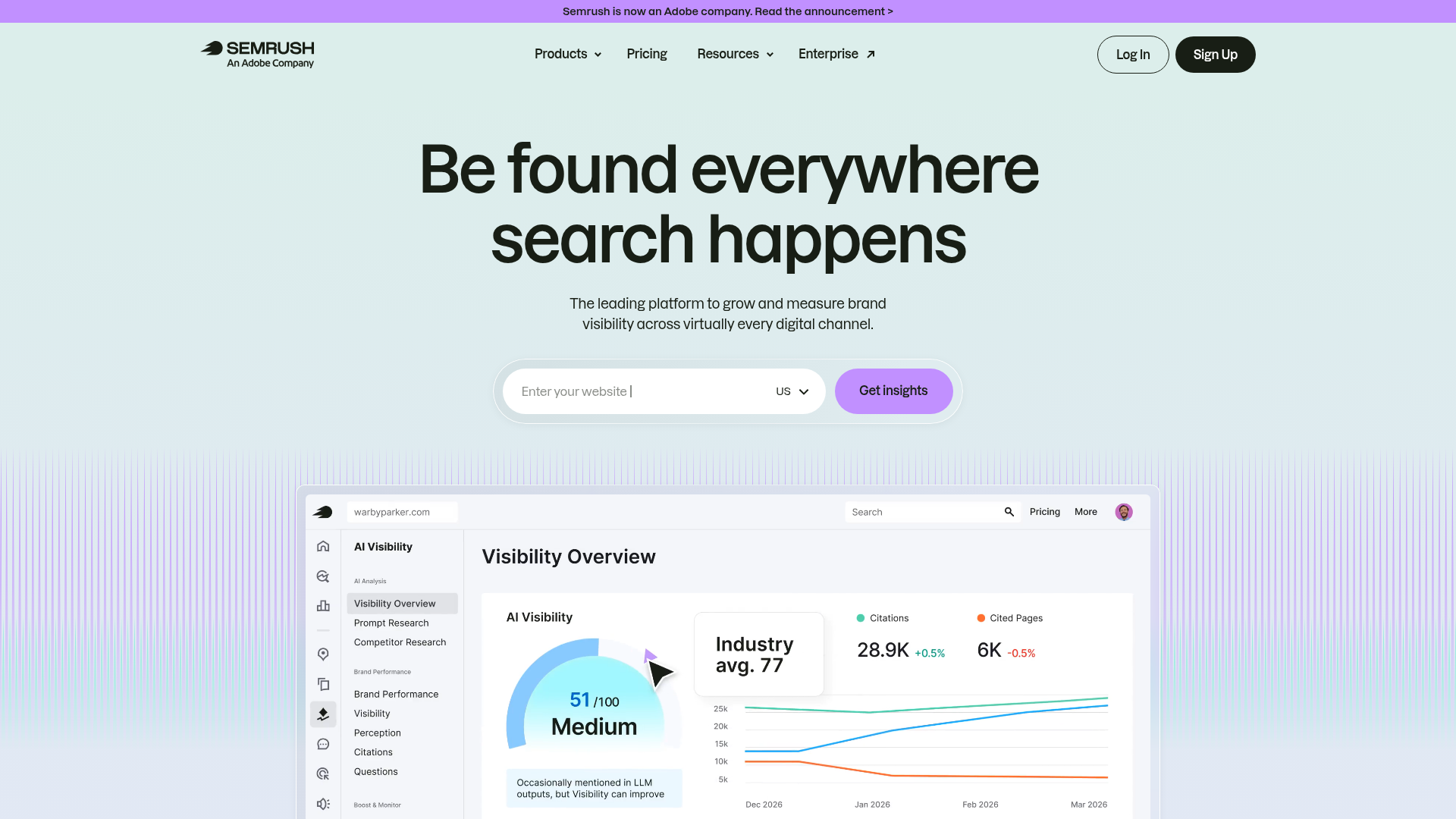
Positioning: AI-powered writing optimization tool integrated within the broader Semrush SEO platform.
If your team already runs keyword research, site audits, and competitive analysis through Semrush, the Writing Assistant keeps content optimization within the same environment. It's less a standalone Frase alternative and more a writing layer on top of a comprehensive SEO suite.
Key differentiators (confirmed):
- AI-assisted content drafting with Rephraser (paraphrase, simplify, expand, summarize), Compose with AI, and Ask AI features
- On-page optimization scoring across SEO, readability, originality, and tone of voice
- Integrates with Google Docs, MS Word, and WordPress
- Document sharing and collaboration features
- Summarizer feature for content condensation
Semrush's marketing materials reference GEO scoring, though detailed feature documentation for this capability is limited.
Best for: Teams that already use Semrush for keyword research, site audits, and competitive analysis and want writing optimization within the same environment.
Limitations vs. Slate: Semrush Writing Assistant does not appear to offer AI search visibility tracking (ChatGPT, Perplexity, AI Overviews), bulk operations or programmatic content refresh capabilities, brand kit or knowledge base for brand-safe AI generation, or direct CMS publishing to Webflow (WordPress integration is confirmed) based on official site review. It's a writing optimization add-on within a broader SEO suite rather than a standalone content engineering platform.
Pricing: Semrush platform plans start at $139.95/month for Pro ($117.33/month billed annually), $249.95/month for Guru ($208.33/month billed annually), and $499.95/month for Business ($416.66/month billed annually). Semrush One plans include Starter at $199/month ($165.17/month billed annually), Pro+ at $299/month ($248.17/month billed annually), and Advanced at $549/month ($455.67/month billed annually). A free tier with limited daily queries is also available. The Writing Assistant is part of the broader Semrush platform; check which plan tier includes it.
Content Harmony — Best For Structured Content Briefs And Search Intent Analysis
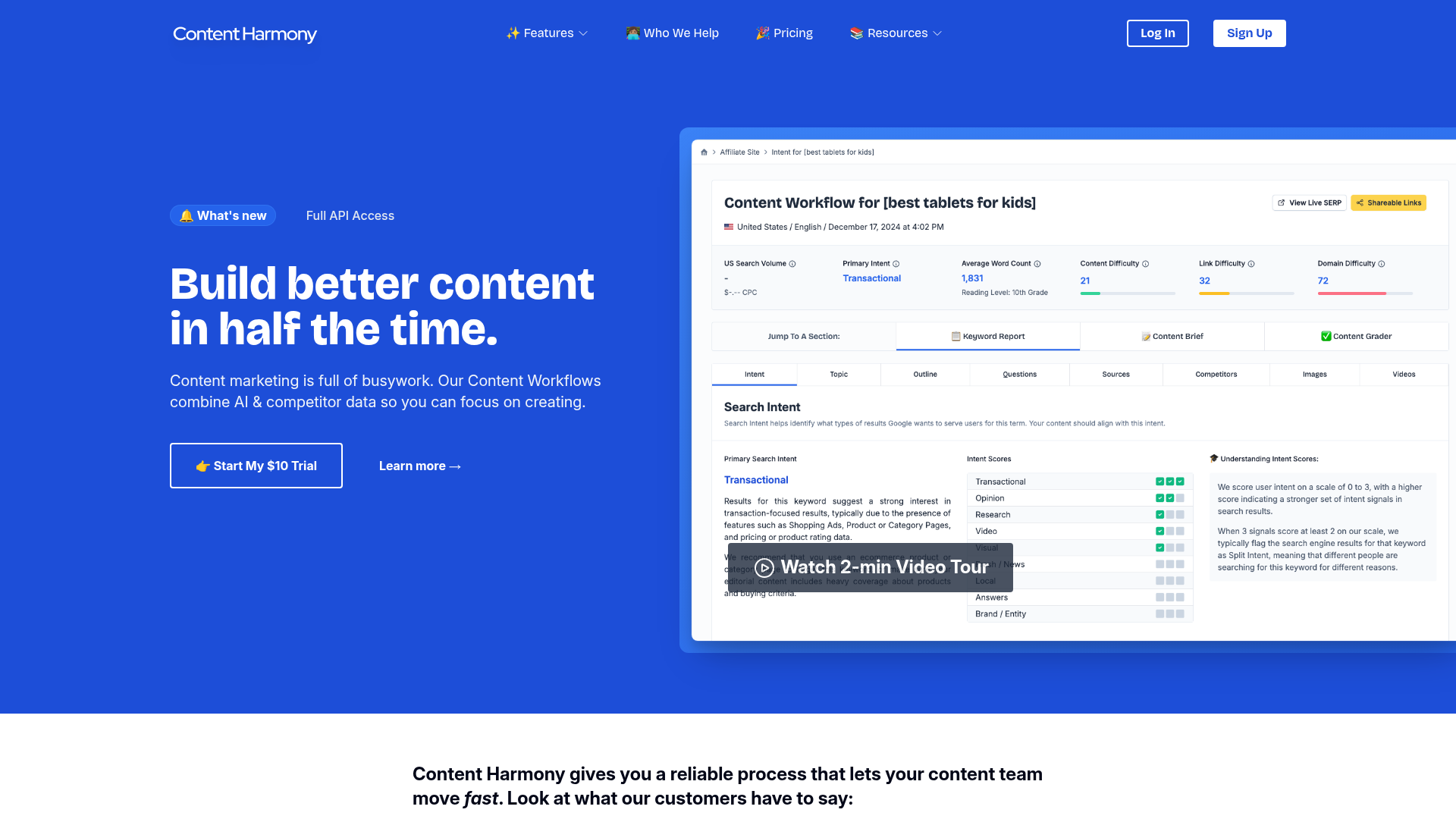
Positioning: Content brief and workflow platform focused on search intent classification and structured brief creation.
Content Harmony has carved out a specific niche: producing the most detailed, workflow-ready content briefs in the category. If your bottleneck is getting writers the right information before they start drafting, this tool deserves a close look.
Key differentiators (confirmed):
- Keyword Reports with search intent classification (8 custom intent types), topic model, competitor outlines, keyword difficulty, question analysis, image/video analysis, and international keyword research
- Content Briefs with customizable block editor, templates, shareable links, and copy to clipboard
- Content Grader with AI-driven topic model, readability metrics, and content scoring
- AI Overviews displayed in Keyword Reports
- Full REST API access for workflows, research tools, brief export, and content grader
- Integrations with Google Docs, Word, Notion, Moz, DataForSEO, EditorNinja, and outgoing webhooks
- Free onboarding, training, and migrations
- Unlimited users and projects across all plans
Best for: Content teams that need detailed, workflow-ready briefs with intent classification and structured research outputs, especially teams that value API access for custom integrations.
Limitations vs. Slate: Content Harmony does not appear to offer AI search visibility tracking (ChatGPT, Perplexity, AI Overviews citation monitoring), AI-assisted content drafting, bulk operations or programmatic content refresh capabilities, collaboration roles/approvals/brand voice enforcement, or content decay detection based on official site review. It excels at the research-to-brief stage but lacks the execution, AI search tracking, and governance layers.
Pricing: Credit-based plans range from $50/month for 5 workflows ($42/month billed annually) to $799/month for 150 workflows ($719/month billed annually). Enterprise plans start at $1,000+/month for 200+ workflows. A one-time $10 trial for 10 credits is also available.
Jasper — Best For High-Volume AI Content Generation
Positioning: AI content generation platform focused on marketing copy and brand voice at scale.
Note: Jasper's features could not be fully verified due to domain confirmation issues during research. All claims should be verified against jasper.ai before making a purchasing decision.
Best for: Marketing teams that need volume-first AI writing with brand voice controls.
Limitations vs. Slate: Based on Jasper's general market positioning, it focuses on AI content generation rather than AI search visibility tracking, content optimization scoring, or structured SEO workflows. Verify specific capabilities at jasper.ai.
Pricing: Pricing is not publicly listed. Check jasper.ai/pricing for current plans.
Scalenut — Best For Teams Wanting GEO Visibility And AI Content In One Platform
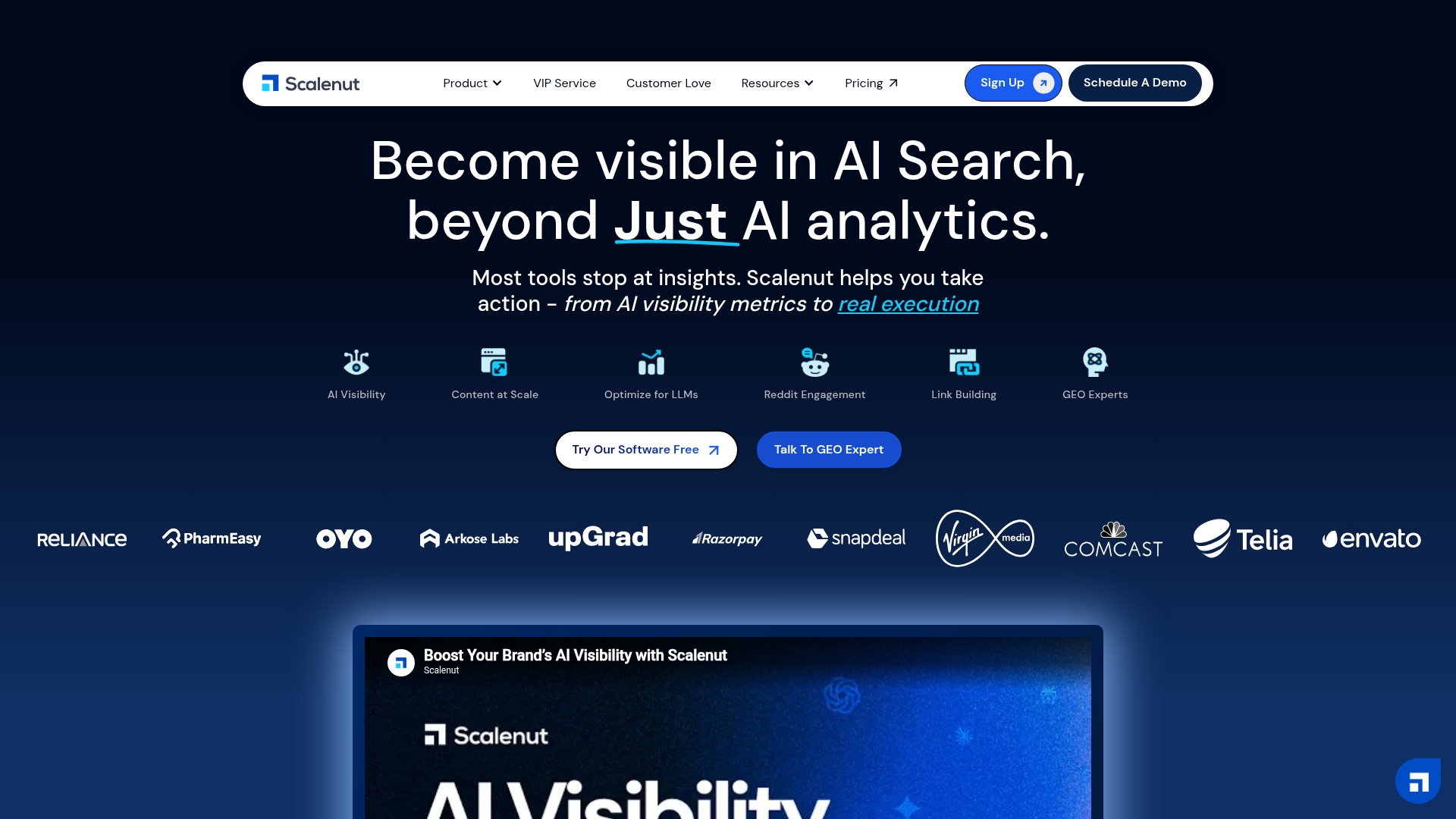
Positioning: All-in-one content and GEO platform with AI search visibility tracking, AI writing, and content optimization.
Scalenut is one of the more complete alternatives for teams that want AI search visibility tracking and AI content creation in a single platform. Its GEO Watchtower module and Brand Kit make it a credible option for teams prioritizing AI search.
Key differentiators (confirmed):
- AI Visibility module (GEO Watchtower): tracks LLM perception, mentions, and citations across ChatGPT, Claude, AI Overviews, and Perplexity, with AI Traffic Monitor and AI Superstars pages
- Brand Kit and Knowledge Base: style guides, tone rules, and knowledge base for brand-safe AI content generation
- Cruise Mode (Article Writer): factual, SEO-optimized drafts with SERP-based intelligence, brand tone, and social listening
- GEO AI Editor: real-time content scoring on SEO and GEO parameters, with Fix It and Auto-Optimizer, NLP key terms, and prompt discovery
- Content Optimizer: import live URLs, side-by-side analysis, content gap identification
- CMS Publishing: direct publishing to WordPress and Shopify (no Webflow)
- Backlink Marketplace: curated domains for backlinks, integrated with AI Visibility recommendations
Best for: Teams that want AI search visibility tracking and AI content creation in a single platform, particularly those publishing to WordPress or Shopify.
Limitations vs. Slate: Scalenut does not appear to offer a visual workflow builder with conditional logic and 24+ AI models, a spreadsheet interface for bulk content operations, pre-built workflow templates, CMS publishing to Webflow, or Claude integration via MCP based on official site review. Scalenut covers GEO tracking and AI writing well, but lacks the structured workflow execution layer and the breadth of CMS publishing options.
Pricing: Pricing is not publicly listed. Check scalenut.com/pricing for current plans.
Writesonic — Best For AI Search Visibility Tracking With Fast AI Drafting
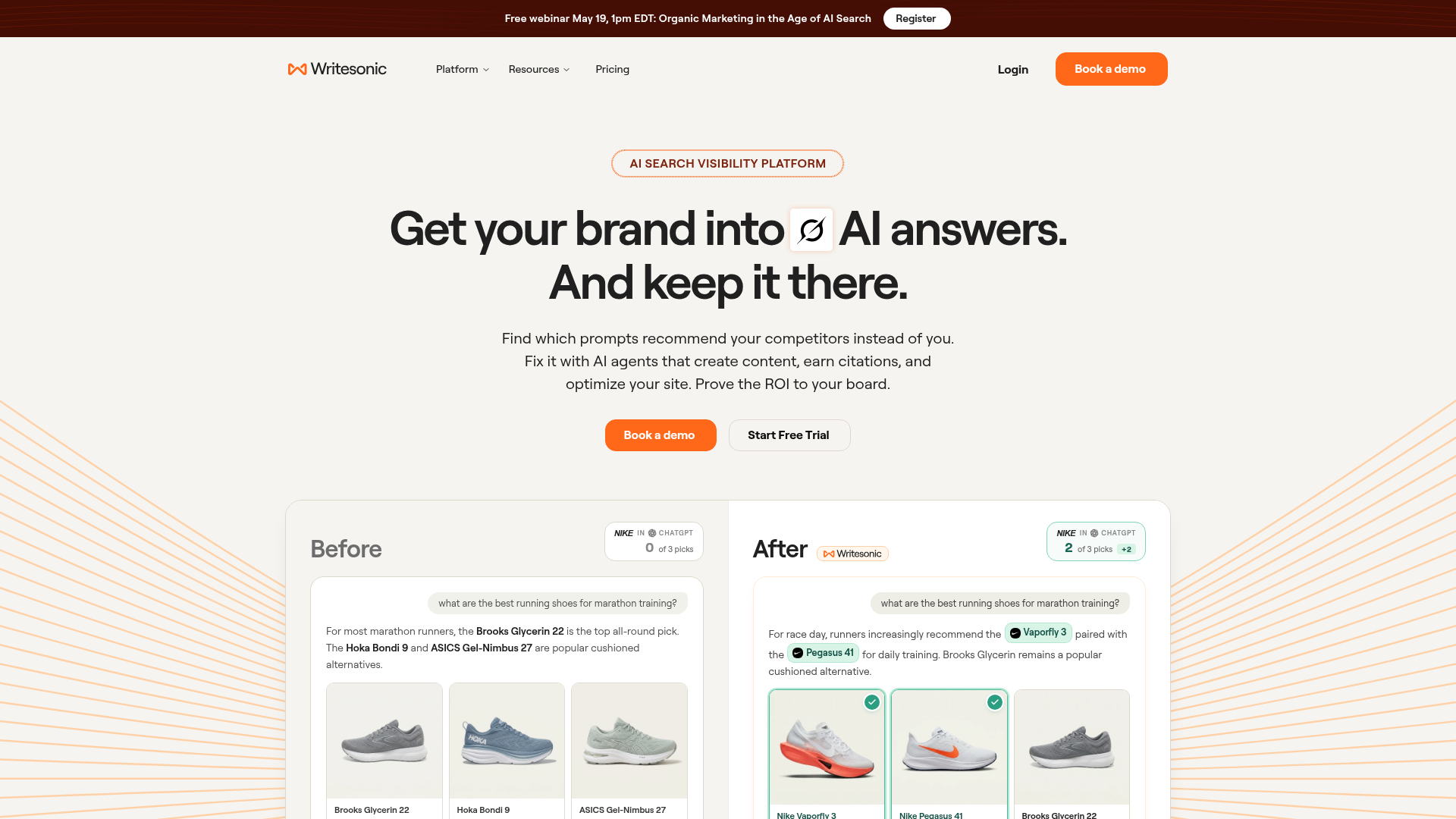
Positioning: AI content and GEO platform combining AI search visibility tracking with fast article generation.
Writesonic tracks AI search visibility across the widest range of AI platforms among the tools in this comparison. If breadth of AI platform coverage is your top priority, Writesonic deserves evaluation.
Key differentiators (confirmed):
- AI search visibility tracking across ChatGPT, Google AI Mode, Google AI Overviews, Perplexity, Claude, and Gemini
- Brand Explorer: instant brand intelligence across AI platforms
- Action Center: strategic command hub for maximizing brand visibility across AI-powered search engines
- Prompts Overview dashboard: AI visibility trends, leaderboards, visibility gaps
- GEO project setup: track brand visibility by domain, URL, or path, with prompt generation and competitor benchmarking
- AI-assisted content drafting (Instant Article Writer, AI Article Writer)
- AI Document Editor: SEO optimization, plagiarism check, multilingual support
- CMS Publishing: direct publishing to WordPress (no Webflow confirmed)
Writesonic's marketing materials reference integrations with Google Analytics, Google Search Console, Looker Studio, and MCP, though these are mentioned in marketing copy rather than detailed feature documentation.
Best for: Teams that prioritize AI search visibility tracking across the widest range of AI platforms and want fast AI drafting capabilities in the same tool.
Limitations vs. Slate: Writesonic does not appear to offer a visual workflow builder with conditional logic, a spreadsheet interface for bulk content operations, brand kit or knowledge base for brand-safe AI generation, CMS publishing to Webflow, or pre-built workflow templates based on official site review. Its AI search tracking covers more platforms (including Claude and Gemini), but it lacks the structured workflow execution and brand governance layers.
Pricing: Lite at $49/month ($39/month billed annually). Standard at $99/month ($79/month billed annually). Professional at $249/month ($199/month billed annually). Advanced at $499/month ($399/month billed annually). Basic at $199/month. Growth at $399/month. Enterprise at custom pricing. A free trial is also available.
Page Optimizer Pro — Best For Technical On-Page SEO Optimization
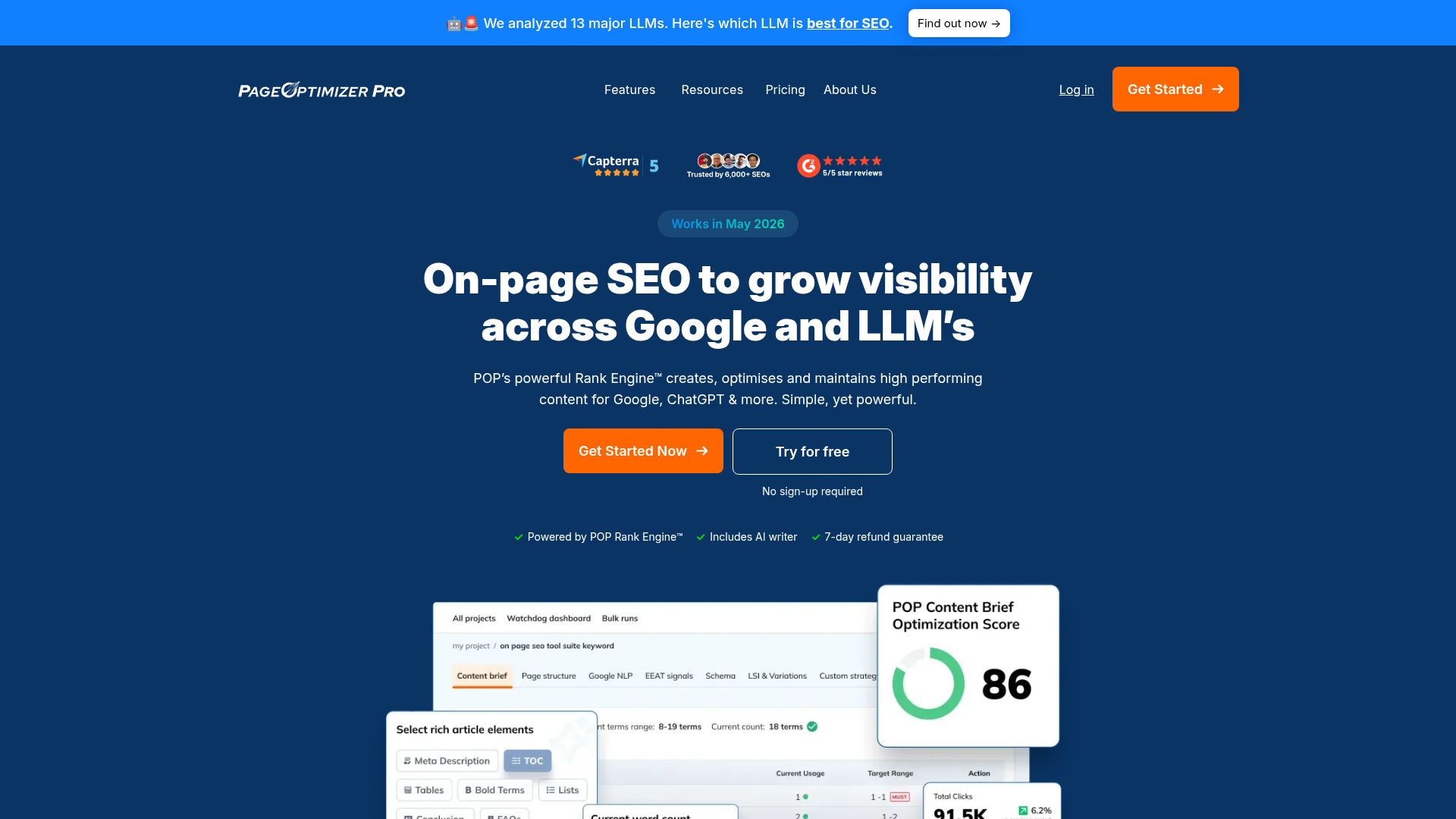
Positioning: Technical on-page SEO optimization tool with AI writing and content clustering capabilities.
Page Optimizer Pro takes a more granular, technical approach to on-page optimization than most tools in this comparison. If you're the kind of SEO who wants to control optimization levels down to specific parameters, POP gives you that control.
Key differentiators (confirmed):
- AI Writer with optimization levels (Minimal, Balanced, High, Maximum) using competitive SERP analysis
- Silo Tool for content clustering (Keyword Strategy, Custom Silo, One-Click Silo)
- POP Rank Engine for on-page scoring
- AI-powered Schema, EEAT, NLP, and Watchdog features
- Content Brief and Content Editor
- Chrome Extension integration with Google Docs and CMS editors
- API Access
- AI Writer supports internal linking
Page Optimizer Pro's homepage mentions the ability to "instantly create up to 50 pieces of AI-optimized content," though this is marketing copy rather than detailed feature documentation.
Best for: Technical SEOs who want granular on-page recommendations with SERP-driven optimization levels and content clustering tools.
Limitations vs. Slate: Page Optimizer Pro does not appear to offer AI search visibility tracking across ChatGPT, Perplexity, AI Overviews, or other AI platforms, direct CMS publishing integrations (WordPress/Webflow), brand kit or knowledge base, visual workflow builder, or a bulk operations spreadsheet interface based on official site review. It's focused on technical on-page optimization rather than AI search visibility or scalable content workflows.
Pricing: Basic plan at $40/month. Unlimited plan at $72/month ($739/year). Teams plan at $143/month ($1,425/year) starting at 5 sub-accounts with additional seats at $12/month or $120/year. White Glove (done-for-you service) starting at $275/month.
Frase Alternatives Comparison Table
This matrix covers the capabilities most relevant to teams evaluating best frase alternatives in 2026. Each entry reflects verified feature documentation, not marketing claims.
*Jasper's capabilities could not be fully verified during research. Check jasper.ai for current features.
How to read this table: "Not found" means the capability was not found on the tool's official site during research. It does not necessarily mean the tool lacks it entirely. "Marketing copy only" means the feature was mentioned in homepage or marketing materials but not in detailed feature documentation.
How AI Search Changes What You Need From A Content Tool
Why Traditional Content Optimization Isn't Enough Anymore
For years, the content optimization playbook was straightforward: research a keyword, write a comprehensive article, hit a target content score, publish, and track rankings. That playbook assumed one thing: that Google's ten blue links were the primary discovery surface.
That assumption no longer holds. When a B2B buyer asks ChatGPT "what's the best project management tool for remote teams" and gets a direct answer with cited sources, the content that gets referenced in that answer captures attention in a way that a position-seven ranking never could. The content that doesn't get cited might as well not exist for that query.
This creates a new set of requirements that most content optimization tools weren't designed for. Content needs to be structured for extraction, not just for reading. Claims need to be explicit and attributable. Definitions need to be clear enough for an LLM to pull and cite accurately.
Tools built for the old model help you match what already ranks on Google. Tools built for the new model help you get cited across ChatGPT, Perplexity, Gemini, and AI Overviews simultaneously.
What GEO-Ready Tools Actually Do Differently
GEO (Generative Engine Optimization) tools differ from traditional content optimization platforms in three fundamental ways:
They track brand mentions and citations across AI platforms. Instead of monitoring keyword rankings on Google alone, GEO tools show you when and where your brand appears inside AI-generated answers. This includes ChatGPT, Perplexity, Google AI Overviews, Google AI Mode, and in some cases Gemini and Claude.
They help structure content for LLM extraction. This means clear definitions, explicit claims, source attribution, and formatting that makes it easy for AI systems to pull accurate information from your pages.
They measure AI search share-of-voice over time. Traditional rank tracking tells you where you sit on a SERP. AI search tracking tells you how often your brand gets cited relative to competitors across AI platforms, and whether that presence is growing or shrinking.
Several tools in this comparison now offer confirmed AI search tracking: Slate, Surfer SEO, Clearscope, Scalenut, and Writesonic. But the depth of tracking and the connection between tracking and execution varies significantly. Some tools show you the data. Fewer tools help you act on it at scale.
Where Slate Fits In The AI Search Landscape
Slate's AI Search Analytics tracks visibility across ChatGPT, Google AI Mode, Google AI Overviews, and Perplexity. But tracking alone isn't what differentiates it from other tools that also offer AI search monitoring.
The differentiator is the execution layer. Slate's Workflows and Power Sheets allow teams to act on AI search insights at scale, refreshing hundreds of pages for citation readiness without manual bottlenecks. When AI Search Analytics reveals that a competitor is getting cited for a topic cluster where your content should appear, Workflows can automate the brief creation, content refresh, and publishing process for every affected page.
Slate's Brand Kit ensures that AI-generated content stays accurate, on-voice, and trustworthy throughout this process. For teams where brand credibility directly affects whether AI systems cite them, that governance layer is a strategic advantage rather than a nice-to-have.
For a broader look at how AI SEO tools compare across categories, see Slate's guide to the best AI SEO tools.
Workflow Comparison — Frase Vs. Slate For Common Content Operations
Feature lists tell you what a tool can do. Workflow comparisons tell you what it's like to actually use one. Here's how Frase and Slate handle three common content operations that most B2B content teams run regularly.
Scenario 1 — Creating A New Content Piece From Scratch
In Frase: You start with a keyword, and Frase pulls SERP data to generate a content brief. You review competitor headings, questions, and topic coverage. From there, you draft directly in Frase's editor, using the optimization score to guide topic coverage. When the score looks good, you copy the content and paste it into your CMS.
This workflow is clean and fast for individual articles. The tight loop between research and writing is Frase's core strength.
In Slate: The workflow starts earlier and ends later. AI Search Analytics identifies the opportunity, showing not just keyword potential but where the brand currently appears (or doesn't) in AI-generated answers. A Workflow builds the brief with brand context pulled from the Knowledge Base. AI drafts with Brand Kit guardrails, ensuring tone and accuracy match brand standards. Power Sheets can audit optimization across the draft and related existing content. CMS Publishing pushes the finished piece directly to WordPress or Webflow.
The difference isn't speed on a single article. It's that every step is connected, governed, and repeatable. The second article follows the same system. So does the fiftieth.
Scenario 2 — Refreshing 50+ Existing Articles For AI Search
In Frase: Each article gets opened individually. You pull fresh SERP data, compare your content against current competitors, identify gaps, and manually update the draft. Multiply that by 50 articles, and you're looking at weeks of work for a single content strategist.
Frase's workflow is designed around individual article creation and scoring. It does not appear to offer bulk operations or programmatic content refresh capabilities.
In Slate: Power Sheets imports all 50 URLs into a spreadsheet interface. Bulk audit identifies which pages have dropped in optimization score, which lack citation-ready structure, and which have content decay issues. Workflows automate the refresh process with conditional logic: pages below a certain threshold get a full rewrite, pages close to target get targeted updates, and pages already performing well get skipped. CMS Publishing deploys all updates directly.
What takes weeks in an article-by-article tool takes days in a system built for scale.
Scenario 3 — Tracking And Improving AI Search Visibility
In Frase: Frase has positioned around GEO in its marketing, but the depth of its AI search tracking dashboard compared to dedicated platforms is limited. Teams looking for detailed citation monitoring across ChatGPT, Perplexity, and AI Overviews will likely need to supplement Frase with another tool.
In Slate: AI Search Analytics provides a dedicated dashboard tracking citations across platforms. Teams can see which queries trigger AI answers that cite their brand, which cite competitors, and where gaps exist. From there, the workflow is direct: identify underperforming content, use Workflows to automate the refresh with citation-ready structure, and deploy through CMS Publishing. The loop from insight to action to measurement happens within a single platform.
Book a demo to walk through these workflows with the Slate team.
When To Keep Frase (And When To Switch)
Keep Frase If...
Frase is still a solid tool for specific use cases. If any of these describe your situation, switching may create more disruption than value:
- You're a solo creator focused on individual article optimization. Frase's research-to-write loop is fast, intuitive, and affordable for one person producing a handful of articles per month.
- Your primary concern is traditional SERP content scoring. If your strategy is centered on matching and exceeding what currently ranks on Google, and AI search visibility isn't yet a priority, Frase handles that job competently.
- You don't need bulk operations, team collaboration, or AI search tracking. If your content operation is small enough that article-by-article optimization works, Frase's limitations won't feel like limitations.
Switch From Frase If...
The case for switching becomes clear when your needs have outgrown what Frase was designed to do:
- You need to track and improve visibility across AI search platforms. If your leadership is asking how the brand appears in ChatGPT or Perplexity answers, Frase doesn't have the dashboard for that conversation.
- Your team is producing or refreshing content at scale. Dozens or hundreds of pages per quarter means you need bulk operations, programmatic refreshes, and workflow automation.
- You need structured workflows with brand governance. Multiple writers, editors, and stakeholders require roles, approvals, and brand voice enforcement that Frase doesn't provide.
- You want a single platform connecting insight to action to publishing. If you're currently stitching together three or four tools to get from research to published content, consolidation into a workflow-driven platform saves meaningful time and reduces errors.
Consider A Hybrid Stack If...
Full replacement isn't always the right move. Sometimes the smartest approach is keeping what works and adding what's missing:
- You like Frase for individual briefs but need AI search analytics on top. Frase handles the brief-to-draft workflow. A tool like Slate adds AI Search Analytics, Power Sheets for bulk operations, and CMS Publishing for deployment.
- You want to keep your current writing tool but add programmatic content operations. If your team is comfortable in Frase's editor, adding a workflow-driven platform for the operations layer can extend your capabilities without retraining everyone.
Tools like Slate, Surfer SEO, Clearscope, Scalenut, and Writesonic complement Frase in different ways. Slate and Scalenut add the broadest execution layer (workflows, bulk operations, brand governance). Surfer SEO and Clearscope add AI search tracking with strong content scoring. The right complement depends on which gap you're filling.
How To Switch From Frase — A Practical Migration Guide
No competing comparison page offers practical switching guidance. If you've decided to move, here's how to do it without disrupting your content operation.
Step 1 — Audit Your Current Frase Usage
Before evaluating alternatives, get honest about what you actually use Frase for. Open your account and answer these questions:
- Which features do you use weekly? Briefs only? Writing and optimization? Research? All three?
- Which workflows would break if you cancelled tomorrow? If your entire brief creation process lives in Frase, that's a critical dependency. If you only use it for content scoring after writing in Google Docs, the dependency is lighter.
- How many team members actively use Frase? One person switching tools is simple. Ten people switching requires training, documentation, and a transition period.
This audit determines whether you need a full replacement or a targeted addition.
Step 2 — Run A Parallel Evaluation
Pick 2 to 3 alternatives from this guide based on the decision framework above. Then test each on the same 3 to 5 content tasks your team runs every week. Specifically:
- Create a content brief for the same target keyword in each tool. Compare the depth of research, the quality of the brief output, and the time it takes.
- Draft or optimize the same article in each tool. Evaluate the AI writing quality, optimization guidance, and brand voice consistency.
- If AI search tracking matters to your team, set up monitoring for the same brand queries across tools and compare the depth and actionability of the data.
- Have at least two team members test each tool independently. Individual preferences matter less than team-wide adoption.
Evaluate on four dimensions: speed, output quality, team adoption friction, and coverage of AI search capabilities.
Step 3 — Migrate Gradually
Resist the urge to cancel Frase and go all-in on day one. A phased approach reduces risk:
- Start with new content on the new platform. Don't migrate historical projects immediately. Let the team build comfort with new workflows on fresh assignments.
- Retrain the team on new workflows. Document SOPs for the most common content operations. If you're moving to a workflow-driven platform like Slate, map out the specific workflow for each content type your team produces.
- Set a 30-day review checkpoint. After one month, measure the impact on output quality, production speed, and AI search visibility. If the new tool is delivering measurable improvements, expand adoption. If not, adjust the approach before going further.
Conclusion — Choosing The Right Frase Alternative For Your Team
The right frase alternative depends on where your team is headed, not where it is today.
Start with your job-to-be-done. If you need better research and portfolio strategy, MarketMuse deserves a close look. If you need stronger on-page scoring with AI search tracking, Surfer SEO alternatives or Clearscope fit well. If you need structured briefs with deep intent analysis, Content Harmony is purpose-built for that.
Match to your team type. Solo creators and small teams may find that Frase still works, or that a lightweight alternative like Page Optimizer Pro covers their needs at a lower price point. Agencies and enterprise teams need governance, multi-client support, and scalable workflows that most individual-article tools can't provide.
Evaluate for AI search readiness. This is the axis that matters most in 2026. The tools that track AI search visibility and connect that tracking to content execution will define the next generation of content operations. Tracking alone isn't enough. The connection between insight and action is what separates a dashboard from a system.
Slate is built for teams that need that connection: AI Search Analytics to see where the brand appears across ChatGPT, Google AI Mode, AI Overviews, and Perplexity. Workflows and Power Sheets to act on those insights at scale. Brand Kit to maintain quality and trust throughout. CMS Publishing to deploy without leaving the platform. Slate starts at $199/month.
Book a demo to see how Slate connects AI search insight to scalable content execution for your team.
Frequently Asked Questions
What Is The Best Frase Alternative For AI Search Visibility?
For teams that need AI search tracking connected to scalable content execution, Slate offers the strongest combination of visibility monitoring and workflow-driven action. Slate's AI Search Analytics tracks citations across ChatGPT, Google AI Mode, AI Overviews, and Perplexity, while Workflows and Power Sheets enable teams to act on those insights at scale. Surfer SEO, Clearscope, Scalenut, and Writesonic also offer confirmed AI search visibility tracking. Writesonic covers the widest range of AI platforms (including Claude and Gemini). The key differentiator is whether the tool connects tracking to execution or treats them as separate functions.
Is Frase Still Worth Using In 2026?
Yes, for specific use cases. Frase remains a capable tool for solo creators focused on individual article optimization and traditional SERP scoring. Its research-to-write workflow is fast and intuitive for small-scale content production. However, teams scaling content operations, managing multiple contributors, or prioritizing AI search visibility will likely find Frase's limitations around bulk operations, collaboration governance, and AI citation tracking increasingly constraining.
What's The Difference Between SEO Content Optimization And AI Search Optimization (GEO)?
SEO content optimization targets traditional SERP rankings by matching topic coverage, keyword usage, and content structure against what currently ranks on Google. GEO (Generative Engine Optimization) targets visibility in AI-generated answers by structuring content for citation and extraction by LLMs like ChatGPT, Perplexity, and Gemini. SEO asks "will this page rank?" GEO asks "will this content get cited in an AI answer?" Teams increasingly need both, because AI search surfaces are growing alongside traditional search rather than replacing it entirely.
Can I Use Frase Alongside Another Tool Instead Of Replacing It?
Absolutely. A hybrid stack often makes more sense than a full replacement. For example, you might keep Frase for individual content briefs and on-page optimization while adding Slate for AI search visibility tracking, bulk content operations through Power Sheets, and CMS publishing. The key is identifying which job Frase handles well for your team and which jobs require a specialized tool. Full replacement makes sense when the overlap is high enough that maintaining two subscriptions creates more friction than value.
Which Frase Alternative Is Best For Agencies Managing Multiple Clients?
Agencies need multi-client workspace separation, brand voice controls, scalable brief creation, and reporting. Slate's Workflows and Brand Kit support scalable, brand-safe execution across multiple client accounts, with the ability to maintain separate style guides and knowledge bases per client. Surfer SEO's Workspaces feature supports managing multiple domains. Content Harmony offers unlimited users and projects across all plans with free team training. The right choice depends on whether your agency's primary bottleneck is brief creation (Content Harmony), content scoring (Surfer SEO), or end-to-end workflow execution with brand governance (Slate).
How Do I Evaluate A Frase Alternative Before Committing?
Run a parallel evaluation over 30 days. Pick 2 to 3 tools from this guide based on the decision framework. Test each on the same 3 to 5 content tasks your team runs weekly: brief creation, content drafting, optimization scoring, and (if relevant) AI search tracking. Have multiple team members test independently. Measure speed, output quality, team adoption friction, and AI search coverage. Set a review checkpoint at 30 days to compare results before making a final decision.
Do Frase Alternatives Integrate With WordPress And Other CMS Platforms?
CMS integration varies significantly across tools. Slate publishes directly to WordPress and Webflow. Surfer SEO integrates via Contentful and Zapier. Semrush Writing Assistant integrates with WordPress. Scalenut publishes to WordPress and Shopify. Writesonic publishes to WordPress. Content Harmony exports to Google Docs, Word, and Notion but does not offer direct CMS publishing. Clearscope, MarketMuse, and Page Optimizer Pro do not appear to offer direct CMS publishing based on official site review. Jasper's alternatives CMS integrations should be verified at jasper.ai.
What Should I Look For In A Content Tool If AI Search Is My Priority?
Four capabilities matter most. First, AI citation tracking: can the tool show you where your brand appears (or doesn't) in answers from ChatGPT, Perplexity, AI Overviews, and other AI platforms? Second, content structuring for LLM extraction: does the tool help you format content with clear definitions, explicit claims, and source attribution that LLMs can cite accurately? Third, AI search share-of-voice measurement: can you track your citation presence relative to competitors over time? Fourth, workflow support for making content citation-ready at scale: can you act on AI search insights across hundreds of pages, or only one at a time? Slate's AI Search Analytics is purpose-built for this, and the connection between insight and execution through Workflows, Power Sheets, and CMS Publishing is what separates a tracking dashboard from an actionable platform.