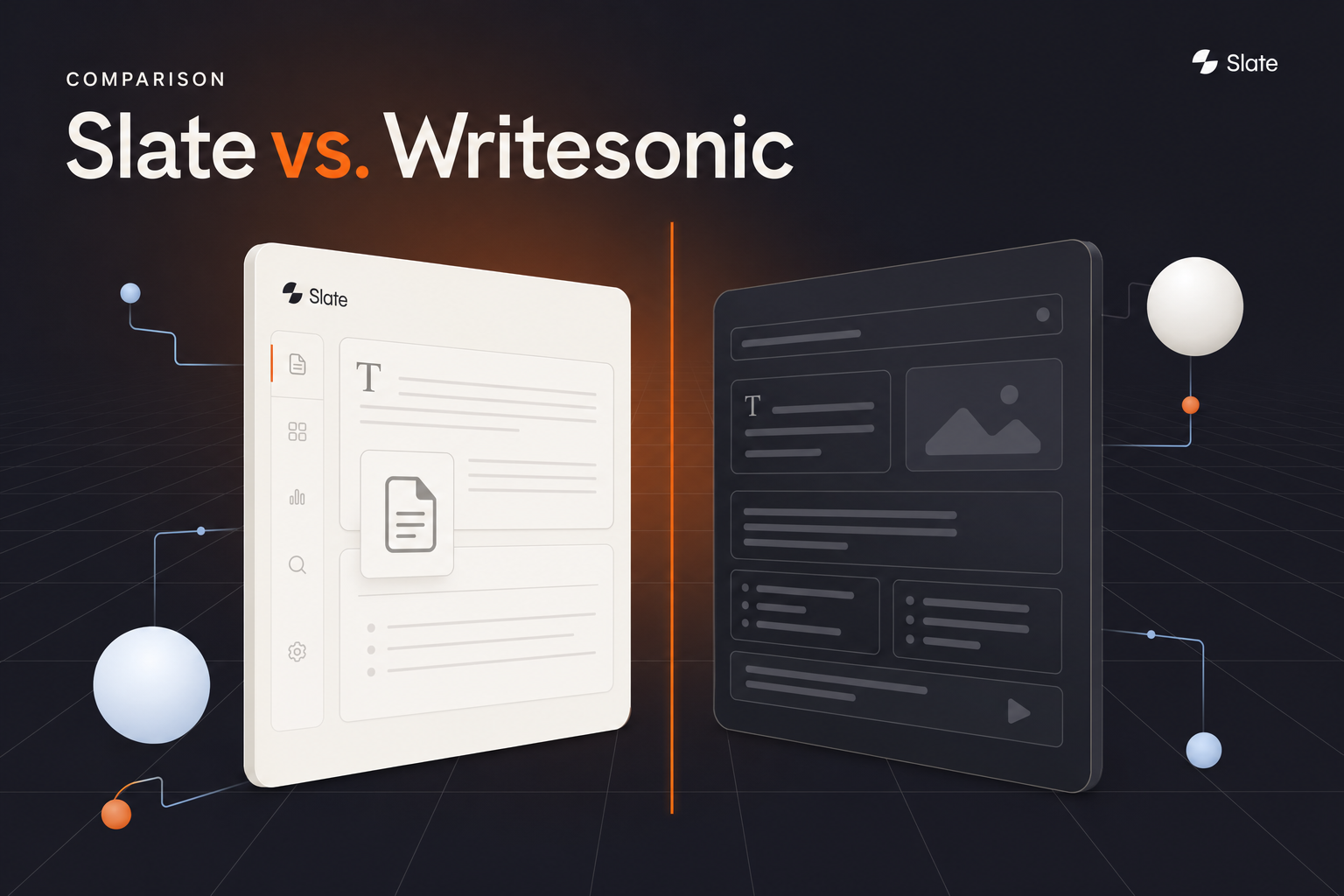
Compare Slate vs Writesonic for AI search visibility, workflows, drafting, pricing, and team fit to choose the right tool in 2026.
Slate and Writesonic overlap on content creation, but they solve different core jobs. Slate is built as an AI search and content operations system for engineering visibility and running governed workflows, while Writesonic leans toward fast, templated AI drafting with growing AI visibility features. The right pick depends on whether you need to operate content as a system or generate drafts faster.
This guide is written for Heads of Marketing, SEO leads, Content leads, and Growth teams at B2B SaaS and content-led companies evaluating both tools before purchase. In 2026, discovery no longer lives only in ten blue links-it spans Google AI Overviews, ChatGPT, Perplexity, and Gemini. That shift changes what "winning" content actually means, and it's the lens this comparison uses throughout.
Key Takeaways
This is a decision between an AI search and content workflow system (Slate) and a broad AI writing and SEO platform (Writesonic). The decisive question is whether your team needs to engineer visibility and operate content as a repeatable system, or simply produce drafts faster.
- Category split: Slate is an AI search optimization and content engineering platform; Writesonic is an AI writing and SEO platform with added visibility features.
- Slate's strength: Engineered AI search visibility, citation-ready content, governed team workflows, and ongoing refresh operations.
- Writesonic's strength: Fast AI-assisted drafting, a wide template library, and high-volume content generation.
- Best for B2B SaaS and content-led teams scaling visibility: Slate.
- Best for solo creators and teams needing quick, high-volume drafts: Writesonic.
- Decisive factor: Do you need to engineer visibility and run content as a system, or generate drafts faster?
Slate vs Writesonic at a Glance
Both tools can produce SEO content, but they sit in different categories. Slate is structured around AI search visibility, content engineering, and team workflows. Writesonic is structured around AI-assisted drafting breadth, with SEO and visibility features layered on top. The table below keeps Slate first in every row for clarity.
Are Slate and Writesonic Even Solving the Same Problem?
Not exactly. They overlap on content creation, but they belong to different categories. Writesonic optimizes for output speed and breadth of generation. Slate optimizes for AI search visibility, repeatable workflows, and measurable organic growth. Comparing them is really comparing content visibility operations to article generation.
Think of the market as a spectrum. On one end sits the drafting assistant-paste a prompt, get a draft. In the middle sits the content production tool-templates, SEO suggestions, faster output. On the far end sits an AI search and content operations system that connects insight, briefs, creation, review, publishing, and refresh into one repeatable motion.
Here's the practical contrast:
- Writesonic: Optimizes output speed and volume, with a wide library of templates for fast drafting.
- Slate: Optimizes visibility, workflow repeatability, and content that stays accurate and citation-ready as it scales.
If the only job to be done is "produce drafts faster," this is a simpler decision, and a drafting-first tool may be enough. But if your team is feeling AI answers eat into clicks-and watching competitors get cited instead of you-the question shifts from "how do we write more?" to "how do we engineer what gets surfaced?" That's a different category of tool, and a different kind of purchase.
Which Is Better for AI Search Visibility?
Slate is purpose-built for AI search visibility, while Writesonic includes visibility monitoring inside a broader, writing-first platform. If tracking and engineering how your brand appears across AI answers is the core job, Slate is the more focused choice. If visibility is one feature among many drafting tools, Writesonic covers the basics.
This matters because discovery in 2026 spans Google AI Overviews, ChatGPT, Perplexity, and Gemini-not just traditional rankings. Citation readiness and extractable content structure now decide whether a brand gets summarized and trusted, or skipped entirely. You can dig deeper into how this works in our guide to generative engine optimization.
How Slate Approaches AI Search Visibility
Slate's AI Search Analytics tracks visibility across ChatGPT, Google AI Mode, Google AI Overviews, and Perplexity, so teams can see where they appear-and where competitors get cited instead. The platform is built around citation readiness and extractable content structure, not retrofitted from older SEO tooling. Teams comparing options often start with a roundup of AI search visibility tools before committing.
- Visibility tracking across multiple AI answer surfaces.
- Content engineered for citation readiness and extractability.
- Opportunity discovery tied to visibility gaps, not just keyword lists.
The point isn't to track a vanity metric. It's to turn AI search insights into specific content actions you can execute and measure.
How Writesonic Approaches AI Search and SEO
Writesonic includes AI visibility monitoring across platforms like ChatGPT, Gemini, and Google AI Overviews, plus an Action Center and agentic workflows designed to prioritize and fix visibility gaps. It pairs this with classic SEO features-keyword targeting, on-page recommendations, and content optimization.
The honest framing: Writesonic is capable here, but visibility sits inside a broader writing platform rather than serving as the core operating model. For teams whose primary need is drafting with some SEO support, that bundling is convenient.
Which Is Better for SEO Content Creation and Long-Form Output?
Writesonic is strong for fast, templated long-form drafting at volume. Slate is stronger when SEO content must be engineered for citations, accuracy, and ongoing visibility rather than produced as one-off articles. The better fit depends on whether you value raw drafting speed or structured, system-driven content production.
Content Creation in Slate
Slate supports structured, workflow-driven content creation built around SEO and AI search visibility rather than isolated prompts. Workflows can combine multiple AI models, conditional logic, and web research, while the Brand Kit and Knowledge Base ground output in your tone and verified information. This structured approach is the foundation of content engineering.
- Workflow-driven production from brief to draft to publish.
- Brand voice and internal knowledge grounding for accuracy.
- Bulk content operations through Power Sheets for scale.
This is content engineering: producing fewer, more structured, more extractable pieces rather than chasing volume.
Content Creation in Writesonic
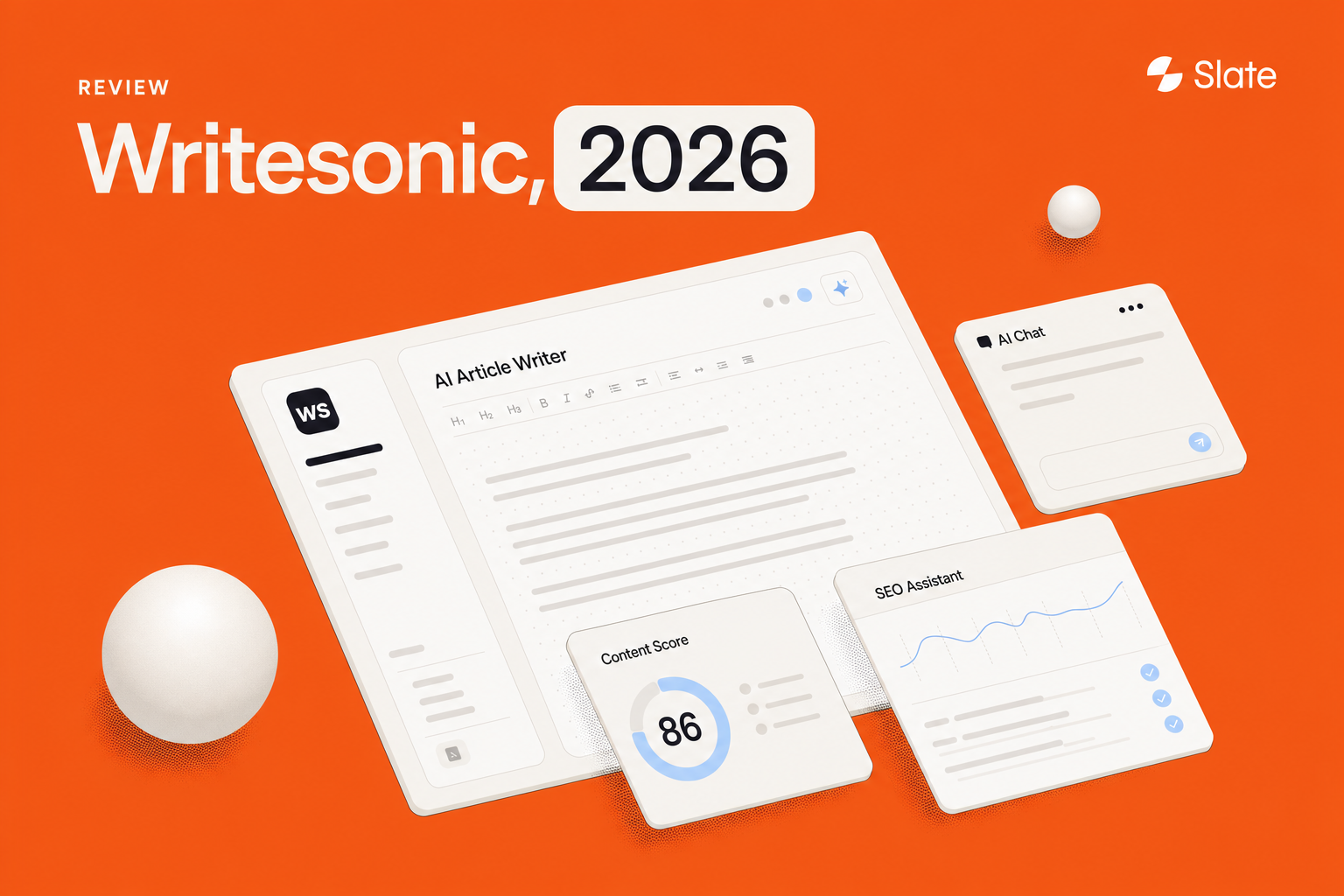
Writesonic's AI Article Writer uses a large template library and tone controls to generate SEO-oriented long-form posts quickly. It offers SEO/content agents and humanization options to make output read more naturally, which suits teams producing high volumes across blogs, ads, and marketing copy.
- Wide template library for blogs and marketing formats.
- Tone and style controls plus humanization options.
- Fast, high-volume article generation.
The trade-off: speed and breadth are real strengths, but high-volume AI output often needs editing and QA to fit brand standards and factual accuracy.
Which Is Better for Teams, Workflows, and Approvals?
Slate is built around repeatable team workflows, review steps, and governance designed for SEO, content, and growth teams to collaborate. Writesonic offers multi-user projects and shared workspaces geared toward broader content operations. For teams that need approvals and structured handoffs, Slate goes deeper; for shared drafting, Writesonic is sufficient.
Slate's Workflow and Collaboration Model
Slate centers on a content lifecycle: insight → brief → create → review → publish → refresh. Instead of treating each article as a standalone task, it connects the stages so SEO, content, and growth functions hand off cleanly. The visual workflow builder supports conditional logic and multi-step automation, while review steps keep human judgment in the loop. These are the kinds of content operations best practices that keep quality consistent at scale.
This is where the "system, not tool" distinction shows up most clearly. A 50-page SaaS site and a 5,000-page documentation library need very different operating models, and Slate is designed to run hundreds of updates without breaking quality control. For teams evaluating a content workflow AI tool or an AI writing tool for teams, governance and repeatability are the differentiators.
Writesonic's Team and Project Structure
Writesonic provides multi-user access and shared workspaces or projects on higher-tier plans, with ways to organize work by brand, client, or campaign. This supports collaboration across a team producing content at volume.
The structure is solid for shared drafting and content organization. It's geared more toward broad content production than toward enforced approval chains and lifecycle governance.
Best for teams scaling AI search content: Slate.
Best for fast individual drafting: Writesonic.
Brand Voice, Accuracy, and Quality Control
Slate treats quality control as a system, not a prompt setting-combining brand voice rules, knowledge grounding, and review checkpoints. Writesonic offers brand voice and tone controls plus humanization to align output with style. Both address voice, but Slate frames accuracy and governance as a repeatable, enforceable process.
Quality control breaks down at scale when it depends on someone remembering to edit. Slate addresses this structurally:
- Brand Kit and Knowledge Base: Style guides, tone rules, and internal knowledge ground content in verified information.
- Review checkpoints: Human review stays built into the workflow rather than bolted on afterward.
- Accuracy over creativity: Brand guardrails prioritize clarity, extractability, and flagging uncertainty instead of guessing.
Writesonic includes tone and style controls and brand voice features that help generated content match your style. As reviewers consistently note, human fact checking and QA remain important to ensure accuracy and editorial fit. The difference is less about whether voice controls exist and more about whether quality is treated as a one-time setting or an ongoing governance system.
Publishing, Integrations, and What Happens After the Draft
Slate connects workflows directly to publishing and ongoing refresh, with CMS publishing to WordPress and Webflow and visibility monitoring after content goes live. Writesonic supports export and CMS publishing, primarily into WordPress. If post-publish operations matter as much as the first draft, Slate's lifecycle approach has the edge.
Most comparison content overweights first-draft speed and underexplains what happens next. Organic growth doesn't come from publishing once-it comes from refreshing, monitoring, and acting on visibility changes over time. The right content refresh tools make this cycle repeatable instead of ad hoc.
- Slate: Direct publishing to WordPress and Webflow from workflows and Power Sheets, plus bulk refresh operations and ongoing AI search visibility monitoring.
- Writesonic: Publish-ready output with export and CMS integrations, primarily WordPress-focused.
The strategic point: AI search rewards systems that consistently produce and update clear, referenceable content across a topic. Treating publishing as the finish line leaves visibility on the table. For teams thinking through SEO workflows, the refresh cycle is where compounding gains live.
Pricing and Total Cost of Ownership
Slate starts at $199/mo and Writesonic starts at $99/mo, but the real decision is what kind of purchase you're making. A lower sticker price on a drafting tool can carry hidden costs once you add editing, QA, separate visibility tracking, and the overhead of stitching disconnected tools together.
Pricing: Slate starts at $199/mo. Writesonic offers Starter $99/mo ($79/mo billed annually), Basic $249/mo ($199/mo billed annually), Growth $499/mo ($399/mo billed annually), and Enterprise custom pricing. Annual billing on Writesonic saves 20%.
G2 rating: Slate 4.9/5 · Writesonic 4.7/5
Total cost of ownership is where the comparison gets real. Consider the costs competitors often skip:
- Editing and QA cost: High-volume AI output usually needs cleanup before it's brand-safe.
- Tool sprawl cost: Separate drafting, tracking, and QA tools add subscriptions and context-switching.
- Content refresh cost: Manual re-optimization at scale eats hours that compound over time.
- Disconnected workflow overhead: Handoffs between unconnected tools create friction and dropped work.
Framed this way, Slate positions as a consolidated system-visibility, creation, governance, and publishing in one place-versus assembling a separate drafting, tracking, and QA stack. Compare the full picture on the Slate pricing page.
Who Should Choose Slate vs Writesonic? (By Use Case)
The right tool depends on the job to be done. Choose Slate if you need to engineer visibility and run content as a system. Choose Writesonic if you mainly need fast, high-volume drafting. The breakdown below maps common team types to the better fit.
Best for B2B SaaS Marketing Teams
Slate. Teams protecting and growing organic pipeline need AI search visibility tracking, governed workflows, and refresh systems-not just drafts. For companies feeling AI answers reduce clicks, Slate's operating model fits the problem more precisely than a drafting-first tool.
Best for SEO-Led Content Teams
Slate. SEO leads adapting to AI search benefit from citation readiness, extractable structure, and scalable refresh workflows. Traditional SEO tools don't cover AI answer surfaces, and manual audits don't scale-Slate adds the execution layer on top of SEO insight. For a wider view, browse the best AI SEO tools available today.
Best for Agencies Managing Multiple Clients
Slate-leaning. Agencies juggling several client sites need repeatable, multi-client workflows and consistent governance more than one-off drafting. Bulk operations and structured handoffs keep quality steady across accounts. Explore fit for the best AI content tool for agencies.
Best for Solo Creators and Founder-Marketers
It depends. Solo creators who mainly need quick drafts may find Writesonic or a lightweight drafting tool sufficient. That said, founders building a content system early-rather than just publishing posts-often benefit from Slate's structure before complexity sets in.
Best for High-Volume Quick Drafting
Writesonic. If the priority is generating a high volume of articles and marketing copy quickly across many templates, Writesonic's drafting breadth and speed are a fair, genuine strength.
Can You Use Slate and Writesonic Together?
Yes. Some teams keep a fast drafting tool while running visibility, workflows, and refresh in a broader operations system. In that split, you draft in one place and engineer, govern, and monitor in Slate-pairing raw output speed with structured content operations.
A realistic stack might look like this:
- Use Writesonic for rapid first drafts and high-volume marketing copy.
- Use Slate for AI search visibility tracking, governed workflows, citation-ready engineering, and ongoing refresh.
This only makes sense if your team genuinely values both speed and system. For many B2B SaaS and content-led teams, consolidating into one operations platform reduces tool sprawl and handoff friction. But if drafting volume is a hard constraint, a complementary setup is a reasonable path. For a broader view of the category, see this AI blog writing software comparison.
Slate vs Writesonic: Final Verdict (2026)
The verdict comes down to the kind of decision you're making. If you're choosing a drafting tool, Writesonic is a strong, fast option. If you're choosing an AI search and content workflow system, Slate is built for that job. They aren't identical products, and treating them as interchangeable leads to the wrong purchase.
- Choose Slate if: You need AI search visibility, structured workflows, governance, and scalable refresh operations across AI Overviews, ChatGPT, Perplexity, and Gemini.
- Choose Writesonic if: Your main need is fast AI-assisted drafting and lighter SEO content production at volume.
- Use both if: You want a dedicated drafting tool operating inside a broader content operations system.
The deeper principle holds across both: volume means little without measurable visibility and growth. Outcomes beat output. For serious B2B buyers in 2026, the more useful question isn't "which writes faster?"-it's "which helps us operate content as a system that compounds?"
Related reading: Slate vs Jasper, the best AI writing tool for SEO, and a Writesonic alternative for enterprise content teams.
Ready to see the difference in practice? Book a demo.
Frequently Asked Questions
Which Is Better for SEO Content, Slate or Writesonic?
Slate is the stronger choice when SEO content must be engineered for AI search visibility, citations, and ongoing refresh. Writesonic is better for fast, templated drafting and high-volume article generation. The decision depends on whether you're operating content as a system or producing drafts at speed.
What Are the Main Differences Between Slate and Writesonic?
The core difference is category. Slate is an AI search optimization and content engineering system built around visibility, governed workflows, and refresh operations. Writesonic is a broad AI writing and SEO platform focused on fast drafting and template breadth, with visibility features layered on top.
Is Writesonic Better for Blog Writing Than Other AI Tools?
Writesonic is genuinely strong for fast blog writing, with a wide template library and tone controls for quick long-form output. Slate takes a more structured, citation-aware approach that engineers content for AI search visibility. The right fit depends on whether you prioritize drafting speed or system-driven quality.
Which AI Writing Tool Is Best for Teams and Content Workflows?
Slate is built for teams that need repeatable workflows, review steps, and governance across SEO, content, and growth functions. Writesonic offers multi-user projects and shared workspaces suited to shared drafting. For approval depth and lifecycle governance, Slate goes further.
Does Slate Include Content Creation or Only Optimization?
Slate includes content creation through workflow-driven production, combining multiple AI models, web research, and brand grounding. It connects creation to optimization, publishing, and refresh in one system, so content isn't generated in isolation but engineered for visibility across its full lifecycle.
Can Slate Replace Writesonic?
It depends on the job to be done. For teams that need AI search visibility, governed workflows, and scalable content operations, Slate can serve as the core system. For buyers whose primary need is high-volume, quick drafting alone, a dedicated drafting tool may still play a role.
Which Is Better for B2B SaaS Marketing Teams?
Slate. B2B SaaS teams adapting to AI-driven discovery benefit from visibility tracking, governed workflows, citation-ready content, and refresh systems. It's designed for content-led companies feeling AI answers reduce clicks and watching competitors get cited-turning insight into measurable organic growth.
What Changed in AI Content Tool Comparisons in 2026?
The biggest shift is multi-surface visibility. Discovery now spans Google AI Overviews, ChatGPT, Perplexity, and Gemini, not just traditional rankings. Comparisons increasingly weigh citation readiness, extractable structure, and post-publish operations-not just first-draft speed-because that's where organic visibility is now won.