Most content teams don't have a production problem anymore. They have a systems problem.
Five years ago, the bottleneck was output. Teams couldn't write fast enough. So they hired more writers, brought on freelancers, built editorial calendars that stretched across quarters. The pipeline was human-powered at every step, and that was fine when Google was the only discovery channel and competition for any given keyword was manageable.
That math stopped working. The Content Marketing Institute's 2025 B2B research put a number on what most teams already felt: 72% of marketers said content demands increased year over year. Only 29% said their teams grew to match. And Salesforce's 2024 State of Marketing report found that 80% of marketing leaders are already using generative AI. The adoption question is settled. The architecture question is not.
Meanwhile, the channels where content needs to perform have multiplied. AI-powered search (ChatGPT, Perplexity, Google AI Overviews) now synthesizes answers on its own, deciding which sources to cite. A blog post that ranks on page one of Google might never show up in an AI-generated answer. The teams still running manual assembly lines aren't just slow. They're structurally unable to keep up.
This guide is for SEO leads, content strategists, and marketing operators who know what they're doing but have hit the ceiling of manual execution. It's not another list of AI writing tools. It's a blueprint for building content and SEO automation as a system, with architecture, governance, and the kind of operational rigor that makes scalable workflows actually work.
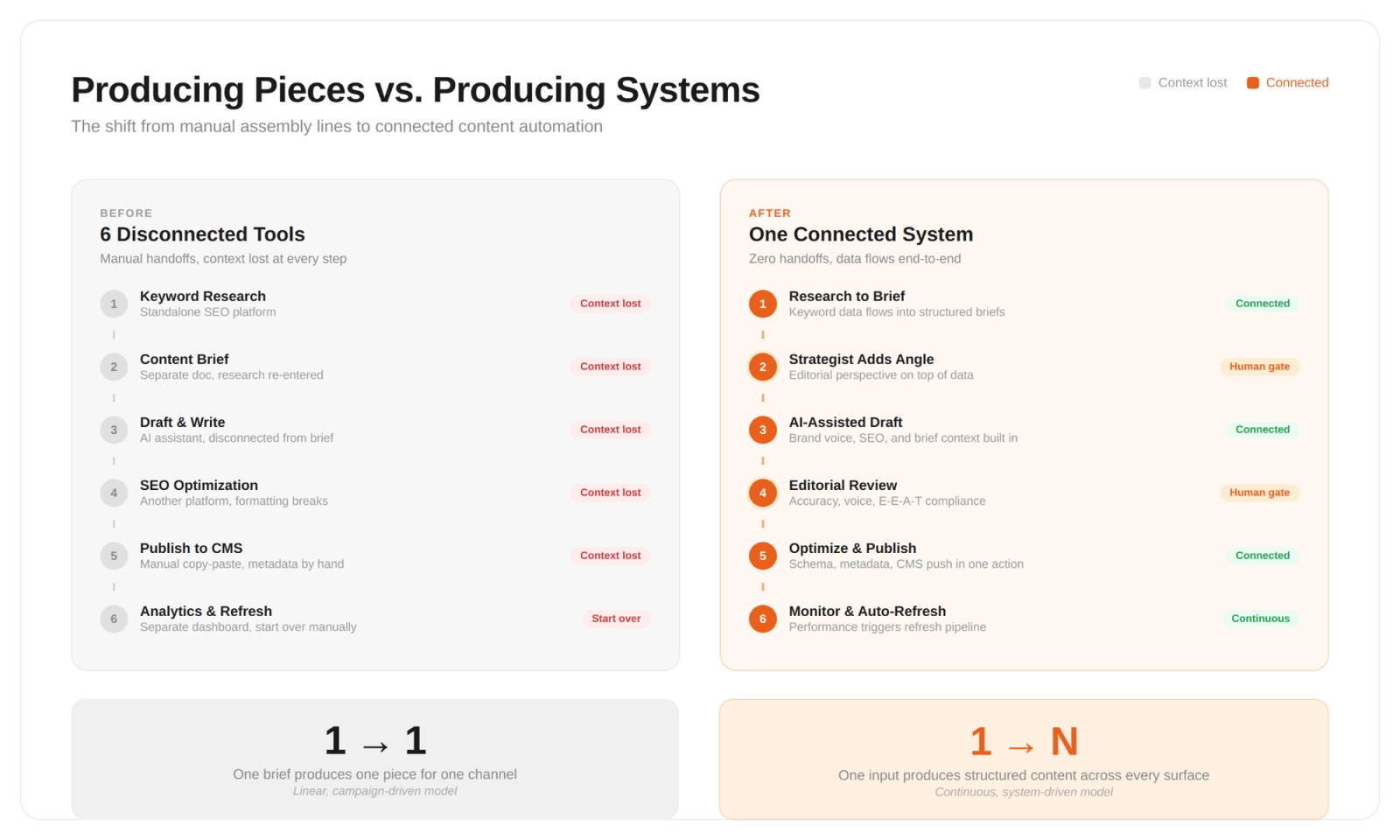
Key Takeaways
What you'll walk away with:
Automation is a systems design challenge, not a tool problem. Teams that scale build end-to-end workflows with data flows, decision points, and human-in-the-loop review gates. Not stacks of disconnected AI tools.
Start with content refresh, not net-new creation. Updating declining pages delivers faster ROI with lower risk than generating new ones from scratch.
Governance comes before volume. Brand voice enforcement, fact-checking, and editorial review gates need to be designed into pipelines from day one. Not bolted on after things break.
AI search is the frontier most teams are ignoring. Citation readiness across ChatGPT, Perplexity, and AI Overviews requires fundamentally different optimization than traditional SEO.
Measure systems, not just outputs. Content velocity, cost per published piece, quality scores, and AI citation presence, tracked together, tell the real ROI story.
What Content and SEO Automation Actually Means in 2026
Beyond “AI Writing Tools”: The Shift to Content Systems
Here's a pattern that plays out on almost every team. Someone discovers ChatGPT can write a passable blog post in four minutes. Excitement follows. Within three months, they've published 50 articles that all sound the same, rank for nothing, and slowly erode the brand voice editorial spent years building.
The problem isn't AI. It's treating automation as a point solution instead of a system.
SEO content automation in 2026 means connecting every stage of the content lifecycle into structured, repeatable workflows. Research outputs feed brief templates. Briefs trigger AI-assisted drafts with brand-specific rules. Drafts route through human review before publishing to a CMS with metadata, schema, and internal links already configured. Each stage passes context to the next. Nothing gets lost in a handoff.
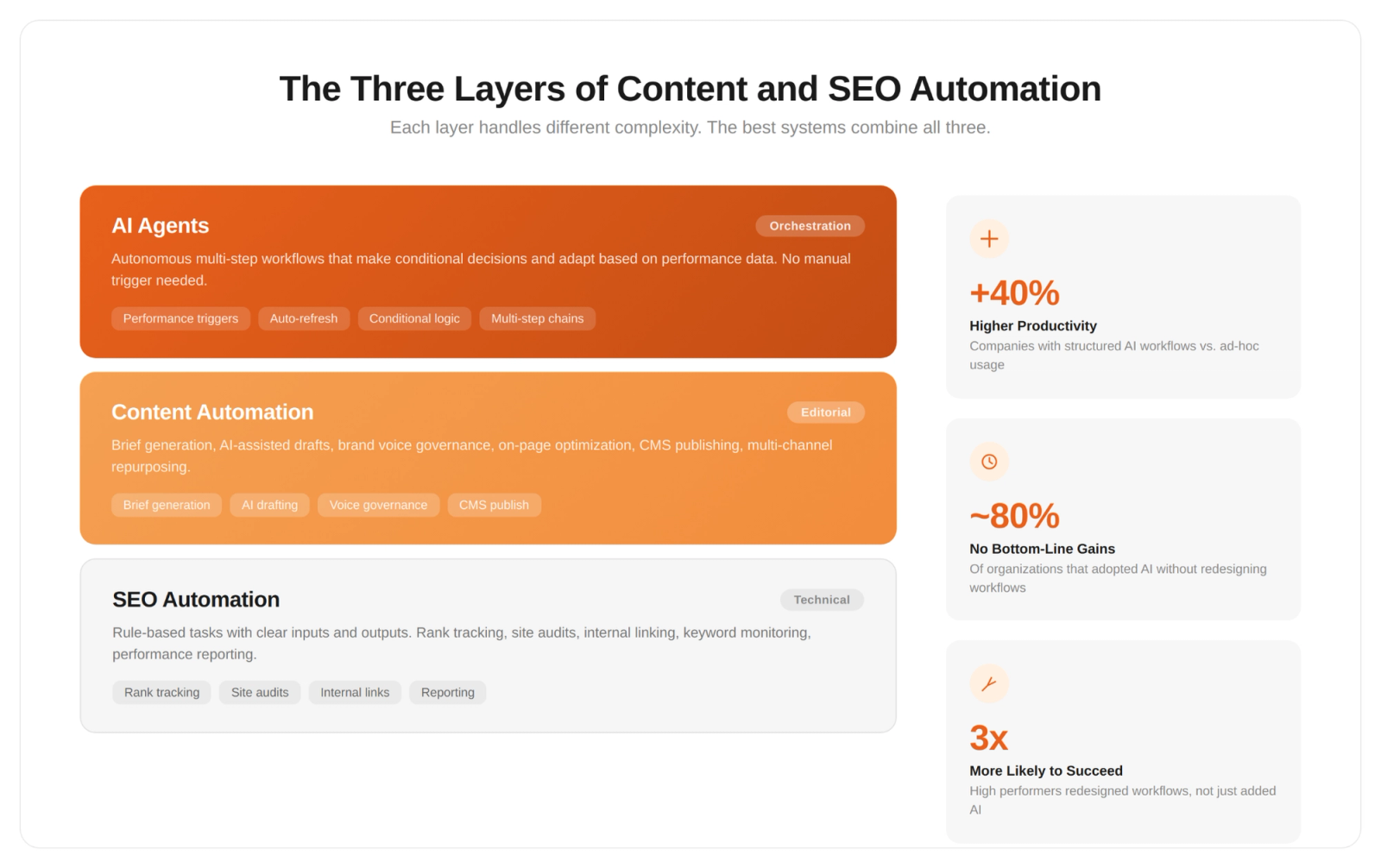
McKinsey's 2024 research found that companies integrating AI into structured workflows see 40% higher productivity than those using AI in ad-hoc fashion. Their 2025 follow-up went further: nearly eight in ten organizations reported no significant bottom-line gains from AI. The differentiator wasn't adoption. It was workflow redesign. High performers were three times more likely to have fundamentally restructured their processes, not just layered AI on top of what already existed.
Diagram: Three-layer automation stack. SEO Automation (technical) at the base, Content Automation (editorial) in the middle, AI Agents (orchestration) on top, with data flow arrows between layers.
SEO Automation vs. Content Automation vs. AI Agents: Definitions That Matter
These terms get used interchangeably. They shouldn't.
SEO automation covers the technical and analytical layer. Rank tracking, site audits, internal linking automation, keyword monitoring, performance reporting. These are rule-based tasks with clear inputs and outputs. Most teams already automate at least some of them.
Content automation addresses the editorial pipeline. Brief generation, draft creation, on-page optimization, publishing. This layer is newer and harder because it involves language, tone, and judgment.
AI agents for SEO are the emerging third layer. These are autonomous or semi-autonomous systems that execute multi-step workflows, make conditional decisions, and adapt based on data. An AI agent might monitor Search Console, detect a ranking drop, generate a refresh brief, draft updated sections, and route the result to an editor. No manual trigger needed.
The most effective AI SEO automation strategies combine all three layers, with clear boundaries around where each one operates and where human oversight steps in. Think of it as SEO marketing automation with intelligence built into every handoff, not just the output.
What You Should Automate (And What You Shouldn’t)
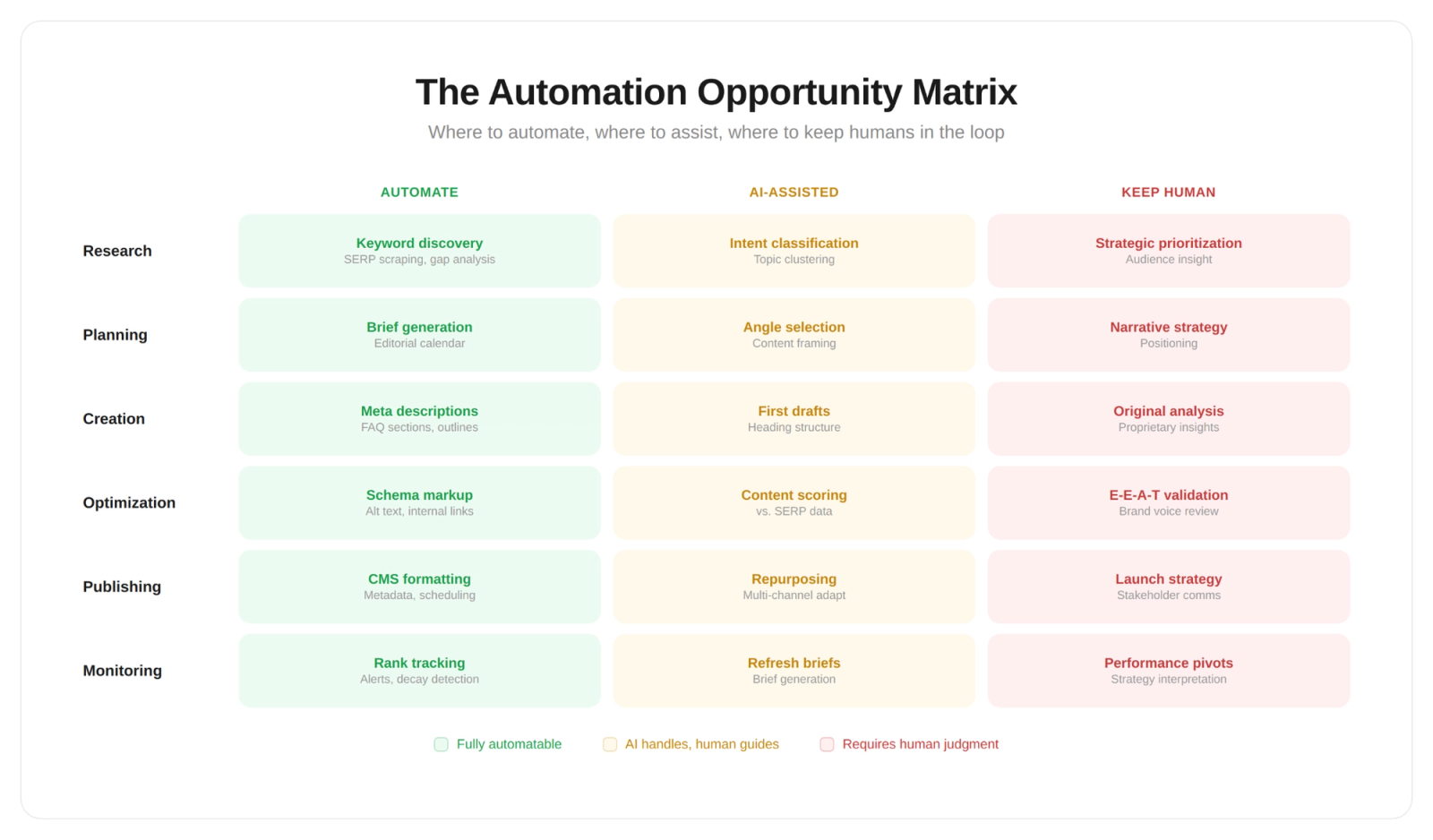
The Automation Opportunity Map
Think of your content operation as a pipeline with six stages. Each has tasks ranging from fully automatable to deeply human. The gap between "we could automate this" and "we should automate this" is where most teams trip up.
High-ROI Targets: Where to Start
Content brief generation. An SEO lead building briefs manually (pulling SERP data, analyzing competitors, identifying semantic gaps) might spend two to three hours per brief. Automated brief generation compresses that to minutes while still producing briefs with target headings, semantic terms, competitor gaps, and word count guidance. Across a 20-article monthly calendar, that's 40 to 60 hours back for strategic work.
On-page optimization at scale. Meta tags, internal linking automation, heading validation, schema insertion across hundreds of pages. Tedious when done manually, straightforward to automate. Semrush's 2025 data found 68% of businesses saw increased content marketing ROI from AI, with 65% reporting an uplift in SEO performance specifically. Those gains came from systematizing the optimization layer, not from AI writing alone.
Content refresh identification. Most teams focus automation on creating new content. But detecting declining pages and routing them into a refresh pipeline often delivers better results faster, because you're working with assets that already have proven traffic potential.
The Human Layer: What Must Stay Manual
Strategic positioning requires understanding your market and your competitors' narratives. No workflow can decide that your company should own a category. Brand voice decisions at the foundational level need human architects. Automation enforces those decisions at scale. It can't make them. E-E-A-T validation demands real domain expertise. Scaling AI content without expert review is how brands end up with hallucinated facts across hundreds of pages. And final editorial judgment (does this piece actually serve the reader?) requires taste and accountability that automation can't provide.
Common Mistake
Teams automate content creation first and governance second. This is backwards. Build your review gates, brand voice rules, and quality checks before you increase production volume. Scaling bad content faster helps nobody.
Automating Research, Strategy, and Content Planning
Manual keyword research (pulling seed terms, exporting thousands of variations, spending hours in spreadsheets grouping by topic and intent) works fine. It doesn't scale when you're managing content across dozens of product categories or market segments.
Automated keyword workflows handle the mechanical parts: pulling volume data, grouping semantically related terms into topic clusters, classifying intent from SERP features. The output is a structured dataset ready to feed content planning. Where automation still needs humans is the strategic filtering. Which clusters align with your product positioning? Which represent topics where you have genuine expertise? Which are worth pursuing given your competitive landscape?
Content briefs sit at the transition point between research and creation. An automated brief system analyzes the current SERP, identifies headings and content structures top-ranking pages use, and generates a brief with word count guidance, semantic terms, and competitive gaps. What it usually misses is the editorial angle, the specific argument that makes your content different from the ten other pages on the same topic. A strategist adds that layer.
Slate's Workflows handles this end-to-end. Teams build visual, multi-step pipelines where keyword data feeds into SERP analysis, which feeds into structured brief generation, complete with brand voice guidelines pulled from a centralized Brand Kit. The brief doesn't just carry a keyword and a rough outline. It carries competitive gaps, entity requirements, audience intent mapping, and tone rules. No manual handoffs between tools. No context lost in the process.
Content and SEO Automation: Without Losing Quality
AI-Assisted Drafting: Where It Works and Where It Fails
For content types with predictable structures (product comparisons, feature pages, glossary entries, FAQ sections) AI-assisted drafting saves real time. HubSpot's 2025 research found marketing teams using AI save 5 to 12 hours per week per marketer.
Where it consistently falls short is the work that makes content worth reading. Original analysis built on proprietary data. Nuanced arguments that take a position. The kind of thinking that comes from actual operational experience. The practical approach: use automated SEO content creation for the structural and formulaic elements. Reserve human effort for the intellectual layers. An AI draft gives your editor a starting point. Not a finished piece.
Brand Voice Governance in Automated Workflows
This is where automation breaks down quietly. The first 10 AI-generated articles might sound fine. By article 100, the content has drifted into generic prose that could belong to any company in your space.
Fixing this requires three things working together. Style guides encoded into the system (not stored in a PDF nobody reads). Knowledge bases that ground AI output in your company's specific expertise and positioning. And human-in-the-loop review gates that catch voice drift before it reaches publication.
Slate's Brand Kit & Knowledge Base encodes all three into a centralized layer that governs output across 24+ AI models. Style guides, tone rules, and company knowledge aren't separate documents. They're embedded in every workflow step, so every draft checks against them automatically.
Automating Publishing, Distribution, and Repurposing
The gap between "content approved" and "content live" eats more time than most teams realize. CMS formatting, featured images, category tagging, metadata entry, scheduling. These last-mile tasks mean approved content sits in a queue, and the velocity gains from everything upstream evaporate right at the finish line.
CMS publishing automation connects workflows directly to platforms like WordPress or Webflow. Slate's CMS integration pushes approved content from both Workflows and Power Sheets directly to the CMS, with formatting, metadata, schema, and publication settings already configured. No copy-pasting into a backend. No reformatting.
Multi-channel repurposing follows the same principle. A 3,000-word guide contains enough material for a LinkedIn post series, an email newsletter section, social media snippets, and a slide deck. Most teams know this. Few do it consistently because the manual effort of reformatting for each channel is tedious enough that it always falls off the priority list. A content strategist at a mid-market SaaS company can build a single Slate Workflow that takes a published blog post and outputs a LinkedIn carousel draft, three email sections, and an executive summary. Same source document, same Brand Kit governing the voice, six different outputs.
Content Refresh Automation: The Highest-ROI Use Case Most Teams Ignore
Here's a pattern that plays out on almost every content-led site. A page ranks well for six months. Traffic starts declining. Nobody notices until it's off page one. By then, competitors have published fresher versions and recovery requires more effort than maintenance would have.
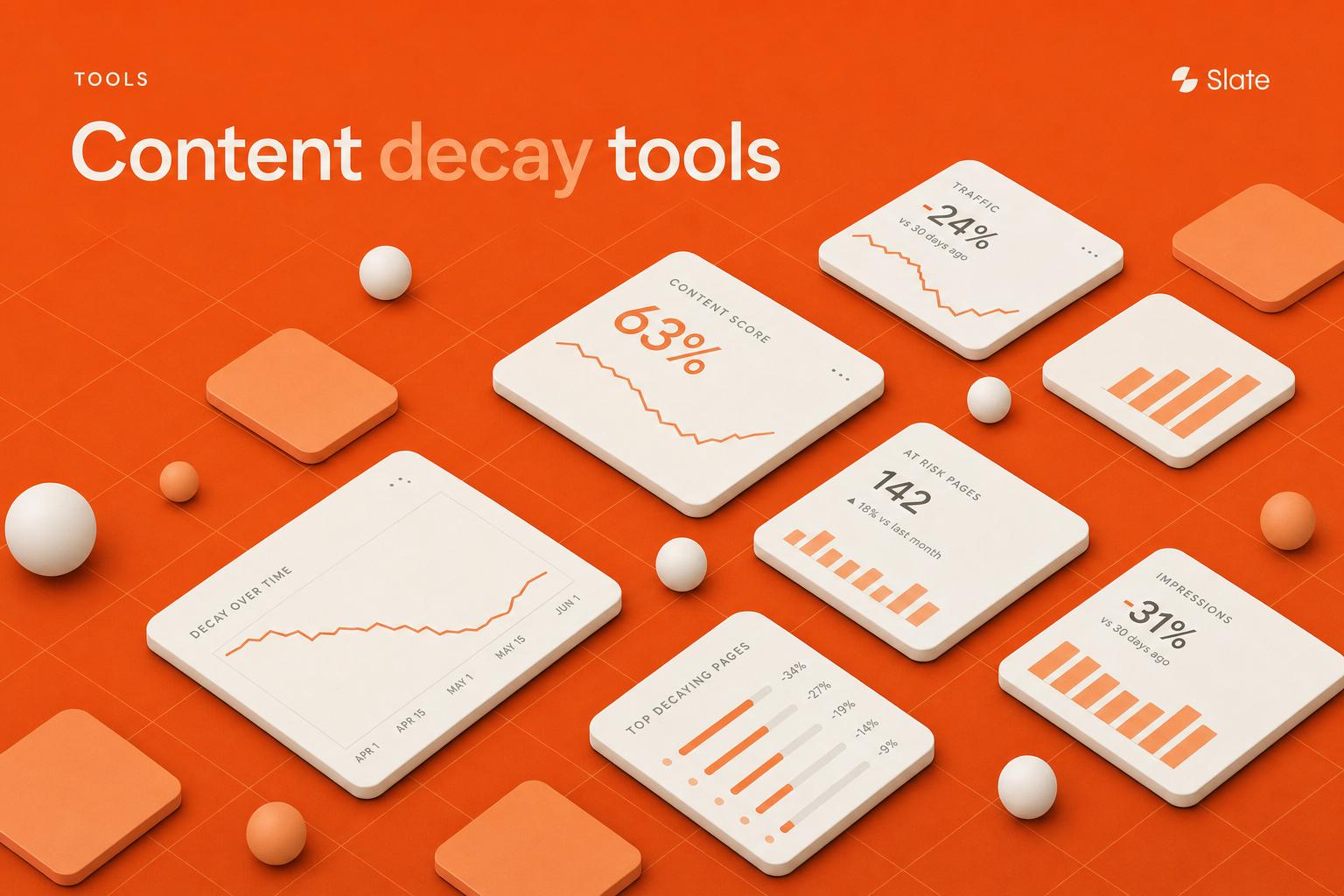
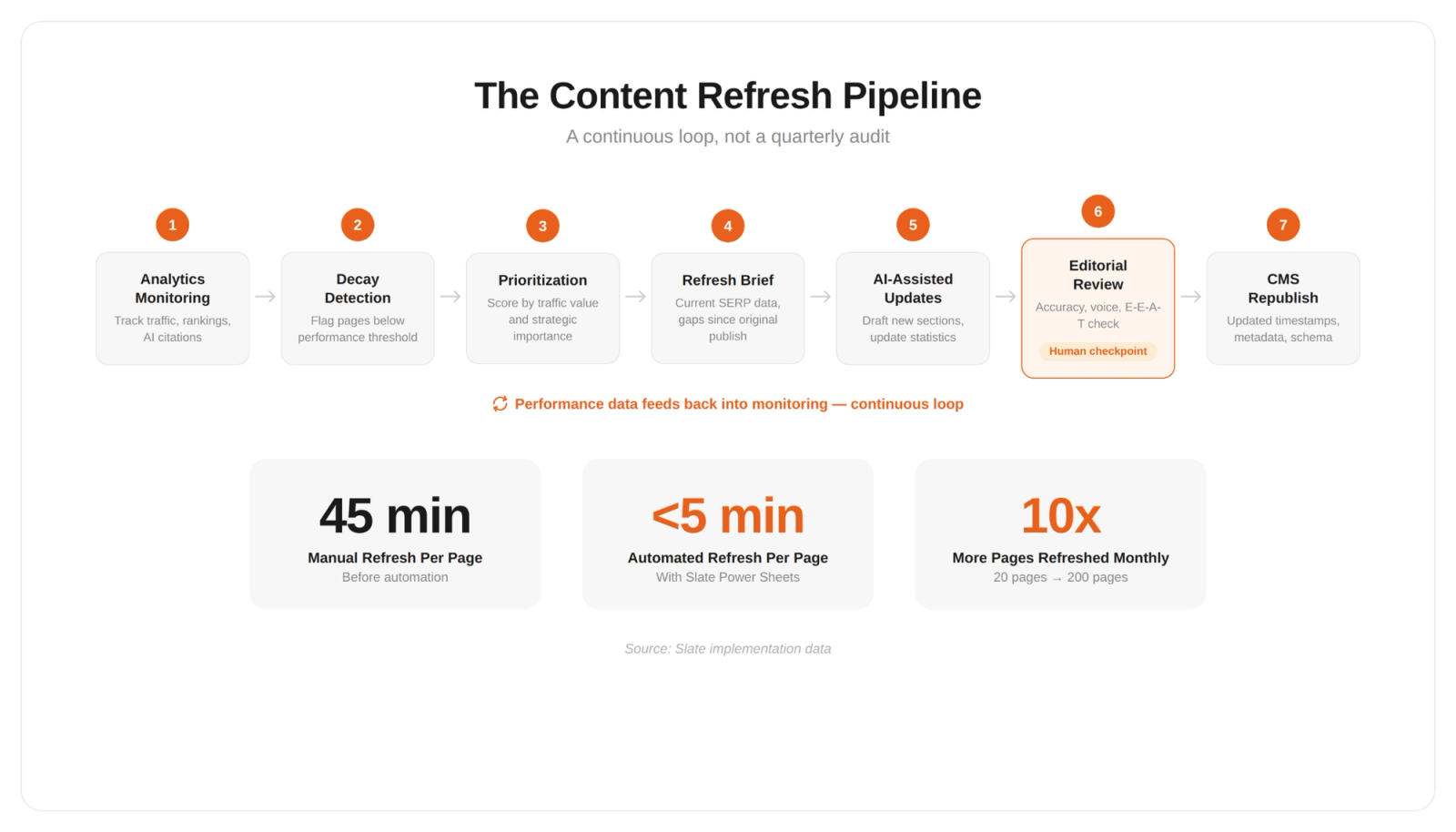
Content refresh automation starts with detection. Automated systems monitor analytics, flag pages where traffic or rankings decline beyond a set threshold, and surface them in a prioritized queue. The triggers are customizable: a 20% traffic drop over 30 days, a ranking decline of five or more positions, or a page that hasn't been updated in 12 months. Then a complete pipeline connects identification to brief generation, AI-assisted updates, editorial review, and republishing. A continuous loop, not a quarterly audit.
This is where Slate's Power Sheets becomes essential. Power Sheets provides a spreadsheet interface for running bulk content refreshes, programmatic content creation, and optimization audits across thousands of URLs simultaneously. Teams import their content library, set performance-based filters, trigger AI workflows for refresh briefs and updated drafts, embed quality gates before anything publishes, and push approved updates directly to the CMS. Slate's own implementation data shows refresh cycles that previously took 45 minutes per page compressed to under five. At scale, that's the difference between refreshing 20 pages a month and refreshing 200.
Quick-Start Recommendation
If you’re building your first automated workflow, start here. Content refresh automation has the best risk-to-reward ratio. Slate’s Content Refresh solution page walks through how this pipeline works in practice.
Preparing Automated Content for AI Search Visibility
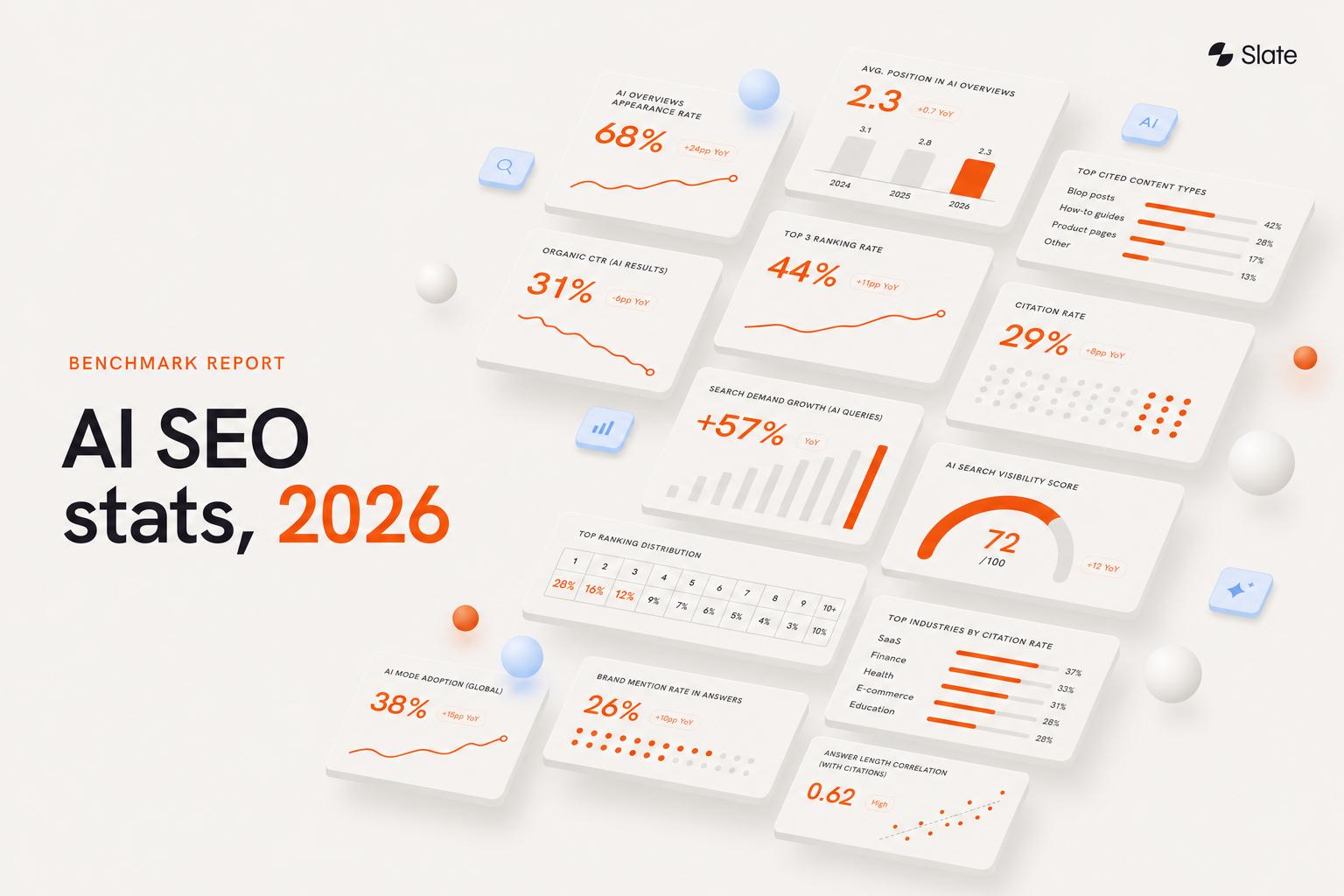
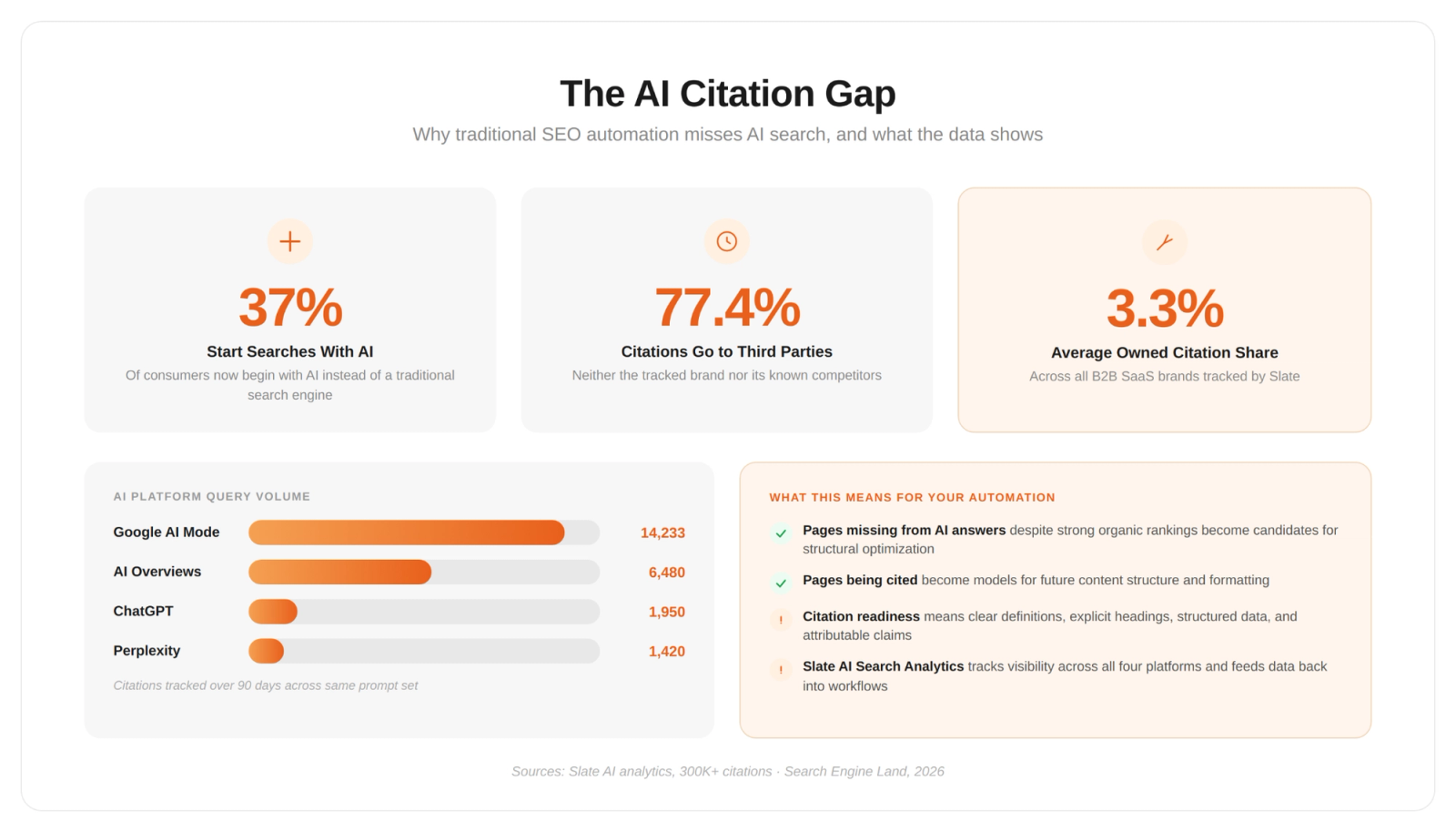
Most SEO automation was built for a world where Google's organic results were the only discovery channel. That world is expanding fast. As of early 2026, 37% of consumers start searches with AI instead of a traditional search engine. ChatGPT processes 250 to 500 million queries weekly. Google AI Overviews reach 1.5 billion monthly users. These aren't fringe behaviors.
Content that ranks organically may never appear in an AI-generated answer if it isn't structured for extraction and citation. Citation readiness means clear, direct definitions that answer questions without making readers (or machines) parse through paragraphs of context. Explicit section headings that map to common queries. Structured data that helps AI systems understand the content's scope. Attributable claims with sources AI can verify. Building these into automated workflows means adjusting brief templates, draft guidelines, and optimization rules to prioritize extractability alongside traditional SEO signals.
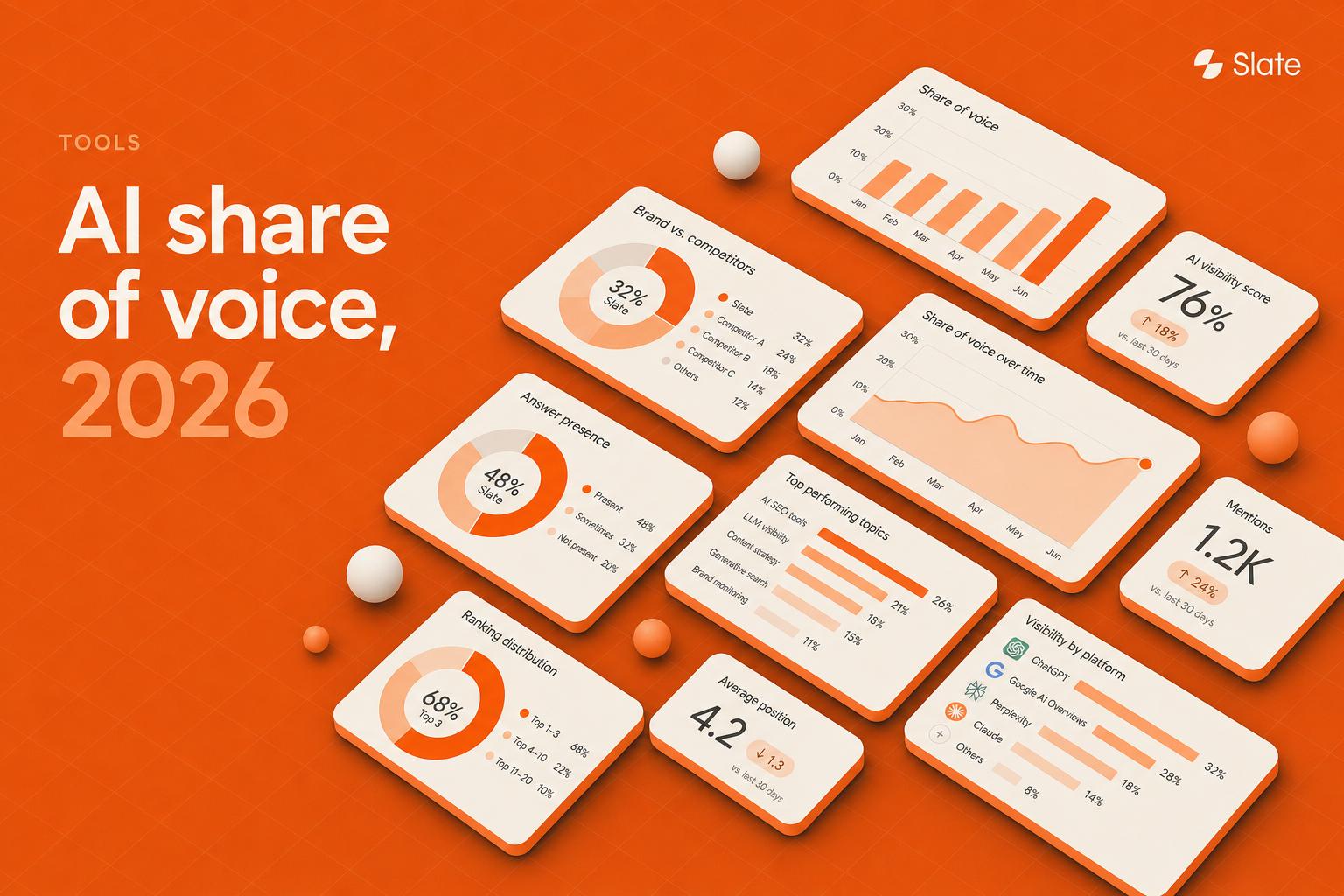
Slate's AI Search Analytics tracks brand visibility across ChatGPT, Google AI Mode, Google AI Overviews, and Perplexity. Slate's research across 300K+ AI citations found that 77.4% of all citations went to domains that were neither the tracked brand nor its known competitors. The average owned citation share was 3.3%. That data feeds directly back into the automation system. Pages not appearing in AI answers despite strong organic rankings become candidates for structural optimization. Pages being cited become models for future content.
Quality Governance and Risk Management at Scale
Speed without quality control is how brands publish hundreds of pages that damage their reputation faster than they build it. CMI's 2026 insights report captured this well: the biggest wins from AI adoption have been in productivity and speed, but when it comes to deeper measures like content quality and performance, the numbers drop. Speed without governance produces volume, not value.
Every automated pipeline needs editorial review gates. These are defined points where humans evaluate output before it advances. High-stakes content (YMYL topics, product claims, competitive comparisons) needs review at the brief, draft, and pre-publication stages. Lower-risk content (glossary updates, meta refreshes) might need only sampling-based review.
AI content hallucinates. It invents statistics, fabricates quotes, presents plausible-sounding claims with no basis in reality. At scale, without systematic fact-checking, hallucinated claims spread across dozens of published pages before anyone notices. Governance frameworks need explicit checks: cross-referencing claims against verified knowledge bases, flagging statistics for manual verification, and preventing AI from generating assertions in areas your team can't independently verify.
Automated cannibalization detection adds another layer. When you increase content production volume, the risk of publishing multiple pages targeting the same queries rises sharply. Two pages competing for the same keyword split your authority and often result in neither ranking well. Cannibalization checks compare new content against existing site architecture before publication and flag overlaps.
Industry Differences Matter
Ecommerce teams need programmatic SEO at massive scale (product descriptions, category pages) but can operate with lighter editorial oversight. Publishers need velocity and freshness, with maximum fact-checking rigor. B2B SaaS teams need depth and original analysis. Regulated industries (financial services, healthcare, legal) need mandatory compliance review gates and audit trails for every published piece. Design your governance to match your content risk profile, not a generic template.
Architecture Blueprints: How Real Workflows Look
Example: B2B SaaS Content Engine
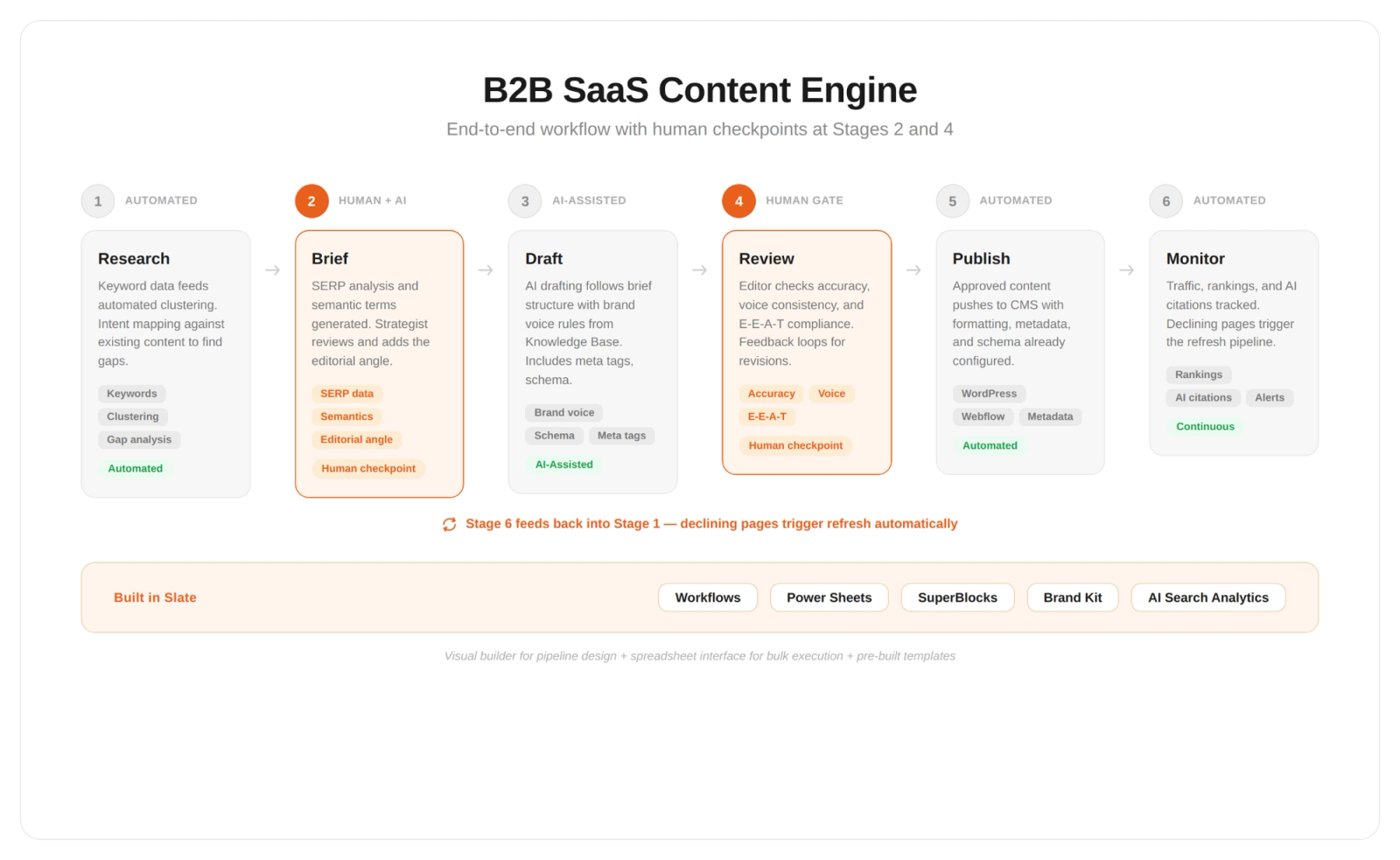
Stage 1, Research. Keyword data feeds automated clustering. Clusters get classified by intent and mapped against existing content to find gaps. A prioritized calendar generates based on traffic potential and strategic alignment.
Stage 2, Brief. Automated briefs generate using SERP analysis, competitor mapping, and semantic term identification. A strategist reviews and adds the editorial angle.
Stage 3, Draft. AI-assisted drafting follows the brief's structure with brand voice rules from the centralized knowledge base. Drafts include suggested meta tags, schema, and internal links.
Stage 4, Review. The draft routes to an editor. Accuracy, voice, E-E-A-T compliance all get checked. Feedback loops back for revisions.
Stage 5, Publish. Approved content pushes to the CMS with formatting, metadata, and schema already configured.
Stage 6, Monitor. Traffic, rankings, and AI citations tracked. Declining pages trigger the refresh pipeline automatically.
In Slate, this entire pipeline is built visually in Workflows and executed at scale through Power Sheets. SuperBlocks (pre-built workflow components and templates) give teams a starting point so they're not building from scratch.
Maturity Stages: From Partial Content and SEO Automation to Adaptive Systems
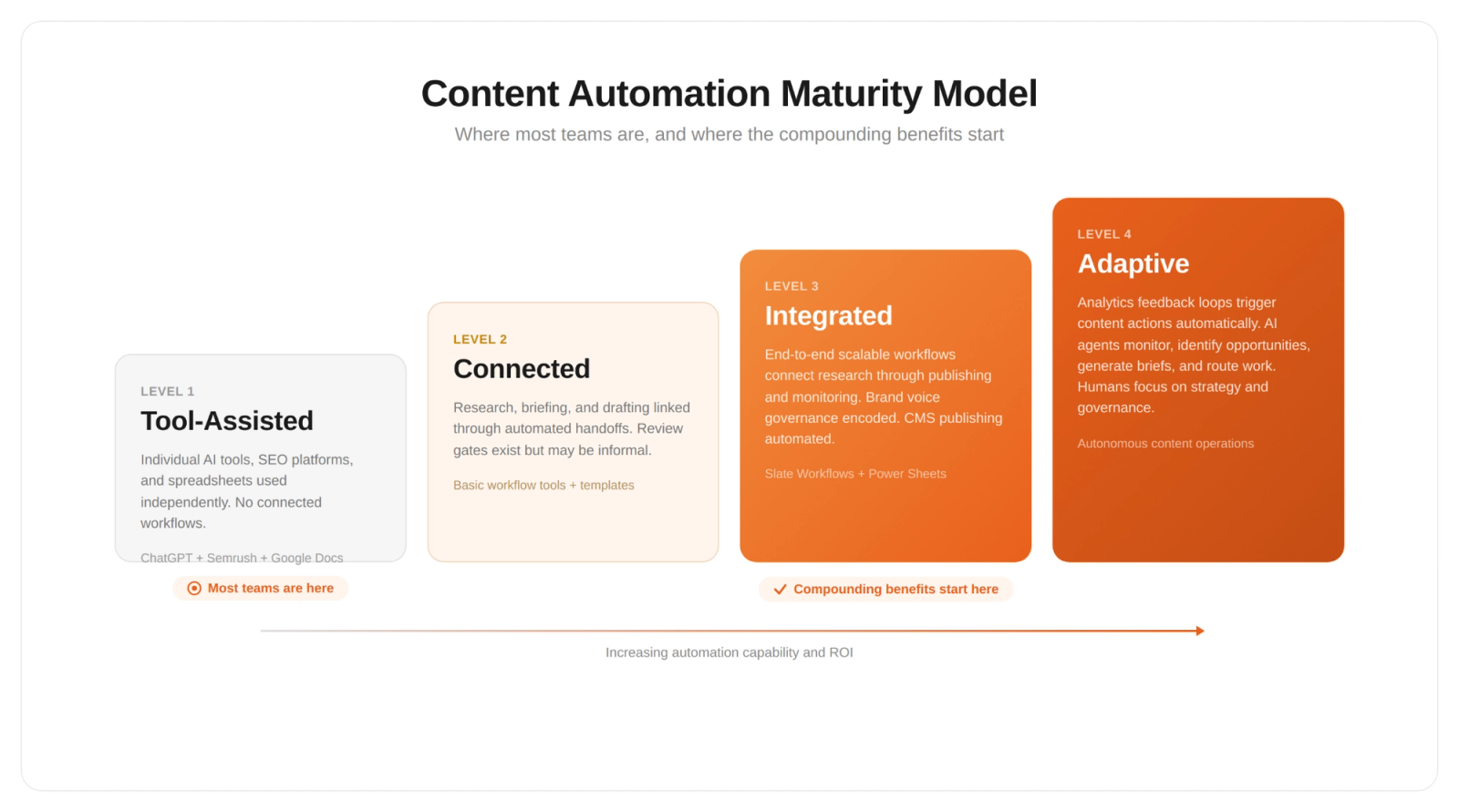
Level 1: Tool-Assisted. Individual team members use AI tools, SEO platforms, and spreadsheets independently. No connected workflows. Most teams are here.
Level 2: Connected Workflows. Research, briefing, and drafting link through automated handoffs. Review gates exist but may be informal.
Level 3: Integrated Systems. End-to-end scalable workflows connect research through publishing and monitoring. Brand voice governance is encoded. CMS publishing is automated. Refresh pipelines run continuously.
Level 4: Adaptive Systems. Analytics feedback loops trigger content actions automatically. AI agents monitor, identify opportunities, generate briefs, and route work with minimal manual intervention. Humans focus on strategy and governance.
The jump from Level 1 to Level 3 is where the compounding benefits become real. Content automation for SEO at this stage compounds over time: modular pieces get reassembled for new channels, refreshed content retains and builds authority, structured data improves AI retrieval with every cycle. Content and SEO workflow automation isn't a one-time migration. It's an ongoing content operations discipline. Platforms like Slate are built to operate at exactly this level.
How to Introduce Automation to Your Team
Automation changes roles, not headcount. Writers who used to spend 70% of their time on research and structural drafting shift toward editing, adding original insights, and ensuring voice consistency. Editors who managed formatting and publication logistics become workflow designers, defining the rules and review gates that govern automated systems.
This shift works when the team is involved in designing it. Writers and editors know where the bottlenecks are. They know which tasks are genuinely creative and which are mechanical. Their input makes the system better. Their involvement makes adoption smoother. For non-technical marketers, start simple. Run a meta description refresh across 50 pages through Power Sheets. Let people see the time savings before introducing more complex multi-step pipelines.
SOPs document how each workflow stage operates, what triggers it, and what the expected output looks like. Prompt libraries standardize AI instructions so output stays consistent regardless of who triggers it. Rule sheets define guardrails: word counts, required sections, forbidden claims, brand voice parameters.
Measuring What Matters
Only 19% of marketers track AI-specific KPIs. That means most teams can't demonstrate the value of automation they've already built. Proving ROI requires tracking across both efficiency and effectiveness.
A team that doubles publishing velocity while halving content quality hasn't improved. Track the full picture.
How Slate Approaches Content and SEO Automation
The problems described throughout this guide (disconnected tools, missing governance, no AI search visibility, manual refresh processes, context lost between handoffs) are the specific challenges Slate was built to solve.
Slate is an AI search optimization and content engineering platform that connects insight to action in one system. Workflows is the visual builder for multi-step automation, connecting 24+ AI models, conditional logic, web scraping, and CMS publishing into pipelines teams design once and run repeatedly. Power Sheets gives teams the spreadsheet interface for bulk execution across thousands of URLs. AI Search Analytics tracks visibility across ChatGPT, Google AI Mode, AI Overviews, and Perplexity. SuperBlocks provides pre-built templates. And through MCP integration with Claude, teams can work with their marketing data conversationally without leaving the platform.
What used to be a six-tool, manual-handoff process becomes one system that runs continuously. Slate starts at $199/month.
Conclusion: Systems Beat Hacks, and Humans Still Matter
Automating content and SEO isn't about replacing your team with AI. It's about building systems that let your team operate at a level that manual workflows structurally cannot support.
The teams that get this right treat automation as a design problem. They build workflows with clear data flows. They encode brand voice into every step. They design review gates that catch errors before they scale. They track performance across both traditional search and AI discovery.
Start with content refresh pipelines. Build governance before volume. Involve your editorial team. Measure systems, not just outputs.
And if you're ready to build this, book a demo with Slate.
FAQs
What is content and SEO automation?
Content and SEO automation uses AI tools, workflow platforms, and rule-based systems to streamline repetitive tasks across the content lifecycle—from keyword research and brief generation to on-page optimization, publishing, and performance monitoring. It replaces manual work while keeping strategic decisions and editorial judgment human-led.
What parts of SEO can be automated?
Keyword research and clustering, technical audits, rank tracking, internal link suggestions, meta tag generation, content brief creation, performance reporting, and content refresh identification are strong candidates. Strategic prioritization, E-E-A-T validation, brand voice decisions, and final editorial judgment should remain human-led.
Will automated content hurt my Google rankings?
Google’s stated position is that content quality and helpfulness matter more than production method. Poorly governed automation producing thin or inaccurate content creates risk. Well-structured automation with editorial oversight and quality governance does not inherently harm rankings.
How do I maintain brand voice with AI content creation?
Brand voice governance requires style guides encoded into AI prompts, knowledge bases grounding output in your company’s expertise, and editorial review gates catching drift before publication. These need to be built into the workflow, not applied after.
What is the difference between SEO automation and AI content writing?
SEO automation covers the full lifecycle—audits, research, monitoring, optimization, reporting. AI content writing is one component. The market is shifting toward integrated systems connecting writing with the broader workflow.
How do I measure the ROI of content and SEO automation?
Track velocity (time from keyword to page), cost (per piece and per refresh), quality (revision rate, accuracy), and performance (organic traffic, rankings, AI citation presence). Comparing before and after implementation gives the clearest ROI picture.
What tools do I need to automate SEO content workflows?
Core categories: workflow orchestration, SEO suites, AI writing assistants, and CMS integrations. Integrated platforms reduce tool sprawl. Slate’s guide to the best AI SEO tools (slatehq.com/blog/best-ai-seo-tools) covers the landscape.
How does content automation work for AI search visibility?
Content structured for AI visibility prioritizes citation readiness: clear definitions, explicit headings, structured data, and attributable claims. Tracking visibility across AI platforms provides feedback to refine your approach.
What are the biggest risks of SEO content automation?
Content cannibalization, factual errors at scale, brand voice drift, duplicate content, and compliance issues in regulated industries. Governance systems with review gates, fact-checking, and cannibalization detection mitigate these.
How do I get my team to adopt automation workflows?
Start with high-ROI, low-risk automations like content refresh or meta tags. Involve editors in workflow design. Build SOPs collaboratively, measure transparently, and frame automation as removing tedious work—not replacing creative roles.