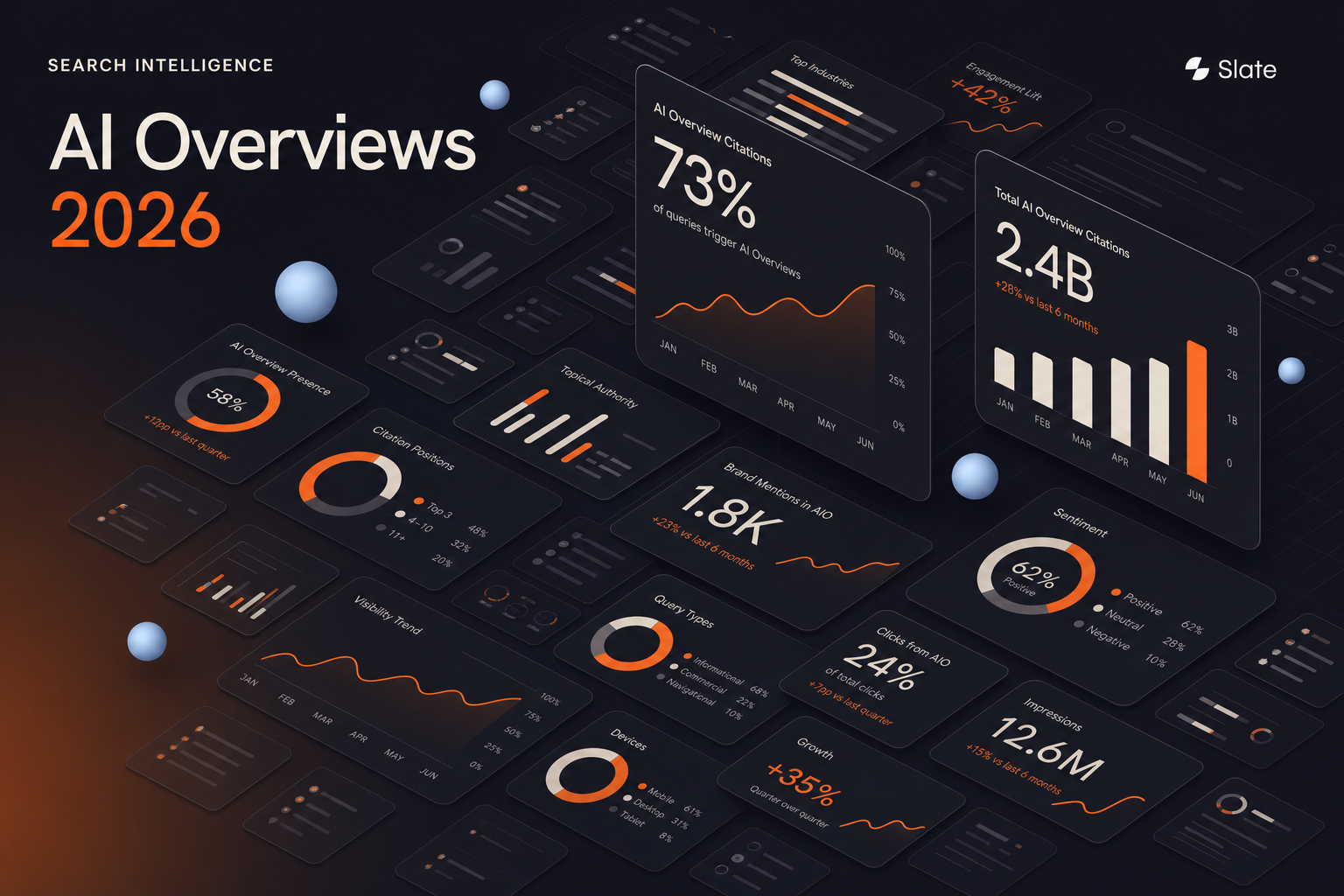
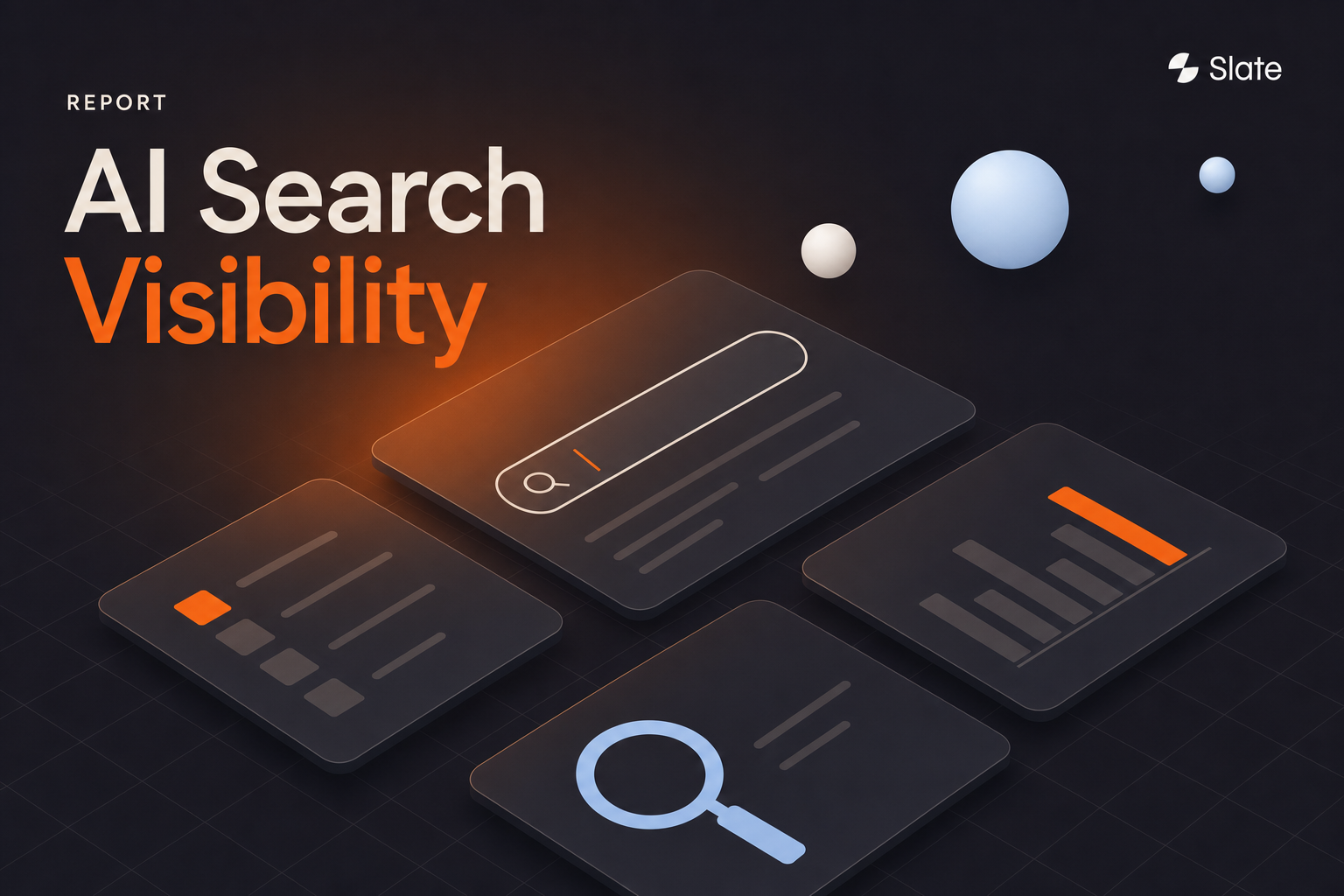
What 1,000 B2B SaaS queries reveal about how Google's AI Overviews choose sources: why top-10 ranking is the entry fee, why your exact page gets cited only a third of the time, where overviews fade as buyers near a purchase, and a protocol you can run on your own category in a month.
Ask Google "best CRM software" and an AI Overview answers before the blue links do, naming a handful of sources and moving on. We wanted to know where it pulls those sources from, because the answer decides how much of your existing SEO still applies.
We ran 1,000 B2B SaaS queries through Google and logged every source each AI Overview cited. The common story is that AI search is a brand-new channel, but the data says it runs mostly on the SEO you already do. Ranking gets you into the room; it does not hand you the microphone.
Key Takeaways
- Ranking is the entry fees: In 944 of 1,000 queries (94.4%), a page in the organic top 10 was cited in the AI Overview. Off page one, you are almost always absent.
- Being in the box is not owning it: Only 30% of citations are the exact page that ranks. Two-thirds come from outside the top 10, from video, forums, and editorial.
- Position decides the quote: Among exact-page citations, the #1 result was cited 490 times against 40 for #10, about 12 to 1.
- Overviews fade at the point of purchase: They fired on 97.9% of queries, but of the 21 that did not, 18 were bottom-funnel, mostly branded-pricing searches.
- YouTube and Reddit dominate, in opposite ways: YouTube was cited 318 times while ranking only 12; Reddit was cited 292 times and ranked for 174.
- Google is an SEO game; Claude is not: In our companion study, Claude recommended brands 8,989 times and cited a source zero times. Play both surfaces, and score them apart.
How We Ran the Study
We assembled 1,000 B2B SaaS search queries across 40 software categories, from CRM and payroll to security, analytics, e-signature, and ERP. We balanced them evenly across three funnel stages, searched every one in Google, and recorded what the AI Overview did.
The study setup:
- Queries: 1,000 total, balanced across 333 awareness (TOFU), 333 consideration (MOFU), and 334 decision (BOFU) queries. Mostly non-branded category queries, with a deliberate set of "vs," "alternatives," and pricing queries included.
- Conditions: United States, desktop, logged-out and incognito, google.com. A single snapshot per query, run under identical conditions.
- Capture method: We ran the study on Slate, reading each search results page and its AI Overview directly. For every query, Slate logged whether an AI Overview appeared, every source it cited, and whether each cited URL and domain also ranked in the organic top 10. All figures come from observed SERPs.
- Result: 979 of 1,000 queries returned an AI Overview, citing 9.6 sources on average.
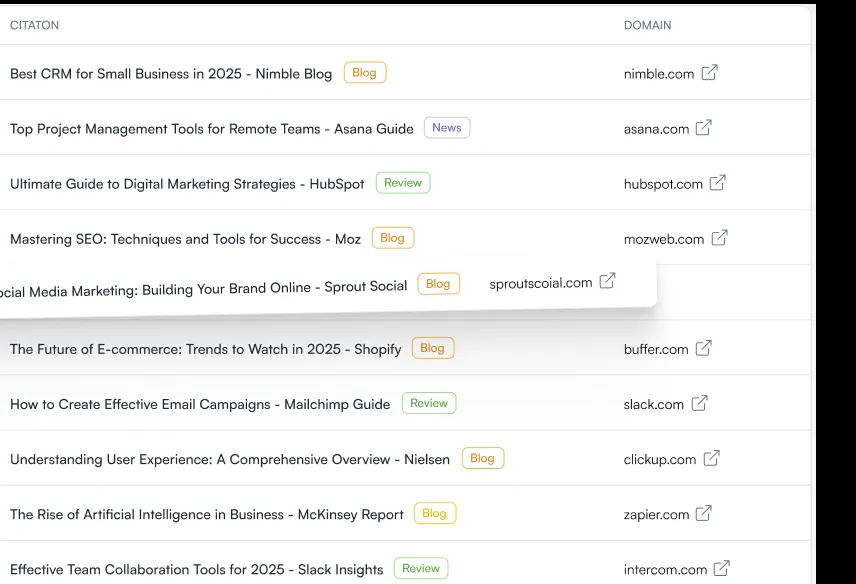
Slate tags every cited source against the organic top 10, which is the classification behind every number in this report.
Two questions organize everything that follows, and it helps to name them up front:
- AI Overview Presence: Whether at least one page from a top-10 ranking domain shows up as a source in the overview. The "are you in the box at all" question.
- AI Overview Share: Of all the sources an overview cites, the fraction that come from top-10 ranking pages. The "how much of the box is yours" question.
Presence and Share move independently, and the space between them is most of the story. Three narrower terms also carry through:
- AIO trigger rate: The share of queries that returned any AI Overview.
- URL-level vs domain-level overlap: URL-level asks whether the exact page that ranks in the top 10 is the page cited. Domain-level asks the looser question of whether the cited site appears in the top 10 at all, even via a different page.
- Match depth: For a given overview, whether all, some, or none of its sources come from the organic top 10.
For scale, that trigger rate sits well above the market. Independent trackers put AI Overviews on 60% of U.S. searches by late 2025, with B2B technology queries among the fastest-growing segments.
Inside B2B SaaS the overview is close to universal now, a pattern our AI SEO statistics hub tracks over time.
Rank in the Top 10 and You Are in the AI Overview
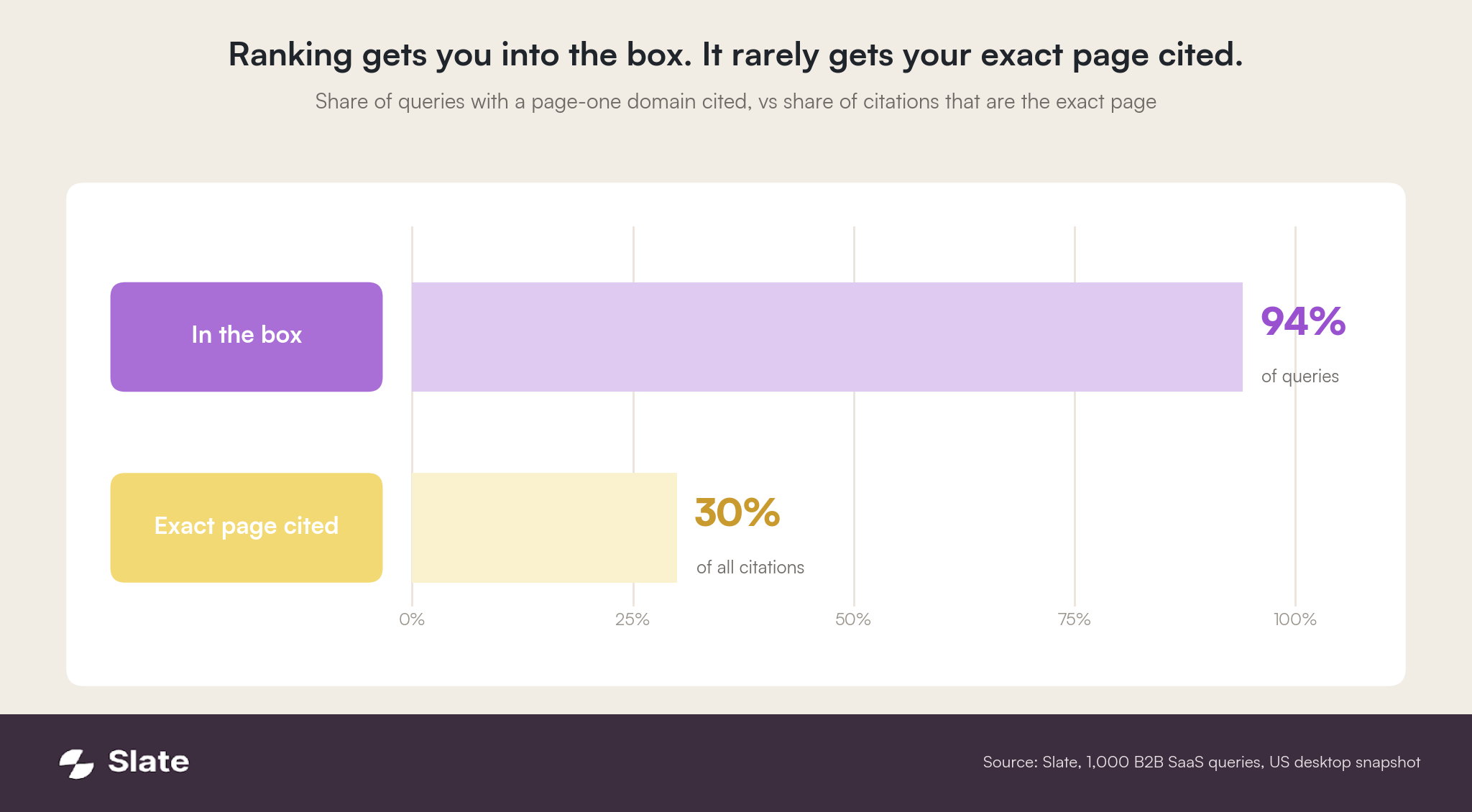
For a B2B query, ranking in the organic top 10 almost guarantees you appear: a top-10 domain was cited in 94.4% of our 1,000 queries. When you rank on page one, you turn up as a source in that overview nearly every time.
It barely moves as the buyer's intent changes, running 97.3% on awareness queries, 97.0% on consideration, and 88.6% on decision queries. Even at the bottom of the funnel, where overviews are scarcest, a ranking domain still gets cited close to nine times in ten.
There is no side entrance. Off page one you are mostly absent from that query's overview, so any AI search analytics baseline has to start with where you already rank.
Being cited at all, though, is a much easier bar than being the page that gets quoted, which is the next thing the numbers pull apart.
The AI Overview Pulls Two-Thirds of Its Sources From Outside the Top 10
Appearing is common, but owning the box is rare: your exact page is the cited source only about 30% of the time. The average overview cites 9.6 sources, and only about three of them rank on page one.
That leaves most of the box to other kinds of content, which is where generative engine optimization lives.
Broken down by source, 30% of citations are the exact ranking page and 4% are another page on a ranking domain. The other 66% come from outside the top 10 entirely.
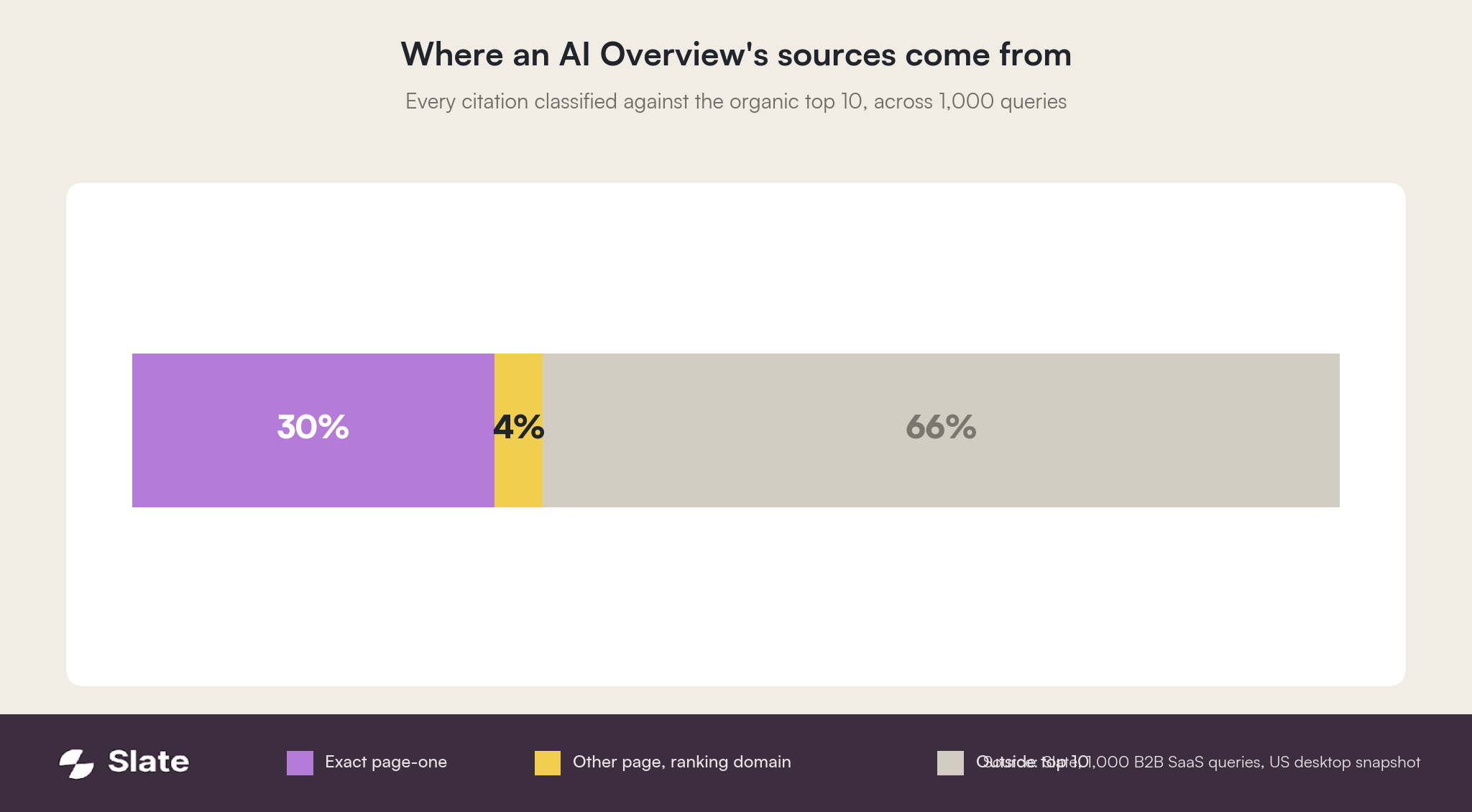
Nearly every overview blends the two. Only 5.3% are built purely from top-10 results and 2.3% skip page one completely, which leaves 92.3% mixing ranking pages with sources from beyond them. Most also lean light on page one, drawing only a quarter to a half of their sources from it.
Ranking, then, protects your presence but hands the rest of the box to video, community threads, and deeper editorial. Owning more of it means competing there too, through content engineering as much as page-one position.
And even among your own ranking pages, the overview is far from even-handed about which one it picks.
Higher Rankings Decide Which of Your Pages Gets Cited
Which page it picks depends heavily on rank. Being on page one barely changes whether you appear, since presence is near-universal, but where you sit on it changes which URL gets quoted.
Among exact-page citations, the #1 result was quoted 490 times against just 40 for #10, a spread of roughly twelve to one.
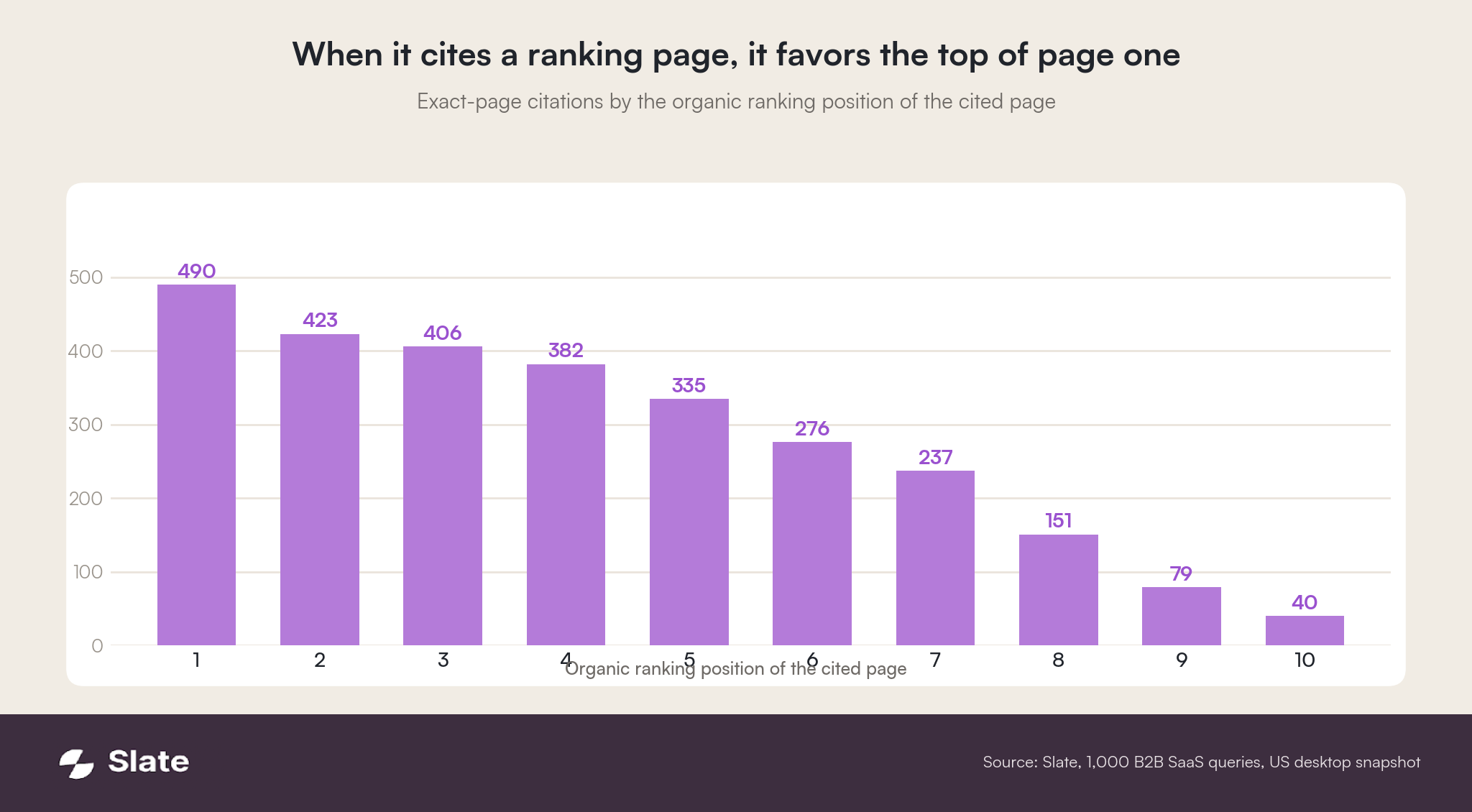
So the two questions pull in different directions. Presence is close to binary, since you either rank on page one or you are mostly absent, while the quote is graded and leans on the top three.
Moving from #6 to #2 will not change whether you can appear, and it does change your odds of being the page Google reads out. Presence holds up almost everywhere, with one exception, and it lands exactly where the money is.
AI Overviews Appear on Almost Everything Until the Buyer Is Ready to Pay
That exception shows up as the buyer gets close to paying. Overviews fired on 97.9% of the queries we ran, so the interesting part is the thin band where they go quiet.
Of the 21 queries with no overview at all, 18 sat at the bottom of the funnel, most of them branded-pricing searches like "[brand] pricing."
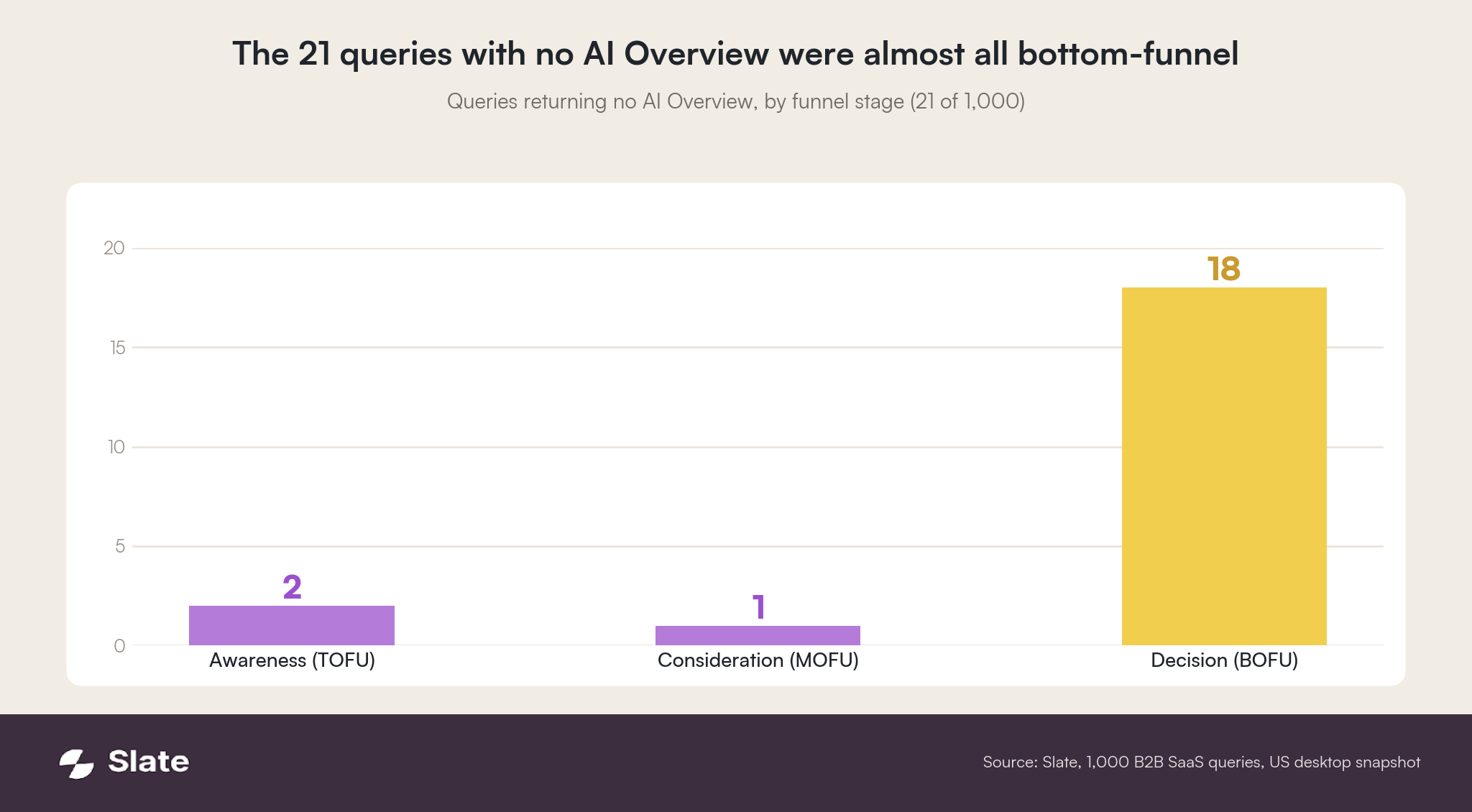
When someone is that close to a purchase, Google tends to route them straight to the results instead of summarizing.
The same drift shows up inside the overviews that do fire. Trigger stays near total across the funnel, while exact-URL overlap slides from 42% on awareness questions to 35% on decision questions. Early research leans on page one; buying-stage questions reach wider.
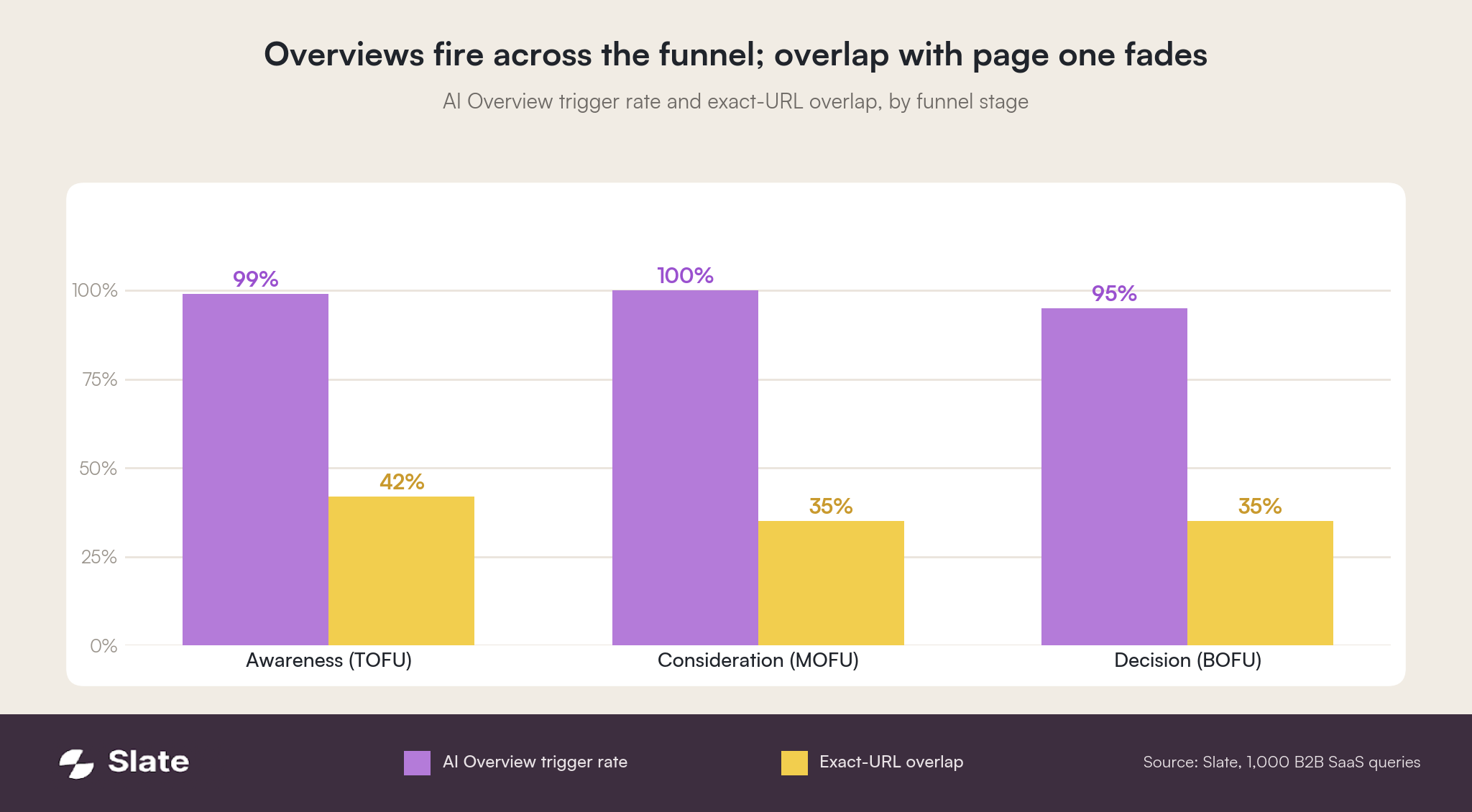
For content teams, the opportunity sits at the top of the funnel, on awareness and consideration, where the box almost always appears and ranking counts most. That band is where Slate's programmatic SEO work tends to sit.
Down at the branded-pricing bottom, where the citation often is not there to win, those pages are better tuned for the click. And when the overview does reach past page one, it reaches for two sources far more than any others, neither of them a software vendor.
YouTube and Reddit Win AI Overviews Two Completely Different Ways
Those two sources are YouTube and Reddit, and they reach the box by opposite routes.
YouTube was cited 318 times but ranked in the top 10 just 12 of them, so Google pulls in video even when it ranks far from the top. Reddit was cited 292 times and ranked for 174, earning its place the old way, by ranking.
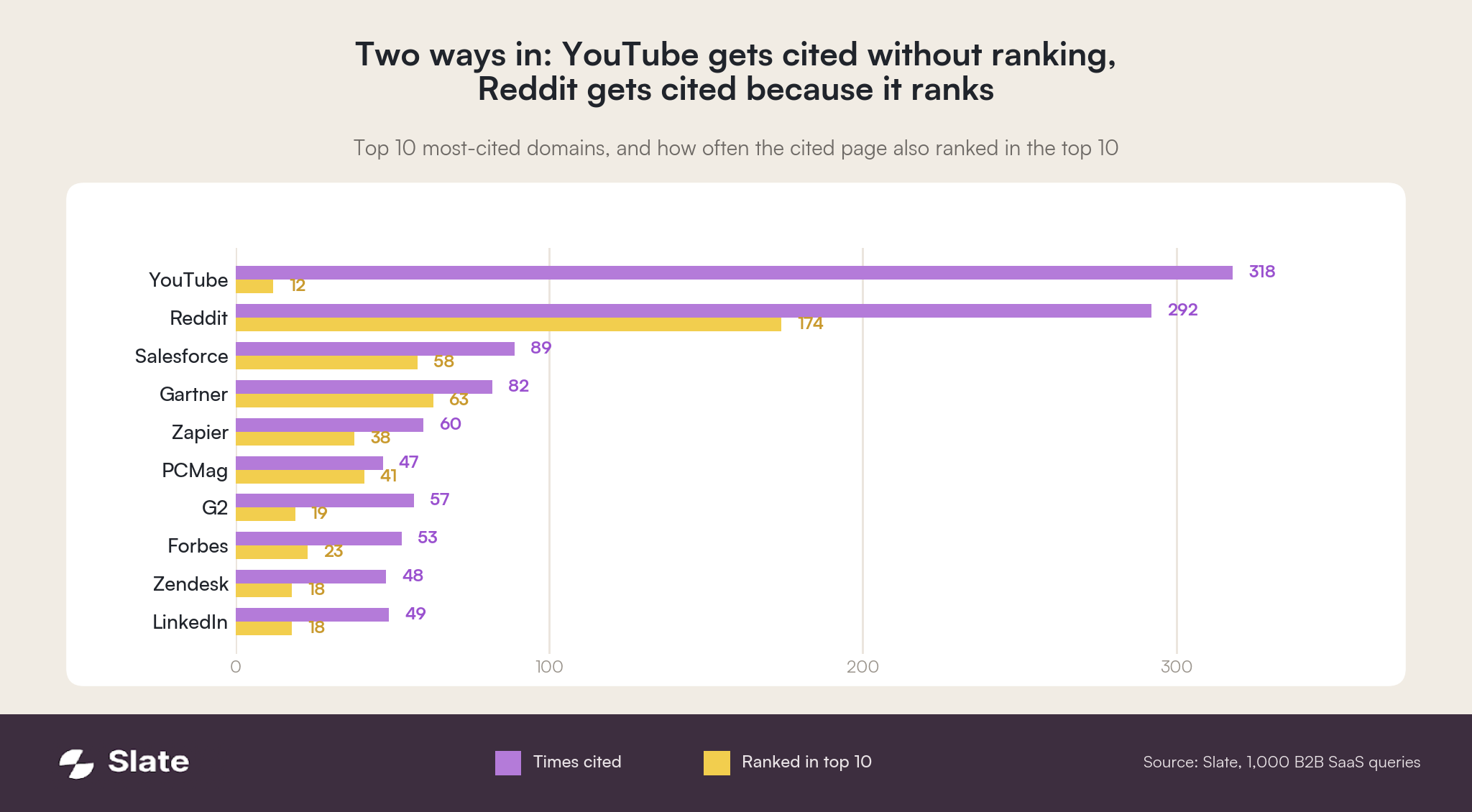
Here are the most-cited domains across the study, with how often the cited page was also ranking in the top 10:
The takeaway for a content program is that stopping at your own pages leaves the whole video and forum surface to whoever else turns up there. The brands cited most often live across YouTube, Reddit, and third-party editorial, well beyond their own rankings.
Semrush's AI Overviews study saw the same pull toward community and third-party sources. If those figures read higher than others you have seen, it is worth pausing on why, because the studies are not all measuring the same thing.
How These Numbers Compare to Other AI Overview Studies
The gap comes down to definitions. BrightEdge tracked citation overlap with organic rankings climbing 32% to 54% over 16 months. Originality.AI put 52% of the citations that sit inside organic results in the top 10, and Ahrefs landed near 38% of all citations.
Our figures fit inside that range once you separate the two questions those studies fold together. Presence asks whether any page you rank shows up at all, and in our data that happens 94.4% of the time.
Share asks how much of the box is yours. At the citation level, top-10 domains hold 34%, split between 30% exact URLs and 4% other pages, which lands close to the Ahrefs figure.
Two outside results line up with ours. BrightEdge finds the lowest overlap in transactional categories like e-commerce, where Google keeps buying queries out of the overview. That is the same suppression we saw at the bottom of the funnel.
Zyppy's review of citation factors ranks organic search position among the strongest, the lever this whole study keeps returning to. That leaves one question that changes what you do next: what do these numbers look like in your own category?
How to Run This Study on Your Own Category
None of this has to stay our numbers. The method behind the report carries over to any category, and a small team can run it in about a week. Before you start, the baseline from our 1,000 queries gives you something to hold your own results against.
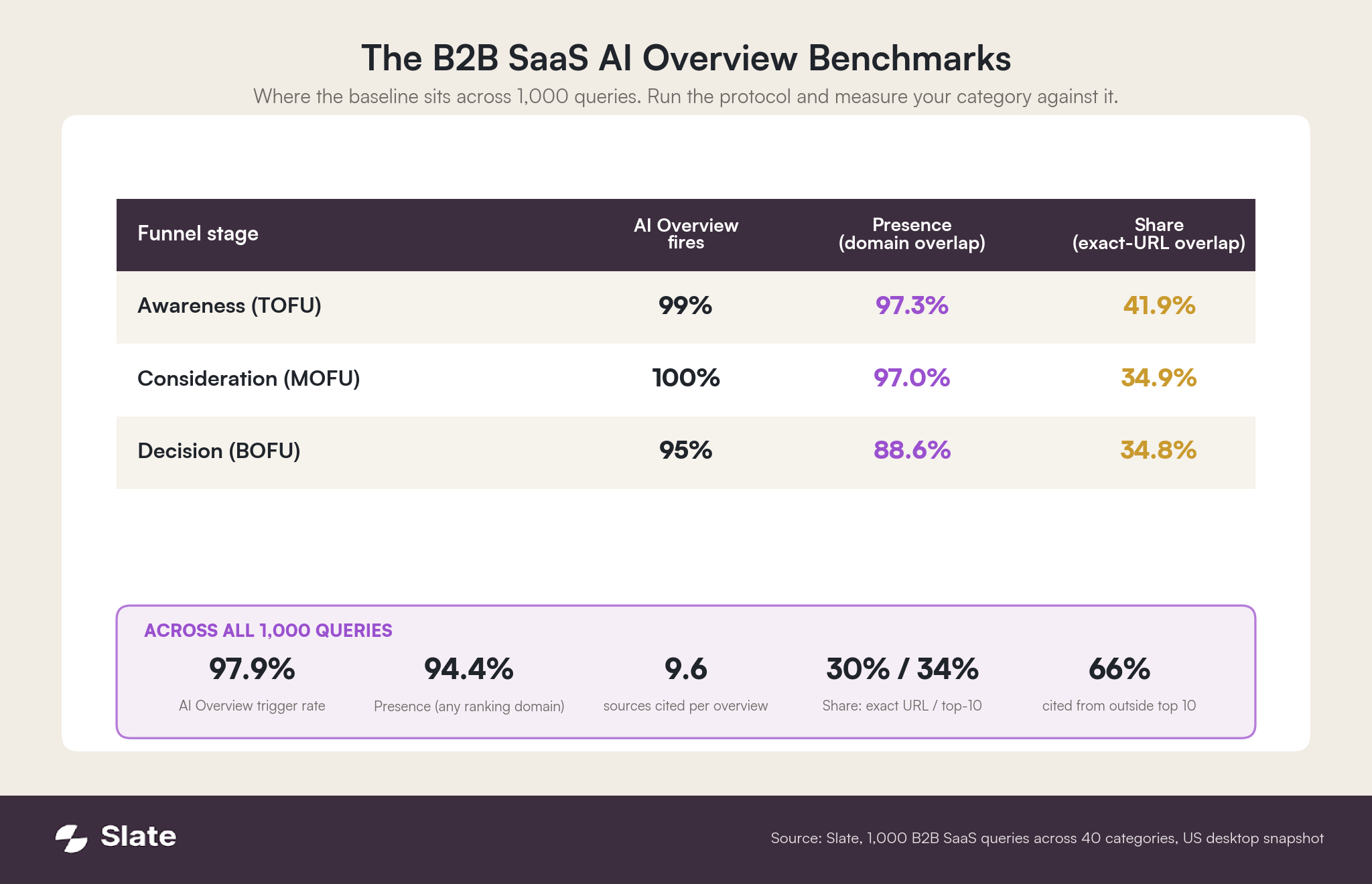
B2B SaaS AI Overview benchmark scorecard: trigger rate, Presence, and Share by funnel stage, with across-all-query totals
Build a Balanced Query Set
Pull 60 to 100 live queries and split them across awareness, consideration, and decision intent. Use the phrasings buyers use: "best [category] tools," "[category] comparison," "alternatives to [leader]," and "[category] pricing."
Search Each One and Capture the AI Overview
Under fixed conditions (one location, one device, logged-out), record whether an AI Overview appeared and every source it cited.
Tag Each Citation Against Your Top 10
For every cited source, mark whether it is the exact ranking URL, a different page on a ranking domain, or a page from outside the top 10. That single tag is what separates true overlap from the illusion of it.
Compute Four Numbers Per Funnel Stage
Track trigger rate, domain-level overlap, exact-URL overlap, and average sources per overview, then compare across stages. The movement between awareness and decision is usually where the story lives.
Run It Once for a Diagnostic, Quarterly for a Baseline
Run it once and it is a diagnostic. Run it quarterly and it turns into an AI visibility baseline, the gap between guessing where you stand and knowing it.
Slate MCP can automate the capture and tagging, so the quarterly run takes minutes.
What to Do With This: Plays for SEO, Marketing, and Leadership
Turned into practice, the data points to five plays.
Treat Page-One Ranking as the Entry Fee
Ranking domains are cited 94% of the time, so if a priority query has you off page one, AI Overview visibility for it is closed until you rank. Go after the queries where you sit at positions 4 to 15 and within reach of the top.
Push for the Top of Page One on Your Highest-Intent Queries
Presence is near-binary, but the quote favors positions 1 to 3 by a wide margin. On the queries that carry the most commercial weight, the climb from #6 to #2 decides whether you are the page Google reads out.
Invest in the Off-SERP Surface
Two-thirds of citations come from outside the top 10, much of it video and community threads. A presence on YouTube and Reddit, and in high-authority third-party content, competes for the part of the box that ranking alone cannot reach.
Tune Bottom-Funnel Pages for the Click
Branded and pricing queries are where overviews thin out or disappear. Spend that effort on conversion and on owning the organic result instead of chasing a citation that often is not there.
For Leadership: Add AI Overview Share to Reporting
Track Presence and Share, along with trigger rate, for your brand and your three closest competitors every quarter. Search Engine Land's data shows how fast coverage moves, so a single snapshot ages quickly.
Slate keeps this view for exactly that: your visibility score and average position tracked over time, against the competitors you name.
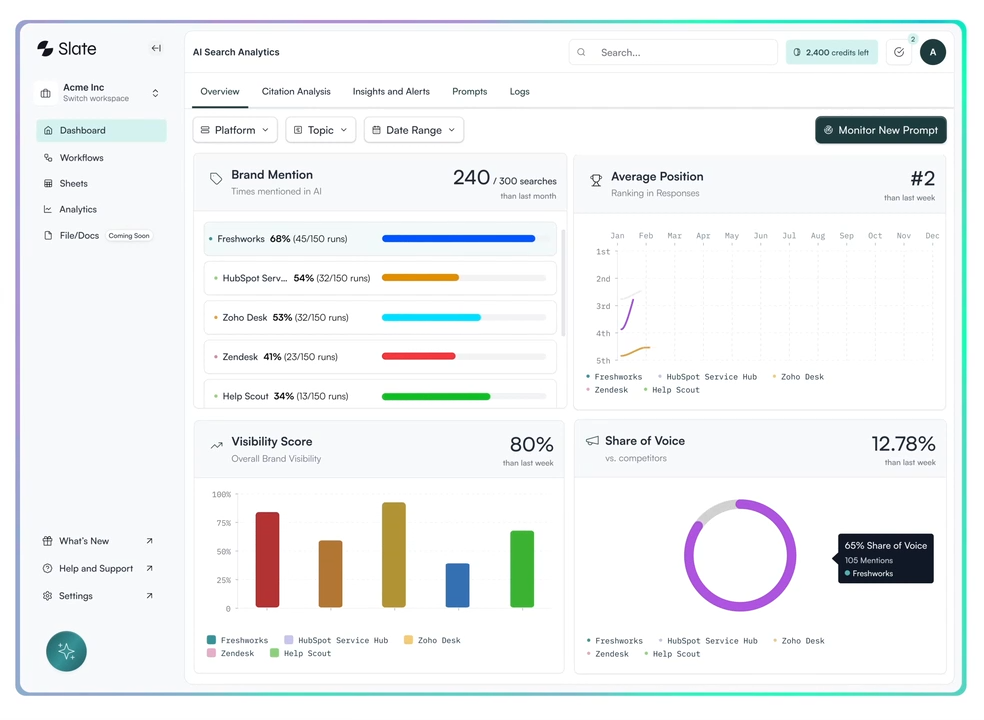
The teams building this baseline in 2026 will hold the advantage as it becomes standard practice, and Slate's roundup of AI citation tracking tools covers the wider market.
Two Surfaces, Two Playbooks
Which brings us back to the assumption we started with. Google's AI Overview turned out to be less a new channel than the search results you already compete in, with a summary laid on top. Ranking on page one still puts you in the box 94% of the time.
The honest caveat is that other two-thirds. Most of what the overview quotes comes from beyond page one, and your exact page is the source only about a third of the time.
So presence is the price of entry, while share is the slower game, won across video, community, and editorial as much as your own rankings.
Near the point of purchase, the overview steps back and sometimes leaves the stage entirely.
Set beside the Claude study, that contrast is the thing to plan around. Inside a chat model, brand memory builds slowly and SEO does little, while Google's overview still runs on where you rank. Most teams will need to play both, and keep score on them separately.
That is what we built Slate to do, tracking presence, citations, and sentiment across Google AI Overviews, AI Mode, Chat GPT, Perplexity, Gemini, and Claude. If you would rather get the wider picture first, our guide to AI search analytics tools is a good place to begin.
When you want this run against your own category and your three closest rivals, book a demo with Slate. We will load your queries and walk the distribution with you.
Frequently Asked Questions
What was tested in this AI Overview study?
We searched 1,000 B2B SaaS queries across 40 software categories in Google, balanced across awareness, consideration, and decision intent. For each query we recorded whether an AI Overview appeared, every source it cited, and whether each cited URL and domain also ranked in the organic top 10. Searches were run in the US, on desktop, logged-out, and captured live with Claude’s Chrome extension.
Do you have to rank in the top 10 to appear in an AI Overview?
In practice, for B2B queries, largely yes. In 94.4% of queries a top-10 domain was cited, and pages outside page one are far less likely to be the source. Ranking on page one is the most reliable path into the AI Overview - it is the entry fee.
If I rank, is my exact page the one that gets cited?
Often not. Only about 30% of all citations were the exact ranking URL, and another small share were a different page on a ranking domain. Two-thirds of citations came from outside the top 10 entirely. Ranking gets your domain considered; it does not guarantee your specific page is quoted.
Does ranking position still matter?
Yes, for which page gets cited. Among exact-page citations, the #1 result was cited roughly twelve times more often than the #10 result. Position barely changes whether you can appear, but it strongly influences whether you are the page chosen.
Why did some queries not show an AI Overview?
Only 21 of 1,000 had no overview, and 18 of those were bottom-funnel buying queries - mostly branded-pricing searches. AI Overviews appear on nearly all awareness and consideration queries and thin out at the transactional bottom of the funnel.
Why are YouTube and Reddit cited so often?
They were the two most-cited sources. YouTube is pulled into overviews even when it does not rank (cited 318 times, ranked 12). Reddit mostly earns its place by ranking (cited 292 times, ranked 174). Together they show that AI Overview visibility extends well beyond your own ranking pages.
How is this different from optimizing for Claude or ChatGPT?
Chat models like Claude generate recommendations from training data and, in our companion study, cited nothing - so on-page SEO did little. Google’s AI Overviews retrieve and cite live pages, and ranking is the dominant lever. The two require different strategies, which is why we measure them separately.
Are these numbers fixed?
No. AI Overviews are personalized and change by location, device, session, and over time as Google updates the feature. These figures are a single US-desktop snapshot and should be read as directional and comparative - most reliable for comparing funnel stages within this dataset - rather than as universal constants.