Discovery has moved off the search results page. Buyers now form opinions inside ChatGPT, Perplexity, Gemini, Google AI Overviews, Bing Copilot, and Claude long before they click anything on your site. The best AI share of voice tools track how often your brand appears in AI-generated answers compared with competitors across a defined prompt set, and the strongest options pair that measurement with a content action layer so visibility gaps actually get fixed.
This guide compares nine tools, explains how the metric works, and maps each option to a buyer profile so you can shortlist quickly.
Key Takeaways
- AI share of voice measures how often your brand appears in AI-generated answers versus competitors across a defined set of prompts and platforms.
- Slate leads for B2B SaaS teams that want measurement plus execution in one system, not a reporting dashboard bolted onto a separate writing tool.
- Monitoring-only tools tell you where you stand. End-to-end platforms close the gap between insight and published content.
- Citation and source attribution tracking are usually more actionable than raw mention counts. In TrustRadius's 2025 B2B buying disconnect study, 90% of buyers who saw Google AI Overviews clicked at least one cited source.
- Category pricing ranges from free graders (HubSpot) to self-serve plans starting around $29/month (Otterly.AI, Ahrefs) up to custom enterprise pricing (Conductor, Profound).
- For B2B SaaS teams, prioritize tools that combine prompt tracking, competitor benchmarking, and a practical path to content action.
What Is AI Share of Voice?
AI share of voice measures how often your brand appears in AI-generated answers compared with competitors across a defined set of prompts, topics, or queries, tracked across platforms like ChatGPT, Perplexity, Gemini, Google AI Overviews, Bing Copilot, and Claude. It is a directional metric, not an absolute one, because AI responses vary between sessions and platforms.
What it actually measures:
- Mentions: how often your brand name appears in answers
- Citations: how often your content is referenced as a source
- Source attribution: how often your URL is linked
- Sentiment: how your brand is described
- Prompt-level coverage: which queries surface you, which surface competitors
- Competitor benchmarking: your relative share against named alternatives
It matters in 2026 because discovery is multi-surface. Buyers research inside synthesized answers, and traditional rank tracking does not capture whether your content was used to generate those answers.
How AI Share of Voice Differs From Traditional SEO Share of Voice
The methodological shift matters. Keywords assume a stable index. Prompts assume a generated answer that may differ across sessions, which is why AI share of voice tools rely on repeated sampling and aggregated trend data rather than a single snapshot.
Why AI Share of Voice Matters in 2026
The old SEO playbook assumed buyers would reach your site through a ranked link. That assumption is breaking. In TrustRadius's 2025 study of 2,548 respondents (2,058 B2B technology buyers and 490 vendors), 72% of buyers reported encountering Google's AI Overviews during software research, and 90% of those buyers clicked at least one cited source inside the summary.
Seven percent of buyers were already using LLMs like ChatGPT directly as part of their buying research.
That changes what marketing teams need to measure. If a competitor gets cited in an answer to "best [your category] tools" and you do not, you have lost the impression before the click ever existed. Traditional rank tracking will miss this entirely.
AI share of voice tools, including AI visibility tracking tools designed for this surface, exist to make that invisible loss visible.
The practical implication: you need a metric that captures presence inside synthesized answers, not just presence on a SERP. And you need a system to act on what that metric shows.
How We Evaluated the Best AI Share of Voice Tools
The shortlist below was evaluated against criteria that matter to B2B SaaS teams operationalizing AI search, not to lightweight experimenters.
- Platforms tracked - Coverage across ChatGPT, Perplexity, Gemini, Google AI Overviews, Bing Copilot, and Claude.
- Prompt-level vs topic-level tracking - Whether the tool tracks individual prompts and rolls them into topic and entity-level visibility.
- Mentions vs citations vs source attribution - Whether the tool distinguishes brand name appearance from content being referenced or linked.
- Competitor benchmarking - Whether you can name competitors and see relative share over time.
- Update cadence - How often prompts are re-run and how recent the data is.
- Action layer - Whether the tool only reports or also helps you create, refresh, and publish content in response.
- Workflow and integrations - CMS publishing, governance, and integrations with your existing stack.
- Pricing transparency - Public pricing versus sales-gated.
- Fit for B2B SaaS teams - Whether the tool is built for a 20-500 employee SaaS operating model.
Best AI Share of Voice Tools Comparison Table
A quick comparison of the nine tools covered in this guide. Use it as a shortlisting reference before reading the deeper writeups.
The Best AI Share of Voice Tools in 2026
The shortlist below is ordered by fit for B2B SaaS teams adopting AI search as an operating model. Each entry includes who it serves best, how it measures visibility, and what to watch for.
1. Slate - Best Overall for B2B SaaS Teams That Need Measurement Plus Execution
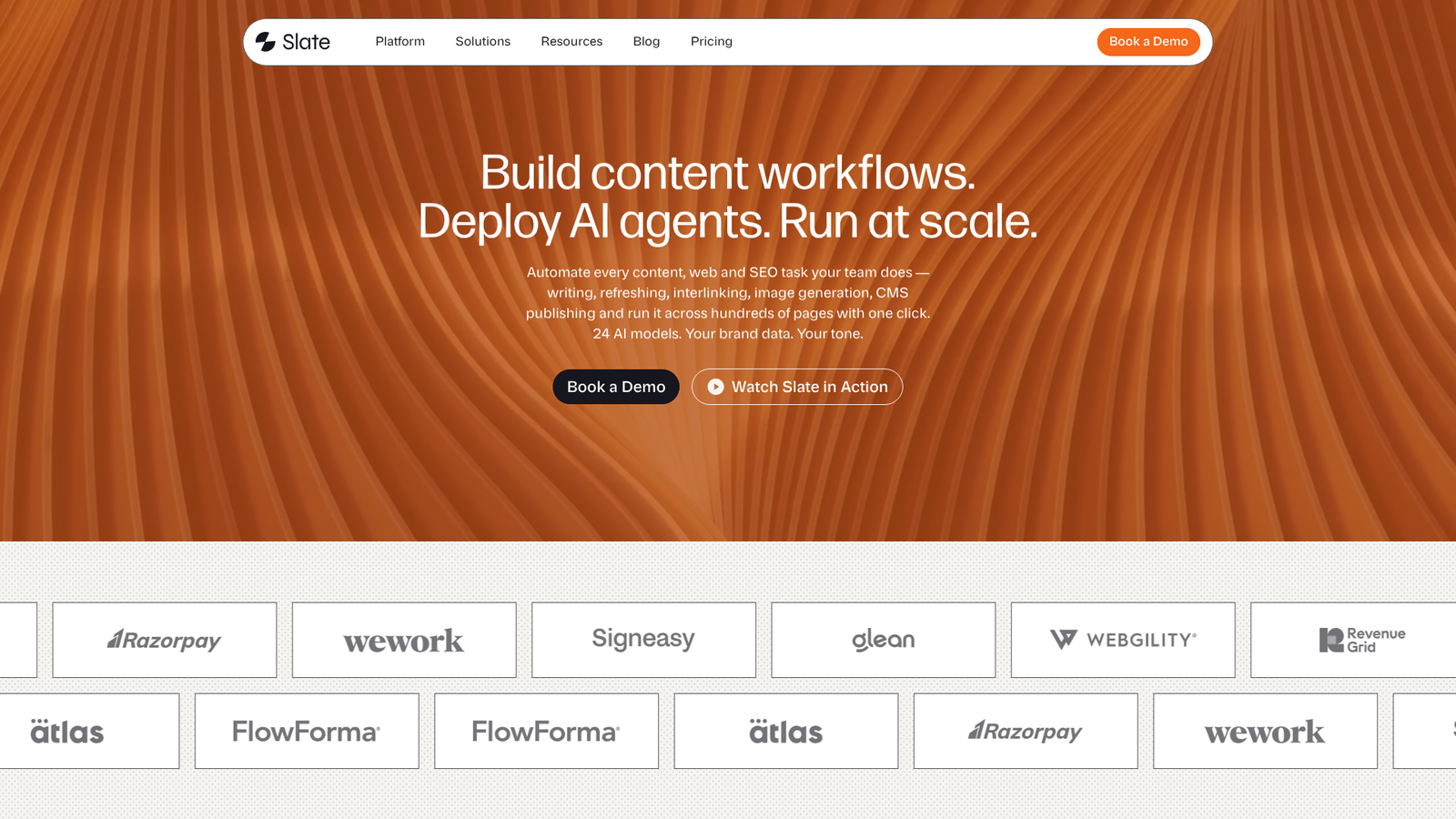
Quick take: Slate is an end-to-end AI search optimization and content engineering platform built for B2B SaaS teams. It tracks visibility across major AI platforms and connects those insights to agentic content workflows and direct CMS publishing.
Slate measures AI search visibility across ChatGPT, Google AI Mode, Google AI Overviews, and Perplexity, then turns the gaps it finds into structured content work. Where most tools in this category stop at a dashboard, Slate runs the next steps inside the same system: opportunity discovery, brief generation, drafting through governed workflows with brand voice controls, and publishing to Webflow or WordPress.
The "measurement plus execution" framing is not branding. It reflects how Slate is built. AI Search Analytics tracks prompt-level visibility and citations.
Power Sheets handles bulk refreshes across thousands of URLs. Workflows orchestrates multi-step content automation across 24+ AI models with conditional logic and web scraping. Brand Kit & Knowledge Base enforces tone, style, and accuracy at scale.
The result: teams move from "we know we're not cited" to "we shipped updated pages this month" without bolting on another tool.
Key capabilities:
- AI search visibility tracking across major AI platforms
- Citation and source attribution tracking, not just brand mentions
- Content opportunity discovery tied to visibility gaps
- Agentic workflows for research, writing, and refreshes at scale
- Direct CMS publishing to Webflow and WordPress
- Brand voice controls, knowledge base, and review steps for governed scale
Best if you need: A single system that moves your team from AI visibility measurement to published, brand-safe content without adding headcount.
What to watch for: Slate is a platform, not a checker. The fit is strongest for teams committed to operationalizing AI search, not for one-off audits.
G2 rating: 4.9/5
Pricing: Starts at $199/month.
2. Profound - Best for Enterprise Visibility Analytics
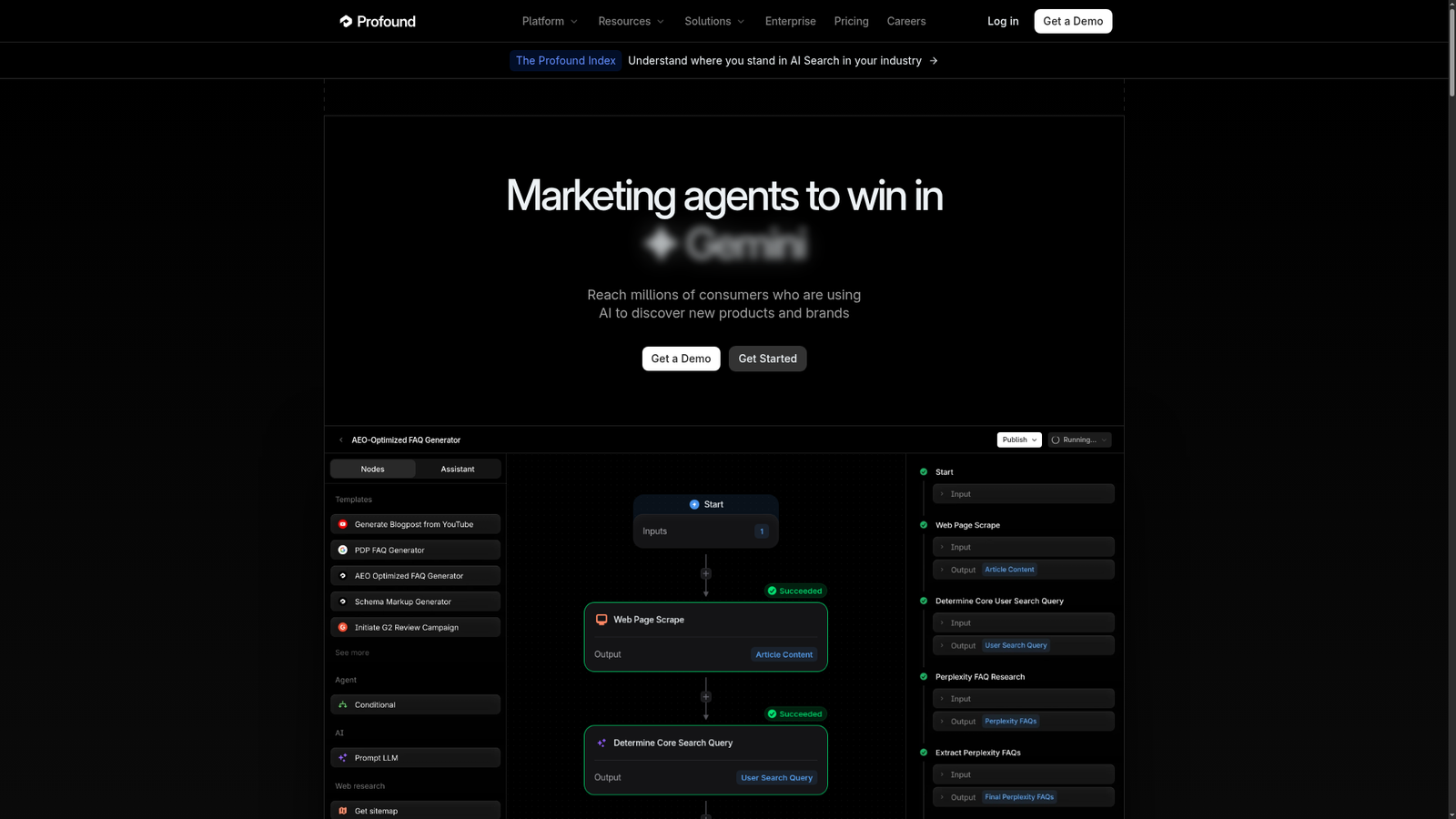
Quick take: Profound is a marketing platform focused on helping brands understand, optimize, and measure visibility across AI search and answer engines, with a clear enterprise lean.
Profound's product surface centers on Answer Engine Insights, Prompt Volumes, and Agent Analytics. That combination is designed to give large brands a quantitative read on how often they appear across tools like ChatGPT, Gemini, Perplexity, and Google AI Overviews, and how those mentions translate into agent-led discovery behavior. For teams that need to defend AI visibility as a board-level metric, the analytics depth is the draw.
The tradeoff is operational. Profound is strong on measurement and lighter on content execution, so most teams pair it with a separate content stack to close the gaps it surfaces.
Best if you need: Enterprise-grade AI visibility analytics with prompt volume data and agent-level insights.
What to watch for: Execution still happens elsewhere. Plan for a second tool or internal workflow to act on what Profound reports.
G2 rating: 4.6/5
Pricing: Custom. Contact sales.
3. Peec AI - Best for Mid-Market Teams Focused on Prompt-Level Tracking
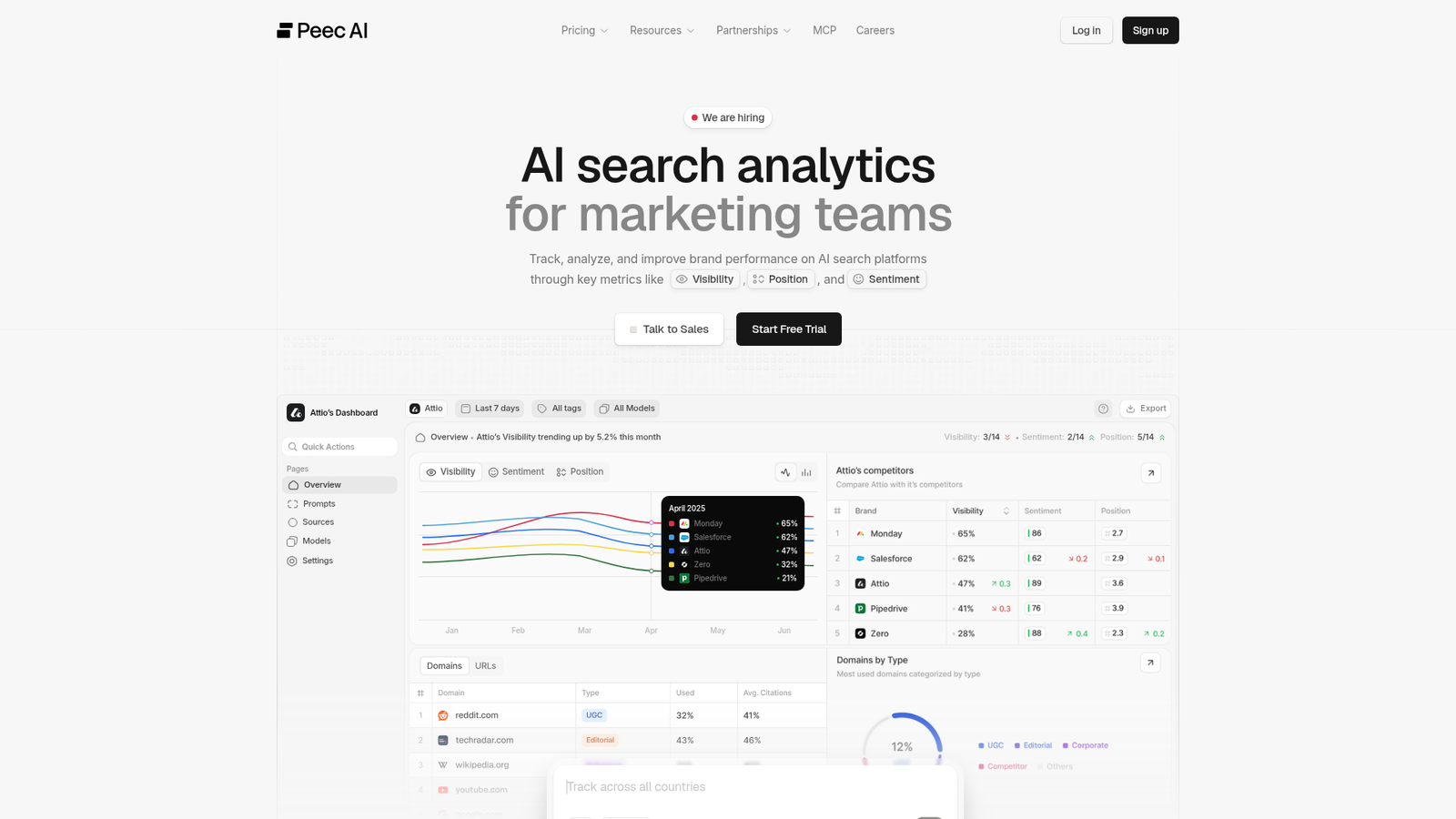
Quick take: Peec AI is an AI search analytics platform for marketing teams to track brand performance across AI platforms with strong prompt-level depth.
Peec AI tracks brand visibility, position, and sentiment across AI search platforms. The product encourages teams to set up and organize prompts manually, with AI-suggested prompts and associated search volumes layered in. The standout feature for mid-market buyers is source citation tracking at the domain and URL level, paired with recommendations to improve rankings inside AI answers.
That focus makes Peec a fit for SEO and content teams that already have a strong publishing motion and just need clear, prompt-level visibility data to direct their work.
Best if you need: Granular prompt tracking, domain-level citation visibility, and recommendations without enterprise overhead.
What to watch for: Recommendations point you toward action, but execution still happens in your existing content stack.
G2 rating: 4.9/5
Pricing: Starter €85/mo, Pro €205/mo, Advanced €425/mo (EUR; up to ~15% off annual); Enterprise on request.
4. Semrush AI Toolkit - Best for Teams Already Using Semrush
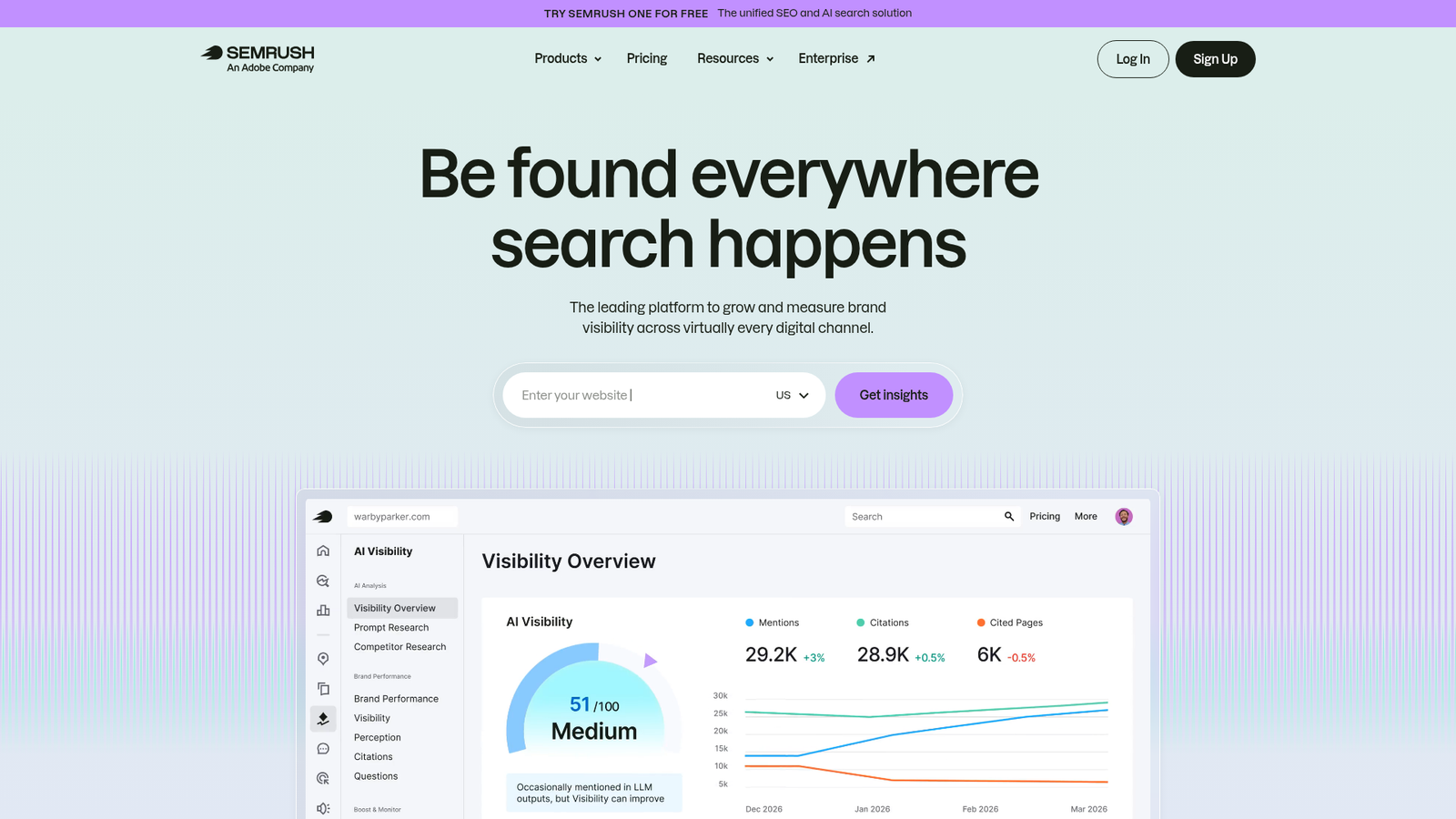
Quick take: Semrush has extended its SEO suite with an AI visibility layer that adds prompt-level tracking and AI market share analysis to its existing keyword and backlink data.
If your team already runs SEO operations inside Semrush, the AI Toolkit gives you AI visibility tracking in the same workspace as keyword research, backlink analysis, rankings, and technical site audits. The benefit is operational: one login, one data model, and competitor benchmarking that spans both traditional SERPs and AI answers.
The tradeoff is depth. Semrush's AI features are part of a broad platform, so dedicated AI search tools often surface prompt-level signals with more granularity. For teams that want one stack instead of two, the integration value usually wins.
Best if you need: Unified SEO and AI visibility data inside an existing Semrush deployment.
What to watch for: AI features are layered onto an SEO platform rather than purpose-built for AI search.
G2 rating: 4.5/5
Pricing: Bundled with Semrush plans. See semrush.com/pricing.
5. HubSpot AI Search Grader - Best Free Entry Point
Quick take: HubSpot's AI Search Grader is a free tool that benchmarks your brand's share of voice across ChatGPT, Perplexity, and Gemini, with week-over-week tracking.
The grader quantifies how answer engines position your brand in its competitive category and shows mention share, sentiment, and which prompts competitors outperform you on. It is the cleanest free starting point in this category and a useful way to make AI search visibility tangible for stakeholders before you invest in a paid tool.
The tradeoff is scope. The free grader is designed as an entry point, not a full operational platform. Most teams use it to make the case internally, then graduate to a dedicated tool when they need deeper prompt sets, more platforms, or an action layer.
Best if you need: A free, credible first read on AI share of voice to benchmark before buying.
What to watch for: Limited to a starter prompt set and a small platform list. Treat outputs as directional.
G2 rating: 4.4/5 (HubSpot platform)
Pricing: Free. HubSpot's broader paid platform starts at $0/month for free tier and $15/seat/month (annual) or $20/seat/month (monthly) for Starter.
6. Ahrefs - Best for SEO Teams Extending Into AI Visibility
Quick take: Ahrefs is an AI marketing platform for search and AI visibility that sits alongside its Site Explorer, Keywords Explorer, and Site Audit tools.
For SEO teams that already run keyword research, competitor analysis, and site audits in Ahrefs, the platform's expansion into AI and search visibility keeps reporting in one workspace. That makes it a natural fit for teams that want AI visibility context without abandoning an SEO-first stack.
The tradeoff is similar to Semrush: Ahrefs remains an all-in-one search platform first. For teams whose primary investment is still SEO, that is an advantage. For teams whose primary metric is AI share of voice, a specialist tool may go deeper.
Best if you need: AI and search visibility data inside an existing Ahrefs deployment with strong SEO data underneath.
What to watch for: AI visibility features sit inside the broader Ahrefs plan structure.
G2 rating: 4.5/5
Pricing: Starter $29/month, Lite $129/month, Standard $249/month, Advanced $449/month, Enterprise $1,499/month.
7. Conductor - Best for Enterprise Content Teams with Reporting Needs
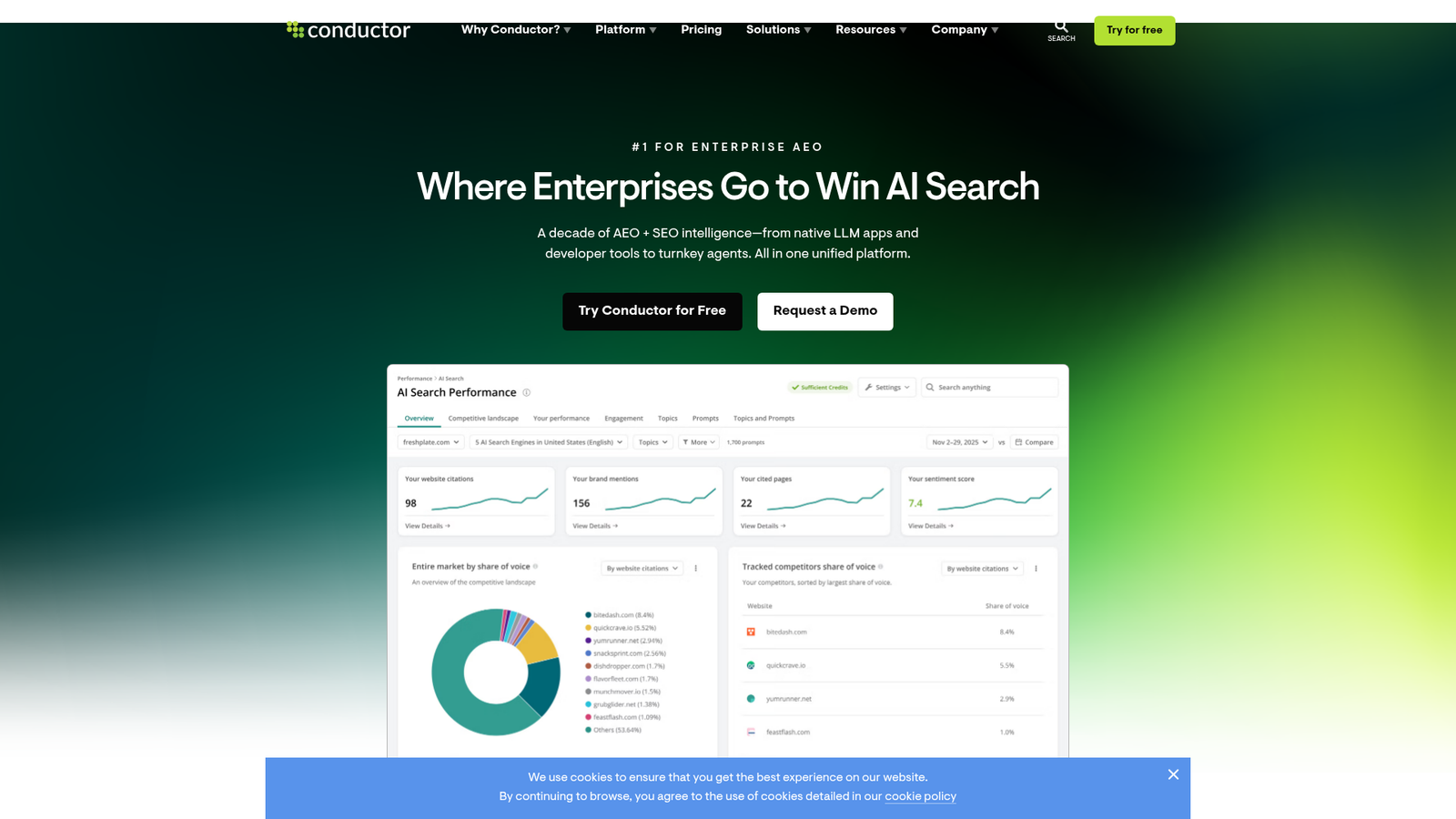
Quick take: Conductor is an enterprise AEO and SEO platform that combines AI and search visibility tracking with AI content generation and 24/7 technical site monitoring.
Conductor is designed for large marketing organizations that need unified reporting across AI search and traditional SEO. AI and search visibility tracking sits next to performance reporting, content workflows, and site health alerts, which makes it easier to argue AI visibility as part of an existing organic growth narrative rather than a separate program.
The platform's enterprise positioning shapes the buying motion. Conductor's pricing is usage-based and not publicly listed, and the tool is best for teams that need enterprise governance, integrations, and reporting depth.
Best if you need: A single enterprise platform that unifies AEO, SEO, content, and technical site monitoring with consolidated reporting.
What to watch for: Pricing is custom and the buying cycle reflects enterprise procurement.
G2 rating: 4.5/5
Pricing: Essentials, Growth, and Enterprise plans with usage-based pricing. Free 3-week trial available.
8. Otterly.AI - Best for Lightweight Prompt Monitoring
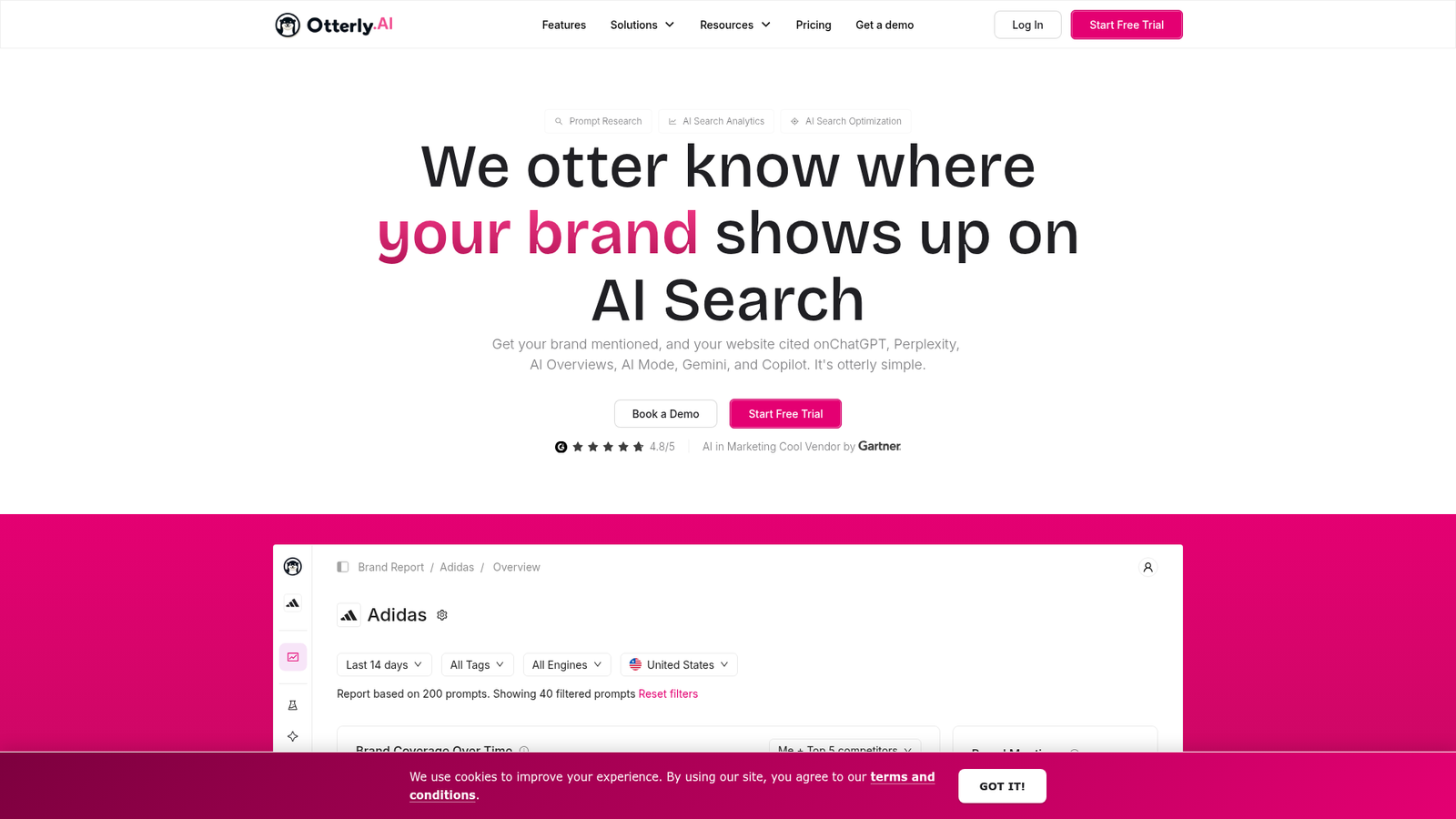
Quick take: Otterly.AI is an AI search monitoring platform that tracks how your brand and website are mentioned, ranked, and cited across ChatGPT, Google AI Overviews, Perplexity, Gemini, and Copilot.
Otterly.AI focuses on the monitoring side of the workflow: prompt research, AI search analytics across major engines, and GEO content audits with recommendations. The platform coverage is one of the clearest in this list, which makes it a solid fit for teams that need confirmation their brand is visible inside specific AI surfaces.
For mid-market teams running lean, the pricing is accessible and the product is straightforward. Execution still happens outside Otterly, but the recommendations give content teams a clear starting point.
Best if you need: Lightweight, accessible AI search monitoring across a confirmed list of AI platforms.
What to watch for: Monitoring-led product. Content execution lives elsewhere.
G2 rating: 4.8/5
Pricing: Lite $29/month, Standard $189/month, Premium $489/month. Annual billing discounts apply.
9. AthenaHQ - Best for Generative Engine Optimization Workflows
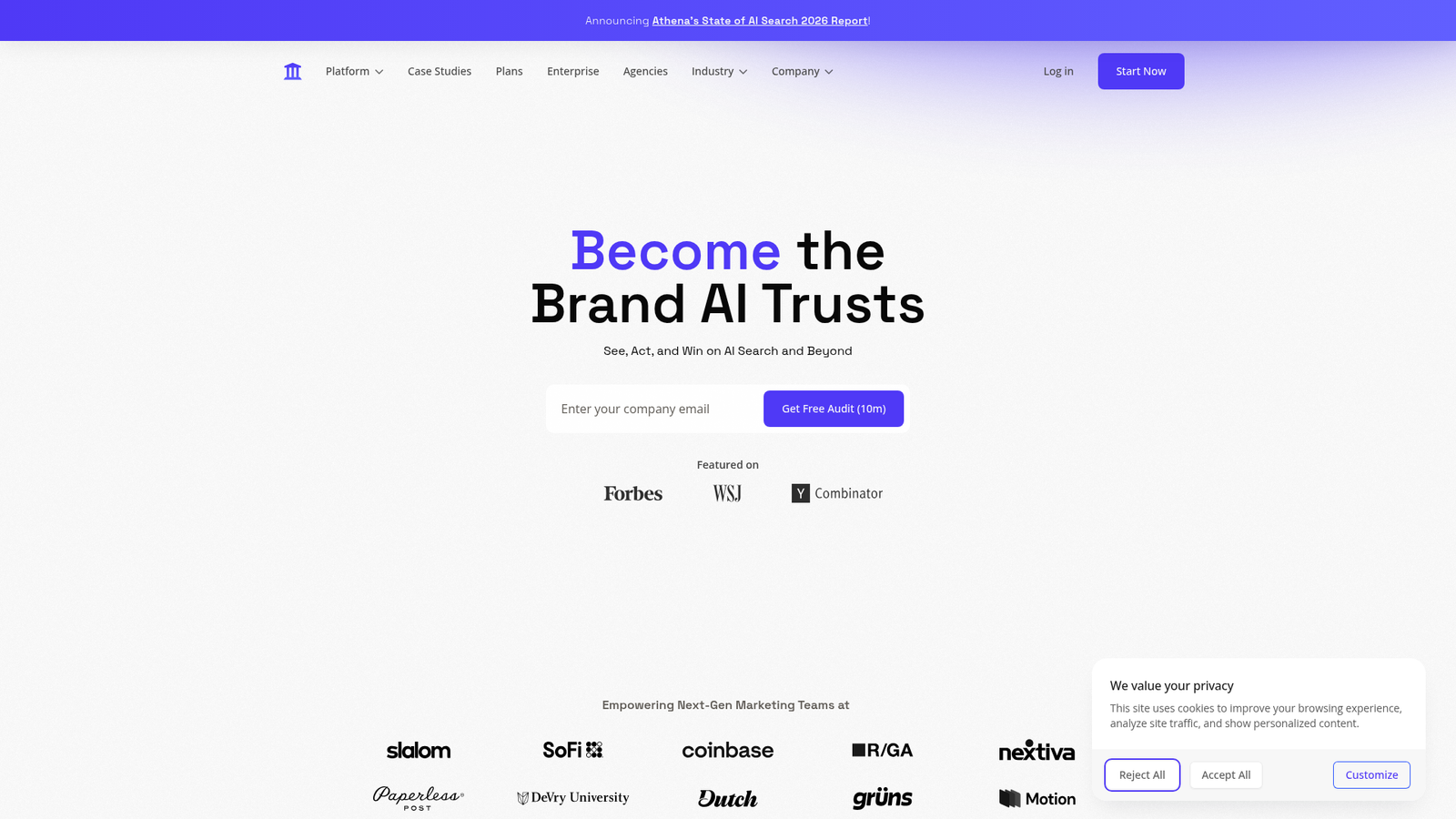
Quick take: AthenaHQ is an AEO/GEO platform that tracks brand visibility across major AI search platforms, shows where you're winning or losing, and recommends what to fix.
AthenaHQ covers eight or more major LLMs, including ChatGPT, Perplexity, Gemini, and Claude. The product layers competitor monitoring and citation intelligence on top of that visibility data, then exposes automated content optimization recommendations through an "Ask Athena" copilot interface. For teams that think of their work as generative engine optimization tools rather than traditional SEO, the framing fits naturally.
The platform sits between monitoring-only tools and full execution platforms. You get recommendations and a copilot, but publishing and workflow governance still happen in your own stack.
Best if you need: Broad LLM coverage with GEO-specific recommendations and a copilot to guide content work.
What to watch for: Recommendations guide action but do not publish content.
G2 rating: 4.9/5
Pricing: Self-Serve at $295/month, with the first month discounted to $95/month. Enterprise custom. Annual billing saves 17%.
What to Look for in an AI Share of Voice Tool
Once you have a shortlist, the differences across tools come down to a handful of decisions. These are the ones that matter most.
Platform Coverage
Which AI platforms does the tool actually monitor? At minimum, look for ChatGPT, Perplexity, Gemini, and Google AI Overviews. Bing Copilot and Claude are increasingly important for B2B buyers, especially in regulated industries.
Confirm coverage on vendor pricing pages before you sign, because brand visibility tools for ChatGPT and AI search vary widely in which surfaces they actually query.
Mentions vs Citations vs Source Attribution
A mention means your brand name appears in an AI answer. A citation means your content is referenced. Source attribution means your URL is linked.
These are not the same metric and they do not move together. TrustRadius found that 90% of buyers who saw AI Overviews clicked at least one cited source, which is why citation tracking is usually more actionable than counting mentions. If a tool blends them into a single "presence" number, push for the breakdown.
Prompt and Topic Level Tracking
The strongest tools support both. Prompt-level tracking shows you which specific queries surface you. Topic-level rollups let you report visibility per category to leadership.
A tool that only does one or the other will leave gaps in either reporting or diagnostics.
Actionability Beyond Monitoring
Monitoring without action is a dashboard, not a system. The decisive question for any AI share of voice tool is: when this dashboard shows a gap, what happens next? If the answer is "we copy a list of prompts into a content brief in another tool," you have just bought half a workflow.
Who Each Tool Is Best for
A simple map from buyer profile to tool. Use this to confirm your shortlist after reading the full writeups.
- B2B SaaS teams operationalizing AI search: Slate
- Enterprise analytics buyers: Profound, Conductor
- Mid-market teams focused on prompt-level depth: Peec AI
- Existing SEO suite users: Semrush AI Toolkit, Ahrefs
- Free starting point for first-time benchmarking: HubSpot AI Search Grader
- Lightweight prompt monitoring across multiple AI surfaces: Otterly.AI
- GEO-led teams with broad LLM coverage needs: AthenaHQ
Monitoring-Only vs End-to-End Execution
This is the framing that separates the category, and it's the one most listicles skip over.
Monitoring-only tools track visibility and report it back. They tell you which prompts you appear in, which competitors are cited instead, and how those numbers change over time. They are useful for visibility, board reporting, and benchmarking.
They are limited for growth, because none of that data moves your content forward by itself.
End-to-end execution platforms combine measurement with the workflows that act on it. Insights flow into content opportunity discovery, brief generation, drafting under governed workflows, and publishing to your CMS. The same system that surfaces the gap also closes it.
For a team with three or four content people and a CMO asking for ROI, the difference is material. Monitoring-only forces you to assemble a workflow across three or four tools, with handoffs and quality drift between each step. End-to-end execution removes the handoffs.
Slate is built for the second model, which is why it leads this shortlist for B2B SaaS teams. If your buying motion already includes AI answer engine optimization tools, the execution layer is where the leverage compounds.
How to Turn AI Share of Voice Insights Into Content Actions
A dashboard does not move pipeline. A workflow does. The five steps below convert visibility data into shipped content.
- Identify prompts where competitors are cited and you are not. Sort by commercial intent first. A gap on a "best [category]" prompt matters more than a gap on a definitional query.
- Diagnose the gap. Is the missing content not on your site at all? Is it on your site but poorly structured for extraction? Is it structurally fine but missing the data, examples, or definitions that AI models prefer to cite? Each diagnosis points to a different fix.
- Update or create content with extractable structure. Clear definitions, lists, comparison tables, named examples, and source attribution all increase citation probability — patterns confirmed in Princeton GEO research paper. Practitioners optimizing for AI search consistently recommend writing for citation-worthiness, not just keyword coverage.
- Publish through governed workflows that preserve brand voice. Speed without governance creates drift. Use review steps, brand kits, and knowledge bases to ship at scale without losing trust.
- Recheck visibility on a defined cadence. Weekly for priority topics. Monthly for broader coverage. AI answers are probabilistic, so single-snapshot reads will mislead you.
The teams that win at AI share of voice do not run this loop occasionally. They run it as their default content operating model.
Common Pitfalls When Measuring AI Share of Voice
A few mistakes show up repeatedly in early AI visibility programs. Avoiding them keeps your reporting credible.
- Tracking too few prompts. A dozen prompts is a demo, not a measurement program. Cover discovery, comparison, use-case, and implementation queries across your priority topics.
- Conflating mentions with citations. They move differently and require different responses. Insist on the breakdown.
- Ignoring platform-specific differences. ChatGPT, Perplexity, and Gemini return different answers to the same prompt. Rolling them up too early hides the platforms where you are actually weak.
- Reporting visibility without action. If visibility numbers do not feed a content backlog, you are running a vanity metric.
- Treating AI share of voice as a one-time audit. Answers change. Cadence matters more than any single reading.
- Trusting opaque methodologies. Ask vendors to share their prompt sets, sampling frequency, and platform query approach. Directional is fine. Mysterious is not.
Ready to operationalize AI search visibility? Book a demo to see how Slate connects measurement to published content in one system.
FAQs
What Is AI Share of Voice?
AI share of voice measures how often your brand appears in AI-generated answers compared with competitors across a defined set of prompts, tracked across platforms like ChatGPT, Perplexity, Gemini, Google AI Overviews, Bing Copilot, and Claude. It captures presence inside synthesized answers, not just rankings on a search results page.
How Is AI Share of Voice Measured?
Tools run a defined set of prompts against major AI platforms on a recurring schedule. They record which brands are mentioned, which content is cited, and which URLs are linked. Results are aggregated into a share metric per topic and platform.
Because AI answers are probabilistic, repeated sampling matters more than any single reading, and reputable tools report directional trends rather than absolute scores.
What Is the Best AI Share of Voice Tool?
For B2B SaaS teams that need measurement plus execution in one system, Slate is the strongest fit because it combines visibility tracking across major AI platforms with agentic content workflows and direct CMS publishing. For enterprise analytics buyers, Profound or Conductor fit better. For free first-time benchmarking, HubSpot's AI Search Grader is the cleanest entry point.
How Is AI Share of Voice Different From Brand Monitoring?
Brand monitoring tracks mentions broadly across the open web, social media, news, and reviews. AI share of voice is narrower and more specific: it tracks brand presence inside AI-generated answers across a defined prompt set. The methodologies differ too.
Brand monitoring listens for any mention. AI share of voice queries specific prompts to measure relative share against named competitors.
Do AI Share of Voice Tools Track Google AI Overviews?
Some do, some do not. Slate, Profound, Conductor, and Otterly.AI explicitly include AI Overviews or broader Google AI surfaces in their tracking. Other tools focus more on ChatGPT, Perplexity, Gemini, or broader AI visibility reporting.
Because Google AI Overviews appear for a majority of B2B technology buyers during software research, confirm coverage on the vendor's pricing or product page before signing.
What Is the Difference Between Mentions and Citations?
A mention is when your brand name appears in an AI answer's text. A citation is when your content is referenced or linked as a source for that answer. Citations are usually more actionable because they correlate with buyer behavior.
TrustRadius found that 90% of buyers who saw AI Overviews clicked at least one cited source. Mentions build awareness. Citations build pipeline.
How Many Prompts Should You Track?
It depends on your topic breadth and competitive set. For a focused B2B SaaS category with a few core ICPs, 50 to 100 prompts across discovery, comparison, use-case, and implementation queries is a defensible starting point. Multi-product or multi-segment companies typically need 100 to 300.
Statistical reliability comes from prompt coverage plus recurring sampling, not from any single number.
How Much Do AI Share of Voice Tools Cost?
The category spans a wide range. HubSpot's AI Search Grader is free. Otterly.AI and Ahrefs Starter begin at $29/month.
AthenaHQ runs $95/month for the first month and $295/month thereafter. Slate starts at $199/month with an end-to-end measurement and execution platform. Conductor and Profound use custom enterprise pricing.
Match the price tier to the operating model you actually need.
Can You Track AI Share of Voice Manually?
You can run a small set of prompts manually for a handful of topics and get a directional read. It will not scale. Manual checks lack consistent sampling, history, competitor benchmarking, and the cadence needed to spot trends.
They also drift in methodology over time. For any serious B2B SaaS program, dedicated AI search share of voice tools replace manual tracking quickly.