Brand discovery has moved upstream. Before a buyer ever sees your homepage, an answer engine has already summarized your category, named a few vendors, and quietly shaped the shortlist. AI brand monitoring tools track how your brand is cited, summarized, and recommended across ChatGPT, Perplexity, Gemini, and Google AI Overviews - going beyond traditional social listening or rank tracking to show prompt-level visibility, citation share, and competitive displacement.
This guide compares 15 platforms, organizes them by team type, and shows what to do after you find visibility gaps.
Key Takeaways
- AI brand monitoring tracks how a brand appears inside answer engines like ChatGPT, Perplexity, Gemini, and Google AI Overviews - covering mentions, citations, sentiment, and prompt-level performance.
- Slate is the strongest fit for B2B SaaS and content-led teams that need end-to-end AI search visibility combined with content engineering and publishing, starting at $199/month.
- The best tool depends on team type. SEO-first teams, brand and PR teams, agencies, SMBs, and enterprise buyers each weight criteria differently.
- Core evaluation criteria include platform coverage, citation and source tracking, prompt portfolio management, sentiment and context, evidence logs, and workflow depth.
- Monitoring without execution leaves value on the table. The strongest platforms connect insight to content updates and publishing.
- Pricing spans from lightweight tools with entry-level self-serve plans to custom enterprise contracts. Confirm current pricing directly with each vendor before shortlisting.
What Is AI Brand Monitoring
AI brand monitoring is the practice of tracking how a brand is mentioned, cited, summarized, and recommended inside AI answer engines like ChatGPT, Perplexity, Gemini, Microsoft Copilot, Claude, and Google AI Overviews. It pairs prompt-level monitoring with citation analysis, sentiment, and competitor benchmarking.
The category goes by several names that often get confused. AI brand monitoring, AI visibility tracking, AI search monitoring, and answer-engine monitoring refer to roughly the same measurement work. Generative engine optimization (GEO) and AEO are the optimization disciplines that follow - what you actually do once you can see where you stand.
A quick taxonomy helps:
- Social listening watches conversations across social, news, and forums.
- SEO rank tracking watches traditional search engine results.
- AI brand monitoring watches what AI systems say about a brand when a user asks a question.
The three are complementary. None of them replaces the others.
Why AI Brand Monitoring Matters in 2026
The shift is not about a new metric. It is about where buyer research actually happens. When someone opens ChatGPT and asks for the best vendor in a category, the answer they get reshapes their shortlist before they ever touch a SERP.
Invisible brands at that moment do not get a second chance later in the funnel.
A few consequences fall out of that:
- Competitors who get cited in AI answers displace you from consideration sets your buyers see daily.
- AI systems can describe a brand using outdated positioning, missing products, or stale comparisons - a reputation problem that traditional SEO tools cannot see.
- Executive reporting now needs new metrics: prompt coverage, citation share, and share-of-voice inside AI answers.
- Zero-click behavior continues to grow as AI Overviews answer queries directly, meaning AI responses can influence consideration even when users never visit your site.
OpenAI reported surpassing 100 million weekly active users for ChatGPT in late 2023, and assistant usage has continued to grow as buyers increasingly use AI for early research. For B2B teams, that means AI visibility is no longer an experimental measurement track. It is an input into pipeline.
How We Evaluated These AI Brand Monitoring Tools
Methodology matters in a category where new tools launch every quarter and feature claims outpace documentation. The shortlist below was assessed against eight criteria, weighted toward what actually changes buying outcomes.
- Platform coverage - does it track ChatGPT, Perplexity, Gemini, Google AI Overviews, Copilot, and Claude?
- Citation and source tracking - does it surface which URLs get cited, not just whether the brand is mentioned?
- Prompt portfolio management - how many prompts, how easily refreshed, how organized by buyer intent?
- Sentiment and context - how is the brand described, not just whether?
- Competitor benchmarking - share-of-voice and displacement insight.
- Evidence logs - screenshots, source URLs, and historical change tracking.
- Workflow and execution support - does the tool stop at insight, or help teams act on it?
- Pricing transparency and team fit - public versus sales-led, SMB through enterprise.
Tools were evaluated using vendor documentation, demos, and third-party research.
Quick Comparison of the Best AI Brand Monitoring Tools
The table below summarizes the 15 platforms covered in this guide. Coverage and pricing change quickly, so confirm specifics on each vendor's pricing page before shortlisting. For a deeper view of category overlap, see this guide to AI search visibility tools.
The Best AI Brand Monitoring Tools in 2026
Each tool below is positioned for a different team profile. Read them as a shortlist filter, not a ranking - the right answer depends on the workflow you need.
Slate
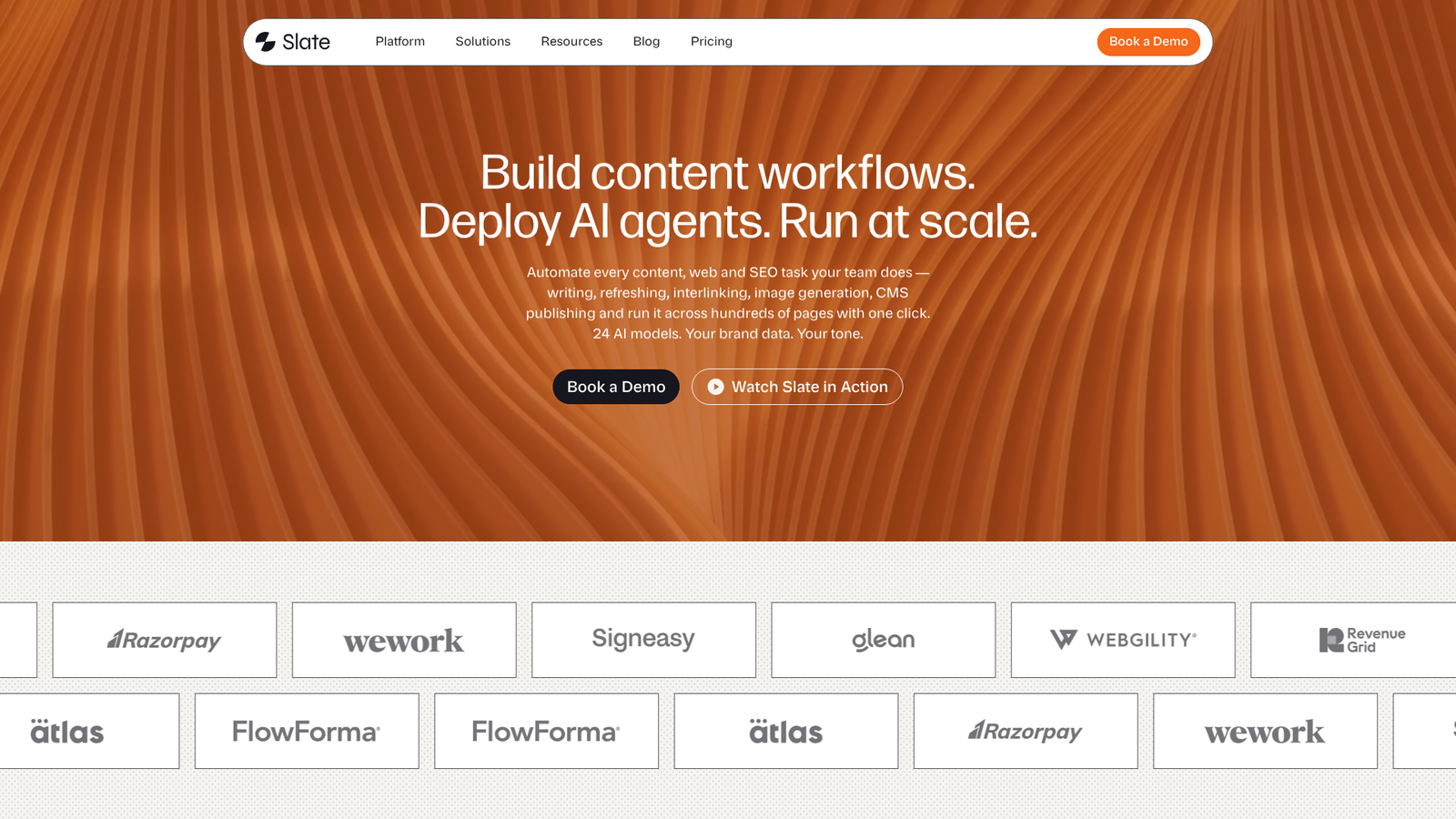
Best for: End-to-end AI search optimization and content engineering for B2B SaaS and content-led teams.
What it does: Slate is an AI search optimization and content engineering platform that tracks visibility across AI answer engines, surfaces content opportunities tied directly to visibility gaps, and executes content workflows through agent-based automation - all while preserving brand voice, accuracy, and governance.
Standout features:
- AI search visibility tracking across ChatGPT, Google AI Mode, Google AI Overviews, and Perplexity
- Content opportunity discovery linked to visibility gaps
- Workflows and Power Sheets for bulk content creation and refresh
- Direct CMS publishing to Webflow and WordPress
- Brand Kit and knowledge base for brand-safe generation
- Citation-readiness optimization for extractable content
Pricing: Starts at $199/month.
Pros:
- One of the few platforms that connects AI visibility tracking to content creation and publishing in a single system
- Built AI search-first, not retrofitted from legacy SEO tooling
- Strong G2 standing at 4.9/5
- Designed for scale without losing brand voice or governance
Cons:
- More platform than lightweight SMB teams need if they only want mention counts
- Best fit for teams already publishing content regularly, not pre-launch startups
Who should shortlist it: B2B SaaS marketing leaders, Heads of SEO, content leads, and growth teams who need both AI visibility insight and the workflow infrastructure to act on it without rebuilding their stack.
Most tools in this category stop at the dashboard. Slate is built around a different premise - that visibility must be engineered, not guessed, and that monitoring without execution leaves value on the table. For teams that want measurable organic growth from AI search rather than experiments, Slate operates as the system of action between insight and outcome.
Promptwatch
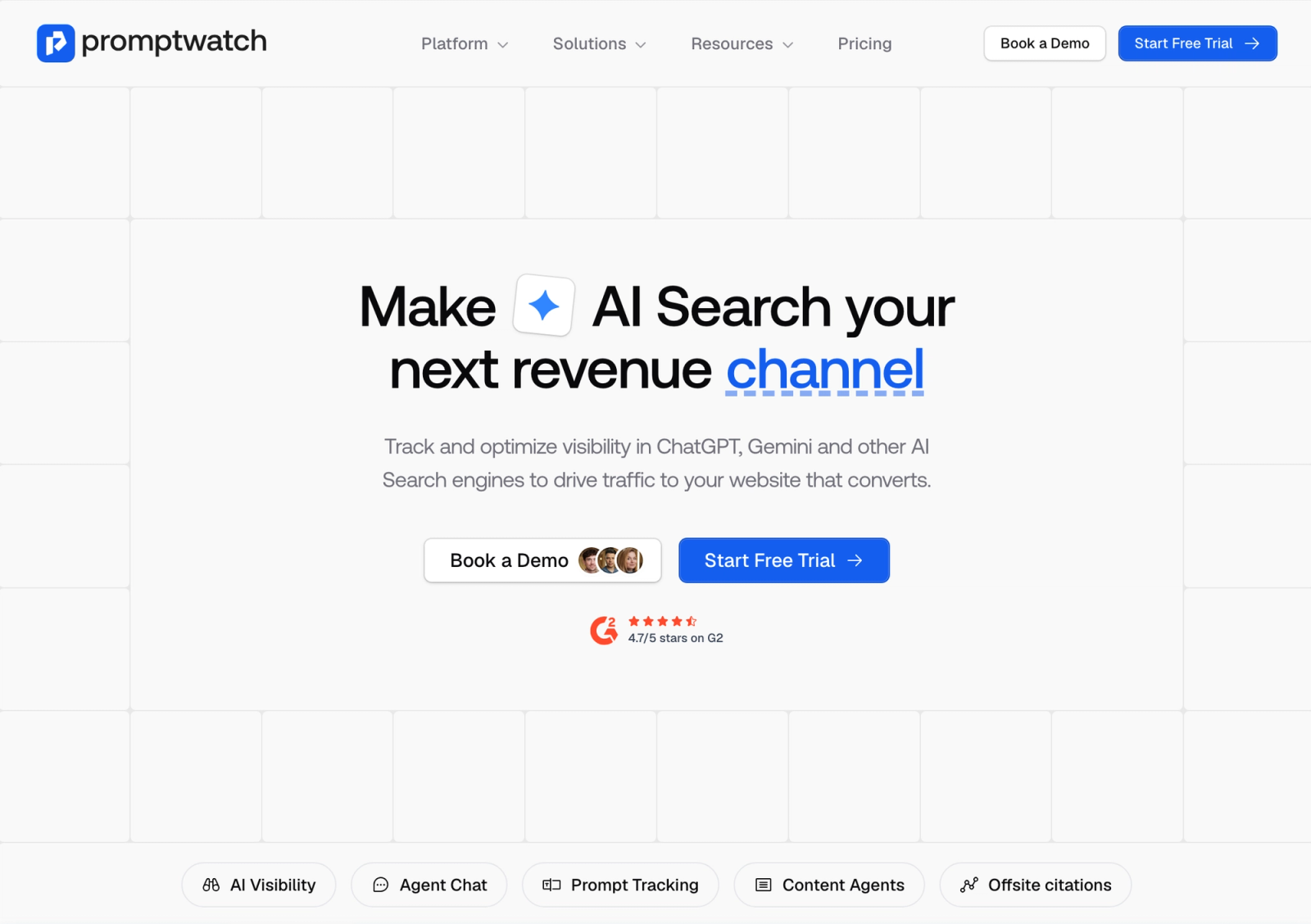
Best for: Marketing teams and agencies that want to connect AI visibility to crawler activity, traffic, and revenue in one platform.
What it does: Promptwatch is an AI search visibility and GEO platform. It tracks how brands appear in AI answers by scraping the real interfaces of ChatGPT and 10 other engines, instead of relying only on API responses. It then adds AI crawler logs and visitor analytics, so teams can see the full path from crawl to citation to visit.
Standout features:
- Visibility tracking across 11 AI platforms, with every engine available on every paid plan
- Agent Analytics: real-time crawler logs for GPTBot, ClaudeBot, and PerplexityBot, joined to citation data
- Off-site Mentions plus dedicated Reddit, YouTube and LinkedIn citation tracking
- Content Gap Analysis tested against your own indexed site, and a Content Agent that publishes directly to Webflow, Framer and WordPress
- Agent Chat: ask questions about your AI search performance and act on the answers in the same conversation
- Prompt tracking down to country, state, and city level, including on the entry plan
Pricing: Essential $95/month, Professional $245/month, Business $579/month. Enterprise and agency volumes are custom. There's a free plan, and Essential comes with a 7-day free trial.
Pros:
- Data comes from real UI responses, so it reflects what users actually see in each market and language
- One of the few tools that tracks AI-referred human traffic and conversions separately from bot activity
- Methodology is published: the Visibility Score formula and how sentiment is averaged are both documented
- Self-serve pricing is public, with REST API and MCP access on every paid plan
Cons:
- Crawler logs and Shopping Insights start at the Professional tier
- Direct CMS publishing is limited to Webflow, Framer and Wordpress, so other CMSs need a manual export
Who should shortlist it: Heads of SEO, growth marketers, and agencies managing several brands who need to know why they're visible in AI answers, not just whether they are, and want monitoring, technical signals, and content execution in one stack.
Cognizo
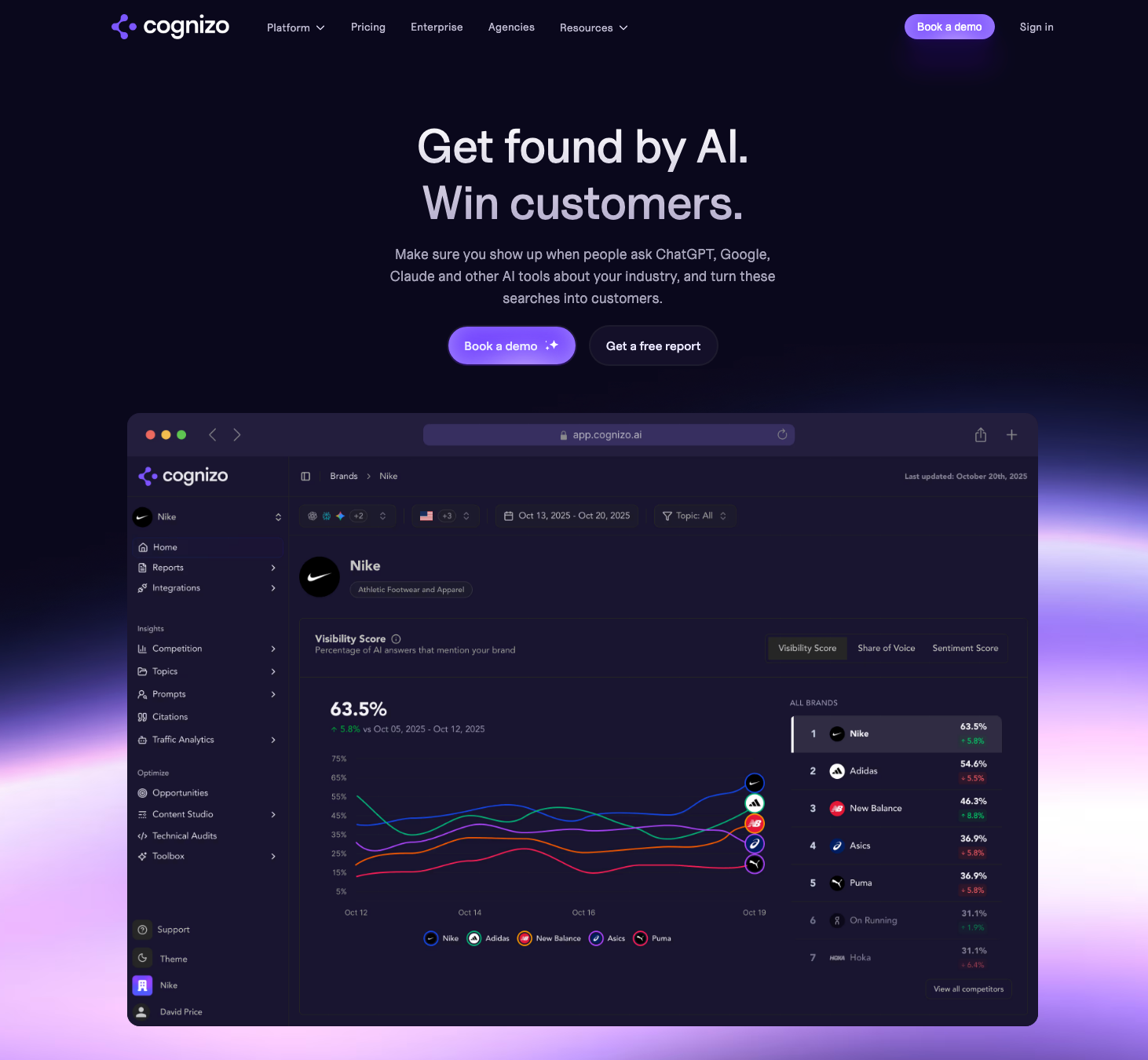
Best for: Teams that want AI brand monitoring tied directly to the content that changes how AI engines describe them.
What it does: Cognizo tracks how a brand appears across ChatGPT, Google AI Overviews, Gemini, Perplexity, Microsoft Copilot, and Grok on its Growth and Pro plans, with Enterprise extending coverage to 10 engines including Claude, Google AI Mode, Meta AI, and DeepSeek. Tracking runs daily and reports visibility and share of voice, citation share, mention share, sentiment, and source and page-type classification, with regions, languages, and competitors unlimited on every plan. What separates it from a monitoring-only tool is the content agent: when the data shows a gap, Cognizo drafts and auto-publishes articles to close it, and AI Traffic Analytics then shows whether AI crawlers fetched the page and sent referral visits. For how this category splits between reporting and execution, see this breakdown of AI visibility platforms.
Standout features:
- Daily tracking across up to 10 AI engines with sentiment, citation share, and mention share
- Prompt Volumes: real volumes on tracked prompts, prompt exploration, and competitive gap analysis
- Content agent with auto-publishing (8 articles per month on Growth, 20 on Pro)
- AI Traffic Analytics for crawler activity and AI referral traffic
- AI Ads module with an ad library, competitor tracking, and targeting opportunities
- MCP and API access from the entry tier, unlimited seats on every plan
Pricing: Growth $499/month (150 prompts, 5 engines), Pro $999/month (350 prompts, 5 engines), Enterprise custom (all 10 engines, multiple brands and workspaces, dedicated AI search strategist, SSO and SLA).
Pros:
- Monitoring and execution in one plan, no separate content stack to buy
- Unlimited seats, regions, languages, and competitors on every tier
- Prompt volume data to decide which prompts are worth optimizing for
Cons:
- Growth and Pro cover 5 engines; Claude, Google AI Mode, Meta AI, and DeepSeek are Enterprise-only
- Entry price is higher than monitoring-only tools
- AI Traffic Analytics covers one domain on Growth and Pro
Who should shortlist it: B2B and ecommerce teams that have outgrown reporting and want monitoring data to turn into published content without adding tools or headcount.
Nightwatch
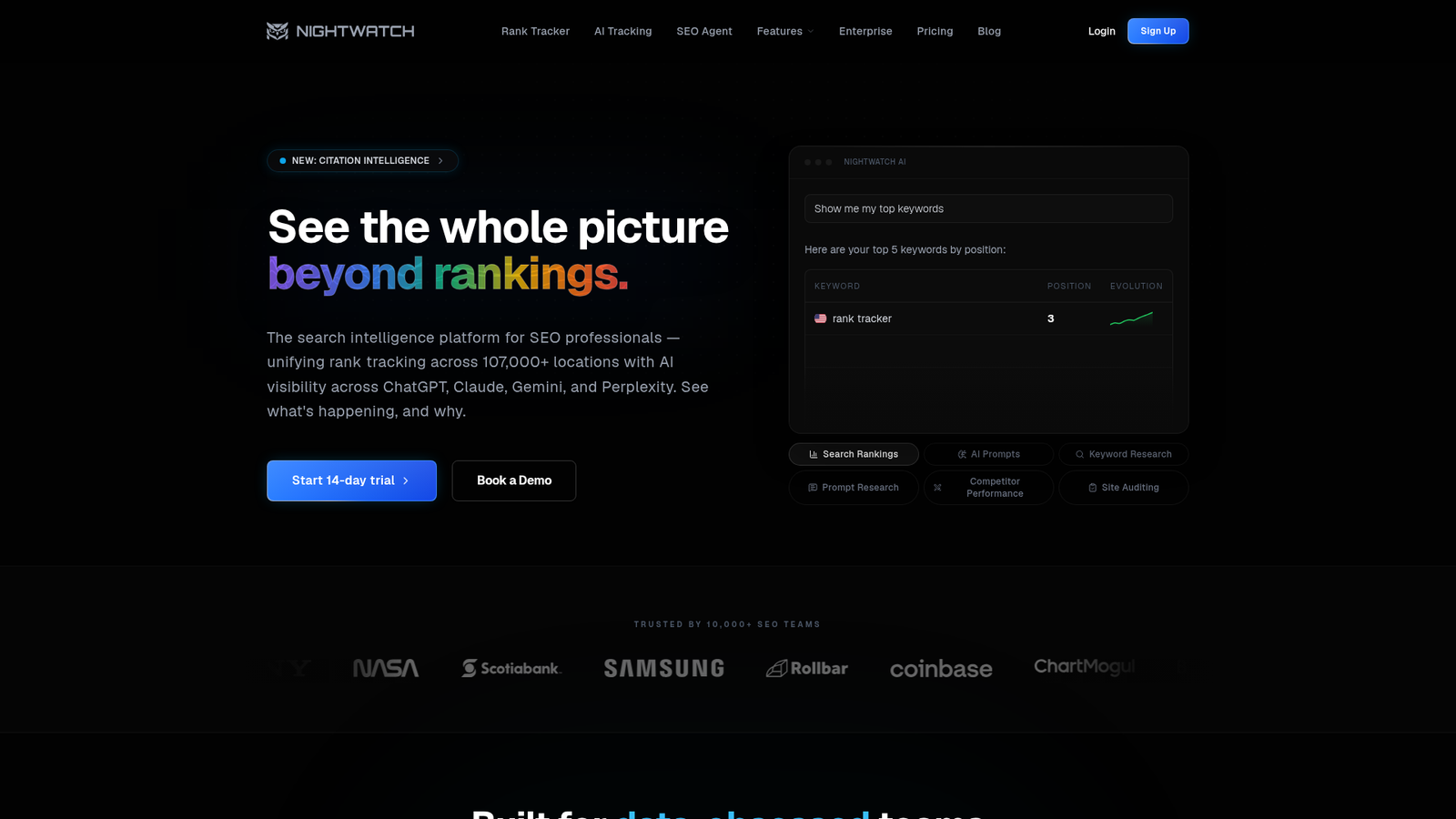
Best for: SEO teams and agencies that want traditional rank tracking and AI visibility in one platform.
What it does: Nightwatch is a search intelligence platform that combines rank tracking with AI visibility monitoring. It tracks brand presence across Google AI Overviews, ChatGPT, Claude, Gemini, and Perplexity alongside traditional search results.
Standout features:
- Rank tracking across 107,000+ locations worldwide
- AI visibility tracking across ChatGPT, Claude, Gemini, and Perplexity
- White-label reporting with unlimited user seats
Pricing: Starter €79/month, Professional €159/month, Agency €399/month, Enterprise custom. Annual billing saves 20%; all plans include a 14-day free trial.
Pros:
- Strong overlap with traditional SEO workflows
- Unlimited user seats useful for agencies
- 4.9/5 on G2
Cons:
- Less depth on content execution than dedicated content platforms
- Sentiment and citation depth less developed than purpose-built AI visibility tools
Who should shortlist it: SEO-led teams and agencies who want one screen for rank tracking plus answer-engine visibility.
Brand24
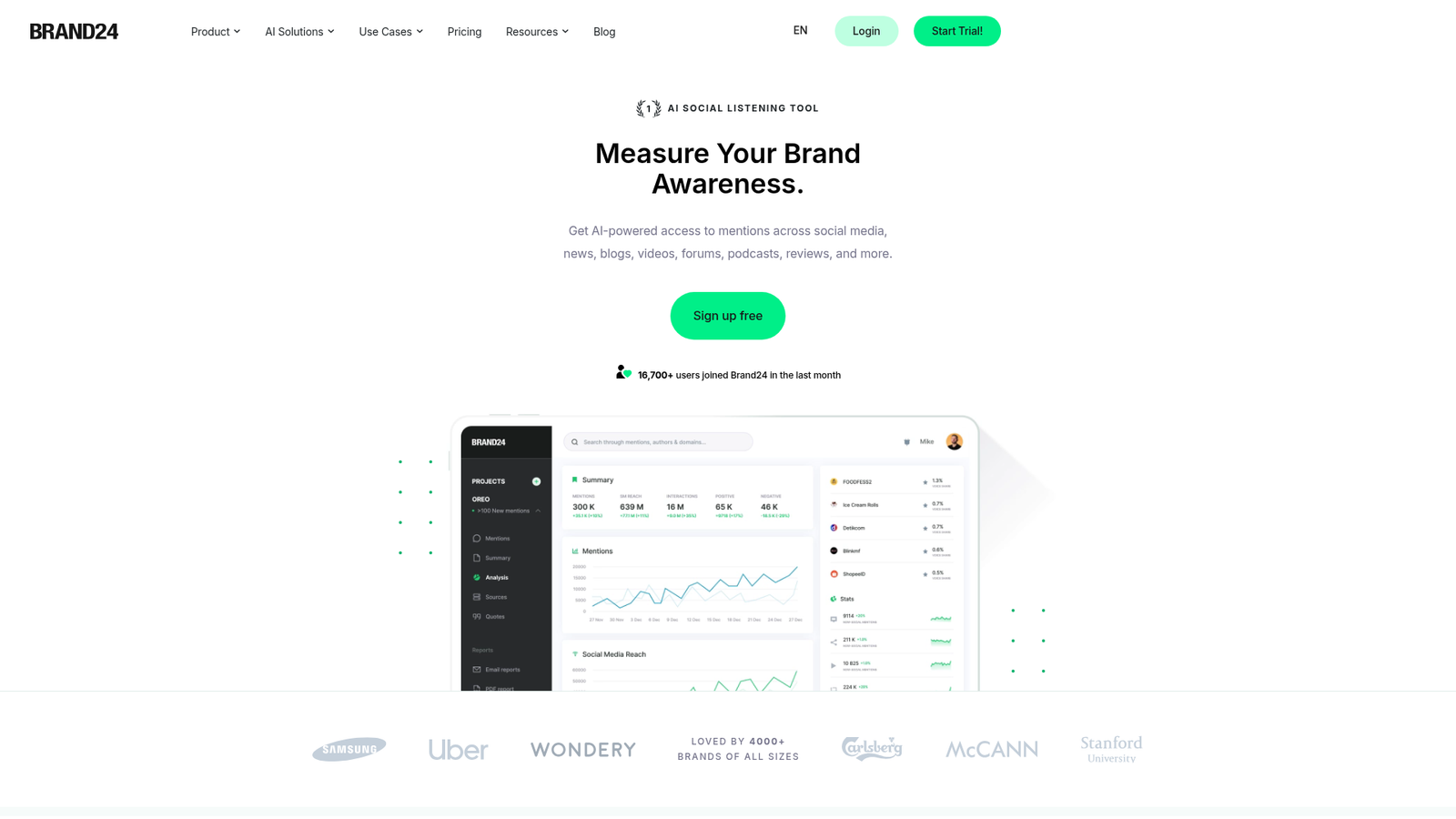
Best for: Brand, PR, and reputation teams that need real-time mention monitoring with sentiment.
What it does: Brand24 is an AI-powered social listening platform that tracks online mentions across 25 million+ sources including social media, news, blogs, videos, forums, podcasts, and reviews, with sentiment and source impact analysis layered on top.
Standout features:
- Real-time monitoring across 25 million+ sources
- AI-powered sentiment analysis and topic insights
- Automated alerts and reach/engagement tracking
Pricing: Individual $249/month, Team $349/month, Pro $499/month, Business $699/month, Enterprise from $1,499/month. Annual billing lowers the listed rates significantly.
Pros:
- Strong sentiment and source influence measurement
- Deep coverage of social, news, and forum mentions
- 4.6/5 on G2
Cons:
- Built primarily for social listening; prompt-level AI answer monitoring is not its core
- Higher entry price than lightweight monitoring tools
Who should shortlist it: PR and reputation teams that need real-time alerts and want a sentiment layer on top of brand visibility tracking.
Sight AI
Best for: Enterprise teams that need LLM brand representation monitoring under formal governance.
What it does: Sight AI is positioned as an enterprise-focused platform for monitoring how large language models describe a brand against competitors, with reporting designed for executive consumption.
Standout features:
- Enterprise-grade LLM monitoring
- Competitor benchmarking inside AI answers
- Reporting tailored to brand and executive stakeholders
Pricing: Custom; confirm directly with the vendor.
Pros:
- Built for enterprise governance and reporting
- Focused specifically on LLM brand representation
Cons:
- Limited public information on features and pricing
- Likely overkill for SMB and mid-market teams
Who should shortlist it: Enterprise brand and communications teams that need executive-grade reporting on how LLMs describe the company.
Semrush
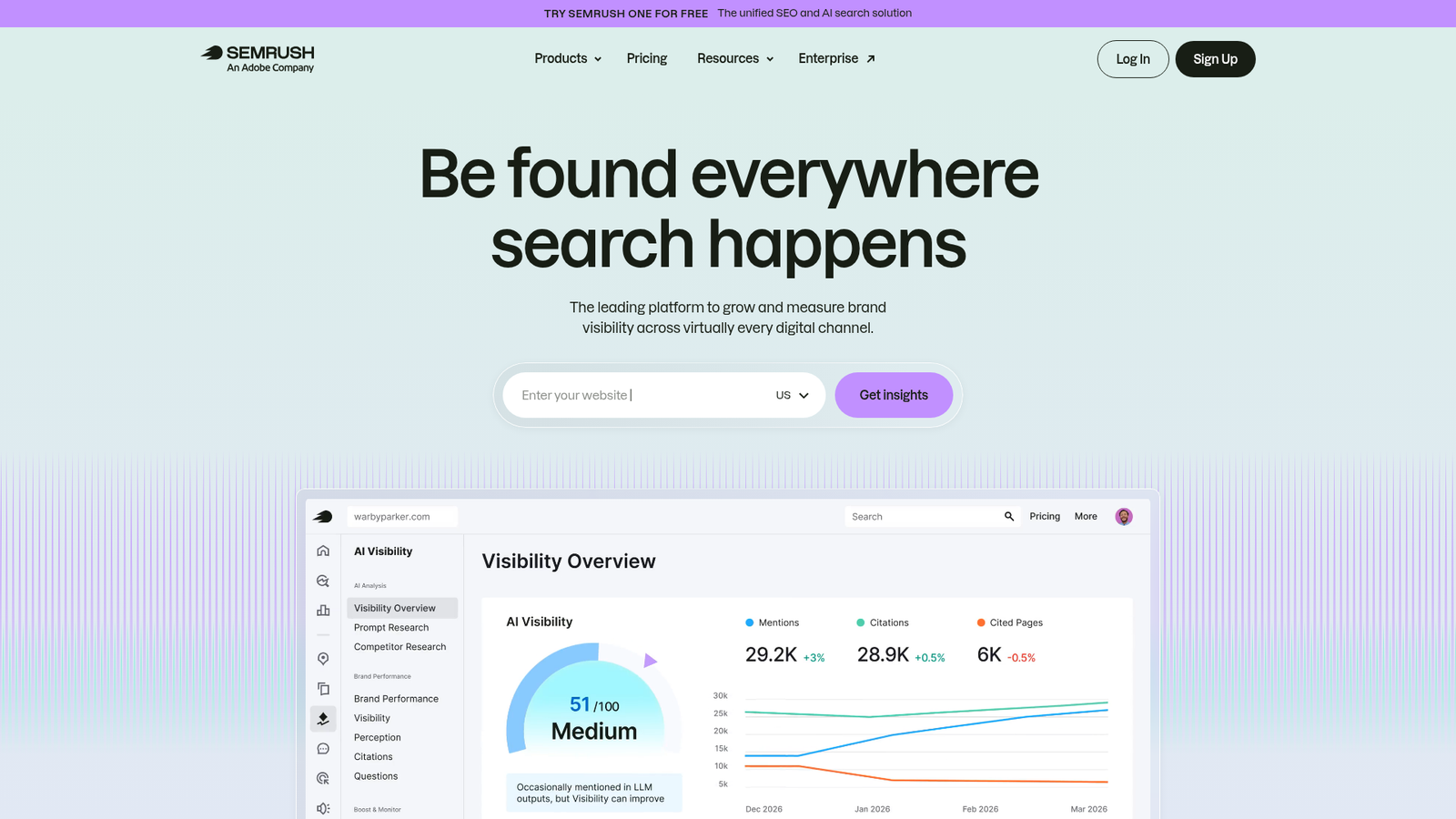
Best for: SEO-first teams already running Semrush who want AI visibility inside the same suite.
What it does: Semrush is an AI-powered marketing platform that combines SEO, AI search visibility, content, advertising, social, and competitive intelligence. AI visibility tracking sits inside the broader SEO and competitor research stack.
Standout features:
- Keyword research, competitor analysis, backlink analysis, and site audits
- AI visibility tracking across platforms like ChatGPT and Google
- Traffic and market analysis with audience insights
Pricing: Public pricing tiers available on the Semrush site.
Pros:
- Single platform across SEO and AI visibility
- Mature competitor research and backlink data
- 4.5/5 on G2
Cons:
- AI visibility module is one feature among many, not the product's center of gravity
- Content execution workflows less developed than dedicated content platforms
Who should shortlist it: SEO teams already invested in Semrush who want AI visibility as an add-on rather than a separate purchase.
Otterly AI
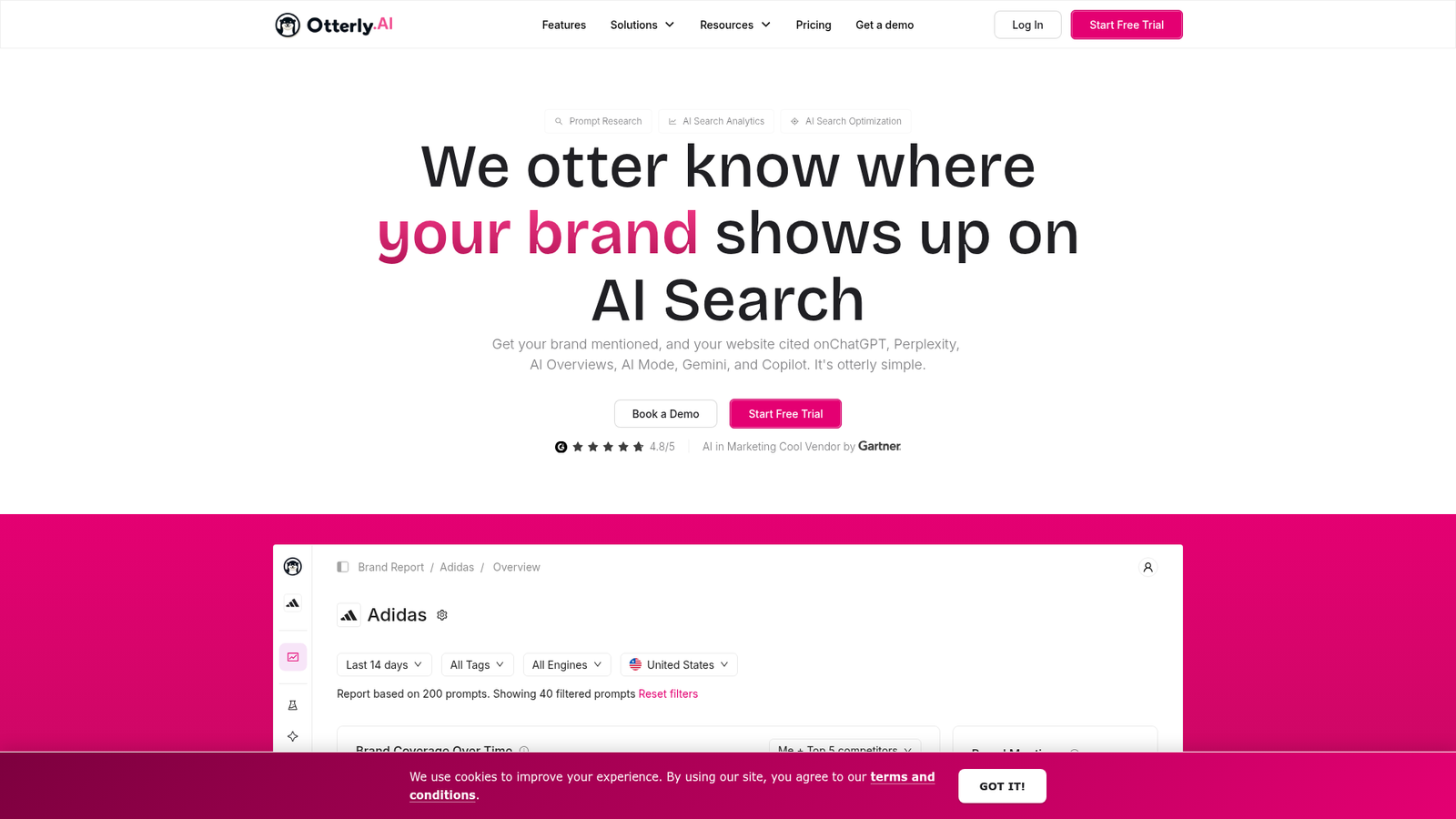
Best for: Small-to-midsize marketing teams running GEO audits across AI search engines.
What it does: OtterlyAI tracks mentions, rankings, and citations across ChatGPT, Perplexity, Google AI Overviews, Gemini, and Copilot, with prompt research and content audits oriented toward GEO.
Standout features:
- AI prompt research
- AI search analytics across major AI engines
- GEO optimization and content audits
Pricing: Lite $29/month, Standard $189/month, Premium $489/month. Annual billing is 15% off. Enterprise is custom.
Pros:
- Accessible entry pricing at $29/month
- Coverage across major AI search engines
- 4.8/5 on G2
Cons:
- Prompt limits on lower tiers can be restrictive
- Less workflow depth than end-to-end content platforms
Who should shortlist it: SMBs and lean marketing teams who need multi-engine GEO monitoring without enterprise pricing. For more on optimizing for this surface, see AI Overviews optimization.
Peec AI
Best for: Mid-market teams focused on prompt-level visibility, position tracking, and sentiment.
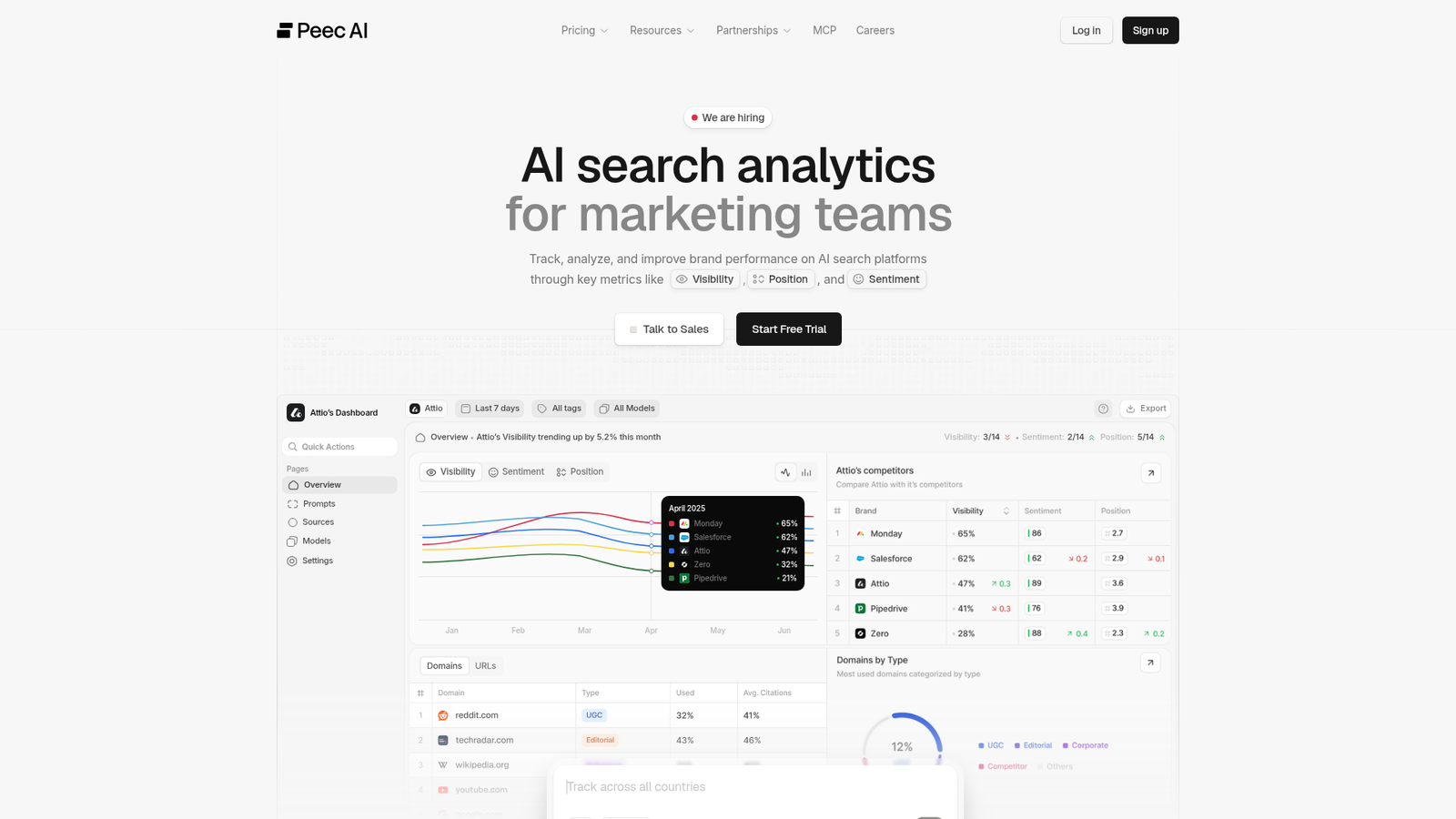
What it does: Peec AI is an AI search analytics platform that tracks visibility, ranking position, and brand sentiment across AI search engines. It is aimed at marketing teams and agencies who want clean dashboards over operational complexity.
Standout features:
- Visibility tracking across AI search platforms
- Position tracking inside AI answers
- Sentiment analysis on how AI describes the brand
Pricing: Public pricing tiers listed on the Peec AI site.
Pros:
- Strong focus on prompt-level visibility and sentiment
- 4.9/5 on G2
- Multi-engine coverage
Cons:
- Lower starter allocations than enterprise tools
- Content workflow support is light
Who should shortlist it: Mid-market teams who want clean prompt and visibility tracking without a heavy enterprise contract.
Ahrefs
Best for: SEO teams already using Ahrefs who want AI visibility tracking through Brand Radar.
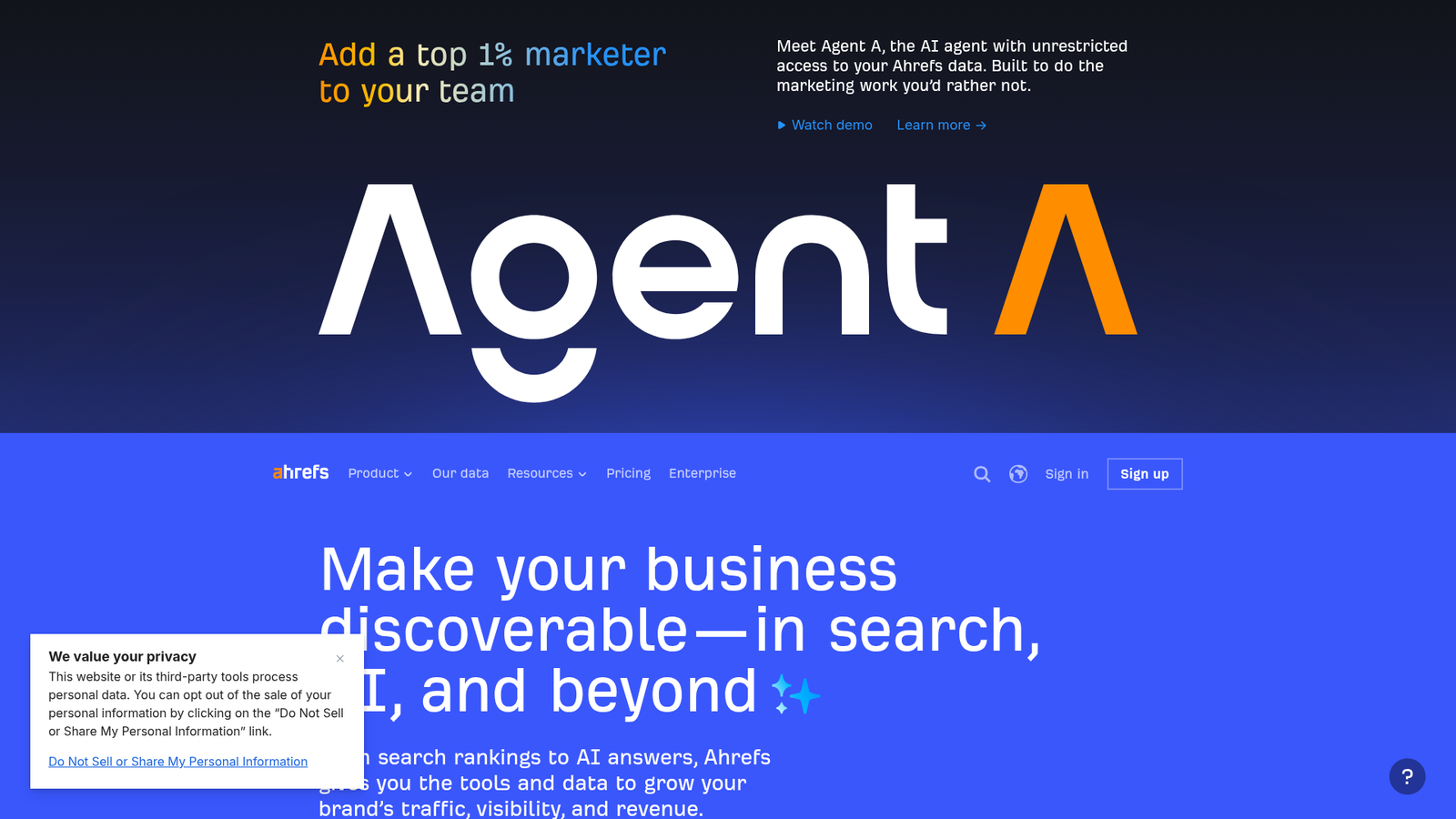
What it does: Ahrefs is an SEO platform with Site Explorer, Keywords Explorer, and Rank Tracker, extended into AI visibility through Brand Radar, which tracks how a brand appears across AI-generated answers using Ahrefs' AI index.
Standout features:
- Site Explorer
- Keywords Explorer
- Rank Tracker
Pricing: Starter $29/month, Lite $129/month, Standard $249/month, Advanced $449/month, Enterprise $1,499/month. Annual billing saves up to 17%. A free tier exists.
Pros:
- Deep backlink and keyword data
- Brand Radar layered onto an existing Ahrefs subscription
- 4.5/5 on G2
Cons:
- AI visibility features are an extension, not the core product
- Workflow depth for content execution is limited
Who should shortlist it: SEO teams already running Ahrefs who want AI visibility without adding a separate vendor.
Profound
Best for: Enterprise teams that need AI answer analytics and prompt-volume insights.
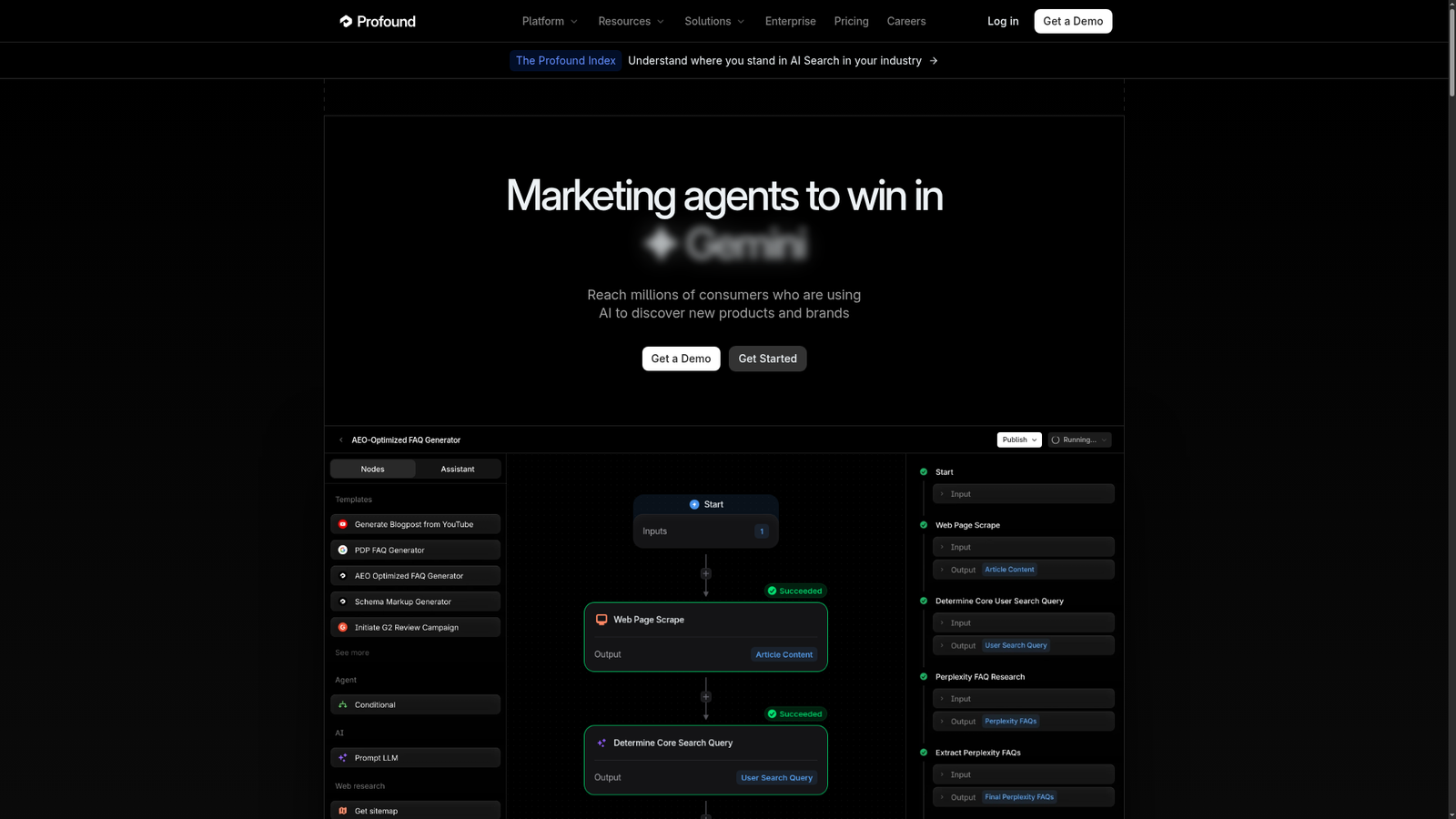
What it does: Profound is a marketing platform for measuring brand visibility across AI search and answer engines like ChatGPT, Perplexity, Gemini, and Claude, with answer engine insights, prompt volumes, and agent-based research.
Standout features:
- Answer engine insights
- Prompt volumes
- Agents for AI search research
Pricing: Custom; sales-led.
Pros:
- Strong enterprise positioning and analytics depth
- 4.6/5 on G2
- Multi-engine coverage
Cons:
- Limited public pricing transparency
- Heavier than SMB or mid-market teams typically need
Who should shortlist it: Enterprise marketing and SEO teams that need executive-level AI answer analytics. For alternatives in this segment, see Profound alternatives and the Slate vs Profound comparison.
AirOps
Best for: Teams combining AI search visibility with content workflow automation.
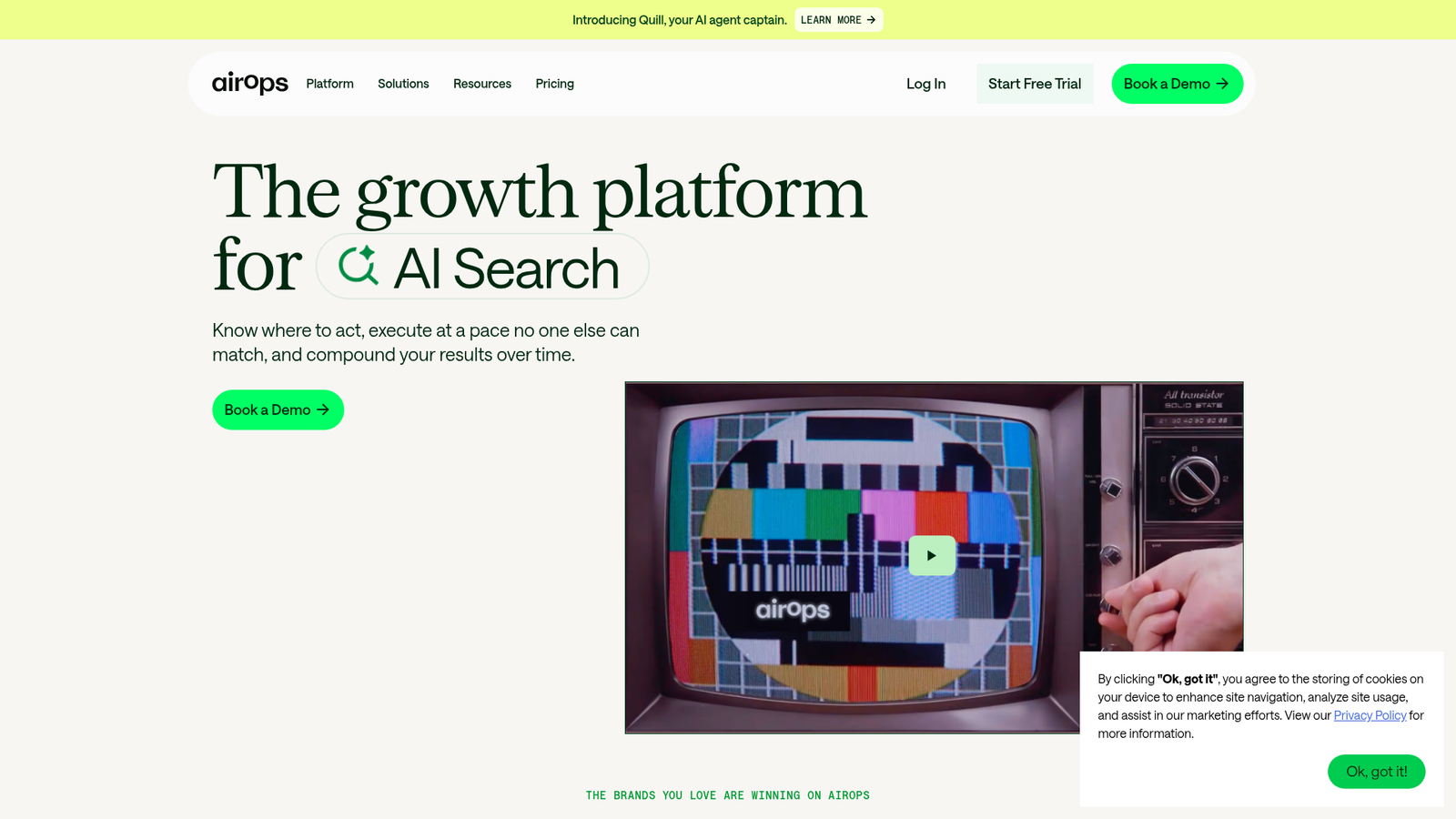
What it does: AirOps is a growth platform that measures AI search visibility, prioritizes opportunities, and operationalizes content through workflows and an AI agent. It tracks citations, competitor share of voice, and connects insight to content creation.
Standout features:
- AI search visibility insights with citation tracking and share-of-voice monitoring
- Quill AI agent and workflows for content operations
- Content refresh tools with brand governance, knowledge bases, and CMS/SEO integrations
Pricing: Insights starts at $0/month. Pages is custom. Solo, Pro, and Enterprise tiers also available.
Pros:
- Combines AI visibility and content workflows
- Free tier for Insights
- 4.6/5 on G2
Cons:
- Workflow-heavy product can require more setup than lightweight monitoring tools
- Pricing for Pages tier is sales-led
Who should shortlist it: Content and SEO teams that want both AI visibility data and execution automation in one platform.
Evertune
Best for: Enterprise brands focused on AI visibility benchmarking and generative engine optimization.
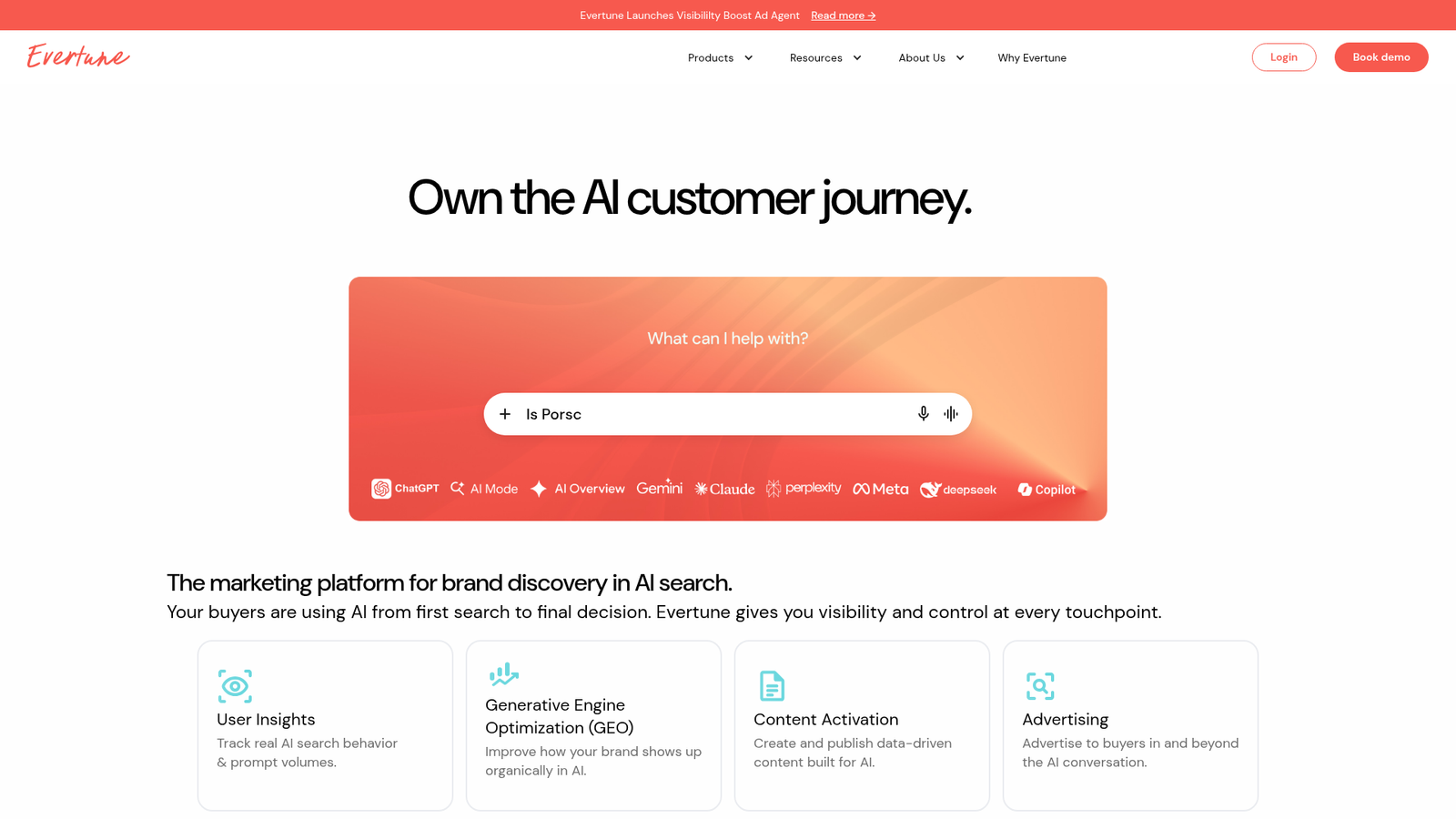
What it does: Evertune is an AI visibility and generative engine optimization platform with user insights into real AI search behavior, competitor intelligence, and content activation tools to publish AI-ready content.
Standout features:
- User insights into real AI search behavior and prompt volumes
- Generative engine optimization with competitor intelligence
- Content activation for AI-targeted publishing
Pricing: Custom; sales-led.
Pros:
- Strong enterprise benchmarking focus
- Combines monitoring with content activation
Cons:
- No public pricing
- Likely scoped for larger brands rather than SMBs
Who should shortlist it: Enterprise brand and growth teams aligning AI visibility with brand strategy.
Frase
Best for: Content marketers and SEO teams adding AI visibility to a content optimization stack.
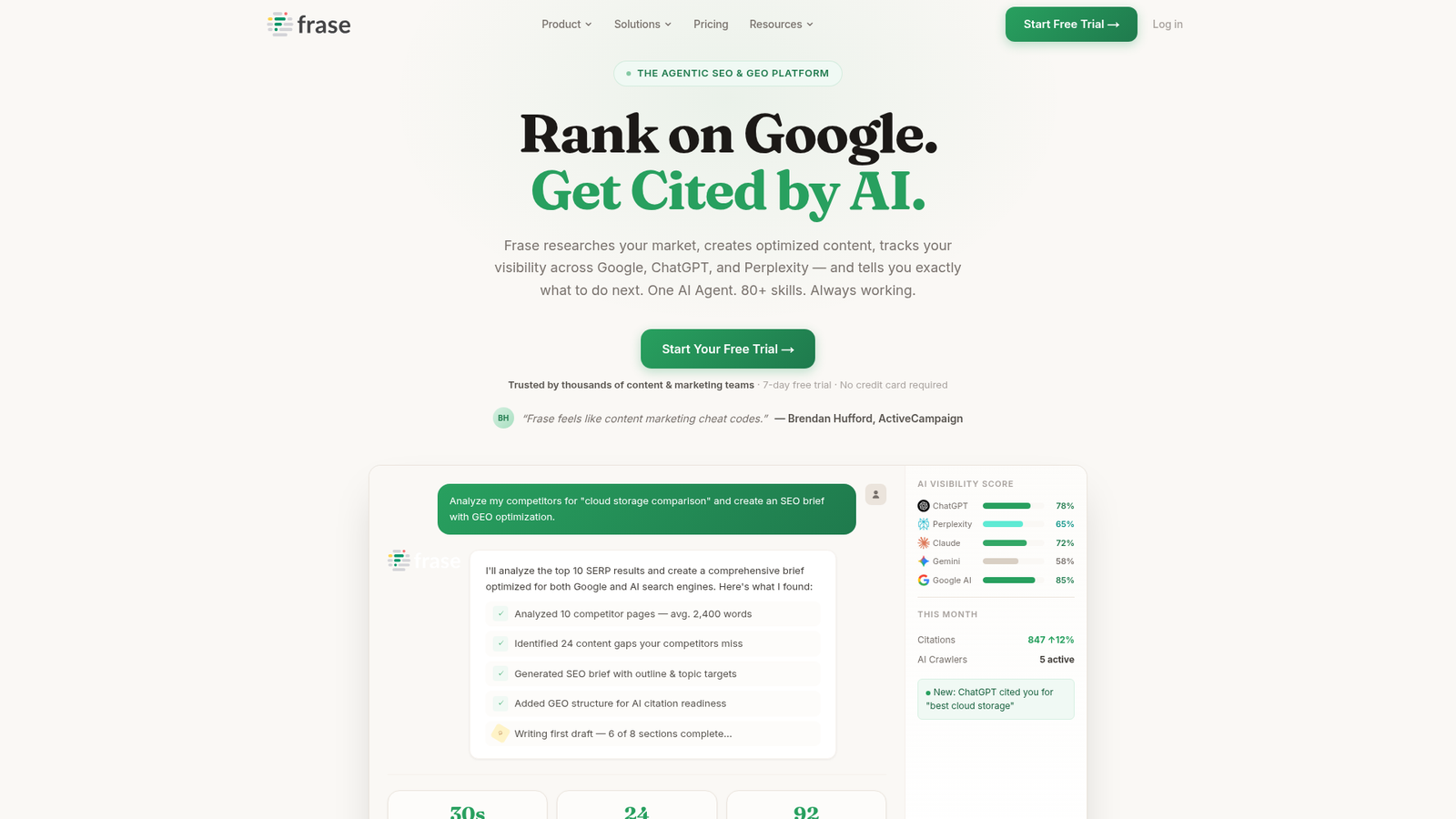
What it does: Frase is an agentic SEO and GEO platform that researches, writes, optimizes, and tracks content so it can rank on Google and get cited by AI. It includes AI visibility tracking across ChatGPT, Perplexity, Claude, and Gemini.
Standout features:
- AI Agent with 80+ skills for research and content creation
- SEO and GEO content optimization with real-time scoring
- AI visibility tracking across ChatGPT, Perplexity, Claude, and Gemini
Pricing: Starter $49/month, Professional $129/month, Scale $299/month, Enterprise custom. 7-day free trial; annual billing saves 20%.
Pros:
- Strong content optimization heritage
- AI visibility tracking integrated into content workflows
- 4.8/5 on G2
Cons:
- AI visibility analytics are lighter than dedicated platforms
- Content scoring is the product's center of gravity, not citation analysis
Who should shortlist it: Content-led teams who want SEO scoring, content optimization, and AI visibility tracking in one product.
SE Ranking
Best for: SEO teams who want an all-in-one platform that adds AI visibility to an existing SEO suite.
What it does: SE Ranking is an AI SEO platform for rank tracking, site audits, keyword and backlink research, and visibility monitoring across traditional and AI search.
Standout features:
- Rank tracking across major search engines
- Website and on-page audit tools
- Keyword, competitor, and backlink research
Pricing: Core $129/month ($103.20/month annual), Growth $279/month ($223.20/month annual), Enterprise custom. 14-day free trial.
Pros:
- Strong SEO foundation with AI visibility add-ons
- 4.7/5 on G2
- Transparent public pricing
Cons:
- AI visibility is one module among many
- Content execution depth is limited
Who should shortlist it: Mid-market SEO teams who want a single tool for rank tracking, audits, and AI visibility.
LLMrefs
Best for: Teams that want focused, lightweight LLM mention and citation tracking.
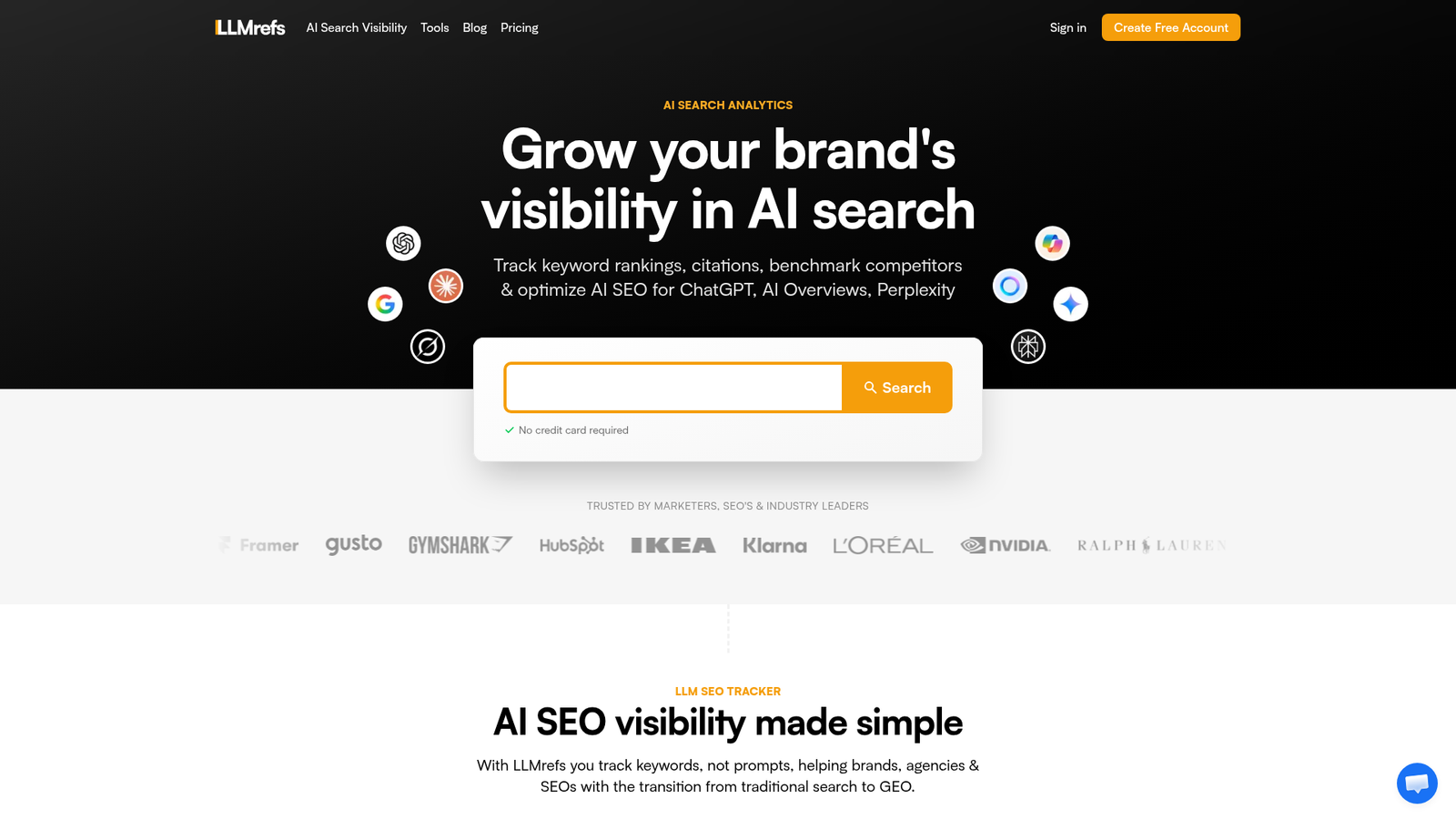
What it does: LLMrefs is an AI search analytics platform that tracks brand visibility, rankings, citations, and competitors across ChatGPT, Google AI Overviews, Perplexity, Gemini, Claude, and Grok.
Standout features:
- Keyword rankings, share of voice, and brand visibility across major AI search engines
- Citation and source tracking to see which URLs influence AI answers
- Competitor benchmarking with geo-targeting, weekly reports, CSV exports, and API access
Pricing: All in One plan at $79/month, including 500 prompts, all AI search engines, weekly reports, citation tracking, geo-targeting, unlimited team members, CSV export, and API access. 7-day free trial.
Pros:
- Single-plan simplicity
- Strong AI citations tracking
- Unlimited team members at one price
Cons:
- No native content execution workflows
- Less mature than larger enterprise platforms
Who should shortlist it: Small teams and consultants who want citation-level AI visibility tracking without negotiating enterprise contracts.
Goodie AI
Best for: Early adopters exploring emerging AI brand visibility platforms.
What it does: Goodie AI is an emerging entrant in the AI brand visibility category. Public information on features and pricing is limited.
Standout features:
- Positioned in the AI brand visibility space
- Emerging product with developing capabilities
Pricing: Custom; confirm directly with the vendor.
Pros:
- Worth tracking as the category matures
Cons:
- Limited public documentation
- Less mature than established alternatives
Who should shortlist it: Teams who actively pilot new platforms and want exposure to emerging vendors in the space.
How to Choose the Right Tool for Your Team
The right shortlist depends on what your team actually owns. A brand lead and an SEO lead will rank the same tools differently because they care about different signals.
Best for SEO and Growth Teams
SEO-first teams should weight prompt research, citation tracking, and overlap with traditional rank data. The point is to fold AI visibility into existing reporting rather than build a parallel stack. Strong fits: Slate for teams that need execution alongside monitoring, Nightwatch for combined SEO and AI tracking, Semrush and Ahrefs for incumbents extending into AI.
Best for Brand and PR Teams
Brand and PR teams should prioritize sentiment, context, source influence, and real-time alerts. The job is reputation, not rankings - and what AI says about the brand often matters more than where it ranks. Strong fits: Brand24 for sentiment and mention breadth, Sight AI for enterprise reputation reporting, Slate when brand teams co-own visibility with content.
Best for Content and Product Marketing Teams
Content and PMM teams should look for prompt-to-content workflows, citation readiness, and refresh prioritization. Insight without an execution layer slows everything down. Strong fits: Slate for end-to-end visibility plus content engineering, Frase for content optimization with AI tracking, AirOps for workflow-first teams, Otterly AI for SMB GEO audits.
Best for Agencies and Consultants
Agencies should prioritize multi-client reporting, seat economics, and platform breadth. White-label reporting and unlimited seats matter at scale. Strong fits: Nightwatch for SEO-led agencies, Slate for content-led agencies managing client production, SE Ranking for budget-conscious shops.
Best for Enterprise Teams
Enterprise buyers should evaluate governance, security, custom prompt portfolios, and executive reporting. Pricing is rarely the constraint; control and accountability are. Strong fits: Sight AI, Profound, Evertune for enterprise reporting depth, and Slate for enterprise teams that also need content execution at scale.
AI Brand Monitoring vs Social Listening vs SEO Tools
Social listening watches conversations. SEO rank tracking watches search results. AI brand monitoring watches what AI systems say when asked a question.
The three measure different signals and serve different teams, even when they share vocabulary.
Most B2B SaaS teams in 2026 need at least AI brand monitoring plus SEO tracking. Social listening is a useful third layer when reputation and PR are core priorities.
What to Do After You Start Monitoring AI Visibility
Monitoring is the easy part. The work that actually moves pipeline starts after the dashboard lights up. This is where most teams stall - and where a system, not another tool, makes the difference.
The GEO guide covers the broader strategy; the framework below is the operating loop.
Step One: Identify Visibility Gaps
Surface the prompts where competitors get cited and the brand does not. Look for pages that should be cited but are not, and prompts where the brand appears with stale or inaccurate framing. Treat these as a gap inventory, not a one-off audit.
Step Two: Prioritize by Impact
Not all gaps matter equally. Rank by prompt volume, buyer intent, and competitive overlap. A bottom-of-funnel comparison prompt where three competitors get cited deserves more attention than a top-of-funnel definition prompt with low buying signal.
Step Three: Engineer Citation-Ready Content
This is where content engineering replaces ad-hoc writing. Citation-ready content has clear entity definitions, direct answers near the top, structured comparisons, source-backed claims, and consistent terminology. The goal is extractability - making it easy for an AI system to lift a passage and attribute it correctly.
Step Four: Publish and Refresh at Scale
Use repeatable workflows, not one-off updates. Maintain brand voice and governance across volume by encoding style guides, knowledge bases, and review steps into the workflow itself. This is where most teams underinvest - and where execution speed quietly compounds.
Step Five: Re-Monitor and Report
Track changes in citation share, prompt coverage, and share-of-voice. Translate movement into executive language: pipeline-adjacent metrics, not vanity counts. Use a checklist like this AI SEO checklist to make the cycle repeatable.
Step Six: Iterate
Prompt portfolios need refreshing as buyer questions evolve. Content needs ongoing updates as products and competitors change. AI search is an operating model, not a one-time project - the teams that win treat it that way.
Slate is built for exactly this workflow. Book a demo to see how it connects monitoring to execution.
FAQs About AI Brand Monitoring Tools
What Is the Best AI Brand Monitoring Tool for B2B SaaS?
The best tool for B2B SaaS depends on whether the team needs monitoring only or monitoring plus execution. SaaS teams usually benefit most from platforms that combine AI visibility tracking, competitor insight, content opportunity discovery, and repeatable workflows for refreshing high-value pages. Slate is purpose-built for that combination.
Nightwatch and Semrush work well for SEO-first teams.
How Much Do AI Brand Monitoring Tools Cost in 2026?
Pricing varies widely by prompt volume, platform coverage, seats, and workflow depth. Entry-level tools start at $29/month (Otterly AI Lite), $49/month (Frase Starter), and $79/month (LLMrefs, with Nightwatch starting at €79/month). Slate starts at $199/month.
Enterprise platforms like Profound, Sight AI, and Evertune use custom pricing. Always confirm whether pricing is public or sales-led.
Which AI Platforms Should Brands Monitor First?
Brands should monitor ChatGPT, Perplexity, Gemini, and Google AI Overviews first because these platforms shape most early research and buying journeys. Depending on audience and market, teams may also track Microsoft Copilot and Claude. Coverage breadth varies by tool, so verify against vendor documentation before shortlisting.
Can Traditional SEO Tools Replace AI Brand Monitoring Tools?
Traditional SEO tools can support parts of AI visibility analysis, but most do not provide full prompt-level monitoring, citation analysis, or evidence logs. Some platforms like Semrush, Ahrefs, and Nightwatch now combine both, but depth varies. For dedicated answer-engine visibility with sentiment and citation tracking, purpose-built tools remain more useful.
How Many Prompts Should You Track?
Most teams start with 50–150 prompts covering top-of-funnel and bottom-of-funnel buyer questions, brand queries, and competitor comparisons. Mature programs expand to 300–1,000 prompts. The right number depends on category breadth, product complexity, and buyer journey length.
Prompt limits vary significantly by plan - entry tiers are often more constrained, while plans like LLMrefs include 500 prompts and enterprise plans scale higher.
Who Should Own AI Brand Monitoring Internally?
AI brand monitoring usually sits with SEO or organic growth leaders because the workflows overlap with content and visibility. Brand and PR teams often co-own sentiment and reputation signals. In B2B SaaS, the Head of Marketing or VP Marketing typically owns the function, while content leads execute the response.
Cross-team workflows tend to outperform single-owner setups.
What Matters More: Mentions, Citations, or Sentiment?
Citations matter most for commercial impact because they reflect whether AI answers point users to a brand's content. Mentions show presence; sentiment shows perception. Strong programs track all three but prioritize citation share for organic growth attribution, sentiment for brand and PR reporting, and mention volume for early-stage benchmarking.
How Is AI Brand Monitoring Different From GEO or AEO?
AI brand monitoring measures how a brand currently appears in AI answers. Generative engine optimization (GEO) and answer engine optimization (AEO) are the practices of improving that appearance. Monitoring tells a team where they stand; GEO and AEO are what they do about it.
The strongest platforms combine both - measurement and content engineering - in a single workflow.