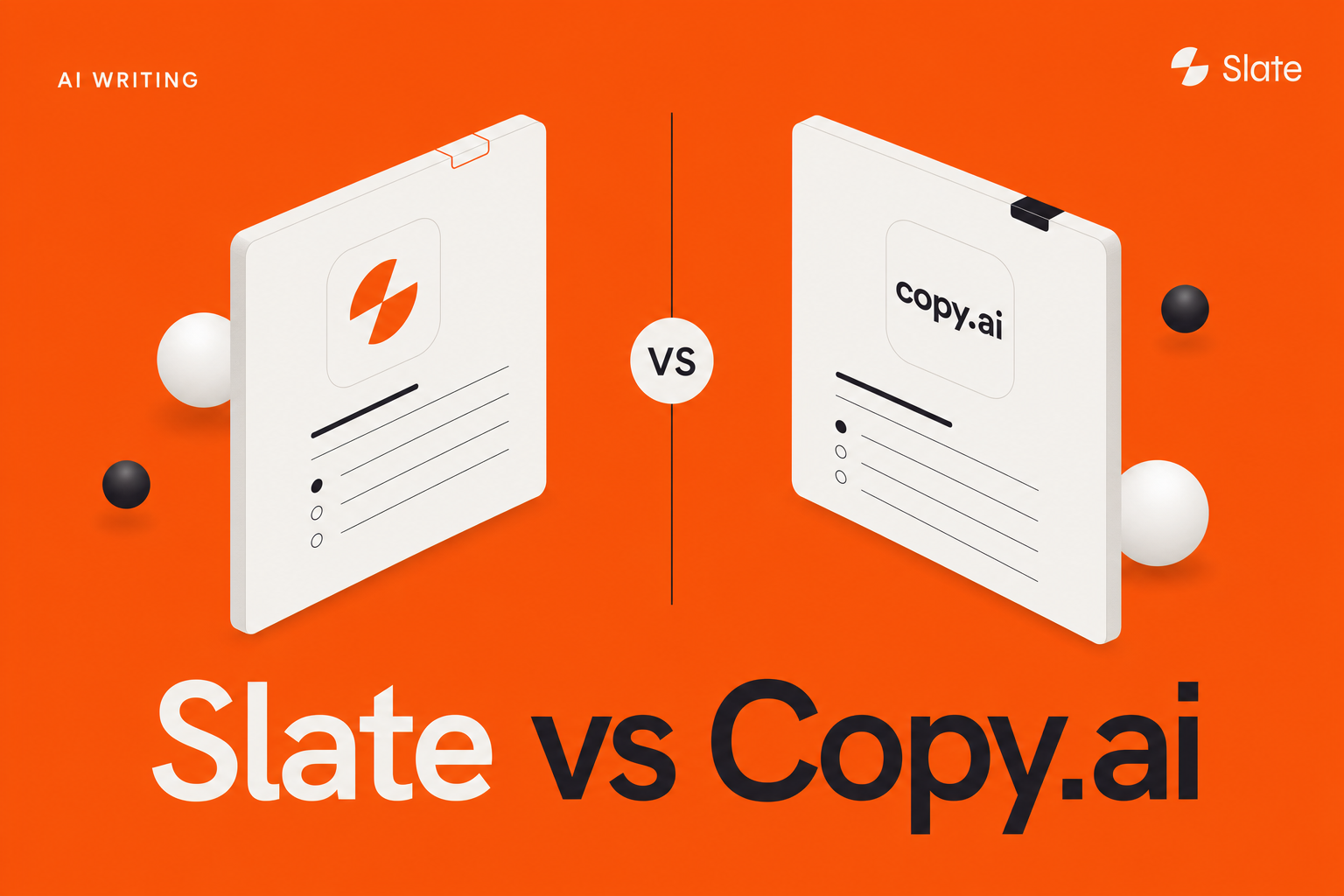
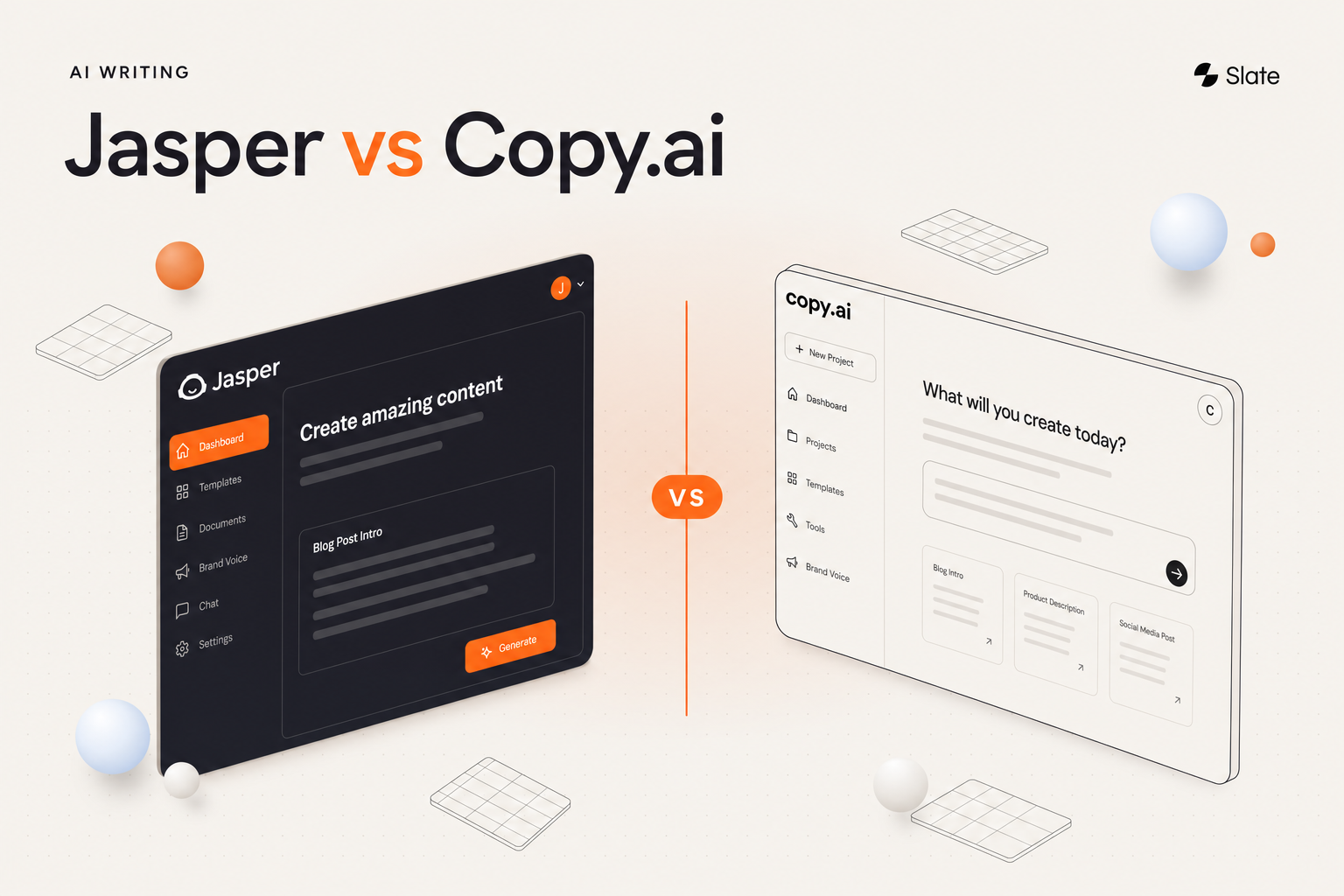
Choosing between Jasper and Copy.ai is no longer a question of which tool writes better sentences. In 2026, both have evolved into workflow platforms, and the real decision comes down to whether your team needs long-form marketing governance or fast go-to-market automation. This guide breaks down features, pricing, SEO, brand control, and team fit so you can pick with confidence.
For most teams, Jasper is the stronger fit for long-form marketing content, SEO-led production, and brand voice governance, while Copy.ai is the stronger fit for GTM, sales, and RevOps teams that prioritize short-form output and multi-step workflow automation. There is no universal winner - the right choice depends on your operating model. If you're still weighing options, our roundup of the best AI content marketing tools offers a wider view.
Key Takeaways
Jasper and Copy.ai now solve different problems, even though both started as AI writers. Use this summary to orient before the detailed breakdown below.
- Jasper is positioned for marketing and content teams that need long-form production, collaboration, and stronger brand governance.
- Copy.ai is positioned for GTM, sales, and RevOps teams that care more about workflow automation and short-form execution.
- Pricing entry points differ in structure: Jasper Pro starts at $59/month billed yearly ($69/month monthly) for one seat; Copy.ai Chat starts at $29/month, with a free tier capped at 2,000 words per month.
- The long-form vs short-form split still matters, but in 2026 the bigger distinction is workflow model - content production versus pipeline execution.
- SEO support and brand voice governance should be evaluated as team-scale operating concerns, not just output-quality features.
- Slate's POV: Evaluate these tools by workflow fit and citation readiness, not output speed alone.
Jasper vs Copy.ai at a Glance: Quick Verdict
Pick Jasper if your priority is structured long-form content, SEO production, and consistent brand voice across reviewers and channels. Pick Copy.ai if your priority is GTM execution - outbound sequences, short-form campaign copy, and multi-step sales and marketing automation. The category has shifted from "AI writer" to "workflow platform," so match the tool to your operating model, not just its draft quality.
Best for long-form marketing content teams: Jasper.
Best for GTM, sales, and RevOps workflows: Copy.ai.
Best for budget-conscious solo and startup use: Copy.ai, thanks to a permanent free tier and a lower paid entry point.
Best for brand voice and SEO governance: Jasper.
If you want to compare Jasper vs Copy.ai against a workflow-first system, that lens matters more in 2026 than raw output.
Comparison Table: Jasper vs Copy.ai (2026)
The table below summarizes how each platform maps to common buying criteria. Use it as a skim layer before the feature deep-dives.
What Each Tool Is Built For in 2026
Both Jasper and Copy.ai started as text generators and have since repositioned as platforms. The clearest way to understand the difference is to look at who each one is built to serve and which workflows it optimizes around. For more options beyond these two, see our list of Jasper AI alternatives.
What Jasper Is Built For
Jasper is an AI platform built for marketing teams to run on-brand content creation and end-to-end marketing workflows.
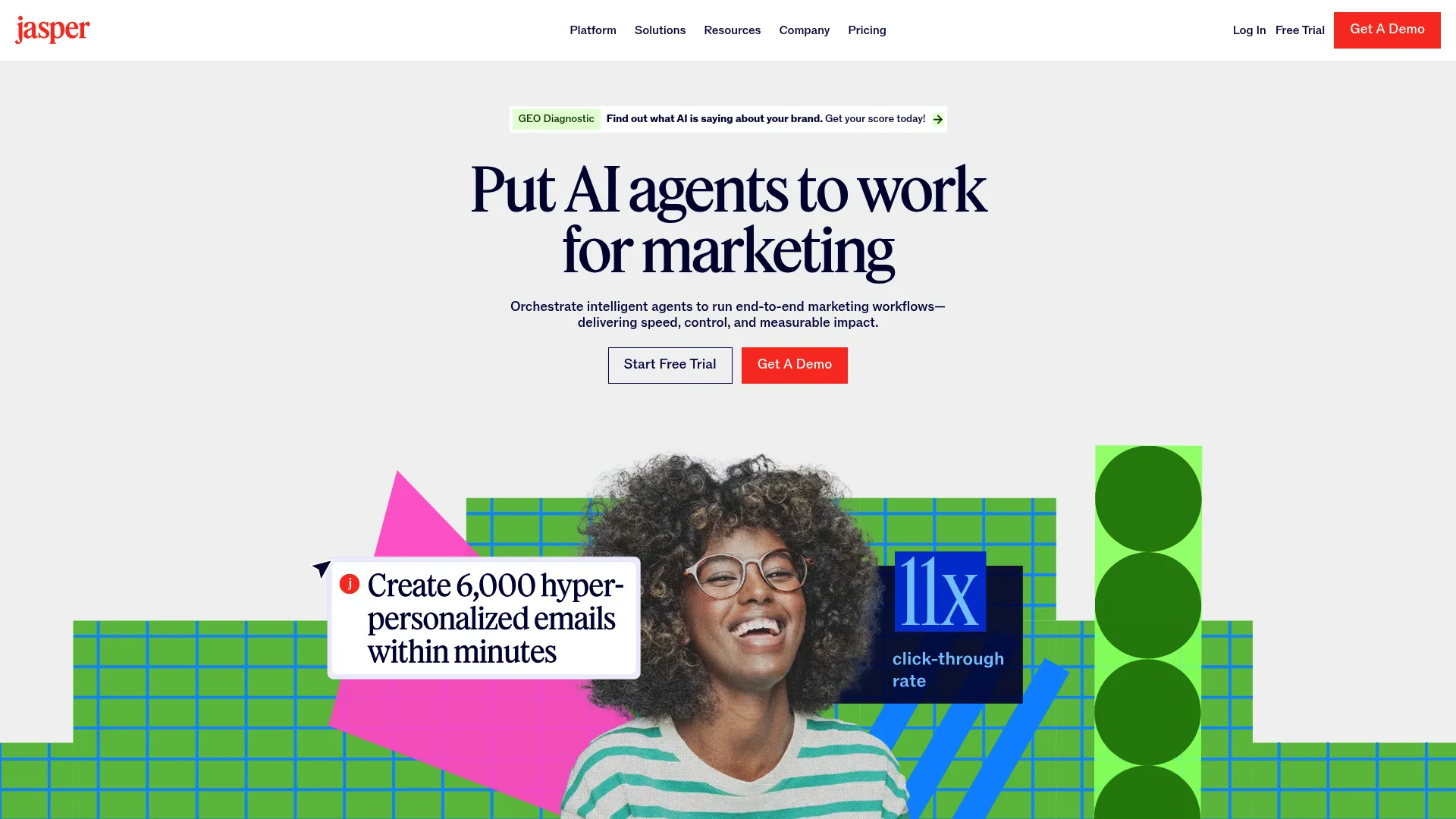
Best for: Marketing teams that need brand-consistent AI for campaign execution, content workflows, and team-scale automation.
Key features: Purpose-built AI agents for marketing tasks; Jasper IQ for brand voice, style guides, audiences, and knowledge; content pipelines and no-code automation for scaling campaigns.
Pricing: Pro $59/month billed yearly ($69/month billed monthly) for one seat; Business is custom and adds advanced agents, a no-code AI app builder, Jasper Grid, API access, admin controls, and priority support. 7-day free trial.
G2 rating: 4.7/5
Jasper leans into long-form drafting, brand voice enforcement, and campaign production - the daily work of content and marketing teams.
What Copy.ai Is Built For
Copy.ai is an AI-native go-to-market platform for sales, marketing, and operations teams to automate workflows, unify data, and generate content.
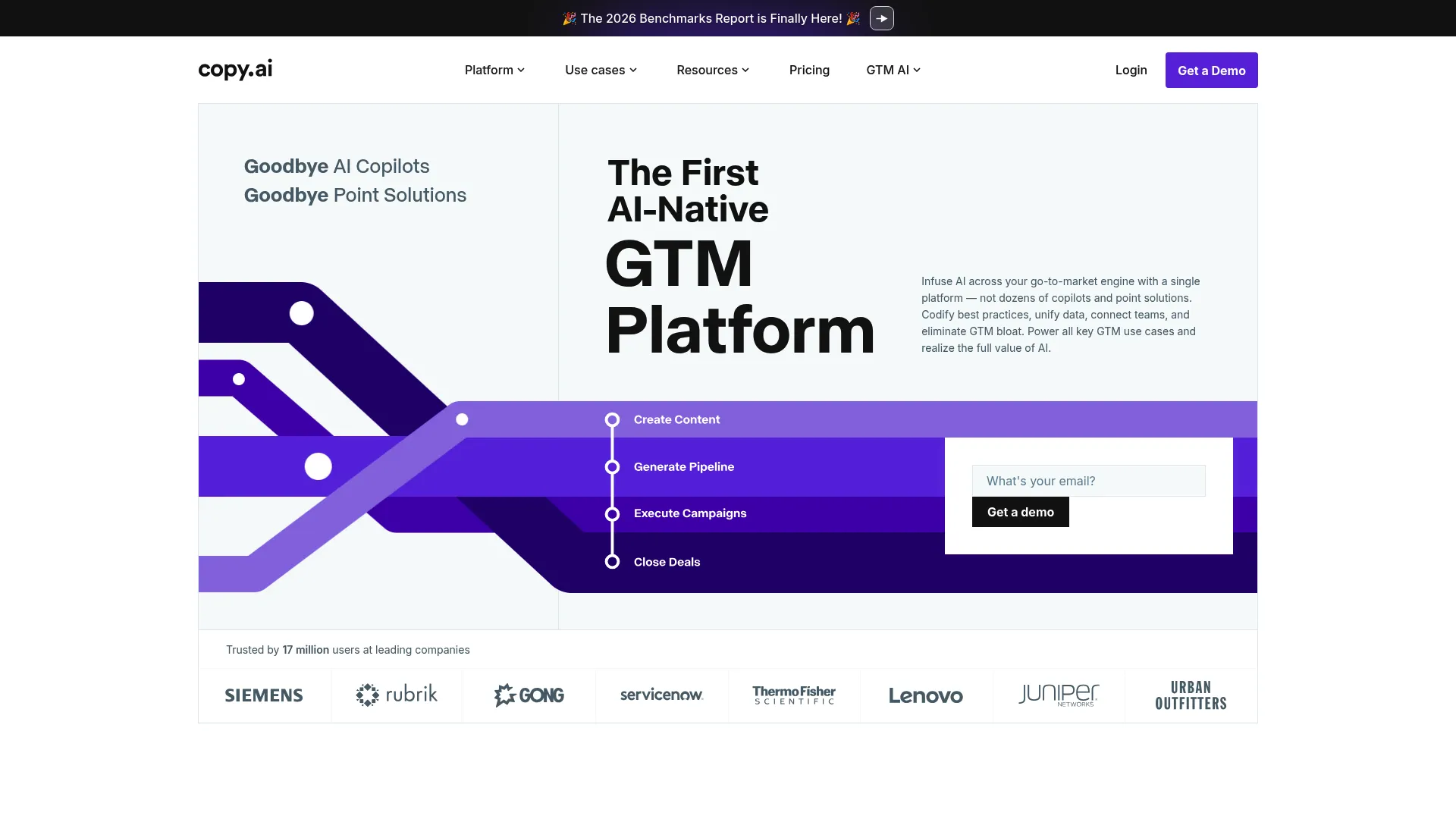
Best for: Go-to-market teams that want to automate sales, marketing, and ops workflows while keeping content and outreach in one platform.
Key features: Customizable AI workflows for GTM processes; Brand Voice, Chat, and AI content generation tools; 2,000+ integrations with data and automation components like Tables and Actions.
Pricing: Chat $29/month billed monthly ($24/month billed annually); Growth $1,000/month; Expansion $2,000/month; Scale $3,000/month; Enterprise custom. Free tier available with 2,000 words per month.
G2 rating: 4.7/5
Copy.ai is built around chat-driven workflows and multi-step automation - research, enrichment, outbound sequences, and high-volume short-form copy.
Feature-by-Feature Comparison
Feature buckets matter more than a single narrative because team needs are rarely uniform. A content team and a RevOps team are evaluating the same two tools for completely different jobs. The sections below break the comparison into the criteria that actually drive a purchase decision, including a Jasper vs Copy.ai view of each capability.
Long-Form Content Creation
For structured long-form marketing content, Jasper is generally the stronger choice. Its editor-centric workflow lets you supply an outline, generate sections, and iterate inside a single document, which suits blog posts and landing pages. Copy.ai can produce long-form content, but it leans on chat and templates rather than a dedicated editor.
Jasper's document workspace is built for the blank-page problem: Brief in, structured draft out, then refine in place. That control compounds when a post needs revisions across multiple reviewers.
Copy.ai handles long-form by assembling sections through workflows or chat, then often needs more manual stitching and editing on longer posts.
If your core output is long-form content and topic clusters, Jasper's editorial depth is the more natural fit.
Short-Form Marketing & Sales Copy
For high-volume short-form copy - ads, social posts, cold email, and outbound sequences - Copy.ai is generally the stronger fit. Its chat-first workflows make it fast to spin up multi-step sequences, and the platform is explicitly built for GTM execution at volume.
Copy.ai shines when the job is "research this account and draft a five-step outbound sequence." That kind of task maps directly to its workflow model.
Jasper still ships a strong template library for ads, headlines, and social captions. The difference is framing: Jasper treats short-form as part of a marketing content suite, while Copy.ai treats it as the front end of a sales motion.
SEO Support
For SEO-led content operations, Jasper has the stronger built-in support, largely through integrations like SurferSEO that let you optimize for target keywords while writing. Copy.ai can support SEO workflows, but mostly by producing content you then run through external SEO tools.
If SEO is a top-three acquisition channel, that distinction is operational, not cosmetic. Optimizing inside the drafting environment removes a handoff that otherwise slows every refresh cycle.
A practical lens here: Which tool fits your brief-to-draft-to-refresh loop with the least friction. For teams weighing which tool is better for SEO and brand voice, Jasper's editor-plus-SEO combination is the safer default.
Brand Voice & Governance
Brand voice is an operational buying criterion, not a feature bullet - especially once multiple writers and reviewers are involved. Jasper's brand voice and style-guide controls, paired with its editor, make it stronger for governing tone and consistency across long-form marketing assets.
Jasper supports defining a brand voice, ingesting knowledge to ground generation, and applying style guidance across outputs. Higher tiers can also support multiple brand voices, which matters for teams managing several products or sub-brands.
Copy.ai also offers Brand Voice, but its governance strength is operational consistency across GTM touchpoints - keeping pitch language and product details aligned across outbound and campaigns through workflows.
The split is clean: Jasper governs editorial voice in documents; Copy.ai governs messaging consistency across sales and marketing execution.
Collaboration & Team Workflows
Both tools support multi-seat plans and shared workspaces, but they lean toward different team shapes. Jasper's collaboration centers on content teams - multiple writers and editors working against shared brand voices in a document environment.
Copy.ai's collaboration centers on GTM teams - shared workflows and shared messaging context used by multiple SDRs and marketers running the same automations.
For larger organizations evaluating Jasper vs Copy.ai for enterprise content teams, confirm seat models, admin roles, and any approval steps directly during a trial, since formal editorial sign-off flows are often handled in adjacent tools.
Workflow Automation
This is where the two tools diverge most sharply. Copy.ai is the stronger choice for GTM and sales automation, with multi-step workflows that chain research, enrichment, personalization, and outbound - positioned around generating pipeline and executing campaigns.
Jasper offers campaign-type workflows where a single brief produces multiple related assets, but its automation is content-focused rather than pipeline-focused.
In short, Copy.ai automates the motion around a deal; Jasper automates the production of marketing content. Teams comparing automation depth in a broader Jasper vs Copy.ai comparison should weigh which kind of automation actually moves their numbers.
Integrations & API
Match integrations to the job, not the raw count. Jasper is stronger on content marketing integrations - a Chrome extension, SEO tooling like SurferSEO, and an API for embedding into workflows.
Copy.ai is stronger on GTM ecosystem connections, advertising 2,000+ integrations spanning CRM, sales engagement, and ops stacks, plus data components like Tables and Actions.
If your content lives in a CMS and your SEO stack drives publishing, Jasper's ecosystem fits. If your work threads through a CRM and sales tooling, Copy.ai's breadth is the advantage.
Image Generation, Plagiarism & Compliance Extras
Jasper includes extras that Copy.ai does not emphasize, notably image generation and plagiarism checking inside its suite. These matter for marketing teams producing visual campaign assets and publishing original long-form content at scale.
Copy.ai's product narrative centers on text and workflows rather than creative media or plagiarism tooling. Confirm any specific compliance requirements - security certifications, data handling - directly with each vendor before signing.
Pricing Comparison: Jasper vs Copy.ai (2026)
Is Copy.ai cheaper than Jasper? At the entry point, yes - Copy.ai's Chat plan starts at $29/month and offers a free tier, while Jasper Pro starts at $59/month billed yearly. But the answer flips as you scale: Copy.ai's team and GTM tiers jump to $1,000/month and above, while Jasper stays seat-based until you reach custom Business pricing.
For a full breakdown of how seat-based versus workflow-based pricing affects cost - and how that compares to whether Copy.ai is cheaper than Jasper - model your actual team size before committing to an annual plan.
Real-World Pricing Scenarios
Starter prices hide team-size tradeoffs, so it helps to model cost by team shape.
Solo marketer: Copy.ai is cheapest - the free tier or $29/month Chat plan covers light short-form use. Jasper Pro at $59/month yearly is the entry point if you need long-form and brand voice.
3-person content team: Jasper's seat-based Pro plan stays predictable, roughly in the low hundreds per month. Copy.ai at this size depends on whether short-form Chat seats suffice or the team needs workflow tiers.
5-seat team: Jasper remains seat-based and predictable on Pro. Copy.ai teams needing shared GTM workflows typically move beyond Chat into higher tiers, which raises cost quickly.
Sales plus marketing (10 users): This is where the models split hardest. Jasper scales by seats toward custom Business pricing; Copy.ai's GTM tiers start at $1,000/month and climb, reflecting its workflow-automation value rather than per-seat writing.
The takeaway: Copy.ai is cheaper to start but gets expensive faster once GTM automation and team workflows enter the picture. Jasper's seat-based model scales more linearly for content teams.
Can You Use Jasper and Copy.ai Together?
For many teams, Jasper and Copy.ai are complementary rather than redundant. Jasper acts as the marketing content engine; Copy.ai acts as the GTM and sales automation engine. They overlap on short-form copy but solve genuinely different jobs.
A natural division: Use Jasper to produce core assets - SEO blog posts, messaging pillars, website copy - then use Copy.ai to turn those into outbound sequences, ad variants, and social snippets for execution.
They become redundant only if your team needs just one of those pillars. A content-only organization rarely needs Copy.ai's automation; a sales-only team rarely needs Jasper's editorial depth.
Either way, neither tool is a complete content workflow system on its own. Both produce output, but turning that output into governed, trackable, citation-ready content at scale requires a broader layer of content workflows - which is where Slate's content engineering lens comes in.
Which Should You Choose? Recommendations by Team Type
There is no universal winner. The right choice depends on your operating model, content type, and where your growth actually comes from. Use these segmented recommendations to match the tool to your team.
Best for Content Marketing Teams
Choose Jasper if your primary output is long-form blog content, campaign assets, and on-brand marketing copy produced by a team of writers and editors. Its editor, brand voice controls, and campaign workflows are built for exactly this motion, and consistency holds up as more reviewers enter the process.
Best for GTM, Sales & RevOps Teams
Choose Copy.ai if your priority is pipeline and execution. Its chat-driven workflows automate research, enrichment, outbound sequences, and follow-ups, keeping sales and marketing messaging consistent through a shared knowledge base. For teams measured on pipeline rather than published pages, this is the stronger fit.
Best for Startups & Solo Founders on a Budget
Choose Copy.ai if budget is the deciding factor. Its permanent free tier and $29/month Chat plan make it the cheapest starting point for short-form needs. Move to Jasper only when long-form production and brand governance justify the higher floor - which often happens sooner than founders expect.
Best for Multi-Seat Collaboration & Brand Governance
Choose Jasper if multiple writers and reviewers need to produce consistent, on-brand long-form content. Its brand voice, style guides, and multi-voice support on higher tiers govern editorial consistency at scale better than chat-based generation.
Best for SEO-Led Content Operations
Choose Jasper if SEO is a top acquisition channel. Optimizing inside the editor through integrations removes a handoff and speeds your refresh cycle. Teams running Jasper vs Copy.ai for SEO teams will find Jasper's editor-plus-SEO setup the more operationally efficient default.
Best for Agencies Managing Multiple Brands
Choose Jasper if you manage distinct brand voices across clients and need editorial consistency per account. Choose Copy.ai if your agency work is GTM-heavy - outbound, lead gen, and campaign execution. Many agencies weighing Copy.ai vs Jasper for agencies end up running both, splitting content production from execution.
The 2026 Lens: Evaluate Workflow Fit, Not Just Writing Quality
The most useful reframe in 2026 is this: the category has shifted from "AI writer" to "workflow platform." Vendor messaging confirms it - Jasper positions around marketing teams and campaigns, Copy.ai around go-to-market execution. Draft quality has largely converged. What separates these tools now is the operating model each one assumes.
A simple framework helps. Copy.ai maps to speed and GTM execution: it's built to move fast across many short-form touchpoints. Jasper maps to control and process: brand consistency, structured long-form, and governance across reviewers.
So the real buyer question isn't "which writes better?" It's "which workflow fits how my team actually operates, and what does that mean for downstream visibility?"
That last part is where most comparisons stop short. Speed without operational control just produces more content faster - it doesn't guarantee that content gets found, cited, or trusted. The teams winning organic growth in 2026 aren't the ones publishing the most, reflecting the shift from links and rankings to citations in discovery. They're the ones whose content is structured, governed, and built to be extracted by AI answer engines. Understanding how AI citations work is increasingly central to that advantage.
This is the gap a writing tool alone cannot close, and it's why evaluation criteria should be stricter than draft speed.
Which Tool Better Supports Citation-Ready Content?
Citation readiness is the 2026 lens that matters most for teams chasing measurable visibility across search and AI answer engines, reflecting the rise of answer engine optimization. The question shifts from "is this draft good?" to "is this content structured to be extracted, attributed, and cited?" Our overview of the best AEO tools goes deeper on this shift.
Neither Jasper nor Copy.ai was designed around that outcome. Both produce drafts; neither tracks how your content performs inside ChatGPT, Perplexity's approach to source citations, or AI Overviews appearing in Google Search results, or systematically structures it for extraction.
Slate sits at this layer as a system of action. It turns either tool's output into citation-ready, governed, trackable content at scale - combining AI search visibility tracking with content workflows, brand-safe generation, and direct CMS publishing.
For teams thinking in these terms, the deeper discipline of content engineering and a practical look at how to engineer content with Slate reframe the entire evaluation. The AI writer is one layer; visibility is the outcome.
Pricing: Slate starts at $199/month.
G2 rating: 4.9/5
How We Compared Jasper and Copy.ai
This comparison evaluates both platforms across the criteria that drive real buying decisions: Long-form content, short-form copy, SEO support, brand voice and governance, collaboration, automation, integrations, and total cost of ownership.
Pricing and publicly documented features were checked against official pricing pages, product documentation, and current brand profiles. Capabilities that usually require sales confirmation - enterprise security, custom integrations, and exact workflow credit caps - are described conservatively.
The comparison is organized around consistent task-based criteria: A long-form blog draft, campaign repurposing, an outbound sequence, and a brand-safe revision. Enterprise-only capabilities are treated as documentation-based unless publicly documented.
Feature sets and pricing in this category move quickly, so confirm current plans during your own trial before committing to an annual contract.
How to Evaluate Both Tools During a Free Trial
Before you buy, run the same five tasks in both tools. Identical inputs make the differences obvious and keep your decision grounded in your actual workflow rather than marketing claims.
- Long-form draft: Generate a 1,500–2,000 word post from the same outline in both tools. Judge editor UX, structural control, and ease of revision.
- Campaign repurposing: Feed each tool one core asset and request three email variants, five social posts, and two ad variations. Judge message consistency and speed.
- Outbound sequence: Build a four-to-five-step cold sequence for the same ICP. Judge personalization support and how easily you can iterate.
- Brand-safe revision: Take a generic draft and ask each tool to rewrite it in your brand voice. Judge how well tone and terminology hold.
- Multi-user review: Add a teammate, draft in one seat, review in another. Judge sharing, comments, and admin friction.
For each task, time the workflow, capture any off-brand output, and note where approvals require an outside tool. Before signing annually, ask sales about seat minimums, workflow credit caps, and when enterprise pricing triggers.
Final Verdict: Jasper vs Copy.ai
There is no universal winner - the right answer is workflow-dependent. Choose Jasper if your team produces long-form marketing content, runs campaigns, needs SEO support inside the editor, and governs brand voice across reviewers. Choose Copy.ai if your team lives in GTM execution and values multi-step sales and marketing automation over editorial depth.
By team size, Jasper's seat-based pricing scales linearly for content teams, while Copy.ai is cheapest to start but jumps sharply once GTM workflows enter. By content type, Jasper owns long-form and SEO; Copy.ai owns short-form and outbound. By workflow maturity, the question is whether you're optimizing content production or pipeline execution.
But choosing an AI writer is only one layer. Scaling measurable visibility - tracking where you're cited, refreshing content systematically, structuring it for extraction, and governing it at scale - requires a broader system. That's the gap Slate is built to close.
Book a demo: https://slatehq.com/book-a-demo
FAQs
Is Jasper better than Copy.ai for long-form content?
Yes, Jasper is generally the stronger fit for structured long-form content. Its editor-centric workflow lets you draft from an outline, generate sections, and revise in a single document. Copy.ai can produce long-form content but relies on chat and templates, requiring more manual stitching for longer posts.
Which is better for short-form marketing copy: Jasper or Copy.ai?
Copy.ai is generally the stronger fit for fast, high-volume short-form and GTM tasks. Its chat-driven workflows make ads, social posts, cold email, and outbound sequences quick to produce. Jasper handles short-form well too, but frames it as part of a broader marketing content suite rather than a sales motion.
Is Copy.ai cheaper than Jasper?
At entry level, yes - Copy.ai's Chat plan starts at $29/month with a free tier, while Jasper Pro starts at $59/month billed yearly. But the comparison flips at scale: Copy.ai's GTM tiers start at $1,000/month, while Jasper stays seat-based until custom Business pricing. Cost depends on team size and usage.
Which tool is better for SEO and brand voice: Jasper or Copy.ai?
Jasper is the stronger fit when SEO-led content operations and brand governance matter most. It supports keyword optimization inside the editor through integrations and offers brand voice plus style-guide controls for consistency. Copy.ai supports brand voice for GTM messaging but offers limited native SEO tooling.
Who should choose Jasper over Copy.ai?
Choose Jasper if you're a marketing or content team managing long-form content, campaigns, and consistency across multiple writers and reviewers. Its editor, brand voice controls, SEO integrations, and campaign workflows are built for editorial production at team scale rather than sales execution.
Who should choose Copy.ai over Jasper?
Choose Copy.ai if you're a GTM, sales, or RevOps team that prioritizes workflow automation and execution speed. Its chat-driven workflows automate research, enrichment, outbound sequences, and follow-ups, with a shared knowledge base keeping messaging consistent across the pipeline.
Can Jasper replace Copy.ai (or vice versa)?
They overlap on short-form copy but solve different jobs, so replacement depends on your needs. Jasper handles content production; Copy.ai handles GTM automation. A content-only team rarely needs Copy.ai, and a sales-only team rarely needs Jasper. Many teams run both as complementary tools.
Which tool is better for B2B SaaS content teams?
For B2B SaaS content teams focused on long-form, SEO, and brand consistency, Jasper is typically the stronger fit. For SaaS teams centered on outbound and GTM execution, Copy.ai fits better. Many SaaS organizations use both - Jasper for content, Copy.ai for pipeline - split by function.
Is either tool enough without a broader content workflow system?
Both produce drafts well, but neither tracks AI search visibility or systematically structures content for citation and extraction. Turning output into governed, trackable, citation-ready content at scale requires a broader layer. Slate provides that system of action, combining visibility tracking with content workflows and brand-safe publishing.