Everything was set:
A sharp strategy deck. A carefully mapped keyword universe. Buyer personas everyone agreed on. Clear understanding of what content the audience needs.
Six months later:
Barely half the planned content shipped. What went out the door was inconsistent. Nothing got refreshed. No one could explain why the machine stalled.
Why does this sound like a couple’s therapy conversation, and what exactly happened in between?
This is the ”rough relationship” between content strategy and content operations.
As working teams, we don’t separate these two concepts in our daily lives. But given that they solve different problems and neither works without the other, it helps to take a tactical look at them.
In 2026, you are managing visibility across Google, ChatGPT, Perplexity, and Gemini simultaneously. The coordination between strategy and operations has become the differentiator between teams that scale vs scramble.
At Slate, we work with content teams every day, and we’re seeing even experts finding it challenging to adapt their content engines to cater to AI’s more complicated requirements.
Which is when we decided to break it down:
- What content operations and content strategy involve
- Where they diverge
- How they reinforce each other
- How to build both into a system that holds up
Let’s get started.
What Is Content Strategy?
It's the act of deciding what your brand says, to whom, and why, before a single word gets written. Basically, a blueprint that gives content direction and purpose.
A strategy answers three core questions:
- Who is your audience and what do they need?
- What do we want them to think or do after engaging with our content?
- How does all of this connect to business outcomes?
That sounds straightforward, right? But in practice, it is messier than it looks on paper.
You're reconciling four things at the same time:
- What your sales team needs
- What your audience actually searches for
- What your leadership team wants to talk about
- What the market wants to hear
- How your competitors are going about it
These five things put together must contribute to your AI citations and SERP rankings.
This is just not achievable without a solid strategy. It’s what keeps a team focused - a vague one gives everyone permission to go in different directions.
What Does a Content Strategy Consist Of?
Every component listed above is essential. But having them documented doesn't mean they'll translate into published content that hits the mark.
This is the “Big Problem” with content engines today.
According to the Content Marketing Institute, just 29% of B2B marketers with a documented content strategy say it's effective.
This is because strategy is only as good as its execution, and execution requires infrastructure.
Enter content operations.
What Is Content Operations?
Content operations is the system of people, processes, and technology that powers content from idea to published asset.
Content expert Cathy McKnight defines it as "anything that impacts the delivery of content, full stop."
Editorial workflows, approval chains, content calendars, publishing pipelines, quality governance, performance measurement - all of it.
Sounds like boring stuff, doesn’t it?
Without it, even the best content strategy stalls at the planning stage, and you have a collection of ad hoc processes masquerading as one.
Some content teams grind their teeth through it, some use smart systems that do it for them instead.
The Four Core Pillars of Content Operations
Why is Content Operations Important?
Three reasons:
- To avoid content decay
- To engineer content for AI
- To manage content velocity
Content teams are managing visibility across traditional search and AI platforms simultaneously.
This dual-system reality changes the math on three content operations:
First, content decay is more dangerous now
If your article references 2023 data, AI platforms will cite the competitor whose page was refreshed last quarter. Freshness signals carry more weight than they did even 18 months ago.
87% of AI citations in SaaS and finance verticals come from content refreshed within the last three months. That's a narrow window, and keeping up with it across a content library of hundreds or thousands of pages without an operating system is impossible.
Second, the types of content that earn AI citations are more structurally demanding.
LLMs prefer content with clear answer structures, well-organized headers, FAQ sections, and schema markup. Maintaining these standards across every piece in your library with just a bullet list is once again…impossible.
Third, the sheer velocity of content required to maintain visibility is crazy.
Between new content creation, competitive gap-filling, and ongoing refreshes, operations is what keeps teams functioning efficiently. It's what lets you refresh 200 pages in a quarter instead of 20.
Without operational infrastructure, content velocity stalls and visibility erodes.
Content Operations vs. Content Strategy
There seems to be overlaps between these two, doesn’t it?
The overlaps are in terms of the end goal and overall function. But “planning to go to the restaurant in the car” is very different from actually “driving the car to the restaurant.”
Strategy is
- About decision-making
- Market understanding, competitive awareness, and the ability to connect content themes to revenue
- Studying what competitors are publishing
- Distilling all of that into a plan that's focused enough to actually execute
Operations is
- About repeatability and scale
- Turning a one-time win into a system that produces wins consistently
- Making one-off great content into a predictable practice
- Converting insights into action
In reality, the same person could be working on both. In fact, that is more likely. But mentally, this segregation needs to be there.
Otherwise, chances are that one might end up writing one LinkedIn post and call it a day for their contribution to strategy - the big picture view is absent.
This is even more crucial for today’s content teams, because you are battling two beasts at the same time: Google and AI engines.
Strategy now includes factoring in:
- Entity presence
- Citation patterns
- AI answer surfaces
While operations now includes:
- Data instrumentation
- Scalable tracking
- Cross-channel governance
Common Misconception About Content Strategy
A lot of teams confuse having a content calendar with a content strategy.
A content calendar is an operational tool.
It tells you when to publish, not what to say or why it matters. This confusion is one of the main reasons teams feel like their "strategy" isn't working: they skipped the strategic layer entirely and jumped straight to scheduling.
Why Content Fails Even With Good Strategy + Operations?
Most marketing strategies fail in execution because the handoff between "here's what we should do" and "here's how we're doing it" has gaps that widen over time.
Where does this mismatch happen?
There are three patterns we usually see.
No Translation Layer Between Strategy and Execution
Most strategies are defined in a slide deck or planning document, then handed off to writers with minimal operational scaffolding.
There's no:
- Brief template that translates the goal into concrete instructions
- Workflow for getting SME input
- Review cadence
- Process for refreshing content
So, yes. It’s like saying “good idea, we should do this!” to your friend and then ghosting them.
The Strategy is Not Scalable
A team might produce one exceptional thought leadership article when the head of content personally oversees it from brief to publish.
But the moment you try to produce 10 or 20 pieces a month across multiple contributors, freelancers, SMEs, AI-assisted drafts, quality and brand consistency go for a toss.
What worked as a craft doesn't scale without a system.
45% of B2B marketers lack a scalable model for content creation.
45%! Isn’t that concerning?
There is No Feedback Loop
Strategy is only as good as its ability to adapt.
If operations don't include performance tracking, content auditing, and regular reporting back into the strategy layer, the team keeps executing a plan that may no longer reflect reality.
Content that was strategically sound six months ago might now be decaying in both search rankings and AI citations.
The way content gets discovered and consumed is changing quarter over quarter, not year over year. Sometimes, with new models or algorithms, even month-by-month.
Without operations, strategy goes stale. The team keeps producing content for a search environment that no longer exists.
How Content Strategy and Content Operations Work Together
The above three common failures share a common thread: strategy and operations are treated as sequential handoffs rather than connected systems.
What happens when you flip this? When operational thinking is baked into the strategy phase itself?
Consider a B2B SaaS company targeting the "accounts receivable automation" space. They plan 30 blog posts across the funnel.
Without operational thinking, that plan exists as a list of topics in a spreadsheet. It looks complete, but it isn't.
With operational thinking, the same strategist also asks:
- Can we really produce 30 posts at the quality bar our audience expects, given our current team size and contributor network?
- Do we have SME access for the technical pieces on ERP integration and compliance?
- What's our refresh plan when these posts start decaying in six months?
- How are we monitoring whether AI platforms cite us for these queries, and what's our response when they don't?
These questions make the strategy into a plan of action.
The result is a more realistic, more durable plan that accounts for production capacity, technology constraints, and the continuous nature of modern content performance.
The best way to think about it: strategy and operations form a cycle, not a handoff.
Strategy informs what operations produces. Operations generates performance data that refines strategy. Better strategy produces more focused operations.
And the cycle continues.
How to Build Scalable Content Operation + Strategy
When you set out to build or scale a content operation, ask this first:
What's breaking right now, and what will break next when we try to grow?
Then, assess:
- Production bottlenecks
- Governance gaps
- Team capacity
- Technology debt
- Measurement maturity
This is a crucial distinction.
Many teams approach content operations backwards: they pick a tool, try to fit their process into it, and wonder why things still feel broken.
After that, here’s a step-by-step framework to follow:
1. Audit Your Current Content Workflow End-To-End
Map every step from content request to published asset, including the messy handoffs, unwritten approval processes, and the "just Slack it to me" shortcuts.
And then, identify where work stalls, where quality drops, and where effort gets duplicated.
Most teams find that the bottleneck is rarely a writing bandwidth problem. More often, it's a review logjam, an unclear brief, or a publishing process that takes three decades.
2. Define Clear Ownership at Every Stage
Assign a single accountable person for each phase: ideation, brief creation, drafting, review, SEO optimization, publishing, and performance monitoring.
Ownership gaps are the number one cause of content bottlenecks.
3. Build Repeatable Templates and Standards
Create brief templates, style guides, SEO checklists, and brand voice documentation that any contributor, internal or freelance, can follow to produce on-brand content without constant oversight.
This is especially critical when incorporating AI-assisted drafting.
85% of B2B marketers now use generative AI tools. But without clear guardrails, AI-generated content can become generic.
4. Choose the Right Technology
Your stack should enable workflow automation, content management at scale, and performance tracking, ideally in one system rather than a patchwork of tools.
Did you know that only a mere 31% of B2B marketers say their organization has the right content management technology?
Look for platforms that integrate content creation with SEO data, AI visibility tracking, and publishing workflows.
More than saving time, the right tool reduces the number of decisions that need to be made manually, which is where most content processes leak efficiency.
5. Build the Measurement and Feedback Loop
Track content production velocity, time-to-publish, content freshness, organic performance, and AI citation visibility.
Feed this data back into the strategy layer monthly.
The measurement system isn't just for reporting; it's the mechanism that keeps strategy and operations aligned over time.
Building this system from scratch is entirely possible, and the steps above apply regardless of what tools you use.
But the right platform can compress months of setup into days, because the workflows, tracking, and governance capabilities come pre-built rather than cobbled together from five different tools.
How Slate Brings Content Strategy and Operations Together
Slate turns content into a repeatable system instead of a series of manual projects.
The platform is built around each of the operational challenges discussed above, from workflow bottlenecks to brand consistency to AI visibility tracking.
Here’s how you can use it to solve your content operations + strategy alignment:
Workflows: Automated Research-write-refresh Loop
Slate's Workflow Builder lets teams design custom content pipelines that run continuously.
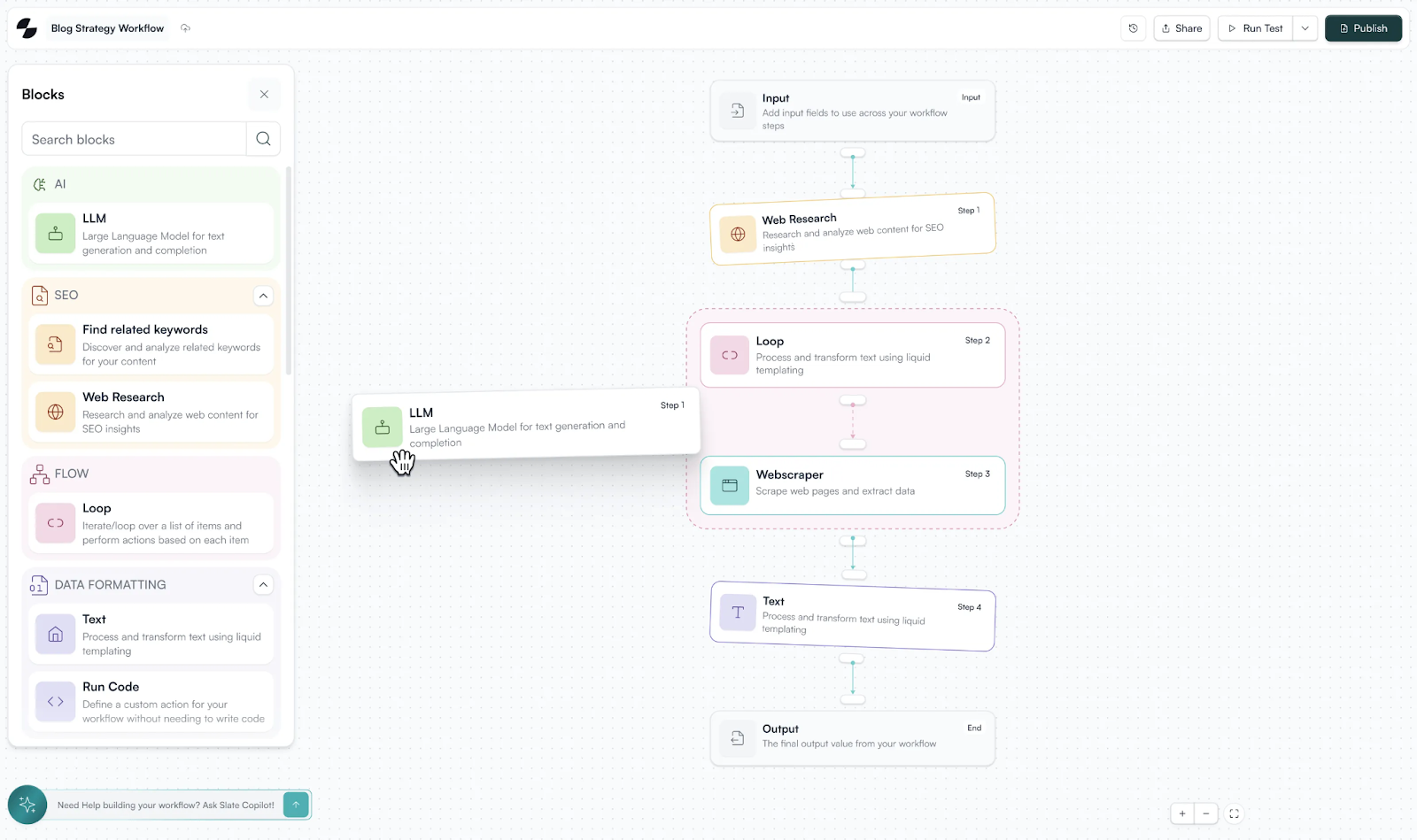
Instead of manually assigning research tasks, briefing writers, and scheduling refreshes, you drag and drop steps into automated workflows that handle the full cycle, from topic research and content drafting to optimization and publishing.
Power Sheets: Manage Content at Scale
For people managing hundreds or thousands of URLs, Slate Sheets provide a spreadsheet-like interface for running bulk operations.
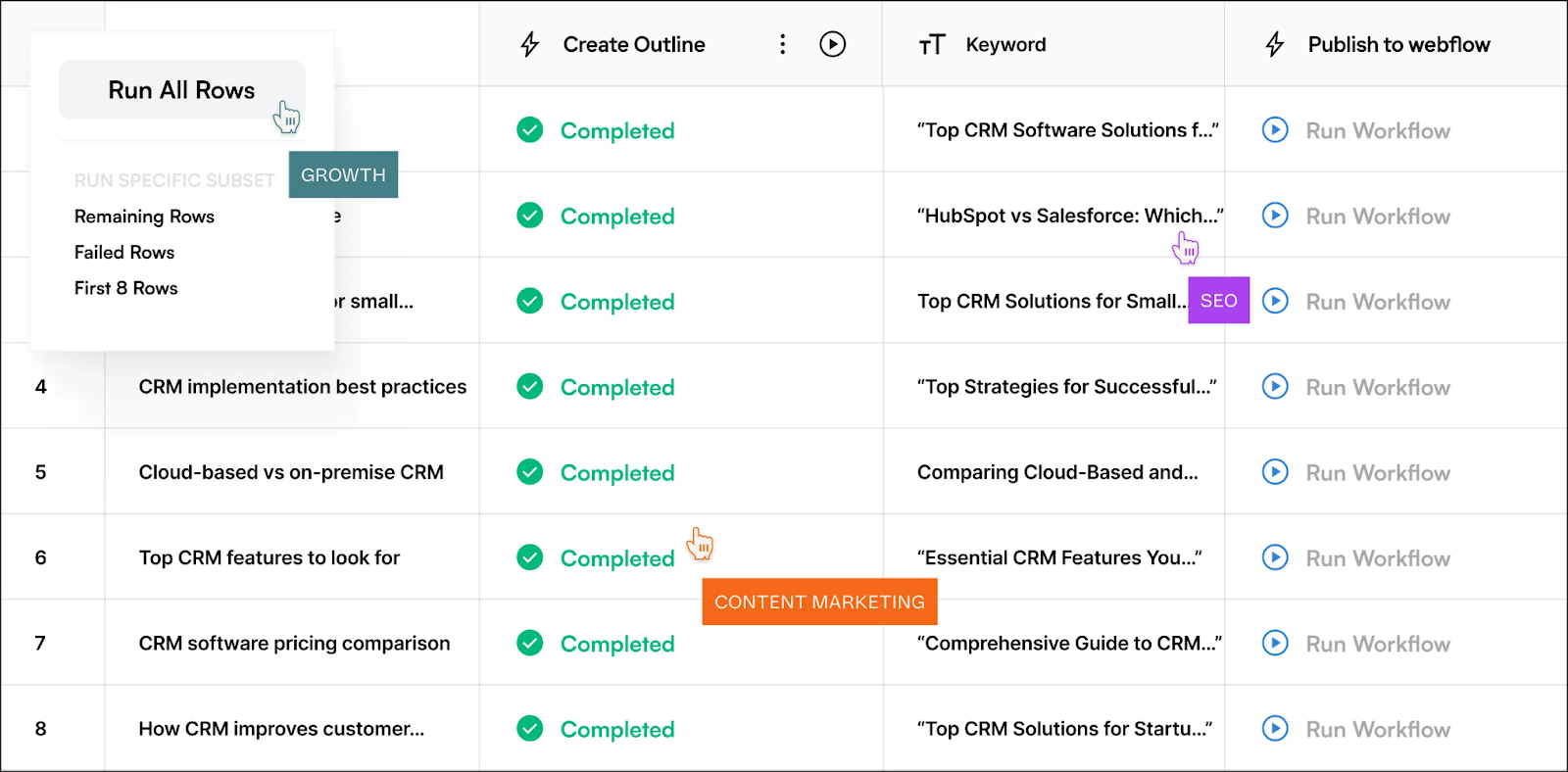
It works like a programmable spreadsheet: attach workflows to rows, trigger actions in bulk, and manage your entire content library as a system instead of one page at a time.
Teams use it to refresh their content library, add internal and external links, update stats, execute programmatic content creation, all from a single control layer.
AI Search Analytics: Track What Traditional Tools Can't See
Slate's AI Tracker monitors brand visibility across ChatGPT, Perplexity, Gemini, Claude, and Google AI Overviews.
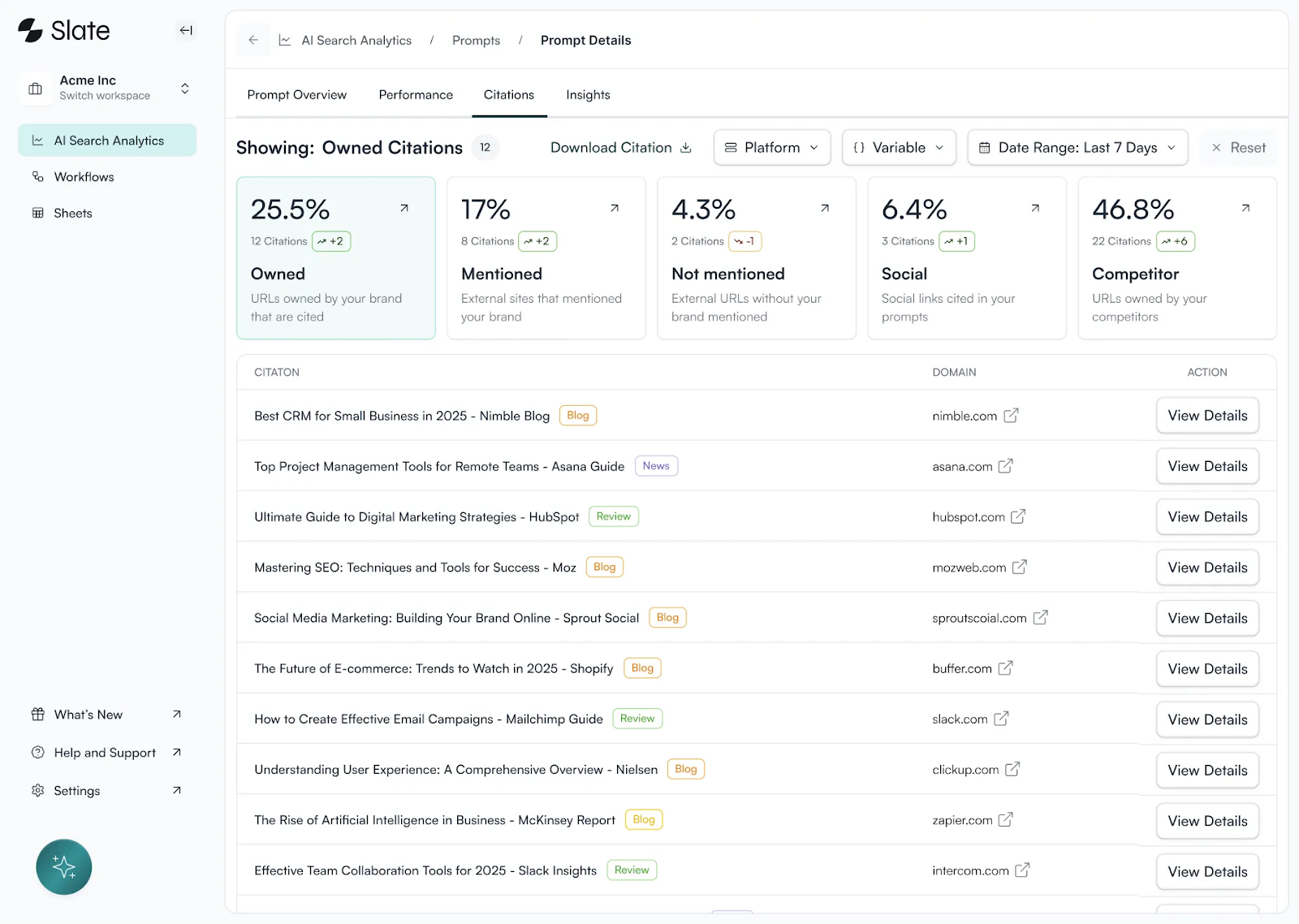
You can track visibility scores, brand sentiment across citations, see exactly which competitors dominate AI recommendations, and identify the citation sources AI models trust and turn those gaps into direct outreach and citation acquisition opportunities.
Super Blocks: Pre-built Workflow Components for Best Practices
Rather than building every workflow from scratch, Super Blocks provides a library of pre-built components that capture proven AISO (AI Search Optimization) best practices.
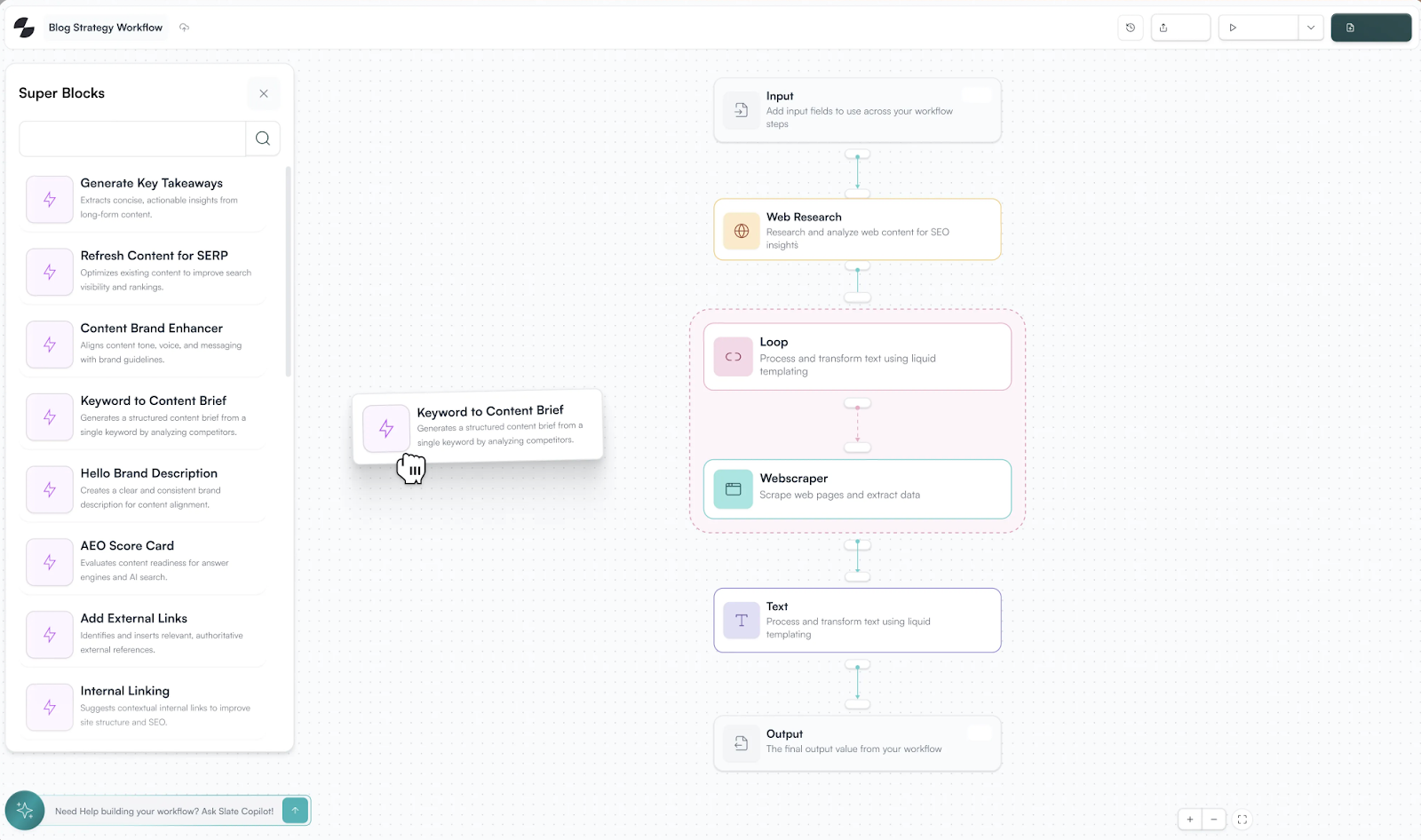
You can assemble sophisticated content pipelines by combining tested building blocks, reducing setup time and ensuring every workflow follows optimization standards.
Content Refresh: Automated Decay Detection and Remediation
Slate's content refresh engine continuously monitors page-level performance across both traditional search and AI citations.
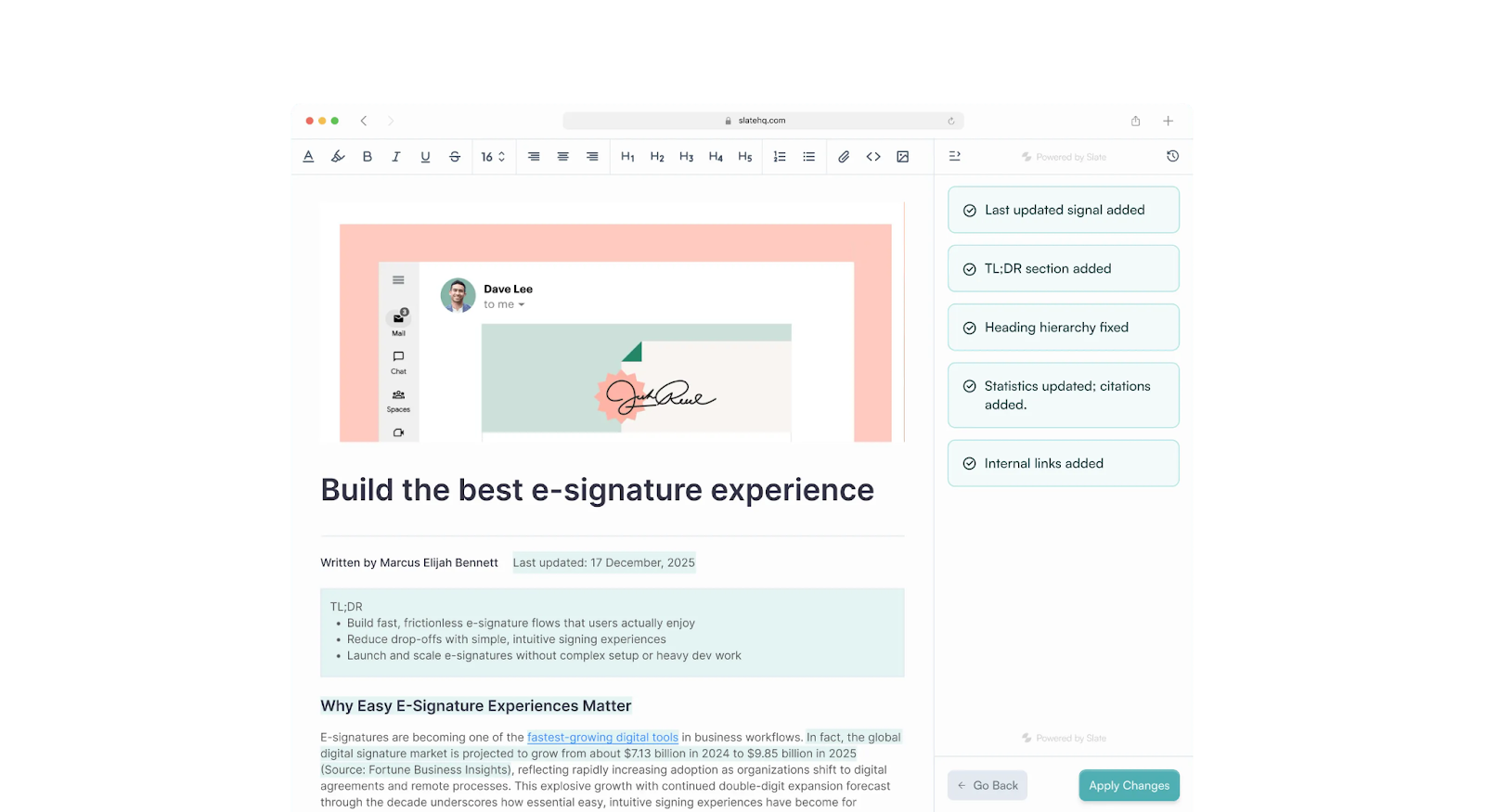
When a page begins losing freshness signals or dropping in AI visibility, the system surfaces it for remediation and can automatically execute optimizations, including stat updates, structural improvements, and schema refresh.
Every page gets scored for freshness, topical authority, structural optimization, and AEO readiness. The refresh happens before the decay costs you rankings, not after.
Conclusion
Content strategy and content operations are complementary disciplines that only produce results when they're connected.
In 2026, content visibility is largely about being cited by Google AI Overviews, ChatGPT, Perplexity, Gemini, and also Google, among them.
Maintaining that kind of dual-system visibility requires both the strategic clarity to know where to compete and the operational infrastructure to execute, refresh, and adapt continuously.
If you’d like to engineer both of these into a high-performing system, try out Slate.
We’ve been in your shoes, and we built Slate to solve exactly your problems.
Frequently Asked Questions
1. What is content operations?
Content operations is the system of people, processes, and technology that powers content from ideation to publication. It's the infrastructure that makes content creation repeatable, scalable, and measurable, ensuring the right content gets created, approved, published, and optimized on time.
2. How is content operations different from content strategy?
Content strategy is the "what" and "why": defining your audience, messaging, and goals. Content operations is the "how": the workflows, tools, teams, and governance that execute the strategy. Strategy is the blueprint; operations builds it.
3. So I need content operations?
Everyone creating content at scale. If you're producing more than a handful of pieces monthly, managing multiple contributors, or struggling with review and publishing bottlenecks, you need content operations. Small teams benefit from documented workflows just as much as enterprises.
4. How do I get started with content operations?
Start with a content audit and process mapping. Document your current workflow from ideation to publishing, identify where work stalls, define clear ownership for each stage, and establish basic templates and standards. Start small and iterate rather than building the perfect system overnight.
5. How do you measure content operations success?
Track operational metrics like time-to-publish, content volume per period, reuse ratio, revision rate, and workflow bottlenecks. Also measure business impact: engagement, conversions, and ROI. Balance efficiency (how fast you produce) with effectiveness (business results delivered).
6. What are the biggest content operations challenges?
Resistance to change, unclear roles and responsibilities, lack of cross-team collaboration, resource constraints, and measuring content ROI. The most common bottleneck isn't writing capacity but review logjams, unclear briefs, and slow publishing processes.
7. Can content operations work without content strategy?
No. Operations without strategy produces content efficiently but without purpose or direction. You'll create volume that doesn't move business goals. The two must work together as a cycle: strategy informs what operations produces, and operations data refines strategy over time.